As each of Orange County’s local governments are looking for ways to improve connectivity and different forms of transportation, they are all partnering on a project that could develop a game-changing option to the southern part.
The quartet are teaming up with UNC and North Carolina Railroad to study the J Branch Rail line, which runs 11 miles from Interstate 85 to UNC’s campus, and see what is possible for converting the tracks into a trail. After starting preliminary work last November, the effort is now gathering community input, with the second of a trio of engagement workshops held on Wednesday at the Hargraves Community Center.
Roughly a dozen community members huddled around tables, putting stickers onto a big map of the J Branch rail line’s route through Orange County and writing sticky notes of their preferences for what the corridor could be used for if the railroad tracks were no longer active.
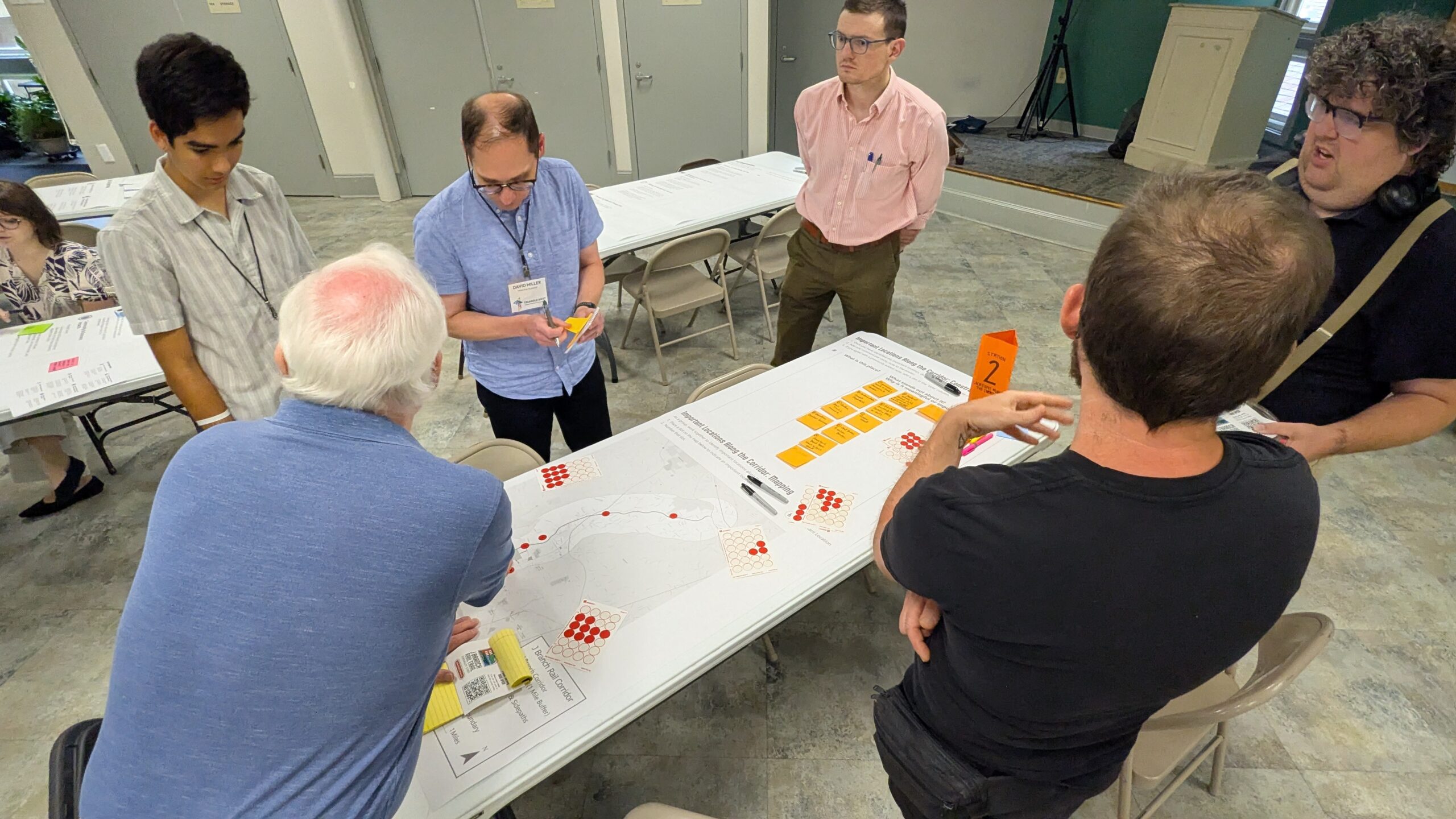
Photo by Brighton McConnell/Chapel Hill Media Group.
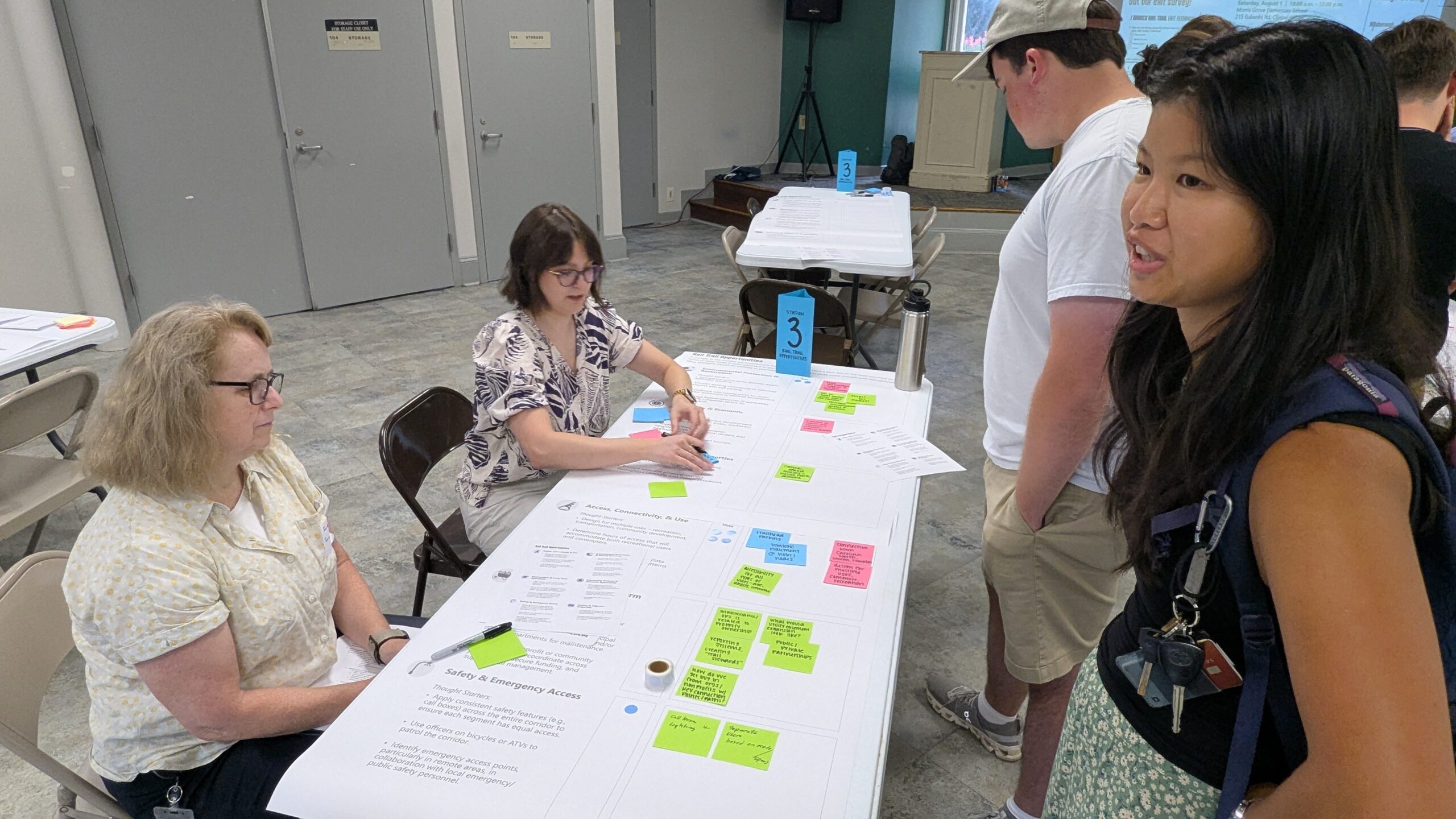
Photo by Brighton McConnell/Chapel Hill Media Group.
Kinzer Hurt was one of those people, sharing important connection points and saying he would regularly walk the corridor as a greenway or trail, if possible. He said he heard about the workshop and upcoming study thanks to a Facebook group that tracks local trains and explores railroads.
“A lot of people really like this branch [rail line] because it’s super scenic, it’s an interesting operation,” Hurt said. “Some people saw this [workshop] and thought, ‘Oh my God, they’re going to get rid of the railroad.’ But as a landscaping architect, I know it’s a feasibility [study]: it’s a long way away. There’s plenty of opportunities for really cool stuff to happen here.”
Some examples people shared were having a rare north-south connection for bicycles and alternative transportation, running as far south as Chapel Hill’s West Cameron Avenue and as far north as the Brumley Nature Preserve. Others went as far as wondering whether the railroad could be used for a new bus line, passenger rail, or simply left for walks through nature. Community members discussed their ideas with each other and planners, leaving notes and filling out an online survey about the project.
The ongoing feasibility study is meant to explore all of those options. Conducted by the Triangle West Transportation Planning Organization, the effort is a partnership with all the local governments, UNC, and the consultant firm VHB. Having been underway since last November, the study’s goal is to gather data both from the site and from the community to inform what’s not only possible, but desired in the corridor beyond its current use as freight rail.
“This project is regional in nature,” David Miller, the project manager for Triangle West TPO, said at the workshop. “It goes from Chapel Hill, Carrboro to the edge of Orange County. So, our partners in Chapel Hill, Carrboro, UNC-Chapel Hill and Orange County reached out to us with this idea of this project, this feasibility study. And since our focus is regional transportation, we’re uniquely positioned to lead such a study. So, that’s what we’re doing here.”
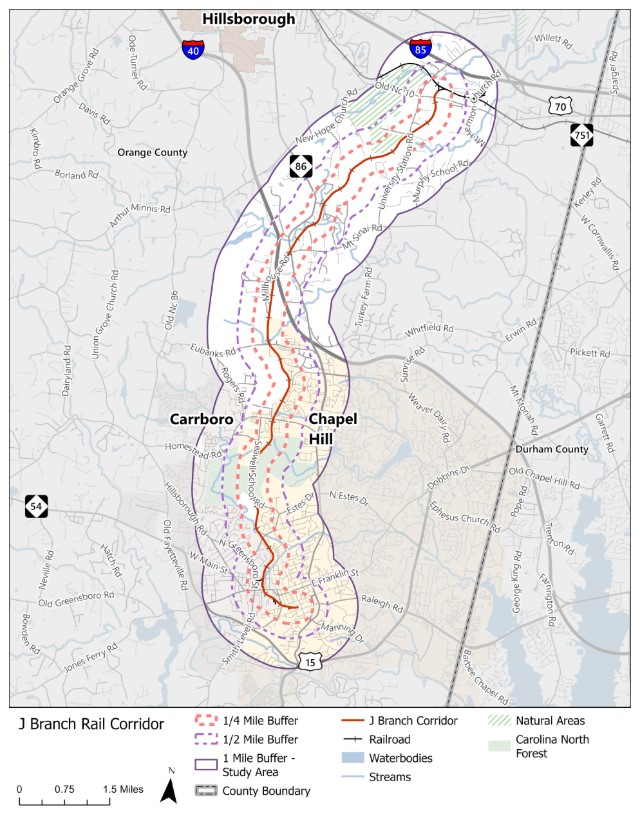
A map of the J Branch Rail line and the corridor being studied in the ongoing feasibility project. (Photo via Triangle West TPO and VHB.)
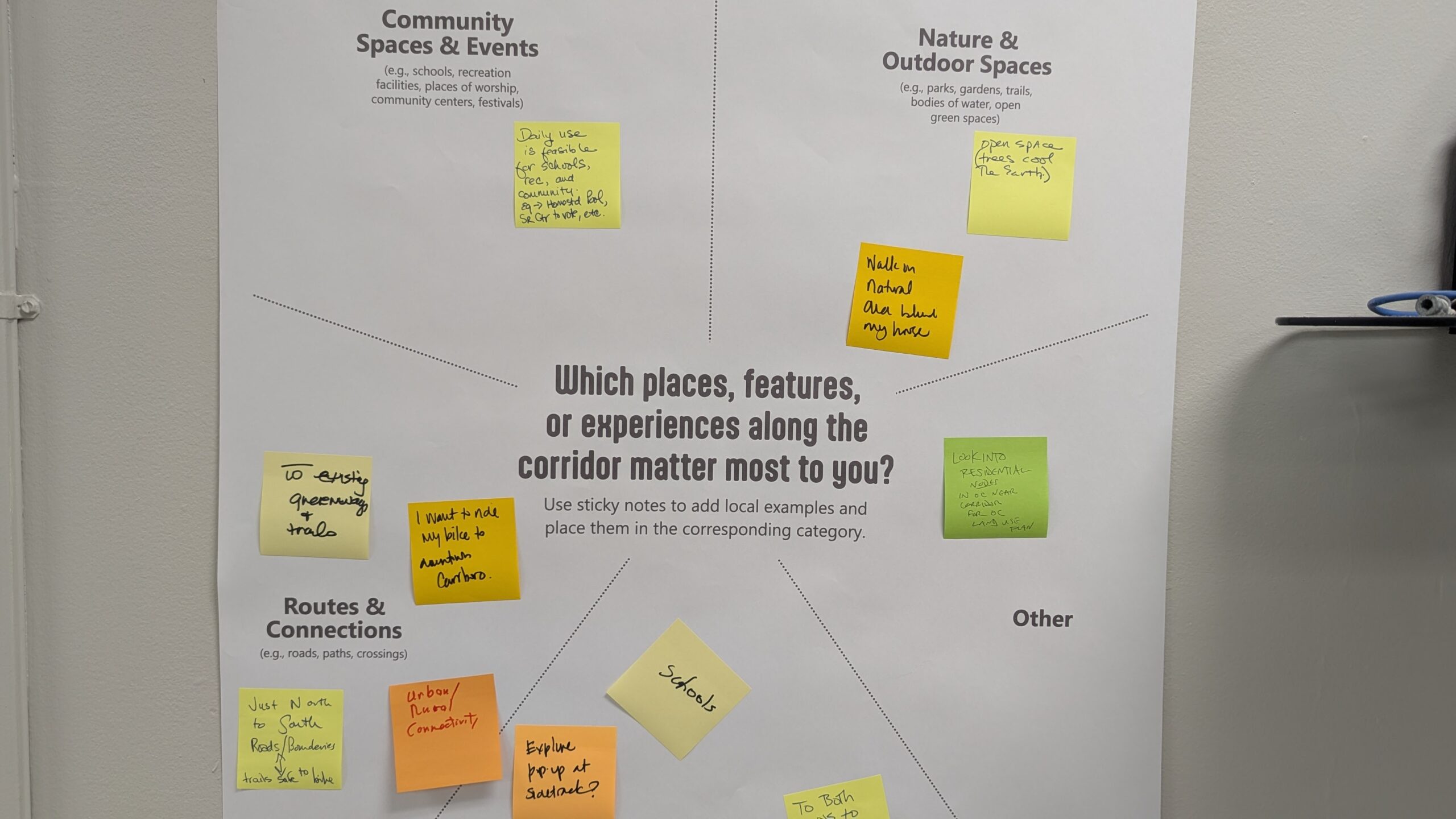
Sticky notes of workshop attendees’ responses to a guiding question, which will help inform project planners what matters most for Orange County residents and community members to see in the J Branch rail corridor. (Photo by Brighton McConnell/Chapel Hill Media Group.)
Because the rail line runs through downtown Carrboro, turning the tracks into a greenway corridor could significantly improve the town’s connection to other areas of Orange County, said Mayor Barbara Foushee.
“I think it could be very transformative,” she told 97.9 The Hill, “and also would help to meet climate action goals here in the Town of Carrboro…and Chapel Hill has them too, as well as the county. [It could] also be potentially taking some cars off the road around town.
“It’s good to have our ducks in a row [for] when the time comes,” Foushee concluded. “We don’t know when that will be, that [ball] is in UNC’s court.”
Nothing can actually happen to the railroad until UNC stops relying on it for delivery of solid fuel to its cogeneration power plant along West Cameron Avenue. The university receives regular deliveries of fuel, like coal, via Norfolk Southern to provide the bulk of electricity, heating and cooling for the campus and UNC Hospital facilities.
While UNC’s Sustainable Carolina team reports it is weaning itself off coal and is seeking alternative fuel sources, there’s no immediate timeline for no longer needing the railroad. UNC Director of Local Relations Ivy Taylor attended Wednesday’s workshop and confirmed that detail, saying the feasibility study does not impact the university’s energy planning nor increase its desire to find a different solution for powering campus.
“I think there’s already a parallel track, to use a bad metaphor, [for ending coal use] that has its own sense of urgency,” Taylor told Chapelboro. “But it’s a great opportunity for us as a university to engage with folks in our own backyard and figure out what folks would like to see in the community.”
Miller said to get even more of a campus perspective, the Triangle West TPO is planning to hold several pop-up events at UNC in August to survey students and add feedback on the potential for a rail trail. Before that, community members can fill out the online survey about priorities and visions for the site. A final in-person workshop will also be held at Morris Grove Elementary School on Saturday, August 1.
“This project could impact not only folks right along the corridor, but nearby,” said Miller. “We want folks to come out and share their concerns, share their thoughts…everything that will help us with our planning process to plan for the community which this line runs through. So, we hope everybody comes out.”
To learn more about the J Branch Rail Trail Feasibility Study, visit the project’s website. The community engagement survey for the rail corridor can be taken here.
Chapelboro.com does not charge subscription fees, and you can directly support our efforts in local journalism here. Want more of what you see on Chapelboro? Let us bring free local news and community information to you by signing up for our newsletter.