Diversity, equity and inclusion are terms that have come to mean different things for different people. In Orange County, many of our institutions, local governments, and leaders are taking up the causes of ensuring the community is not just informed on, but welcoming to people of different backgrounds and identities.
To help engage in these concepts and advance the efforts being made, 97.9 The Hill is starting a weekly segment called “Conversations We Need To Have.” Featuring different voices and leaders in the DEI space, the series will feature interviews with a variety of guests was launched on Monday with an initial quartet of local leaders.
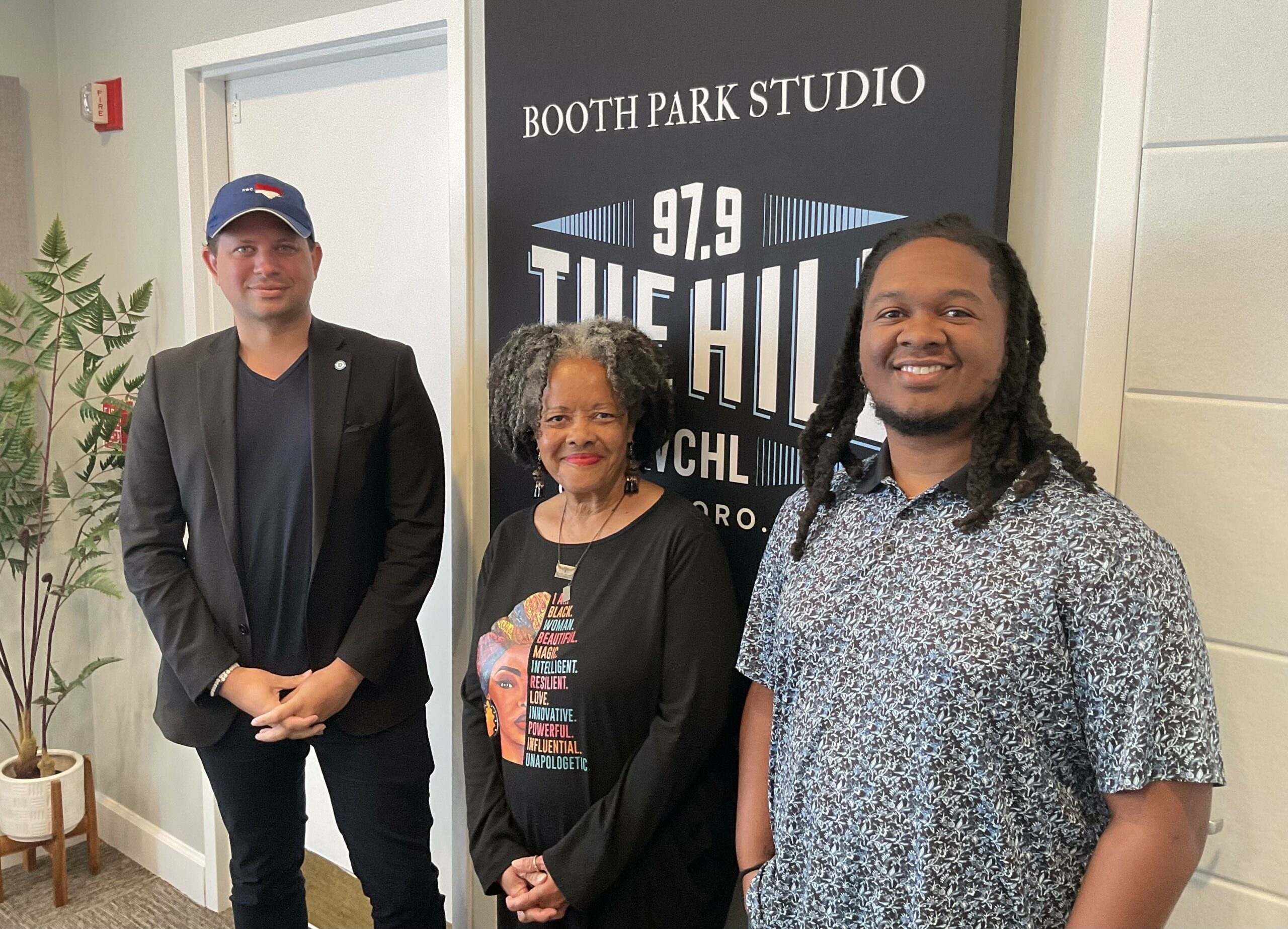
Orange County Chief Equity Inclusion Officer Paul Slack, Carrboro Chief Race and Equity Officer Anita Jones-McNair, and President of the Northern Orange NAACP Matt Hughes convened in the studio, while Town of Chapel Hill Diversity Equity and Inclusion Officer Shenekia Weeks called in for the discussion with 97.9 The Hill’s Andrew Stuckey.
Below are highlights from the conversation sharing panelists’ perspectives on a handful of questions, which have been transcribed and lightly edited for clarity and brevity. To listen to the full interview segment, click here.
On how they define diversity, equity, inclusion, and social justice, and how it plays out in our community:
Paul Slack: DEI work is pretty much any work that is focused on creating better lived experiences for people, in whatever definable community. It’s not localized to race, it’s not localized to gender, it’s not localized to sexuality — it’s pretty expansive. I always often talk about how good DEI work doesn’t just make people that fit into some of these subcategories have a better experience… it creates better experiences for people in the dominant categories as well.
Shenekia Weeks: Everyone has a social identity and a mix of social identities. So, diversity then means having full representation of what our community has to offer. When we think about inclusion, that is the quality of belongingness that is felt in spaces — whether you’re out in the community, whether you are in your workplace, at the stores, whether we’re purchasing or recreating or working. The other part of that, from an equity standpoint… it’s really about those outcomes. What do we want for people? What does it look like to have a life of wellbeing? And does everyone enjoy that at the same level of weight? And so, what are the spaces we’re in where people are not doing that, and how do we change that?
Anita Jones-McNair: It’s not always about sameness. It’s about fairness and meeting people where they are, and providing them what they need. That’s where I think we have not done a good job of in our communities, because everybody doesn’t need the same thing. It’s this opportunity to provide people what they need, so that they feel they belong to the community.
Matt Hughes: I think it’s also making sure all those stakeholders, as we’re talking about DEI, have a seat at the table, and that they’re all participating and giving feedback. Because what we don’t want to do is operate in a void where we’re not having those voices heard, and we’re moving in a direction just assuming what the community needs or assuming what needs to be done. In order to do that, we also have to know what those [needs] are and go out into the community. It’s intimidating to to engage with government, it’s not convenient to engage with government. And that goes back to, I think, a lot of the other barriers that really shut people out in doing this work.
On the biggest impediments to DEI efforts successfully being implemented or embraced:
Paul Slack: It’s uncomfortable. It’s inherently uncomfortable to change, and it’s deeply uncomfortable to ask people to change things that have been happening historically or, characteristically, things that people have felt like were near and dear to who they are. You think about the Confederate flag, right? And how many people have held that flag near and dear to themselves, and how hard it was for a lot of people to let that go.
Anita Jones-McNair: There are unintentional consequences to this work. People are uncomfortable about not knowing what they don’t know, so they don’t like to move forward. Not knowing what those unintended consequences could show up and be, and what that could mean… [people may] just choose to stay on one side of the fence versus moving over to the other. There’s this discomfort there, this intent. They mean well, but they’re not comfortable. They get a little gun shy — and that’s part of it, which is something new and different. People just don’t like to explore those kinds of opportunities.
Shenekia Weeks: It’s really about whose comfort, right? When we think about the context of our community… I think that we’re fortunate to do this work. All of us who are doing this diversity, equity, and inclusion work in Orange County, and the jurisdictions there, we enjoy a different level of freedom than some of our other [peers] across the state and the nation. We are in an area that is historically more liberal, right? But in that more-liberal space, we also are dealing with the identity of economics: a space where we have people who are very well paid and people who are struggling financially. We have to make this distinction between whose comfort will we center, and whose comfort is being de-centered in this process.
On a topic or conversation they look forward to featuring on the segment:
Matt Hughes: Every year, the Chamber of Commerce does this great State of the Community report. A lot of folks go to it. And what really motivates people — or where I hear the most reaction — is about education, particularly educational performance of our Black and Hispanic students in both school districts. We really just kind of end the conversation there in a lot of ways. We’re looking at, uh, school performance and where [student scores] are in elementary, middle, and high school, and what that will look like post-secondary. A lot of those issues with the opportunity gap [go] all the way back to pre-K. What can we do to solve some of those systemic issues before these kids get to kindergarten and they enter ready to learn? [How can we be] partnering and reducing the barriers for why parents can’t or don’t send their kids to pre-K and what else can we be providing in the community? I think that is definitely one of those things that we should be talking about.
Anita Jones-McNair: I think about ‘how do we normalize this work?’ We want this to be embedded in what we do on a daily basis. So, how do we normalize that in light of the fact that we all come from different experiences, different opportunities? We need to talk about that. What does that look like? And what can that mean for all of us?
Paul Slack: We need to discuss accountability more, and we need to discuss how do we have some of these tough conversations with family members, with coworkers, with friends? Because if we don’t have those tough conversations, the things that we don’t want to happen will continue to happen, on and on. People are going to have the legitimate answer [of] ‘I didn’t know that I shouldn’t do that.’ And if we continue to give that space for people not to know, then we’re actually hindering our ability to find progress.
Shenekia Weeks: We need to really think about… what are the outcomes for people in our community? What do we want for everyone that lives in Orange County? What does that look like? And if we’re serious about this high level of wellbeing for all of the residents, what does it take to get there? We have one of the best school systems, right? But when you begin to have conversations around outcomes, then it shifts. So, if we consider outcomes and really think about how we can be more equitable in those outcomes, and it doesn’t mean it’s a zero sum game. It’s about parity. How do we make sure that everyone in our county — our residents — have choices to live the type of life and have the type of outcomes they desire?
“Conversations We Need To Have” will air weekly on Mondays at 5:30 p.m. during “News on The Hill.” Archives of the segment will be available to listen to here.
Featured photo, from left to right: Matt Hughes, Anita Jones-McNair and Paul Slack.
Chapelboro.com does not charge subscription fees, and you can directly support our efforts in local journalism here. Want more of what you see on Chapelboro? Let us bring free local news and community information to you by signing up for our newsletter.