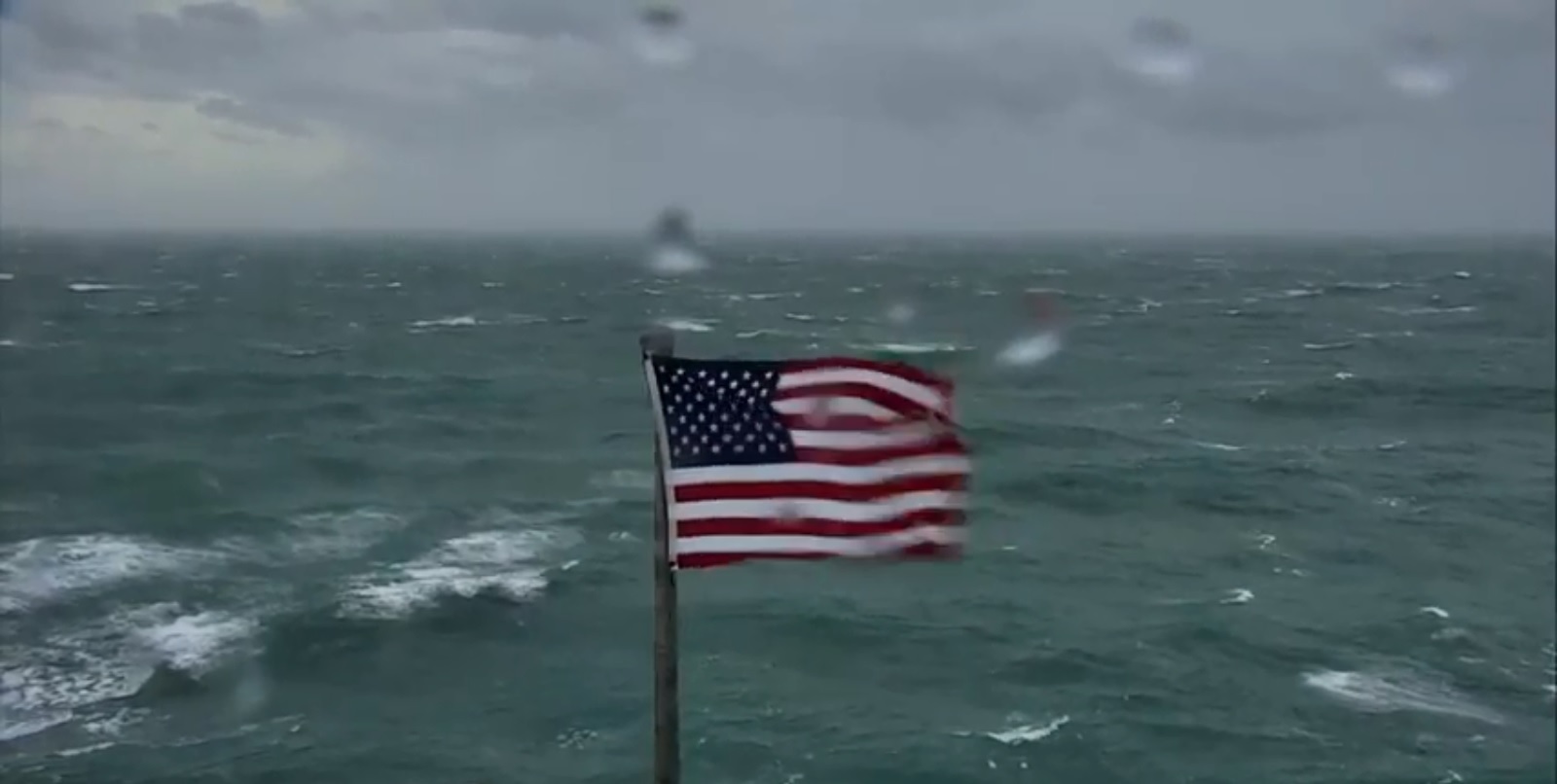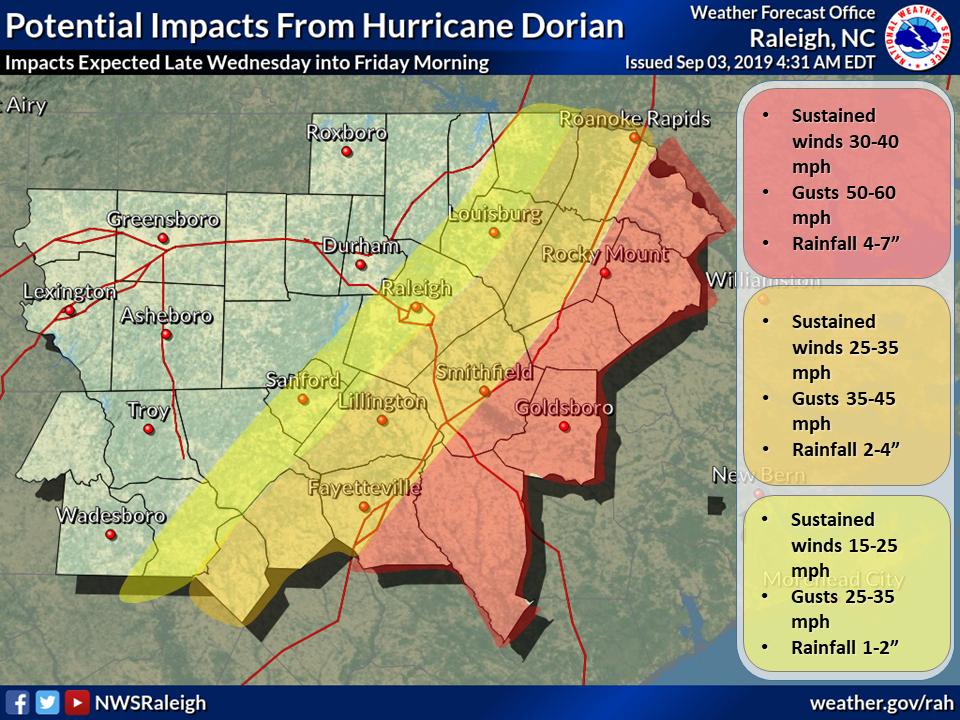
Ferry access to hurricane-ravaged Ocracoke Island on the North Carolina Outer Banks was limited to authorities and supply crews Sunday, as residents there continued work on what’s expected to be a lengthy recovery effort.
Damage surveys and work to clean up the mess left behind by Hurricane Dorian were underway, said Hyde County spokesman Donnie Shumate. There was still no power or any sense of when it might be restored, he said.
While it was far too early to estimate the island’s total economic damages, “It’s going to be catastrophic for sure,” Shumate said.
Gov. Roy Cooper has said about 800 people remained on the island to wait out Dorian, which made landfall Friday morning over the Outer Banks and swamped Ocracoke with floodwaters. Residents said the damage is the worst anyone alive has seen, although no deaths or serious injuries were reported.
Shumate said a staging area was set up at the fire station where residents could access necessities such as food, water and cleaning supplies. The Salvation Army was serving lunch and dinner Sunday at a community center, and the county said disaster counseling services would be available.
The county was still under a mandatory evacuation order, and no one but emergency responders and authorized personnel including supply crews were being allowed on ferries. Private boats attempting to access the island would be turned away, the county warned in a news release.
About 100 National Guard soldiers remained on Ocracoke supporting recovery operations, along with a medical team and emergency managers, Cooper’s office said in a news release Sunday.
The N.C. Department of Insurance was coordinating the arrival of insurance adjusters to help homeowners and businesses and will assist with a plan for disposing of the many flooded vehicles on the island, according to the release.
Ocracoke Island resident and restaurant owner Daphne Bennink told The Associated Press on Saturday that the flooding from Dorian impacted the majority of people and businesses on the island, from Ocracoke’s single public school to its one grocery store to entire homes.
She said repairs will likely take weeks if not months on some properties.
“You can’t just get electricity and go back to work,” said Bennink, who owns the Back Porch Restaurant and Wine Bar. “You have all this insulation and duct work that on most properties is going to have to get ripped out and redone.”
Further north on the Outer Banks, which were subject to a mandatory evacuation order ahead of the storm’s arrival, officials in Dare and Currituck counties were staging re-entries for residents and visitors.
“Not every area evacuated is safe to return to just yet,” Cooper said in a statement. “Those eager to return to the islands should follow the re-entry instructions issued by local governments.”
Two deaths in North Carolina were blamed on the storm. One victim was a man who fell from a ladder while preparing for Dorian, and the other was a man who collapsed while cleaning debris at his home.
Dorian peeled away from the coastline after hitting North Carolina and went to sea as it moved up the Eastern Seaboard. On Sunday, downgraded to a post-tropical cyclone, it was bringing hurricane-force winds to far-eastern Canada, knocking out power to hundreds of thousands of people.
By far the greatest devastation caused by the storm was in the Bahamas, where Dorian struck a week ago as a Category 5 hurricane, killing at least 44 people.
Related Stories
‹
![]()
Cooper: More Disaster Aid Headed to Eastern NC CountiesGovernor Roy Cooper announced Friday that FEMA has approved his request to add 12 more counties to those eligible to receive reimbursements for Hurricane Dorian response and recovery expenses. FEMA Public Assistance funding is now available to local governments, state agencies and certain private nonprofits in Beaufort, Camden, Columbus, Greene, Hoke, Lenoir, Onslow, Pasquotank, Perquimans, […]

Stranded North Carolinians Take Stock of Dorian's DamageAs the sky cleared and floodwaters receded Saturday, residents of North Carolina’s Outer Banks began to assess the damage wrought by Hurricane Dorian. Steve Harris has lived on Ocracoke Island for most of the last 19 years. He’s ridden out eight hurricanes, but he said he’d never seen a storm bring such devastation to his […]

Weakened Dorian Strands People on North Carolina IslandHurricane Dorian howled over North Carolina’s Outer Banks on Friday — a much weaker version of the brute that wreaked havoc in the Bahamas — flooding homes in the low-lying ribbon of islands and throwing a scare into year-round residents who chose to tough it out. Hundreds were feared trapped on one flooded island, the […]

North Carolina's 'Frying Pan Tower' Showing Hurricane Dorian's ApproachLast year, once of the most resonating images of Hurricane Florence in North Carolina was the gradual destruction of the American flag flying high on “Frying Pan Tower” off the Outer Banks close to Cape Fear. This year, as Hurricane Dorian approaches the North Carolina coastline while moving up the Eastern seaboard, the cameras at […]

North Carolina Makes Preparations Ahead of Hurricane DorianEvacuation orders for areas along the North Carolina coast increased Sunday, with powerful Hurricane Dorian expected to brush the state later this week, but state officials said they didn’t expect the torrential flooding experienced during Florence last year. Gov. Roy Cooper said he activated 300 members of the National Guard to help with preparations and […]

On the Porch: Dr. James Wood - Sports Around the WorldThis Week:
James Wood is currently Professor of Latin American and modern world history at North Carolina A&T State University. He is the author of The Society of Equality: Popular Republicanism and Democracy in Santiago de Chile, 1818-1851 and the co-editor of "Problems in Modern Latin American History: Sources and Interpretations", now in its fifth edition with Rowman and Littlefield. As a Fulbright scholar for Chile in 2016 he was a visiting professor at the Universidad Diego Portales in Santiago (where he observed Chilean student activism up close).

On the Porch: Bill Brown - Art and Science Merge at NCMAThis Week:
Bill Brown joined the North Carolina Museum of Art as a Conservation Intern in 1988. Thirty-two years later he retired from the Art Museum as Chief Conservator. He received his M.A. and Certificate of Advanced Studies in Conservation from State University College at Buffalo, NY in 1989. At the Museum, he established the Art + Science Initiative, a collaborative program with Duke University math and science departments. Bill has a passion for Italian Old Master Paintings of the 14th to 18th century. He works part-time as a conservator in private practice and provides conservation support for the Museum and Gallery collection of old master paintings at Bob Jones University in Greenville, SC . He enjoys retirement with his wife and young adult son.

On the Porch: Nora Gaskin - Conjuring Crime StoriesThis Week:
Author Nora Gaskin is a lifelong resident of the Durham-Chapel Hill area. Her latest is novel is "Lammie Loves Cubby". Nora has a bachelor’s degree in English with Honors in Creative Writing from UNC, and a Masters in English from the University of Washington in Seattle. She spent over 24 years as a stockbroker and financial advisor in the Durham office of a major investment firm. She retired in 2005 to focus on writing. She is the publisher at Lystra Books and Literary Services and the author of three novels and one nonfiction book. She lives and writes in Chatham County, inspired by her native landscape, her husband, and dogs. Her favorite word is "gratitude."
![]()
Therapy Smarts and Sen. Natalie Murdock on How HB696 Impacts Children and Families — On Air Today (June 15, 2026)Founder and CEO of Therapy Smarts Avani Shah and N.C. District 20 Sen. Natalie Murdock speak with 97.9 The Hill on Monday, June 15.

On the Porch: Steven Fenberg - What Funded America's Infrastructure?This Week:
Writer Steven Fenberg discovered Jesse Jones was reputedly the most powerful person in the nation next to President Franklin Roosevelt during the Great Depression and World War II. As chairman of the federal government’s Reconstruction Finance Corporation (RFC)—the nation’s indispensable infrastructure bank—Jones initiated and managed massive New Deal agencies that saved and expanded the nation’s economy and then shifted the RFC’s priority from domestic economics to global defense to fight and win WWII. Fenberg told this remarkable story as executive producer and co-writer of the Emmy Award winning documentary film “Brother, Can You Spare a Billion?” that was narrated by Walter Cronkite and broadcast nationally on PBS. Fenberg then wrote the biography “Unprecedented Power: Jesse Jones, Capitalism, and the Common Good.”
›