After two months of uncertainty around the future destination of its magnet Mandarin program, the Glenwood Elementary School community and Chapel Hill-Carrboro City Schools district have answers for one pathway — but questions remain for the other portion of students.
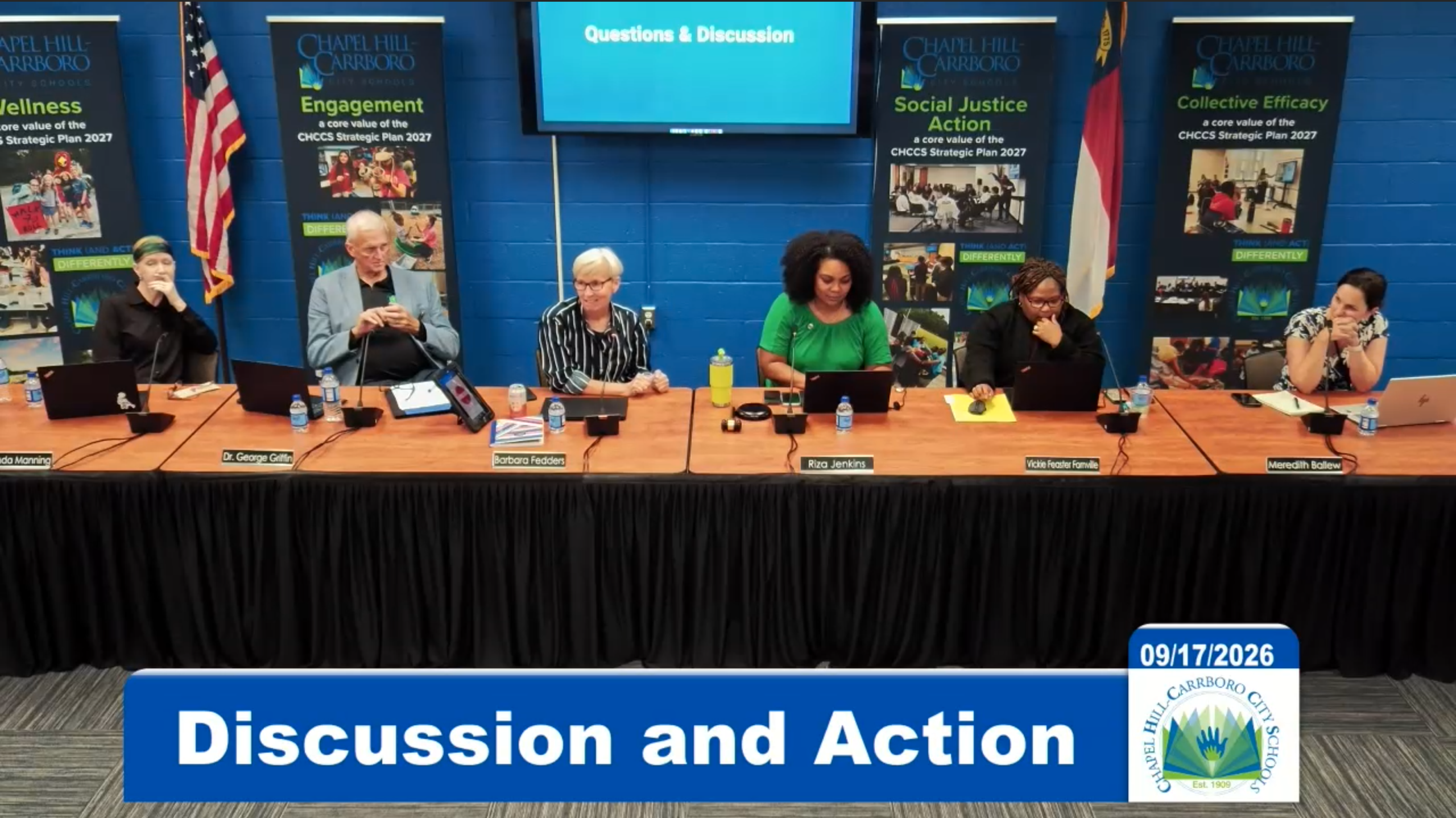
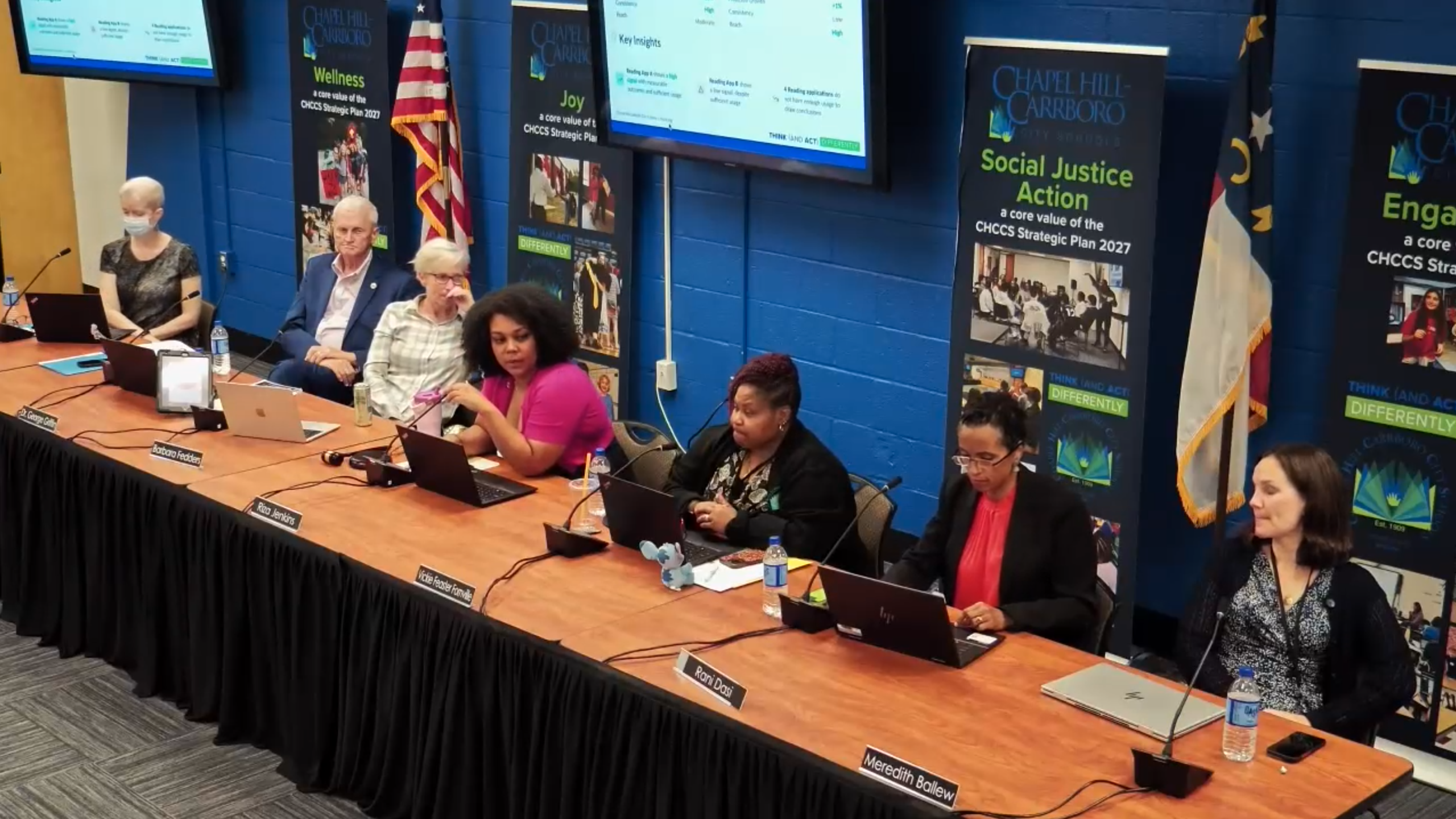
The CHCCS Board of Education voted 6-1 on Thursday night against moving the full student body of Glenwood together to a campus, with Melinda Manning as the dissenting vote. Later, a vote of 5-2 saw the approval of moving the dual language program to Rashkis Elementary, with Manning and Rani Dasi in the minority.
Following Option 2 as presented to the board in July, the world language pathway — where students receive only 45 minutes of focused Mandarin instruction each week compared to dual language students learning with 50% Mandarin instruction each day — also would be moved to a separate school, most likely Mary Scroggs Elementary in Chapel Hill. But board members shared wariness of immediately approving that decision, citing questions around maintaining the learning pathway’s magnet status and integrating the Mandarin world language option alongside the existing Spanish instruction at Scroggs.
Most of the board comments on Thursday acknowledged the challenging task at hand: maintaining the vitality and sustainability of Glenwood’s current culture of Mandarin education, while limiting the disruption to the campuses receiving students. Data presented by N.C. State University researcher Matthew Palmer during July’s meeting indicated splitting up the two learning tracks would require a few dozen students at both Rashkis Elementary and Scroggs Elementary to be redistricted, instead of hundreds at either if the entire STEAM² program was relocated.
George Griffin, the board member who made the motion for moving Glenwood’s Mandarin dual language students to Rashkis, said he sees the program as a “valuable asset” that needs to be fully supported in its move. But he said with the school district facing the need to close one of its schools, the selection of Glenwood should not then come at the expense of the majority of another elementary school’s families.
“Shifting the burden of a problem from one school community to another, to me, does absolutely zero other than to say one group is more important than the other,” Griffin said. “I don’t want to — let’s just name names, you know — move Glenwood into Rashkis, boot Rashkis out and say, ‘Sorry, you just didn’t matter,’ or something like that because that isn’t the case. That’s not what we’re about and I think we’re above that. And so I’m appealing to people to acknowledge that we still have a difficult situation with Glenwood and its relocation. And we’re going to deal with that. But that we don’t do it by creating a new problem at Rashkis.”
The school board’s approach goes against the option many current Glenwood Elementary School families advocated for. Since the possibility of separating the program was raised last month, many wrote and spoke to district leaders about their belief of maintaining the connection of the dual language and world language learning pathways — including several during Thursday’s public comment portion.
While world language students receive less Mandarin instructional time, the two tracks share many resources and spaces within Glenwood’s school building. The result is a diverse and supportive culture, which families argued could be threatened if the pathways are moved away from the other. The ability to fully staff each would present a challenge too, they said, based on how the educators overlap responsibilities and take time to recruit.
Several dual language or multi-lingual educators, advocacy groups and organizations shared those sentiments with Chapel Hill-Carrboro City Schools as well. In the lead-up to Thursday’s vote, the organization FLANC and the Chinese Language Association of Educators penned a letter with recommendations to the district for transitioning Glenwood’s staff and students to a new home. Its primary suggestion was maintaining the program’s two pathways on the same campus, saying it would maintain quality, integrity and sustainability at a time when many dual language programs face uncertainty in the state. Staff retainment and recruitment is a crucial part of that, the president of each group wrote, because of competitive national positions and challenging federal conditions around work visas for immigrants.
In her comments before the vote, Manning said hearing those perspectives since the June vote to close Glenwood’s building helped change her mind and support the idea of keeping both learning tracks on the same campus.
“To use a barbecue analogy, I think there’s a special sauce,” she said. “And I realize I’m probably in the losing end of this vote, but I think it’s the right choice [to keep them together].”
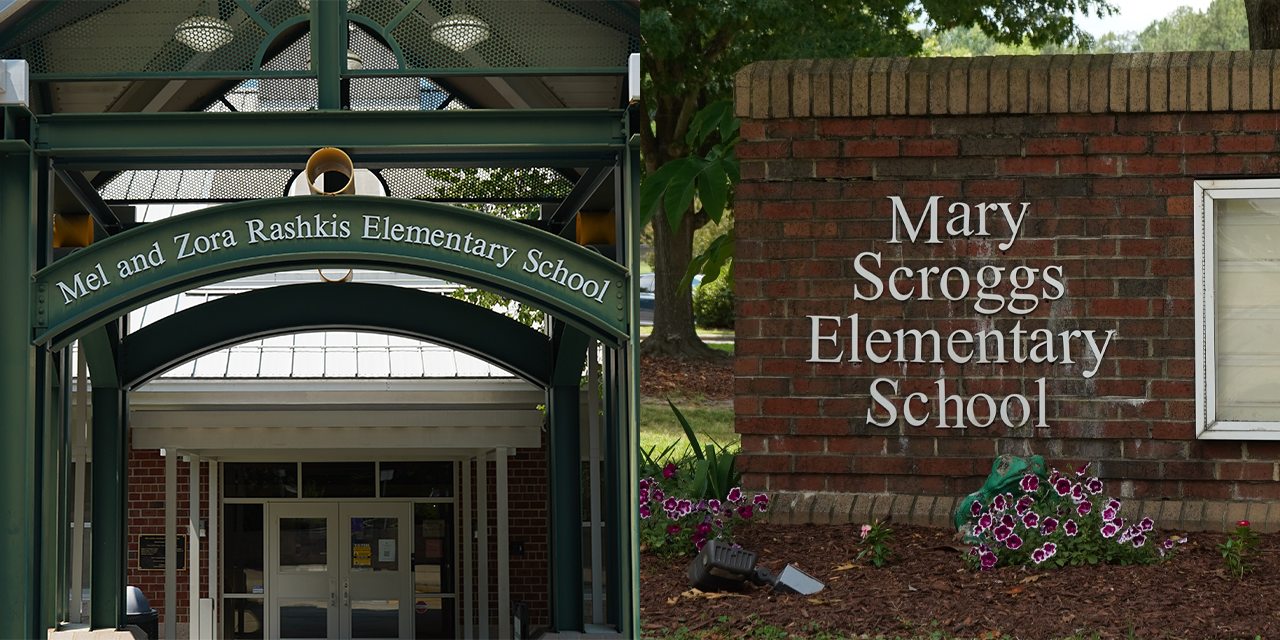
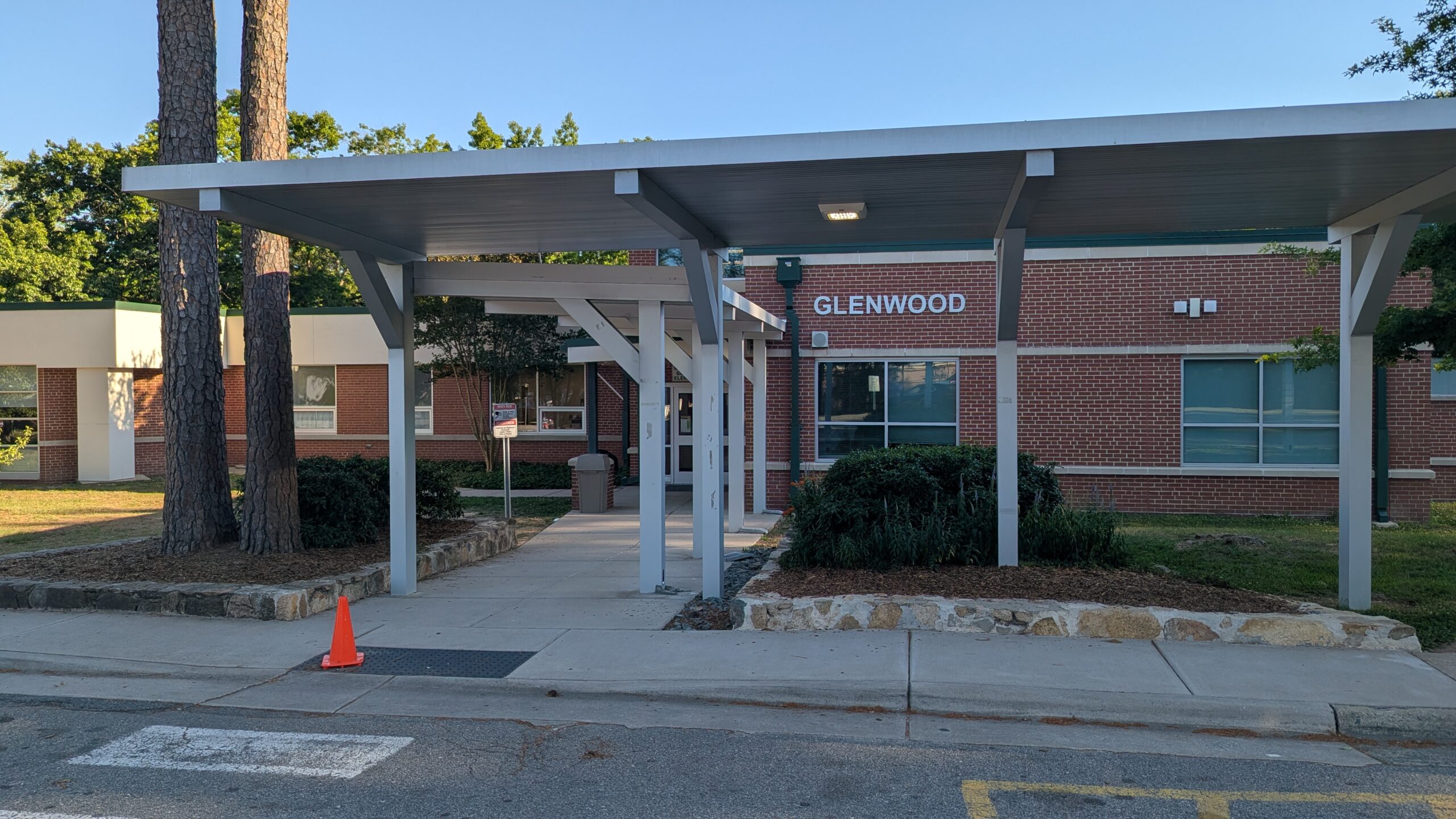
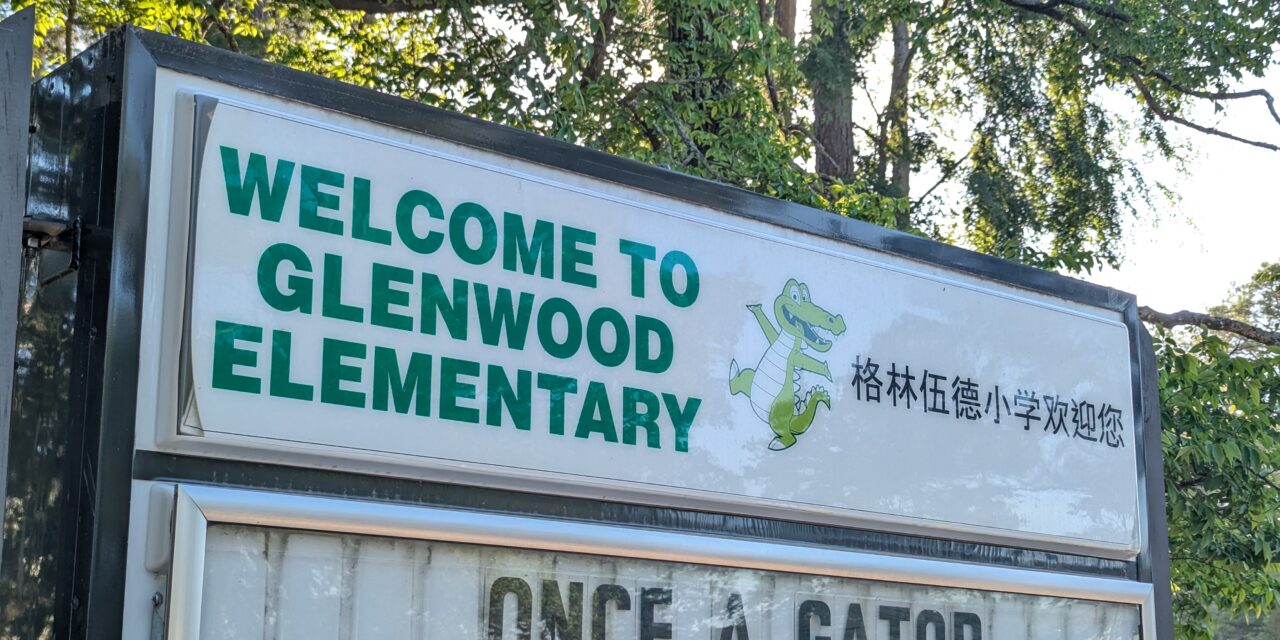
Rashkis Elementary and Mary Scroggs Elementary, both in Chapel Hill, are centrally located in the CHCCS district and have enrollment capacity to absorb Glenwood Elementary students with less disruption than others. (Photos via Elena Pace/Chapel Hill Media Group.)
Meanwhile, Rashkis Elementary community members had also been advocating for their school community to welcome one of the learning pathways. But many shared concerns of how adding all of Glenwood’s students — with a current enrollment close to 400 — would lead most current Rashkis students to be redistricted and only a few remaining in a traditional model. Additionally, some educators shared concerns of how integrating Glenwood’s learning models would work with Rashkis’ robust adaptive curriculum offered to students with intellectual and developmental disabilities. Board Member Meredith Ballew, a longtime advocate for IDD educators and students, similarly shared those concerns and voted only after receiving assurances from Superintendent Rodney Trice that the students in ECAC will be supported and considered during the transition.
But unlike the dual language program, which sees steady and high enrollment, transitioning the world language pathway may not be as straightforward, the board members said. While Option 2 seemed to indicate it would similarly maintain magnet status and integrate into another school’s community — with Palmer and district staff saying Mary Scroggs Elementary is the primary candidate — details shared from Glenwood families during recent listening sessions created fresh uncertainty of whether the pathway could stand on its own from the dual language Mandarin program.
“I’m really uncomfortable going back on things that we previously said,” Ballew said, referencing a diversion from Option 1 or Option 2. “However, I don’t think that that is a good reason to move forward with a program. I mean, there was even a Glenwood family on the [listening session] call last night that said the world language program is not a standalone magnet program. And I’m starting to really see that. So, we need to figure out how to support all these families — the families at the receiving schools, the families in the Glenwood program — and figure out where they’re going to land and thrive.”
“I’m going to ask very clearly,” Griffin said, “whatever iterations we are talking about, how does that warrant being a magnet program as opposed to being a variation on something that is worthy but not a magnet status? And what is the benefit — to all the kids in this district — to having that magnet program at Scroggs? And I’m going to keep asking that question, because that’s where I found myself going to after listening to everybody.
“And,” the retired educator and two-term board member added, “I apologize also for changing my my view here, but it was based on new information to me. I learned, I heard people, I started thinking, ‘Wow, this is kind of fuzzy the way we’re [approaching this.]'”
Ultimately, the board voted unanimously to designate Scroggs as the landing spot for the world language program — but to delay any approval of the Mandarin instruction actually maintaining a magnet designation or any decision to dissolve it. The plan, as discussed by board members and district leaders on Thursday night, is to meet and gather information from Scroggs leaders, Glenwood world language stakeholders, and others before making a more informed decision in September.
Glenwood’s status as a magnet school started in 2020 and followed a vote in 2018 to designate the school for Mandarin learning. That result came from the dual language program’s popularity after being introduced in 2002, with the elementary school routinely facing overcrowding issues between students in its traditional learning pathway and Mandarin program. The school board’s decision in 2018 divided community members at the time, but ultimately improved Glenwood and the district’s ability to grow the STEAM² program’s capacity, add the world language pathway, and build the popularity it enjoys today.
With the school board’s decision now made — even with questions around the feasibility of the world language Mandarin track — the district staff’s planning efforts will shift toward redistricting. To accommodate for Rashkis Elementary students on the move alongside elementary schools with classroom capacity, CHCCS is preparing to conduct widespread redistricting before the 2027-28 school year.
Deputy Superintendent for Operations Al Ciarochi said Thursday night a redistricting plan would be brought to the public in October, “by the earliest,” which would be followed by public information meetings and engagement sessions. The school board would then be voting to approve a plan in December, as the district would need roughly six months to transition. With the board designating Scroggs Elementary as the likely landing spot for Glenwood’s world language students, even if the learning pathway changes, the CHCCS staff are still able to move forward on internal work and preparation for redistricting, according to Ciarochi.
Amid the focus on Thursday night’s meeting, CHCCS families were also preparing for the new school year. Most district schools hosted their “Back to School Night” events on Thursday, while students return to classrooms on Monday, August 24.
Editor’s Note: A previous version of this story said the world language pathway included 90 minutes of Mandarin instruction each week. It has since been corrected to reflect the true amount of 45.
Featured photo by Brighton McConnell/Chapel Hill Media Group.
Chapelboro.com does not charge subscription fees, and you can directly support our efforts in local journalism here. Want more of what you see on Chapelboro? Let us bring free local news and community information to you by signing up for our newsletter.