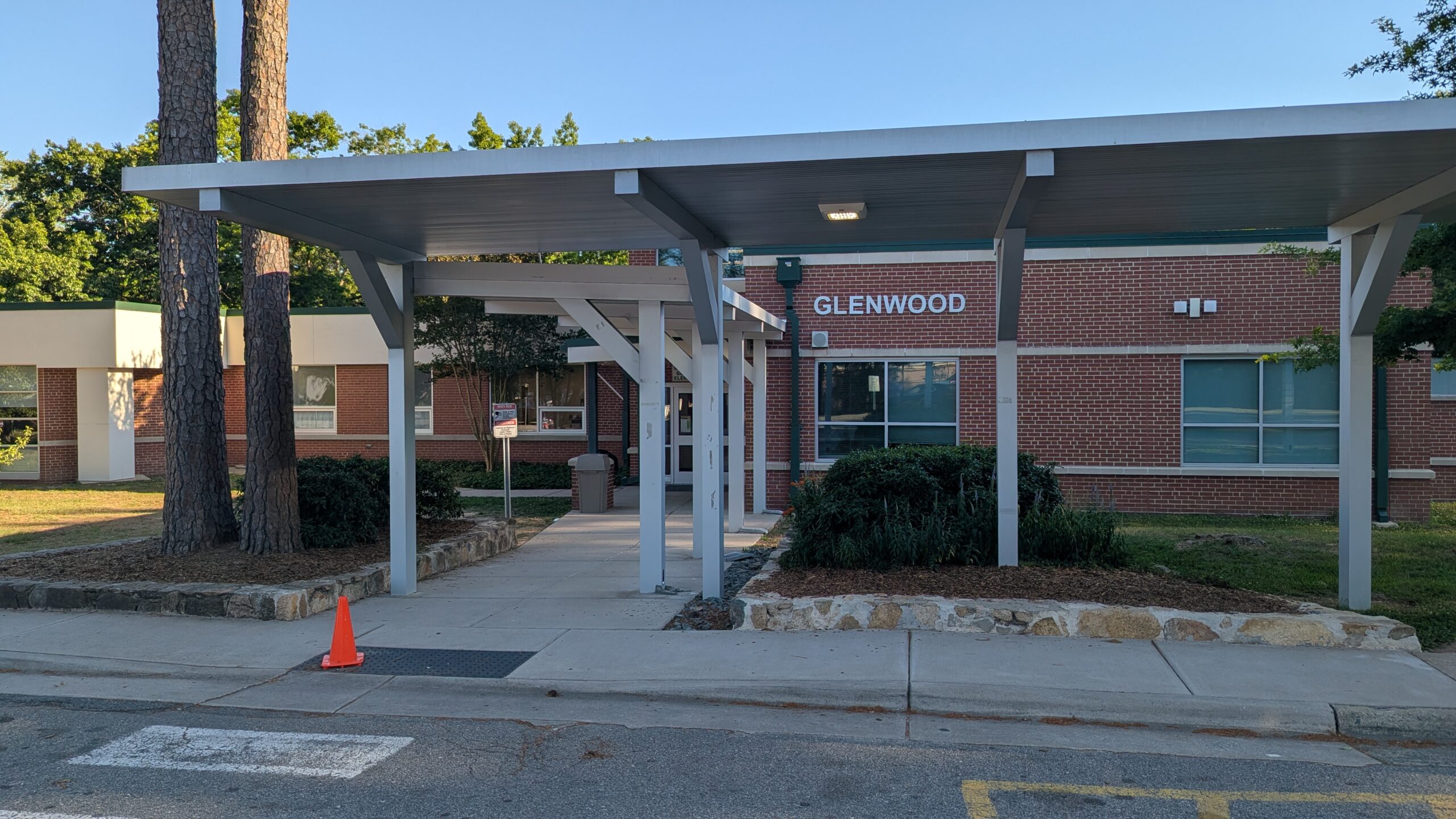
For months, the Chapel Hill-Carrboro City Schools community has discussed whether the district would end up closing an elementary school as it grapples with empty seats and a tough financial landscape. The Board of Education decided yes on Thursday night, choosing Glenwood Elementary School in Chapel Hill as the campus that will be retired by the fall of 2027.
The meeting capped off hours of public comment, listening sessions and debate across CHCCS over which school to close and why. The board members followed North Carolina’s laws for conducting a study on potential closure options and hearing speakers from the potentially-impacted school communities — and most shared comments about their reasoning Thursday night for how they arrived at this unanimous conclusion.
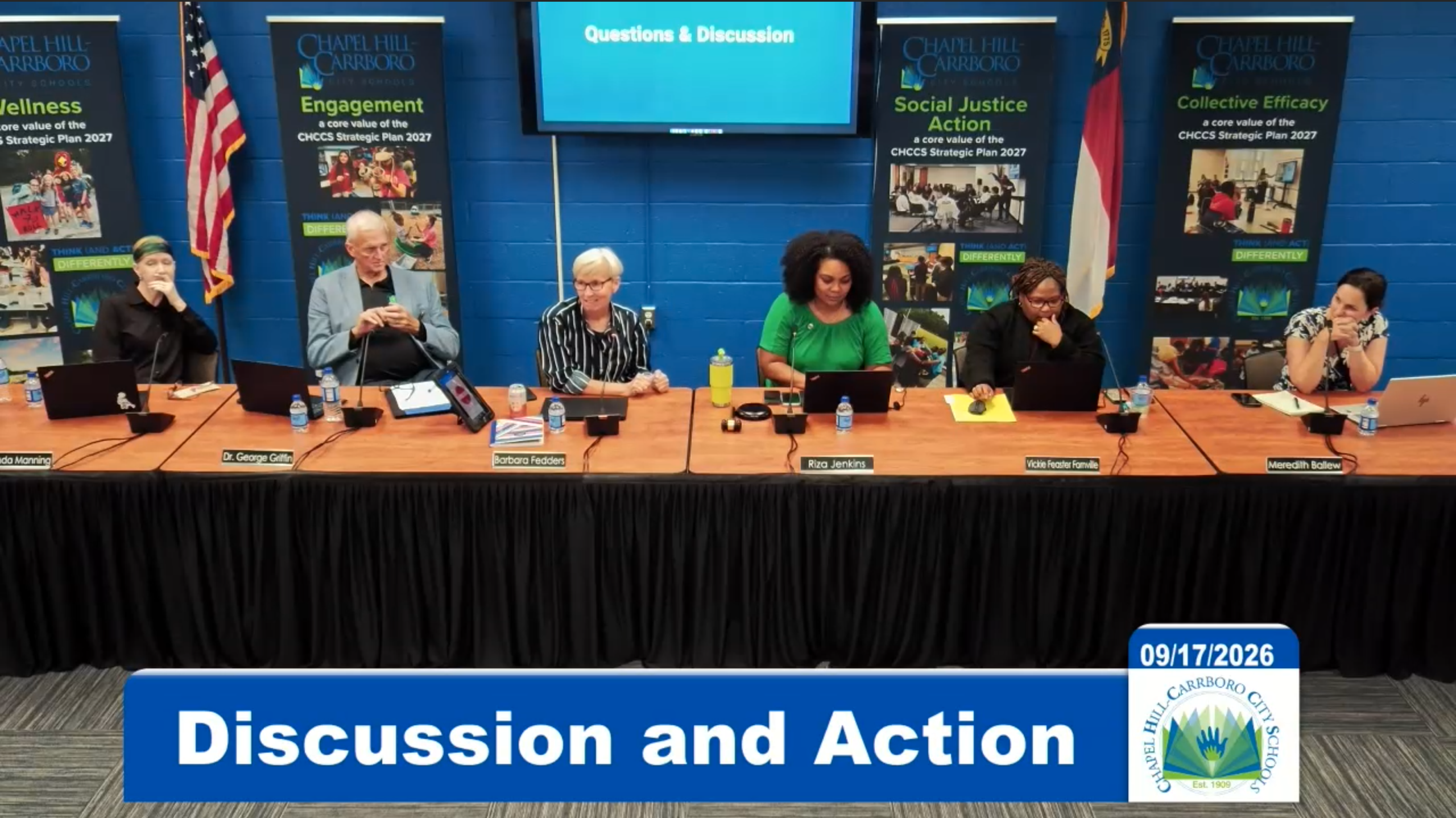
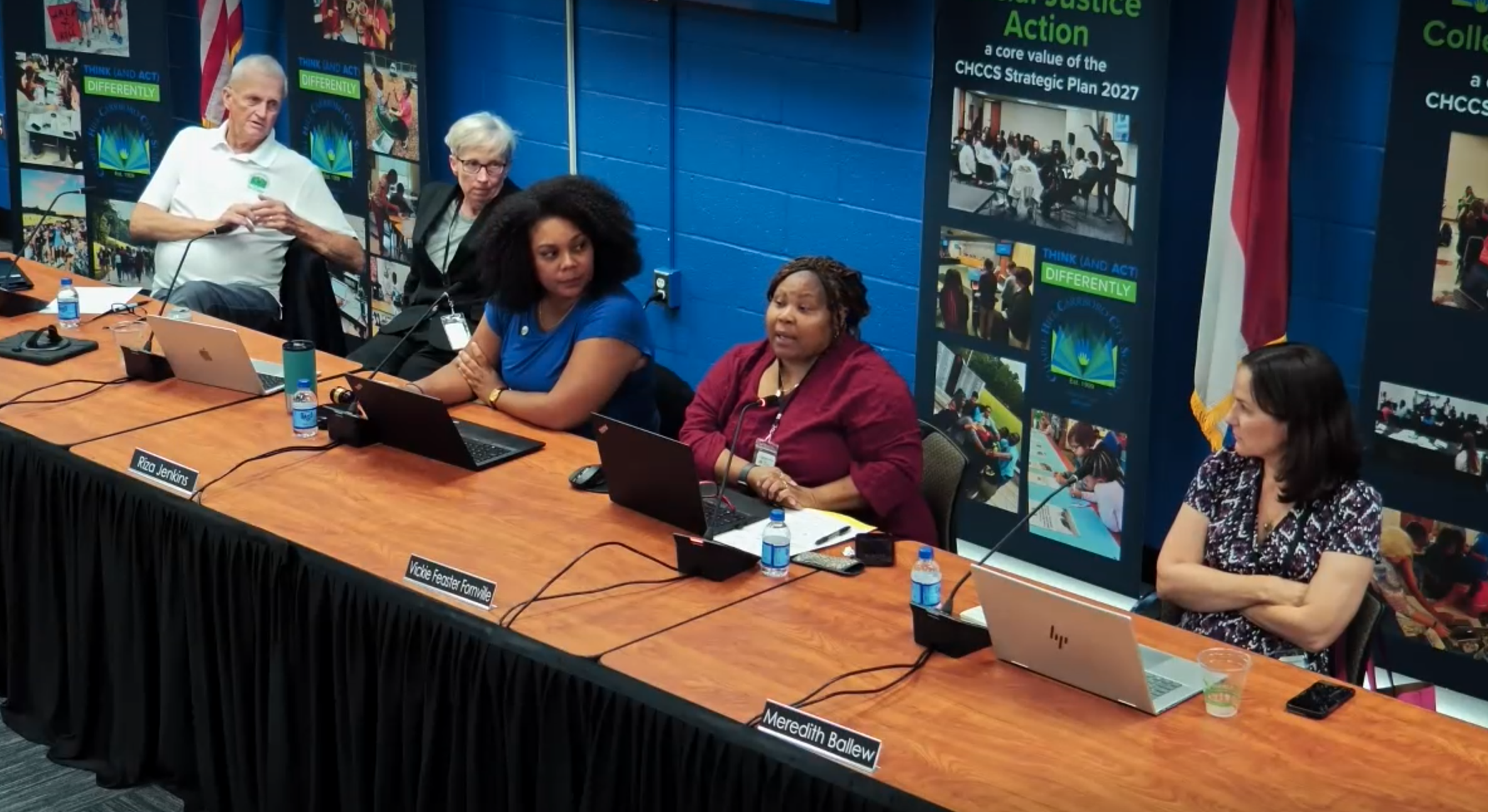
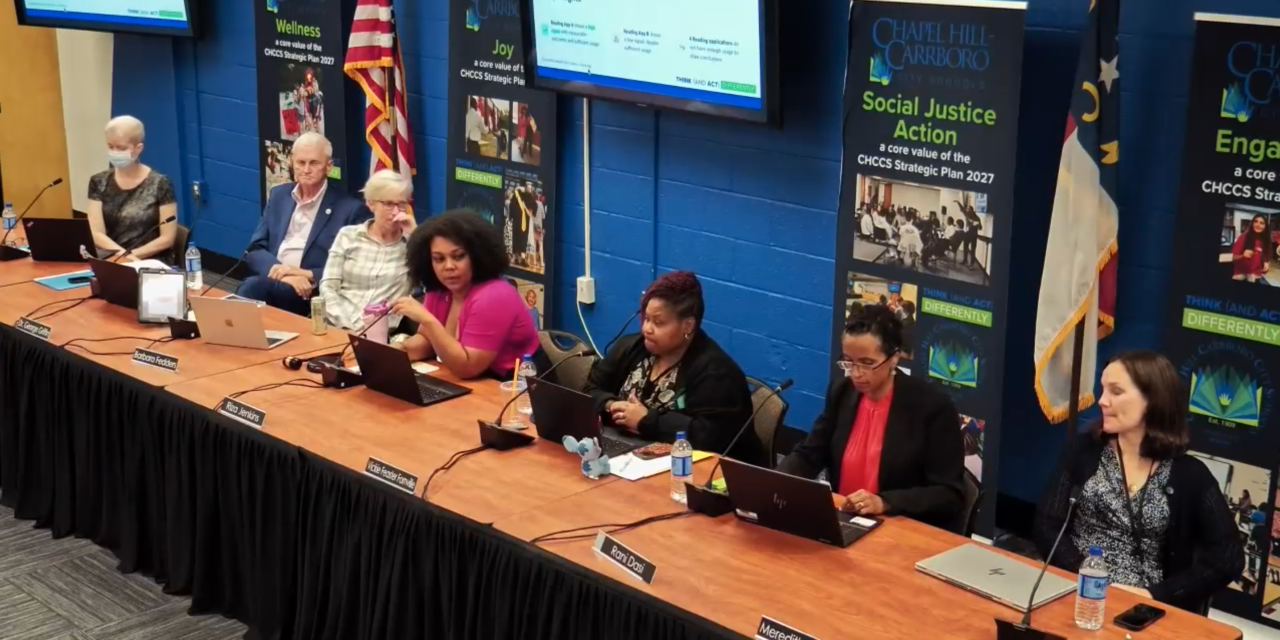
Below are transcripts of each school board member’s comments who spoke during the discussion portion of the school closure agenda item. Some elected officials’ quotes have been lightly edited for clarity and formatting, but the substance and sequence of their statements have not been altered. The livestream of Thursday’s Board of Education meeting, which has the comments in full, is available on the district’s website.
Barbara Fedders, on her motion to close Glenwood Elementary School:
“We are here because of a systematic underfunding of public education at every single level of government. Our staff have made heroic efforts to do what they can and no one is excited about what we’re deciding to do tonight. But I think we all ran, got elected, and our job is to make hard decisions. Having reviewed the study on the proposed closure of Ephesus, Glenwood, and Seawell, met with constituents including families from all three schools, conferring with the PTA council, talking with staff, and listening to public comment over the course of multiple meetings since we commenced this process on March 5th of this year…I believe the most logical school building to close is Glenwood Elementary.
“Closing either the two other schools would result in significant additional transportation costs. Moreover, I’m appreciative of Carolina Demography and our staff for getting up-to-date and ground-truth information on new housing projected to be appropriate and to serve a significant number of school age families in the area closest to Ephesus. And we did not know that when we started this process. I believe that because Glenwood is a magnet school without a defined geographical boundary, closing that school would result in less student and staff displacement than the other two options.
“I do want to say to the families and staff of Glenwood: I understand that you, as much as any school defined by a neighborhood boundary, are a community. And my motion today is motivated heavily by the fact that I trust our district leadership’s repeated commitment to maintain a dual-language and world language Mandarin track [and], regardless of physical infrastructure, that we’ll have the capacity to replicate the successes achieved in your school to date. So, that is my motion.”
Rani Dasi on keeping the choice of school closure practical instead of emotional:
“Any closure decision of this magnitude affects real people. We see you, we hear you, we understand the intensity of the emotion that you’re experiencing around this decision. I wanna start with a huge thank you to administration for all the information you’ve provided. You have answered numerous questions, you have done research, you have informed us really capably along the way. I wanna thank you all, the public, who [have] written emails, made public comments. You’ve done your own analysis and you’ve shown your care for the Chapel Hill-Carrboro community as a whole.
“This was never going to be easy. I am hearing the Glenwood stories of the Lunar New Year celebrations with great appreciation. I’m hearing the Seawell Critter Corner experience. I’m hearing the Ephesus community strength and cohesion. And it just reminds me, again, how lucky we are to have the gems we have — as someone described it earlier — in Chapel Hill-Carrboro City Schools’ crown. Weighing this difficult decision is not about the wonderful things that make each make each school special. It is a very practical consideration about the financial cost that minimize additional cost in student movement.
“I echo [Fedder’s] comments in the magnet school operating within this transportation-dependent model. The two neighborhood schools are centered in areas where proximity and walk zone access reduces the need for district transportation. Closing a neighborhood school would create new and ongoing busing costs for students who currently have local access. And for that reason, closing the magnet school feels like the most practical option — and those [transportation] costs will only continue to grow as we look at development planned in the local communities.
“I hear that this transition brings real concern, especially when it touches on something as important as feeling safe, seen, heard, and valued as a school community. And I think we see diverse students in schools across all of our schools in this district thriving and making meaningful contributions to their school communities. And so as we move to a new chapter, it will be important that we approach one another with empathy, and we recognize the shared responsibility we have to create a welcoming community. And building that kind of community will ask us to stretch. It, again, won’t be easy all the time. It will ask us to learn and it will ask us to come together in new ways. And I also want to be clear that our commitment to the effect that students and families remain strong, and I have a strong interest in ensuring that the Mandarin program has what it needs to continue to be successful. And so part of my support for this vote is to ask administration to consider redistricting in a way that preserves our commitment to the programs. It is not clear how we might be able to preserve both the dual language and world language in the same building, but I would like to explore what that could look like.”
George Griffin, on the financial landscape Chapel Hill-Carrboro City Schools is facing:
“Nobody wants to be doing this, obviously. But our financial situation as a result of declining enrollment, we’ve got budget reduction problems and issues, teacher allotment issues that… well, we’ve discussed them all for three years now, as we have faced this ongoing decline and reduction. We had a reduction in force two and a half years ago, approximately, and laid off almost 120 staff. And then we had another reduction in force just recently, where the superintendent identified 19 high-level, key central office positions — and those were reduced.
“And as we sit here tonight, the bearer of bad news… We’re not going to have our continuation budget funded at 100% by the county commissioners, unless a miracle occurs between now and next week. That’s just the way it is. That’s gonna mean — as we have done, year after year — we’re going to have to reduce even more of our budget just to maintain where we are today. We’re talking about maintenance, not about anything else. So, I say that…because closing one school isn’t gonna solve our financial problem, but it’s another important step in us making a good-faith effort to keep as many of our programs and services and teachers on board and in place as we humanly can. Because, we’re running out of other options.”
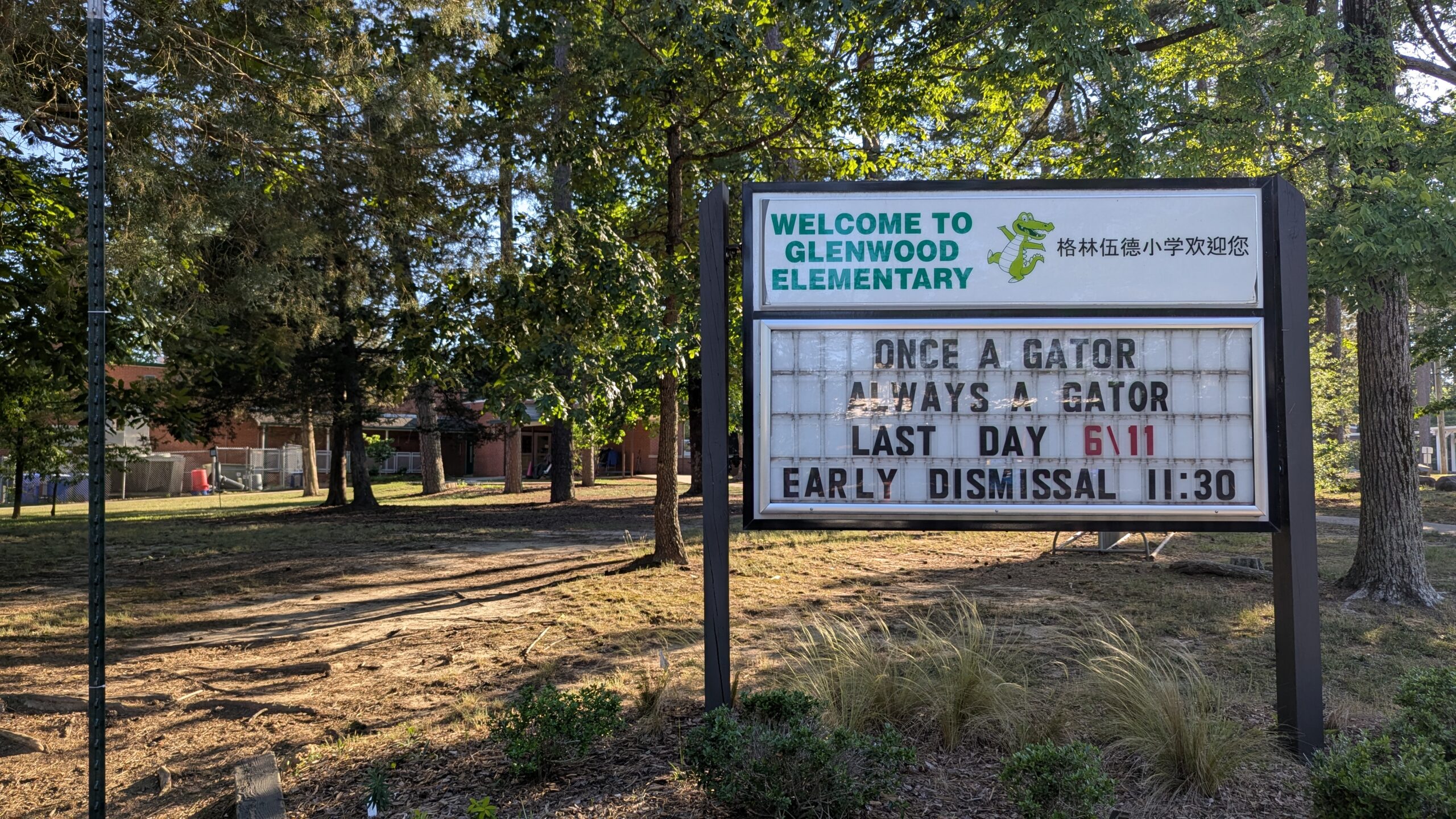
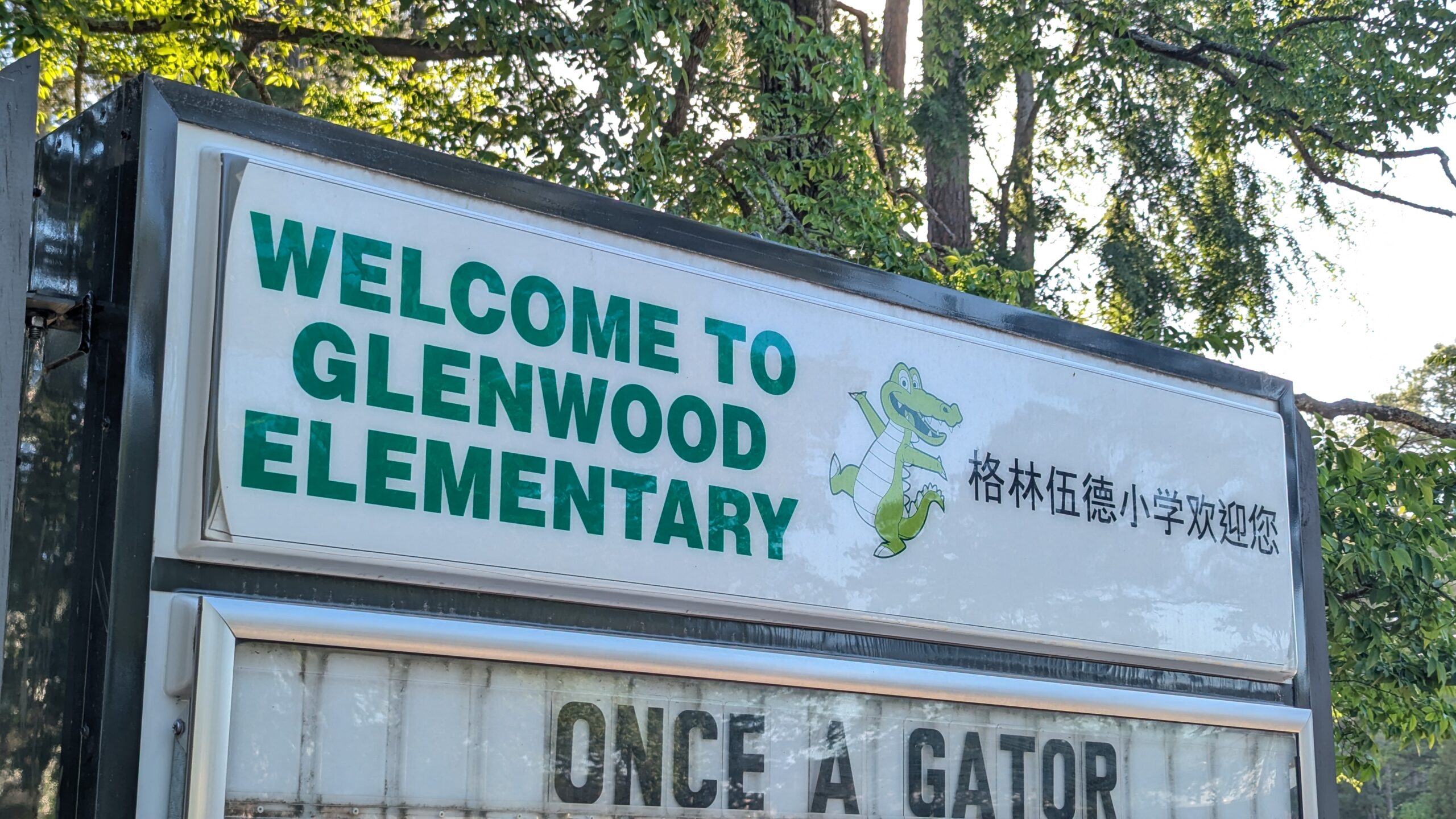
The entrance sign at Glenwood Elementary School on Thursday, June 4, 2026. (Photo by Brighton McConnell/Chapel Hill Media Group.)
Superintendent Rodney Trice on concerns from parents about Glenwood Elementary’s students being discriminated against or bullied in a new school setting:
“First, [I want] to acknowledge those concerns are real. And as many parents have suggested, those are concerns that we have some experience with [from] previous redistrictings in our community. When a decision is made, I think it’s important for the adults in [the] sending school, [the] receiving schools to be intentional about establishing a community. If a decision is made to close a school, certainly the culture, the history of that school, we’ll need to remember. We want to certainly identify the parts of that school that we want to transition to the new school. But that’s not easy if you don’t talk about it, if you don’t talk through it. Mr. Ciarochi talked about an advisory committee — and that’s fine, that’s good for redistricting. But on a more granular level, we have to be able to bring communities together and build community. If you think about PTAs, SITs and what are we going to do with all of those things…it’s a bunch of adults coming together and saying, ‘We want what’s best for our kids, and part of that is not being racist toward each other.’ We need to plan for that — because when there’s a huge decision that impacts us, sometimes the best of us doesn’t show up. And so, I think a pivot toward that type of engagement needs to happen ASAP…perhaps even before a lot of the logistics get started.
“But again, I just want to acknowledge where parents are and what they’ve expressed concerns about. I’m concerned about it as well, having experienced it…what is it, 14 [or] 15 years ago? I mean, I saw it for myself. And at that time, I think we could have done more. Going into this process, that’s one commitment that I have that I’ve shared with board members individually.”
Vickie Feaster Fornville on parents’ fears of threats to safety and chances of discrimination from a school closure:
“I’m going to just ask everybody [to] get comfortable being uncomfortable for a minute. I have heard a lot of white faces talk to me about what discrimination looks like or what it feels to not understand when someone looks at you different…or think that you don’t belong or have your children deserve to be in a safe space…or if you are not in this particular building, your children aren’t safe in a community where we want everybody to feel safe. Unless I, all of a sudden, disappeared…my face is black, my face does not look like everyone’s in here. Some of our faces are brown, some of them are white. But let me be clear: I have most certainly walked the halls in this school district and been in places where I may not have felt safe because I look different.
“I have been in the classrooms where I was the only Black child and [there] may have only been one Latinx child or one Asian child. So, I know what that feels like. To say that if they didn’t find enough of the people that looked like me to bring us back to the prior Northside Elementary or Lincoln Center, to open [those buildings] back up from segregation — which was the last time we closed the school — would be to say that we are not going to accept the fact that it is far time to pull the rug back, and Chapel Hill-Carrboro City Schools needs to stop pretending that you’re not racist to some degree.
“If we don’t tell our children to treat each other differently, they don’t know. Children aren’t born treating each other differently. If we’re trying to raise global citizens, it’s our responsibility to teach children to the best of our ability. All the languages that we can teach them, all the cultures that we can teach them. If English and Chinese are the highest-spoken languages, and the third would be Spanish and the fourth would be French…all of those are offered in this district. What culture should be rated any less than the other one? I beg to differ: it is our responsibility to teach all the cultures. Lunar New Year is important, Juneteenth is important, [the] Asian community, Latinx Heritage Month… all of it is important. And it’s our job to make all of our children feel safe, seen, elevated, and educated to the best of our ability. So, I do not appreciate anyone saying that I think any less of any minority versus the other. And if you think any minority is any less than you are, then you look in the mirror and check yourself, because that is not what I do when I’m sitting in this seat. When I sit in this seat, I’m trying to hold us all to the level and the expectation to do the best by all of our children.”
Meredith Ballew on her reasoning to select Glenwood Elementary for closure:
“For the students, families, staff, and alumni who love Glenwood, I recognize that this is painful. Glenwood is a special, innovative school with a dedicated staff, a strong culture and programs that have positively impacted many children. And on a personal note, including my own two nieces. So I may not have had my own children there, but my two beloved nieces both went to Glenwood K-5, and so I know a lot about the program through them. Nothing about my vote should be interpreted as a value judgment on the school, its staff or its students.
“From the beginning of this process, I’ve consistently said the decision is fundamentally about finances and the long-term sustainability of our district. As we’ve discussed ad nauseam tonight, CHCCS is facing declining enrollment, substantial under-utilization of elementary school capacity, and the resulting loss of state funding that comes with fewer students. Simply put, we have more elementary seats than we need, even when future housing development is considered. Continuing to operate buildings that are not fully utilized diverts resources away from the work that matters most: supporting students and staff, and investing in innovative programs that will keep our district strong in the years ahead. The data made clear that maintaining every school and our current portfolio is not sustainable over the long term.
“After reviewing the closure study and listening to community feedback, I have concluded that Glenwood is the school where closure creates the least disruption for the district as a whole. One factor in that decision is geography. Glenwood is somewhat unique among our elementary schools in that it is not located in the center of a large residential attendance area. While every school serves an important community, Glenwood’s location creates fewer challenges from a district-wide planning perspective. A second factor is Glenwood’s status as a magnet school, no school closure occurs without disruption, and I do not wanna minimize the uncertainty that Glenwood families and staff are experiencing. However, because Glenwood serves students from across the district rather than from a single attendance zone, its closure can be accomplished with less widespread redistricting impact and transportation costs that would likely occur if we closed a districted school. Given that we will already be undertaking broader elementary redistricting work, I believe selecting Glenwood minimizes the number of families who would experience multiple layers of disruption.
“I also wanna be clear that this vote is not the end of the conversation…it is the beginning of the next phase of planning. As we move forward, I encourage district administration to carefully evaluate placement options for Glenwood students and programs — including opportunities to keep existing cohorts together — and to seek meaningful input from families, students, and staff. I would also encourage families and staff at the rest of our elementary schools to please be empathetic and welcome all of Glenwood’s students when the time comes. School closure decisions are among the most difficult responsibilities of a board member. My obligation is to consider not only one school community, but the long-term health of the entire district. After weighing the information and listening to stakeholders. I believe this decision best positions our district to remain financially stable, educationally strong, and be able to serve students well into our future. I appreciate everyone taking the time to participate in this process and sharing their perspectives.”
Melinda Manning on her resolve to move forward with a closure and reasoning to select Glenwood:
“All of us up here have the privilege to be the stewards of some truly special schools — but we also hold a great responsibility to these schools as well. We could choose to take the easy road tonight…the one that doesn’t make anyone upset or result in even more angry emails. But that’s not what we were elected to do. We were elected to make hard choices, the ones that reside within shades of gray, the choices that don’t magically appear within reports or reams of data. We can’t use AI to save us from this. We have to be the decision-makers, and delaying this decision will serve no one. I appreciate all the input we’ve received from the community. I know how lucky we are to have a community that is so invested in our school system. I also know that we can’t allow the loudest voices to make the decisions for us.
“When I look at the criteria, the one that speaks loudest to me is the issue of hardship for our students. If we were to shut down a neighborhood school, that community is effectively wiped out. The students would not follow their teachers or a program. But if we shut down a program school, we can minimize the hardship. We can move the various programs into schools that have lots of empty seats. Students, in many cases, can follow their teachers and their program ,and [I] hope that community can work to stay intact. I know that a lot in many in the Glenwood community strongly believe we have to keep the two programs together. But I can’t justify keeping the two programs together versus shutting down a neighborhood school.
“I also understand the desire of many in the globe community to keep their kids in a school in which large numbers of students and teachers look like them and celebrate their heritage. I’m actually the parent of a self-proclaimed ‘wasian’ young man who attended an elementary school in our district, in which almost no students looked like him. But the wonderful teachers and staff still helped him to thrive. We need to continue to work to make sure that every child and every family in this district is seen and supported in every one of our schools. Other board members have spoken about how we need to educate future global citizens. If we were to expand the Mandarin world language program, we could help more of our students learn this vital language — as well as gain a greater appreciation of Chinese and Taiwanese culture. I also feel strongly that we should use this opportunity to create additional special programs at other elementary schools. As a steward of this school system, I think the best decision to help shore up our financial situation — as well as to create minimal hardship to students — is to close Glenwood.
Board Chair Riza Jenkins to 97.9 The Hill about communicating next steps and her message to broader CHCCS community members:
“I serve as the liaison for Glenwood Elementary — each of our board members have schools [where] they serve as liaisons, and Glenwood is my school. I’ve been in touch with the PTA and I’ll continue to be in touch with them from a board perspective. I know as Dr. Trice has laid out…there’s going to be opportunities where PTA, SIT, the staff, the administration all get together [and] meet in terms of communication, making sure the Glenwood community knows what’s to be expected over the next couple months and the next year as part of the transition. That’s our hope: that they are key partners in this, to make sure none of their families feel like they are out of touch or left out of this process.
Also, I’d say to community members: [students] and families whose students go to Glenwood will be going to one of our schools in our district, if not two. So, what I would say to school communities… let’s start thinking about how we can welcome any of these students and families into our schools. I hope I don’t see in our communities, ‘Well, this is our culture here, and now you have to join our culture.’ I hope we think about — as we bring school communities together and as part of the greater redistricting process — whatever students, whatever school communities are coming into those schools…what are those community cultures, what are those things they’re doing and how can we blend those together? Because at the end of the day, we are all Chapel Hill-Carrboro City Schools, and I want to make sure that every single student, every single family member [and] community member feels welcome at any school [where] students may end up.
Editor’s Note: This story has been updated to include Jenkins’ comments to 97.9 The Hill on Monday, June 8. She chose not to make any direct comments about her vote on Thursday night.
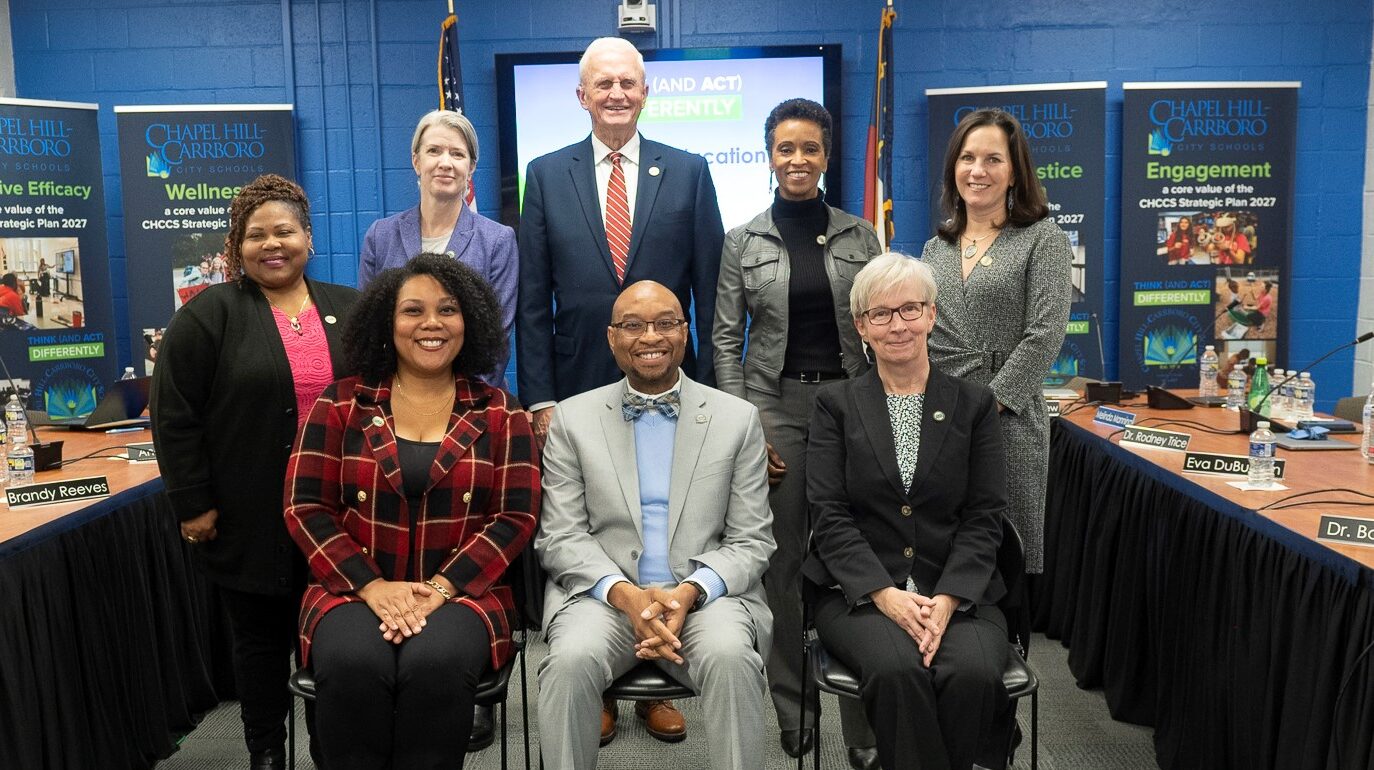
Featured photo via Chapel Hill-Carrboro City Schools.
Chapelboro.com does not charge subscription fees, and you can directly support our efforts in local journalism here. Want more of what you see on Chapelboro? Let us bring free local news and community information to you by signing up for our newsletter.