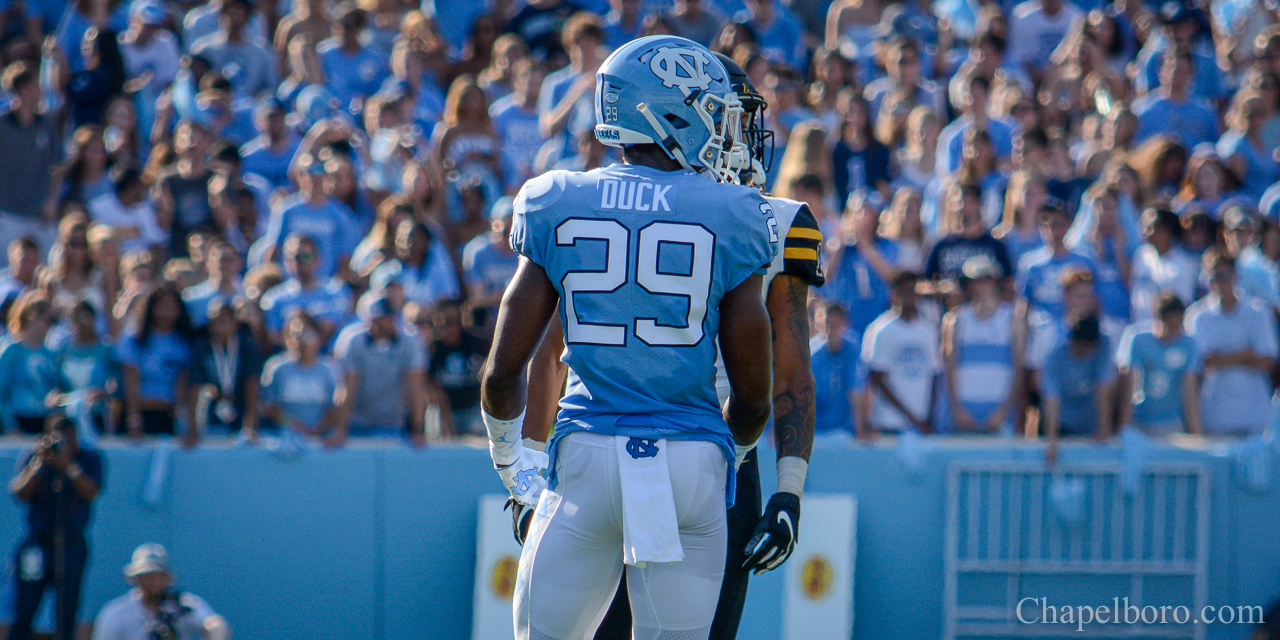
Several reasons why Carolina may still play this fall.
When the coronavirus caused most universities to go on-line with their classes last spring and all sports teams on the planet hit the pause button, speculation soon turned to the coming football season.
College administrators were almost unanimous in their belief that if students did not return to campus in the fall, there would be no sports played. So where is UNC now after taking one of Kevin Guskiewicz’s off-ramps and halting in-person classes?
We’ve learned a lot about COVID-19 infections over the months, enough perhaps to change the minds of college chancellors and presidents, as well as athletic conference commissioners.
One, obviously, students have to stay apart to avoid getting infected. At Carolina, the high-rise dorms on South Campus, as well as fraternity and sorority congregate houses, have proven that impossible. Two, with athletic teams staying in their own bubbles, outbreaks can be held down. After 37 positive tests in July, there are apparently little or no infections among players, coaches and staff.
So Tar Heel sports teams are still practicing, while the brass huddles, goes into Zoom meetings with state health officials plus the Board of Governors, and has conference calls with ACC headquarters.
Meanwhile, the UNC athletic department put out a statement that sports teams would remain on campus, practicing together and isolating in their dorms or apartments. For now, that is.
Because athletic programs with the strictest measures can avoid the clusters that shut down the campus, there may be another reason to keep playing, and it goes beyond the millions of dollars at stake.
With the students gone and distancing somewhere, wouldn’t it boost spirits to have football games to watch and teams to cheer for? And, of course, no one really knows what will happen, COVID-wise.
The Big Ten and Pac 12 postponed their seasons, unsure of their players’ safety. That also may justification to play and see how much more we can learn. Doing it both ways could help determine the immediate future of sports.
Podcast: Play in new window | Download
Subscribe:
Related Stories
‹
Chansky's Notebook: Bailing OutRoy Williams probably had reasons for the soft statements. Carolina fans reacted strongly to the video of a team party after the win over Duke. Only Armando Bacot and Day’Ron Sharpe were in the video, but a statement from players and managers said it was supposed to be a closed event that other students and […]
Chansky's Notebook: Please, Go In!UNC men's basketball faces what is an early season must-win at Georgia Tech. Art Chansky says a look at the statistics is painful, but not terminal.
Chansky's Notebook: Leaky Steps UpDean Smith used to say he’ll be happy with a one-point win. The legendary UNC basketball coach struggled spiritually between playing well according to his teachings, regardless of outcome, and winning no matter how poorly you play. Since his job was to win and he was so competitive, he chose the latter. If he was […]
Chansky's Notebook: Rock(et) StarBen Kiernan was UNC’s MVP of the Notre Dame game. When Mack Brown went over the 31-17 loss, he gave mixed reviews to the two main branches of his Tar Heels’ play. He said the offense was good in the first half and then “went dead” in a scoreless second half. He praised the Tar […]
Chansky's Notebook: Goals and AmbitionsGarrison Brooks has both opportunity and pressure. On paper, the ACC looks as weak as it has been in some time due to widespread losses to graduation and early departures to the NBA, and no sure-shot superstars in the incoming recruiting classes. A beneficiary of this development is Brooks, the Carolina senior who was second-team All-ACC last year and earned the league’s […]
Chansky's Notebook: A COVID DebateClemson was livid that Florida State wouldn’t play the game. Let’s be lawyers, and make a case for each of the teams that did not play its scheduled game over the weekend. Clemson had traveled to Florida State when it learned a player with mild symptoms who had practiced with the team all week tested […]

Chansky's Notebook: Draft DodgersCarolina and Duke players have lost ground in the NBA draft. Like everything else with sports in the COVID era, the NBA draft goes off tonight after being postponed for five months. And if you look at the various mock draft boards, certain things jump off your screen. First of all, about half the names […]

Chansky's Notebook: A Two-Thirds Bet?What if Phil Mickelson and Mack Brown amended their bet? With the Masters being moved back to this weekend due to COVID, perhaps the three-time champion should revisit the fun bet he made with Carolina’s football coach back in 2003. The famed lefthander was still seeking his first Green Jacket when he partnered with the Texas football coach at the […]
Chansky's Notebook: Kudos To CarolinaUNC teams did a commendable job beating the odds. Who among us thought the ACC would be playing football and other fall sports last summer? With the pandemic upon us and the medical experts still learning, the seasons looked like a long shot. While other conferences pumped the breaks and/or called off football, the ACC […]
Chansky's Notebook: Extra MotivationCarolina’s schedule could be working to its advantage. When the COVID-revised list of games came out, it looked troublesome for the Tar Heels with Virginia Tech and Florida State basically bookending Notre Dame and Miami with four rivalry games in a row right in the middle. Coaches usually don’t like that because it takes a […]
›