
“Viewpoints” is a place on Chapelboro where local people are encouraged to share their unique perspectives on issues affecting our community. All thoughts, ideas, opinions and expressions in this series are those of the author, and do not reflect the work, reporting or approval of 97.9 The Hill and Chapelboro.com. If you’d like to contribute a column on an issue you’re concerned about, interesting happenings around town, reflections on local life — or anything else — send a submission to viewpoints@wchl.com.
America at 250: The Revolution Happened Here, Too
A perspective from Matt Hughes
This year marks the 250th anniversary of the signing of the Declaration of Independence and the birth of the United States as a political entity. For such an occasion I have spent significant time reflecting on what that anniversary means. This 250th has taken on a much more personal significance.
Like most people, I grew up asking, “Where did we come from?” That question led me to interview my great-grandfather for a tenth grade civics project on family genealogy. He told me that our family was Scots-Irish and Dutch on his side. He was not entirely wrong, but as it turns out, he only knew part of the story.
In 2006, genealogy resources were far less prevalent. I took my great-grandfather at his word and began piecing together what I could. I managed to trace several generations, but over the next two decades I repeatedly picked up and put down the project. Two questions continued to nag at me: How many generations of my family had lived in Orange County? And was Jacob Albright, a Continental Army soldier I had discovered in my research, actually my direct ancestor? A visit last year to EPIC, the Irish Emigration Museum in Dublin, inspired me to finally find out.
The most recent generations were easy. These were the grandparents, great-grandparents, and great-great-grandparents whose names and stories were still part of family memory. I even knew my great-great-grandmother, who passed away in 1999 when I was eight years old. Beyond them, however, the family tree seemed to be an overgrown bush rather than the tall, deeply rooted tree it should have been.
Fortunately, decades of genealogical research by history sleuths have made their way online. I discovered published family histories and even a distant cousin half-way across the country who maintains an extensive family genealogy website. The challenge was connecting the generations between the 1820s and 1890s. For months, those missing seven decades seemed impossible to bridge. Then I stumbled across a detailed family history that contained the missing link. Suddenly, the entire puzzle fell into place.
The answer to my first question was yes, Jacob Albright was indeed my direct ancestor and did serve during the Revolution. That discovery only led me to obsessively wonder who he was.
It turned out that Jacob Albright settled in Orange County around 1763. Less than a decade later, the region would erupt in protest against the policies of William Tryon, the Crown’s Governor of North Carolina. Residents were outraged by excessive taxation, government corruption, and what they viewed as extravagant public spending, particularly the construction of the lavish Tryon Palace in New Bern, then the colonial capital. Among those drawn into the movement was Jacob’s nephew, William Albright, who is documented as having signed Regulator petitions and been present at the Battle of Alamance. Although the Regulators were ultimately unsuccessful, William’s involvement reflected a willingness to challenge distant authority that would reappear during the Revolutionary era. He later served in the Guilford County Regiment, rising to the rank of captain and emerging as a military leader in the struggle for American independence.
The conflict culminated in the 1771 Battle of Alamance, fought in what was then Orange County. The Regulators were defeated, and several captured leaders were later executed in Hillsborough after proceedings that many contemporaries regarded as little more than show trials. Today, the execution site lies behind the present-day Orange County Schools administrative offices in downtown Hillsborough. For families like the Albrights, however, the defeat at Alamance did not mark the end of their story. Instead, it served as a prelude to a larger conflict. Within a decade, members of the extended family would once again take up arms, this time in support of American independence during the Revolutionary War.
The Albright family’s story mirrors that of many early Americans. Jacob’s parents had emigrated from the Palatinate, a German state within the Holy Roman Empire located in what is now southwestern Germany (Deutsch, not Dutch, as it turns out), likely seeking relief from economic hardship, high taxes, expensive land, and religious discrimination against Protestants. Like countless immigrant families who followed, they moved in search of greater opportunity, eventually leaving Pennsylvania for Hillsborough and Orange County, then part of North Carolina’s frontier and home to a growing community of German-speaking settlers. When the next generation encountered many of the same grievances under British colonial rule, they resisted.
Jacob Albright enlisted in the Continental Army, while his son Henry was drafted into service. Jacob served as a drummer, and Henry as a sergeant in the Northern Orange County Regiment of the Hillsborough District Brigade. Orange County was the only county in the district to provide two regiments rather than one, one from Northern Orange and one from Southern Orange. Apparently, even in the midst of a revolution, Orange County could not resist dividing itself into north and south.
Henry’s pension application provides a remarkable account of his service. Before his formal draft in 1781, he had already answered several emergency calls to suppress Loyalist activity in western Orange County under the command of the notorious Tory leader David Fanning. Though these short campaigns lasted only a few weeks at a time, Henry helped capture a number of Loyalist fighters and witnessed firsthand the bitter divisions of what was often also a civil war that pitted neighbor against neighbor.
In the summer of 1781, Henry was drafted for a three-month term and stationed in Hillsborough, where he was appointed a sergeant under Captain James Trousdale. At the time, Hillsborough served as one of North Carolina’s capitals, and Henry’s company was tasked with guarding the town and protecting Governor Thomas Burke and the state government. Before dawn on September 12, 1781, Loyalist leader David Fanning launched a daring raid on Hillsborough, capturing Governor Burke and nearly 200 Patriot soldiers and militiamen as prisoners of war. Among them was Henry Albright.
Taken first to Wilmington and then confined aboard a British prison ship, Henry was eventually transported to Charleston. There he remained a prisoner for nearly eleven months before being exchanged for British soldiers held by the Continentals. According to his own recollection, exactly eleven months passed between his capture in Hillsborough and his return home to Orange County. After the ordeal, Henry did not return to military service.
What began as a simple family history project ultimately revealed something much larger. I discovered that my Albright ancestors have lived in Orange County for ten generations. They were here and active during the Regulator movement, one of the defining political conflicts in North Carolina’s history, and they were here and active during the American Revolution that followed.
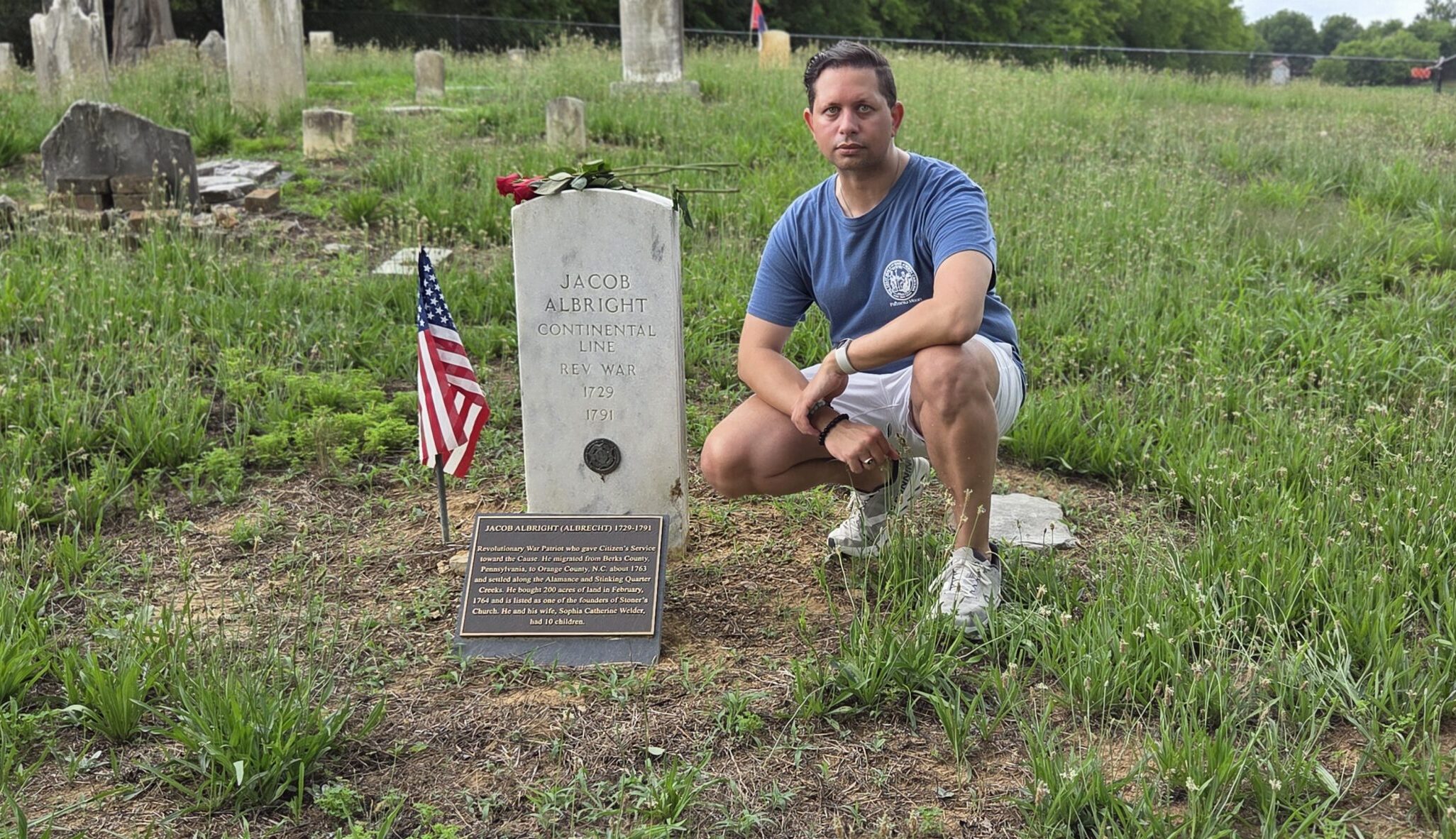
Photo via Matt Hughes.
As we commemorate 250 years of American independence, I take pride in knowing that my family’s story is woven into the larger story of this nation. Long before there was a United States, my ancestors made their home in Orange County. They challenged authority when they believed it had become unjust, fought for the cause of independence, endured the hardships of a young nation, and then remained here to help build it.
Ten generations later, I still call Orange County home. There is something profoundly humbling about standing on the same ground where they once lived, worked, and fought, and realizing that the history we celebrate as a nation is not just something found in books, but also my family’s story. In some small way, I am part of the legacy they left behind.
Matt Hughes is a 10th generation North Carolinian and has served as a Commissioner for the Town of Hillsborough since April 2018.