
Note: This is the latest Interstitial, an intermittent series of shorter periodic missives between our longer columns. This one’s dedicated to our friend David Robert, born in February and a keen observer of the natural world. Miss you, dear DR.
(DR so loved UNC’s Coker Arboretum, he set up a fund to benefit it in perpetuity. If you’d like to contribute, click over to give.unc.edu/donate and enter 525234 in the Fund Search field. Thank you.)
I found myself driving the backroads to Apex the other day. Really trying to enjoy the fact that I was able to have some quality time inside a heated automobile in the company of a not overly crowded roadway. The sun was continuing its annoying lack of shine — depressing lack of shine to be more accurate. Like many, I’m very dependent on the daily dose of shine. Especially in winter when the window is somewhat smaller and the rays somewhat subtler in their court and spark.
Driving and allowing myself a bit of wander along a familiar road. You know how you do when you slide into a moment of reverie? Time passes and then you click, realizing that you have moved some distance without having any good sense of what you passed. The half-a-beat where you scan the middle distance for a familiar sign, hopeful that you’ve not overshot the necessary turn. It’s faintly scary how we can fuzz out like that for a mile or two or ten, coming back into focus and completely intact and still hurtling along the motorway.
The road out that way is still fairly country in composition, though noticeably less so as one approaches the tentacle tips of Cary-Apex-Wake. The periodic feral houses visible from the side of 751 are fewer. The lake is very low at the moment, evidence of well-below-normal precipitation this winter, despite the recent wintry mix. There is an absolutely gigantic concrete rectangular solid at the 64 intersection. Inhuman in scale, utterly unappealing. I lack the imagination to overlay this pile of fabricated rock with anything approaching the aesthetically pleasing. Perhaps there is a landscape architect out there somewhere orbiting this insult to joy who will surprise me. Perhaps.
I was thinking about this article. The fact that I’m late in writing it, late in getting it over to Margot — and, I notice, late in getting to my destination. That’s when I see them coming up on my right…
Murderers’ row
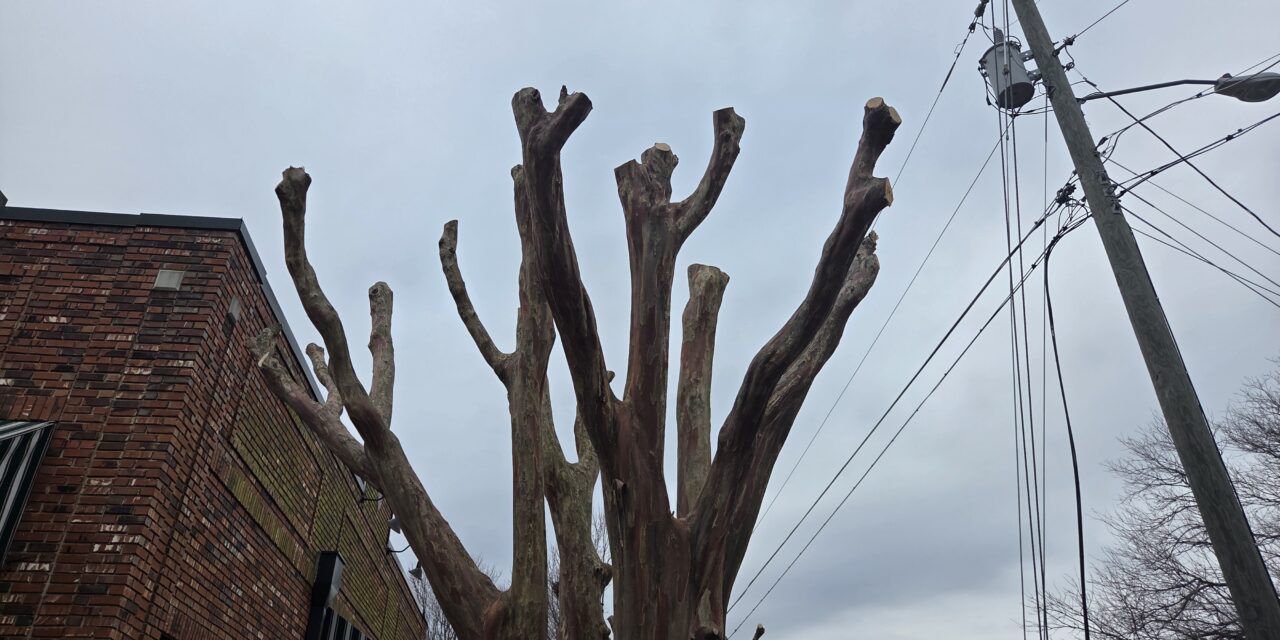
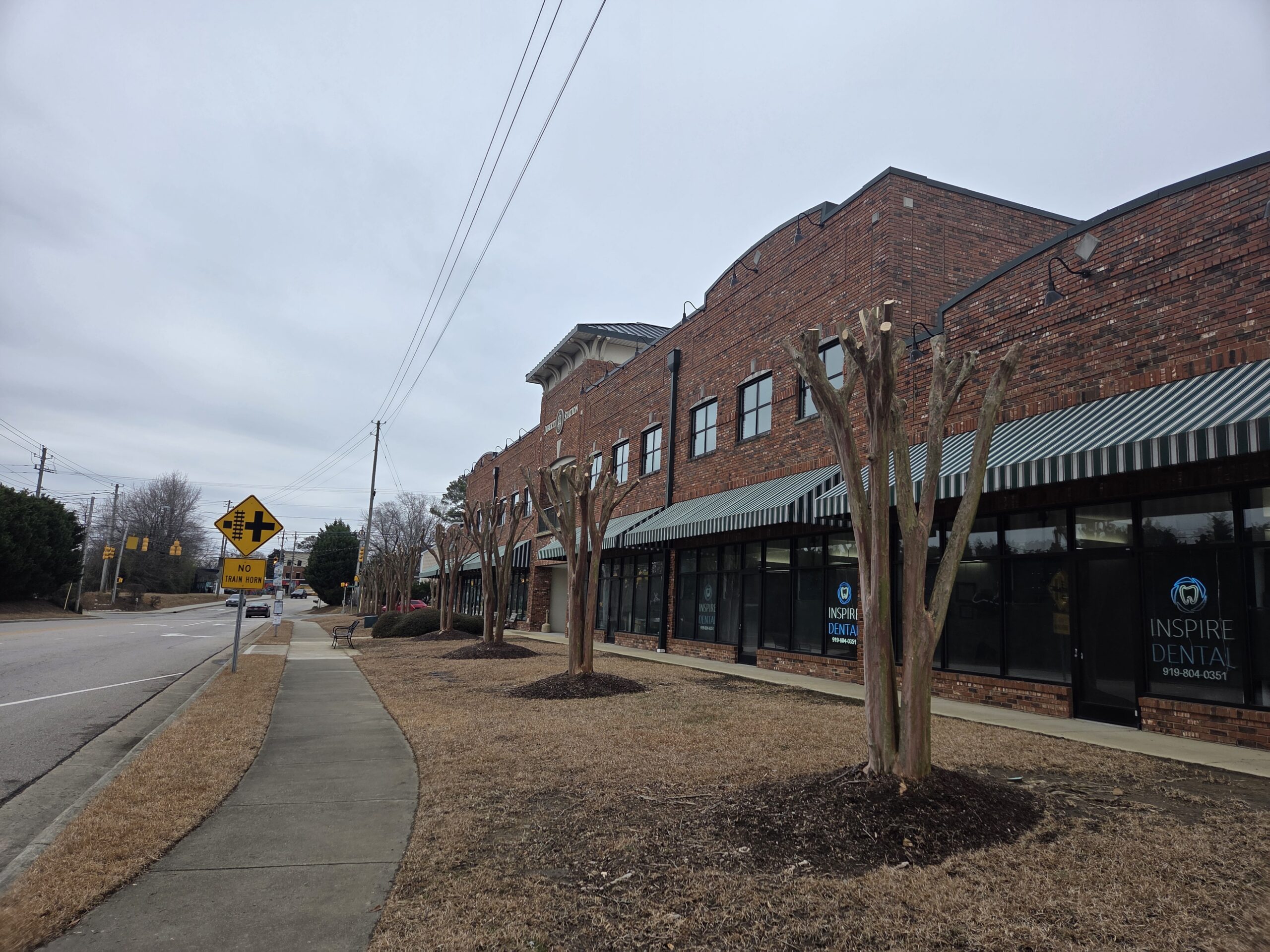
…A line of absurdly mangled trees along an otherwise inoffensive building along Salem St. on the north side of downtown Apex. I’ll slide a photo in here while I gather all the words I’m going to need to fully and faithfully sketch out the hurt I was witness to, the criminal act that forced me to pull over, park, get out and take pictures.
Ampu-trees
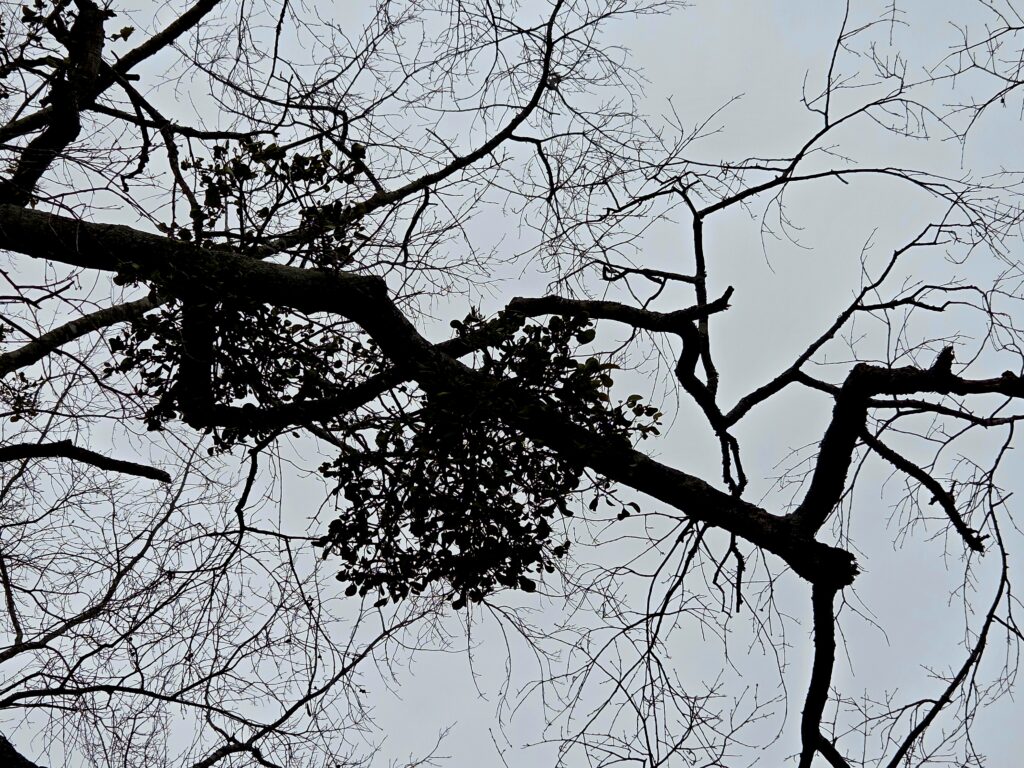
I know. “Crepe murder.” It’s a cliche because it’s everywhere, right? We know it’s wrong — why are you bothering to write something else about it? Can you maybe talk about the pretty flowers that are starting to come up in the Arboretum? Or maybe something about all the mistletoe that’s so visible in the trees on and around campus? Heck, even a bit about the sloppy planting that I’ve noticed in the last month or so. No, reader. I cannot.
I promised myself that I would stick to a single issue. Talking about all that is really beyond the scope of this little puff of prose. And it’s depressing enough wading through one pile of ick without shining light on the next 15 piles just out of eyeshot.
So, bear with me as I beat the drum again and take advantage of my bully pulpit*. Thank you in advance for holding me up in the choir. Margot will catch me out if I start typing in tongues.
Regarding the crepe myrtle…
It’s a long-appreciated non-native tree that has been imported onto our fair shores for centuries. There are hundreds of cultivars, selected for color, bloom size, bloom time, height and spread. In short, if you’ve got a spot in your garden, chances are there is a crepe myrtle that will fill it.
Caveat: these are trees. Even the so-called dwarf form are still trees. They’re just small trees. They want to do all the things that all the other trees in the neighborhood get to do. They want to grow trunks, their trunks want to grow branches, and their branches want to grow twigs. They want to flower and they want to fruit. They want to gather from the soil and the air and the sun and share their beauty with us as their time allows. All they ask is that we plant them in the right location. This should be item number one on the list of any landscape design class, any master gardener course, any HGTV candy floss, any search result. Right plant, right place.
Here’s an undisturbed crepe myrtle in the Coker Arboretum — planted 50 years ago in a spot where it has room to be itself. We should all be so fortunate.
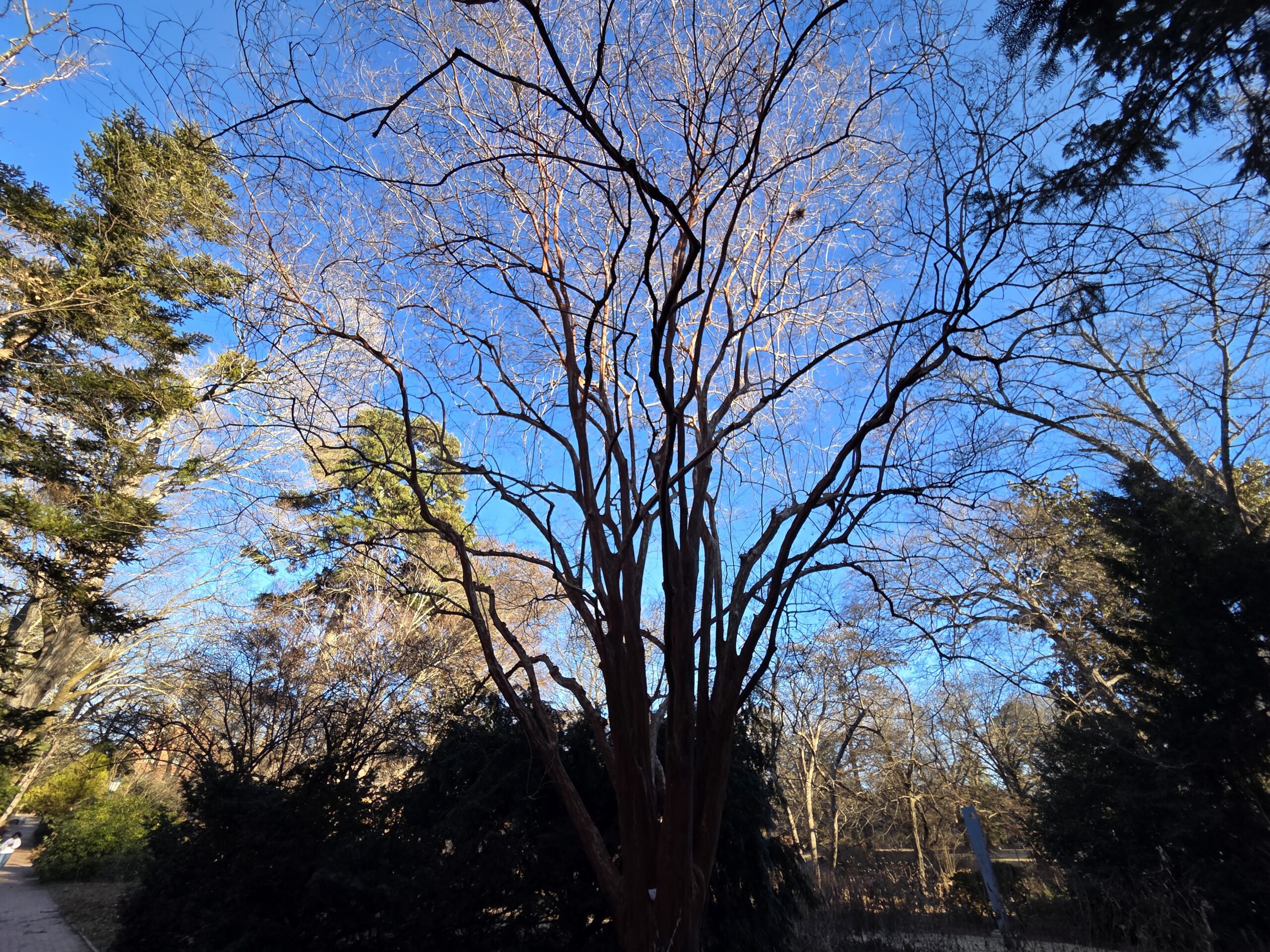
This crepe myrtle (Lagerstroemia ‘Natchez’) at the Coker Arboretum shows what these striking trees look like when planted in the right place and allowed to do their thing.
Returning to the scene of the crime
Back to Apex. Now, this particular stretch of trees, at first glance, appears to have room to continue to grow. I saw no overhead power lines. They are planted a fair distance from the storefront and the road. There is a sidewalk that would remain undisturbed by their ascending branch structure that would overtop the adjacent road at enough height to not be a hindrance to passing traffic, even tractor-trailers.
So, gentle reader, you may be rightfully asking: what the heck? Or some flavor of that phrase that suits your tolerance for spiciness. I confess I was muttering the entire time I paced this section of road. Fortunate to not encounter any pedestrians along the way.
This tree topping is never a good idea. If it is deemed necessary, then one should realize that the wrong plant was planted and should be removed. Mutilation is never the right call. It’s an affront. Countless examples of this aberrant horticultural malfeasance have inoculated the general public, it seems. Most folks have come to accept this cultural horror show. That saddens me. More to the point, it prompts this rant. And takes away pretty flower time. Humbug.
There are always alternatives. In this instance, letting the trees alone would have been the better choice. Not only does doing nothing in this case allow the trees to become their correct and full selves, but it also saves someone time and money. If, for some reason, somebody just had to get out there with their tools, a light pruning at the tips of the branches would have been OK. Nothing greater in diameter than a finger, preferably. Maybe removing the spent infructescences (those are, Margot will want me to tell you, clusters of fruits). But even that excision is not necessary, as the tree will drop them on its own in its own time.
There are those who will argue the merits of the form that this wholesale whacking leaves behind. “Sculptural” and “architecturally striking” are terms that may be thrown out there, like so much overdone pasta desperately seeking a wall to stick to. Again, humbug. If you want art, get art. If you want a tree, get a tree.
* Margot here with a little detour. You probably know that the term “bully pulpit” was coined by President Theodore Roosevelt. Some assume that the “bully” in this instance carries the modern connotation. Not so! I’ll let our friends at Merriam-Webster explain: “For Roosevelt, bully was an adjective meaning ‘excellent’ or ‘first-rate’—not today’s familiar noun bully referring to an abusive meanie. Roosevelt understood the modern presidency’s power of persuasion and recognized that it gave the incumbent the opportunity to exhort, instruct, or inspire. Since the 1960s, bully pulpit has been used as a term for a public position—especially a political office—that provides one with the opportunity to widely share one’s views.”
Speaking of mistletoe…
(Photos by Geoffrey Neal. See more of his work at soapyair.com)
Geoffrey Neal is the director of the Cullowhee Native Plant Conference. See more of his photography at soapyair.com, @soapyair and @gffry. Margot Lester is a certified interpretive naturalist and professional writer and editor. Read more of her work at The Word Factory.

About the name: A refugium (ri-fyü-jē-em) is a safe space, a place to shelter, and – more formally – an area in which a population of organisms can survive through a period of unfavorable conditions or crisis. We intend this column to inspire you to seek inspiration and refuge in nature, particularly at the Arboretum!

