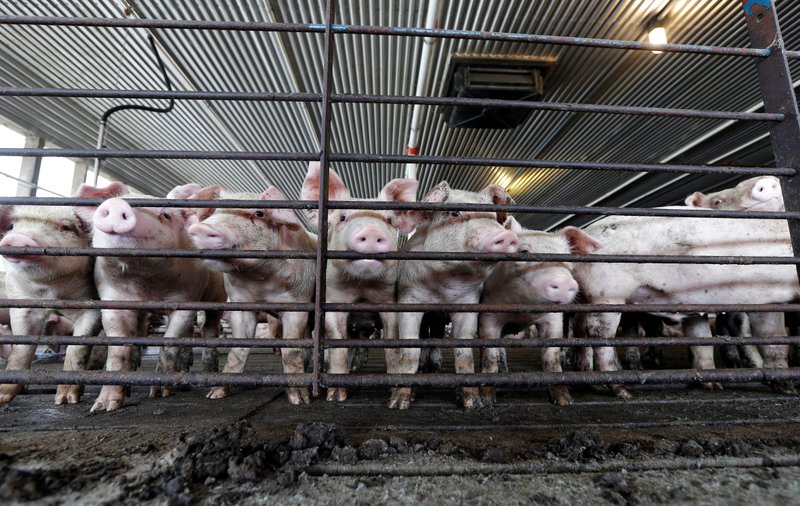
A low-cost, high-volume livestock-rearing method pioneered in North Carolina came under fire Tuesday as jurors began hearing a lawsuit from neighbors who say the world’s largest pork corporation is endangering their health and making their lives miserable.
The legal action is the first in a string of federal lawsuits against the hog-production division of Virginia-based Smithfield Foods. Its outcome could alter production methods and profits for the company, which controls everything from the feed the animals eat to when they are trucked to slaughter and how the meat lands on consumers’ plates. Smithfield was bought in 2013 by a division of China-based WH Group, the world’s largest pork producer.
In dozens of lawsuits, more than 500 neighbors say that for decades they have suffered headaches, sinus problems and intense, putrid smells that can’t be removed from clothing or household fabrics.
“Smithfield has never done anything to change,” Michael Kaeske, a Dallas, Texas-based lawyer, told jurors. “They’re not going to do anything to change unless you make them.”
The suit heard Tuesday is the first of several test cases against the company. It pits Smithfield against 10 neighbors of a farm raising 15,000 livestock hogs under contract with the pork giant. Kinlaw Farm and its owners are not defendants. Instead, the suit targets Smithfield, which determines the farm’s operating standards.
“Smithfield controls what the growers do and they don’t have the money to do anything different,” Kaeske said.
Since pork producers began dramatically consolidating in the 1980s, sprawling operations holding thousands of hogs generating a small city’s worth of urine and feces each day have become standard in North Carolina. The excrement is flushed into pits where it is broken down and then sprayed through a type of agricultural water cannon as fertilizer onto nearby fields.
DNA tests found a type of bacteria originating in swine digestive systems coating exterior surfaces at the homes of all 10 Bladen County plaintiffs, Kaeske told jurors.
Though less-malodorous technologies have been developed and applied at Smithfield operations elsewhere, North Carolina operations haven’t changed, Kaeske said. For example, a lawsuit by Missouri’s attorney general resulted in a 1999 settlement forcing a company that Smithfield later took over to cut in half the nitrogen applied to fields, at a cost of tens of millions of dollars.
The Missouri solution included covering open-air waste pits, Kaeske said, yet Smithfield’s “lagoons in North Carolina remain uncovered.”
“They continue to spray feces and urine near their neighbors.”
Smithfield attorney Mark Anderson said agreements elsewhere, where temperatures and lagoon construction are different, shouldn’t enter into this lawsuit. Jurors should consider only whether the 10 named plaintiffs have suffered so great a nuisance that they can’t enjoy the use of their own property, he said. The farm never faced complaints from neighbors or state regulators until out-of-state lawyers showed up to press their agenda, Anderson said.
“This case is about this land, these neighbors, this farm,” said Anderson, who practices in Raleigh and New York City. “Jurors know how to separate an agenda and an attack from the law.”
Photo via Associated Press
Related Stories
‹
![]()
2 Years After Hurricane Helene, Where Does Relief Fall Short in North Carolina? – On Air Today (September 29, 2026)Public Policy Analyst Alex Campbell joins 97.9 The Hill's Brighton McConnell on Tuesday, September 29 shortly after the two-year mark of Hurricane Helene.

Trump Refers to Black Man From Racially Offensive 1988 Campaign Ad While Stumping in North CarolinaDuring a stop in North Carolina, Trump referenced one of the most controversial campaign advertisements that relied on racist tropes.

Postal Service Work To Comply With Trump’s Executive Order Is Rushed and Sloppy, a Whistleblower ContendsThe U.S. Postal Service is poised to launch a hastily built, error-riddled computer system that could jeopardize the process of mail voting.

Longtime Chatham County Educator Wins $10 Million Lottery PrizeThe North Carolina Education Lottery office revealed that Jean Johnson, who teaches in Chatham County, is the winner of a $10 million prize.
![]()
Theodore Nollert on North Carolina's Budget Corrections Bill and Its Process – On Air Today (August 26, 2026)Theodore Nollert — the directory of policy for Carolina Forward and a Chapel Hill Town Council member — joins 97.9 The Hill's Brighton McConnell on Wednesday, August 26.

UNC Health Expands, Rebrands Venture Capital Efforts of Emerging TechThe statewide healthcare system announced Rex Health Ventures platform is now UNC Health Ventures and will use $125 million to invest in emerging health tech companies.

Corporate Tax Cuts, Prediction Market Leeway, and Underfunding Education: Why Orange County's Legislators Voted Against NC's BudgetAll three of Orange County’s state representatives voted against North Carolina's updated budget, citing issues with its contents and construction.

On the Porch: Dr. James Wood - Sports Around the WorldThis Week:
James Wood is currently Professor of Latin American and modern world history at North Carolina A&T State University. He is the author of The Society of Equality: Popular Republicanism and Democracy in Santiago de Chile, 1818-1851 and the co-editor of "Problems in Modern Latin American History: Sources and Interpretations", now in its fifth edition with Rowman and Littlefield. As a Fulbright scholar for Chile in 2016 he was a visiting professor at the Universidad Diego Portales in Santiago (where he observed Chilean student activism up close).
On the Porch: Bill Brown - Art and Science Merge at NCMAThis Week:
Bill Brown joined the North Carolina Museum of Art as a Conservation Intern in 1988. Thirty-two years later he retired from the Art Museum as Chief Conservator. He received his M.A. and Certificate of Advanced Studies in Conservation from State University College at Buffalo, NY in 1989. At the Museum, he established the Art + Science Initiative, a collaborative program with Duke University math and science departments. Bill has a passion for Italian Old Master Paintings of the 14th to 18th century. He works part-time as a conservator in private practice and provides conservation support for the Museum and Gallery collection of old master paintings at Bob Jones University in Greenville, SC . He enjoys retirement with his wife and young adult son.

On the Porch: Nora Gaskin - Conjuring Crime StoriesThis Week:
Author Nora Gaskin is a lifelong resident of the Durham-Chapel Hill area. Her latest is novel is "Lammie Loves Cubby". Nora has a bachelor’s degree in English with Honors in Creative Writing from UNC, and a Masters in English from the University of Washington in Seattle. She spent over 24 years as a stockbroker and financial advisor in the Durham office of a major investment firm. She retired in 2005 to focus on writing. She is the publisher at Lystra Books and Literary Services and the author of three novels and one nonfiction book. She lives and writes in Chatham County, inspired by her native landscape, her husband, and dogs. Her favorite word is "gratitude."
›