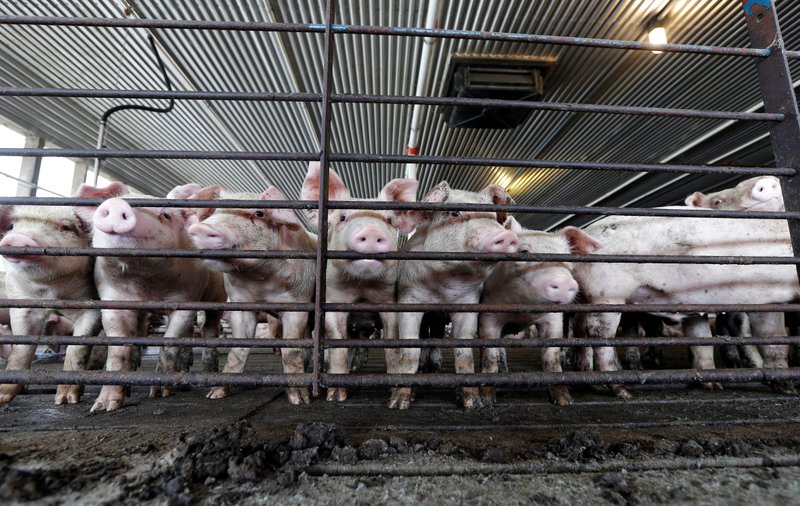
A low-cost, high-volume livestock-rearing method pioneered in North Carolina came under fire Tuesday as jurors began hearing a lawsuit from neighbors who say the world’s largest pork corporation is endangering their health and making their lives miserable.
The legal action is the first in a string of federal lawsuits against the hog-production division of Virginia-based Smithfield Foods. Its outcome could alter production methods and profits for the company, which controls everything from the feed the animals eat to when they are trucked to slaughter and how the meat lands on consumers’ plates. Smithfield was bought in 2013 by a division of China-based WH Group, the world’s largest pork producer.
In dozens of lawsuits, more than 500 neighbors say that for decades they have suffered headaches, sinus problems and intense, putrid smells that can’t be removed from clothing or household fabrics.
“Smithfield has never done anything to change,” Michael Kaeske, a Dallas, Texas-based lawyer, told jurors. “They’re not going to do anything to change unless you make them.”
The suit heard Tuesday is the first of several test cases against the company. It pits Smithfield against 10 neighbors of a farm raising 15,000 livestock hogs under contract with the pork giant. Kinlaw Farm and its owners are not defendants. Instead, the suit targets Smithfield, which determines the farm’s operating standards.
“Smithfield controls what the growers do and they don’t have the money to do anything different,” Kaeske said.
Since pork producers began dramatically consolidating in the 1980s, sprawling operations holding thousands of hogs generating a small city’s worth of urine and feces each day have become standard in North Carolina. The excrement is flushed into pits where it is broken down and then sprayed through a type of agricultural water cannon as fertilizer onto nearby fields.
DNA tests found a type of bacteria originating in swine digestive systems coating exterior surfaces at the homes of all 10 Bladen County plaintiffs, Kaeske told jurors.
Though less-malodorous technologies have been developed and applied at Smithfield operations elsewhere, North Carolina operations haven’t changed, Kaeske said. For example, a lawsuit by Missouri’s attorney general resulted in a 1999 settlement forcing a company that Smithfield later took over to cut in half the nitrogen applied to fields, at a cost of tens of millions of dollars.
The Missouri solution included covering open-air waste pits, Kaeske said, yet Smithfield’s “lagoons in North Carolina remain uncovered.”
“They continue to spray feces and urine near their neighbors.”
Smithfield attorney Mark Anderson said agreements elsewhere, where temperatures and lagoon construction are different, shouldn’t enter into this lawsuit. Jurors should consider only whether the 10 named plaintiffs have suffered so great a nuisance that they can’t enjoy the use of their own property, he said. The farm never faced complaints from neighbors or state regulators until out-of-state lawyers showed up to press their agenda, Anderson said.
“This case is about this land, these neighbors, this farm,” said Anderson, who practices in Raleigh and New York City. “Jurors know how to separate an agenda and an attack from the law.”
Photo via Associated Press
Related Stories
‹

On the Porch: Lisa Sorg - Data CentersThis Week:
Lisa Sorg is the North Carolina reporter for Inside Climate News. A journalist for 30 years, Sorg covers energy, climate environment and agriculture, as well as the social justice impacts of pollution and corporate malfeasance.
She has won dozens of awards for her news, public service and investigative reporting. In 2022, she received the Stokes Award from the National Press Foundation for her two-part story about the environmental damage from a former missile plant on a Black and Latinx neighborhood in Burlington. Sorg was previously an environmental investigative reporter at NC Newsline, a nonprofit media outlet based in Raleigh. She has also worked at alt-weeklies, dailies and magazines. Originally from rural Indiana, she lives in Durham, N.C.

On the Porch: Holly Lux-Sullivan - Walking You HomeThis Week:
Holly Lux-Sullivan of Heartwood Death Doula & Bereavement Care is a trusted end-of-life guide, grief counselor, and board-certified chaplain with 18 years of experience supporting people through illness. She is a respected death doula whose passion is caring for those at life’s margins, particularly during severe and terminal illness, and normalizing conversations about mortality. An ordained Unitarian Universalist minister, she serves people facing the end of life across central North Carolina. HeartwoodDeathDoula.com

'Worried For Our Future': Authors React to Removal Attempt of LGBTQ+ Books from CHCCS Elementary LibrariesNorth Carolina legislators are pushing to remove 63 LGBTQ-themed books from CHCCS elementary schools, saying they violate state law for being available in libraries.
On the Porch: Deana Joy - Child Abuse in NCThis Week:
Deana Joy has spent her career working in the nonprofit sector with victims of crime. She began by working with victims of sexual violence then, in 2006, she was promoted to Executive Director of a local Children’s Advocacy and Sexual Assault Center. In 2014, Deana began working as the CEO of Children’s Advocacy Centers of North Carolina, the state chapter for Children’s Advocacy Centers (CACs). In 2017, Deana became a national accreditation site reviewer for National Children’s Alliance, the accrediting body of Children’s Advocacy Centers. Deana currently serves as the Chair of the Children’s Justice Act for the Governor's Crime Commission and is on the NC Human Trafficking Commission, the NCDHHS Safety Design Team, the central region Citizen Review Panel, and the statewide Mass Violence Committee.
Morinaga Celebrates Completed Mebane Expansion and 'Sweet Partnership' With North Carolina, Orange CountyThe Japanese candy company Morinaga held a ribbon-cutting ceremony Tuesday to celebrate the opening of its expansion Hi-Chew plant in Mebane.
North Carolina’s Electoral Future May Hinge on Rural Black Voters Who Feel Ignored by DemocratsRoughly 4 in 10 Black voters in North Carolina’s last presidential election said they live in small towns or rural communities.

North Carolina Supreme Court Throws Out Longtime Suit Over Education FundingOn Thursday, the North Carolina Supreme Court threw out longtime Leandro Case ruling and litigation over education funding in the state.

North Carolina’s Photo Voter ID Mandate Can Continue as a Judge Upholds the LawNorth Carolina’s photo voter identification law was upheld on Thursday, as a federal judge set aside arguments by civil rights groups.
'Keeping People Safe': North Carolina's Office of Violence Prevention Reaches 3-Year AnniversaryNorth Carolina's Office of Violence Prevention recently surpassed its three-year anniversary, continuing to use public health approaches to address the issue of gun violence.

Democrat Roy Cooper Needs to Defy North Carolina History to Keep Winning Streak Alive in Senate RaceWritten by GARY D. ROBERTSON and BILL BARROW RALEIGH, N.C. (AP) — North Carolina does not mind electing Democrats as governor, but it is a different matter when it comes to sending them to the U.S. Senate. Roy Cooper, who led the state for two terms, is trying to change that with a campaign that could […]
›