
In the spring of 2020, everything changed.
Everything changed first over COVID-19. People worked from home, others lost their jobs. Overnight, our plans changed. Our needs changed. And the organizations we counted on to meet those needs – they had to change as well.
And something else was happening too. The same week North Carolina closed its schools, a woman named Breonna Taylor was shot and killed by police in Louisville. Two months later, George Floyd was killed in Minneapolis. And as people flooded the streets in protest, once again, we realized things had to change.
It’s now been three years since that spring. What have we learned from our experience? What lessons have we taken away? What changes have we made? And which of those changes will last?
“Three Years” is a series by 97.9 The Hill’s Aaron Keck – looking back on our memories and lessons learned from our collective experience, drawn from conversations with numerous government officials, nonprofit heads, scholars and thought leaders in the Chapel Hill-Carrboro community.
Click here for the entire 15-part series.

Listen to Chapter 7:
Chapter 7: The Government
The racial justice movement in 2020 and beyond cast a bright spotlight on the role in the mission of law enforcement specifically.
But what about local government in general?
“It felt like a very serious and anguished pressing to leadership of all kinds in the community,” says Hillsborough Mayor Jenn Weaver. “We talk about racial justice all the time, but what does that mean? What are we going to actually do differently to make that manifest? No more only talking. Much more doing.”
What did that mean in Chapel Hill?
“How I view my role in town government hasn’t at its core changed,” says Tai Huynh, who’d only just been elected to the Town Council the year before. “But it has definitely amplified and given me a lot more resolve to pursue that role.”
“In what way?” I ask.
“You know, I think everything that local government does – especially zoning, which is at the core of what we do – has racist roots,” he says. “And I think before the racial justice movement happened, it was (only) a small group of people who really were able to accept and acknowledge that. And then after that – I mean, we had people starting to read all these books that they never even thought of reading before, about the history of racial inequities in this country (and) just how systemic they are…
“These communities of color, who have been marginalized and underserved and actively predated on – how can we undo that, and give them a step up so they can finally catch up?”
The racial reckoning of 2020 pushed officials to reconsider their missions in every agency of local government – including the ones you’d think would’ve been more affected by COVID-19.
Take the Orange County health department, for instance. When I ask health director Quintana Stewart how her sense of mission has changed, she says the pandemic has affected it to a degree – “We’re doing a lot more educating” – but what’s really impacted their mission, she says, is that greater sense of urgency around addressing racial disparities.
“Over the last couple years, there has been an intentional focus on equity,” she says. “The CDC updated (their list of) ‘ten essential services for public health’ in late 2020. It’s like a wheel…in the center it used to say ‘evidence-based research,’ and now that has changed (to) ‘equity.’
View the CDC’s “Ten Essential Services” wheel here.
“I think (equity) has always been woven into the work we do,” Stewart continues. “Health disparities, that’s not new to us. We’ve always watched that data and tried to target interventions and programs to get to those that are impacted by the disparities – but (now) we’re institutionalizing it and making it part of everything that we do. That’s the biggest change that I’ve seen: it’s now officially being called out and recognized as something that we have to do.”
“Is that commitment as strong today as it was a year ago, or two years ago?” I ask her. “Politically now, we’re in the backlash phase.”
“Yes it is,” she replies. “And I’m (still) seeing it be consistent with our paperwork and requirements coming down from Raleigh and (the state health department). Orange County’s health department, when I came in late 2017, already had a racial equity commission…so they were already doing a lot of this, and we continue to do that work.”
That equity work also continued on campus – where UNC had already been struggling with its own history of racial injustice, from the presence of Silent Sam to the names of white supremacists on campus buildings.
“I think that we better understand how we can engage people to make a difference,” says Chancellor Kevin Guskiewicz.
The most immediate difference occurred around building names. UNC had imposed a 16-year moratorium on changing the names of campus buildings, but that moratorium was called off quickly amidst the movement in the summer of 2020.
“I think people realized that we needed to be that place,” says Guskiewicz, “that went through a process, that brought people to the table, to be sure that everyone felt and knew that they belonged on our campus. And so as a result, we removed four names from buildings.”
But as anyone close to UNC will tell you, the university still has a very long way to go. UNC historian William Sturkey says there’s been a lot of activity to refocus the university around a commitment to racial equity – but that activity has come mostly from the bottom, not the top.
“UNC’s overall sense of itself, I do not think has changed at the very highest levels,” he says. “And that obviously bore out with Nikole Hannah-Jones.”
The controversy over Nikole Hannah-Jones played out in 2021. UNC’s journalism school offered her a chaired faculty position after the publication of “The 1619 Project,” her book about American history through the lens of race and slavery. But even though that position routinely comes with tenure, UNC’s Board of Trustees dragged its heels on a tenure offer for months, only extending the offer under heavy public pressure. Hannah-Jones ultimately turned down the position altogether.
“Even in the wake of George Floyd, even in the wake of the most remarkable racial reckoning that I’ve seen in my lifetime, we still could not get that right,” Sturkey says. “But I think what has changed are the smaller level conversations – and not just in the classroom between professors and students, but in departments and in centers…
“And certainly also in the eyes of donors. I’ve seen a few different examples of donors being involved in pushing the university. We often think of donors as being sort of curmudgeonly white men and women – but there’s also a lot of donors who are very much interested in helping push UNC to play a stronger, more definitive role in helping to fix this issue with race in our country.”
Click here for the entire 15-part series.
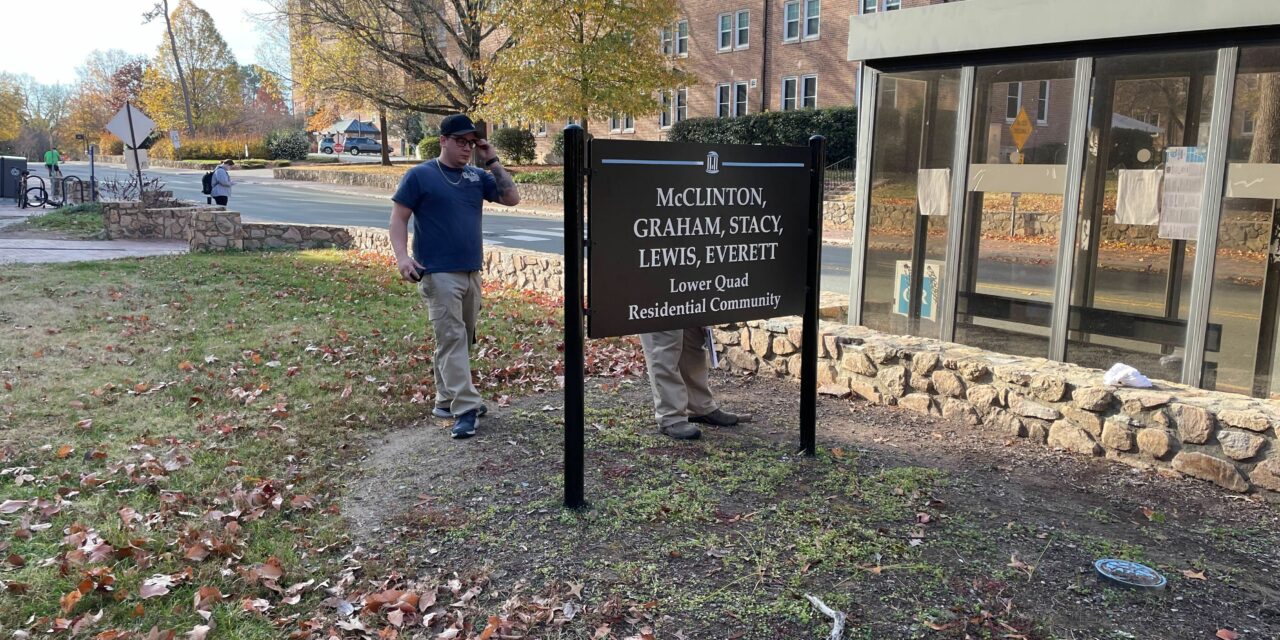
Featured photo: a new sign at UNC, installed in 2021, reflecting the new name of McClinton Residence Hall – formerly Aycock Hall, named after white-supremacist governor Charles Aycock, now named after Hortense McClinton, UNC’s first Black professor.
Chapelboro.com does not charge subscription fees, and you can directly support our efforts in local journalism here. Want more of what you see on Chapelboro? Let us bring free local news and community information to you by signing up for our biweekly newsletter.

