
Often attributed to Mark Twain — perhaps mistakenly, since no historical source shows he actually made the statement — “History doesn’t repeat itself, but it often rhymes” is a common and apt refrain when discussing the connection between historical perspectives and current events. By drawing on knowledge of what happened in the past, and why, we are better able to understand the flow and direction of the history collectively created in each new day.
“Past Rhymes With Present Times” is a series by Lloyd S. Kramer exploring historical context and frameworks, and how the foundations of the past affect the building of the future.
It’s a long journey from the mountains of North Carolina to the ICE-covered, winter streets of Minneapolis. One of our state’s native sons, however, has made this personal and professional trip to secure his place in contemporary American history as the recent “commander-at-large” of the United States Border Patrol.
His name is Gregory Bovino, and his aging North Carolina schoolmates may still remember his classroom days at Watauga High School in Boone or his undergraduate and graduate years at Western Carolina and Appalachian State universities.
Few alumni have advanced from these institutions to comparable public visibility, and none have provoked more anger about the Trump administration’s national assault on immigrants and the anti-ICE activists who are trying to defend them.
Speaking on television after his Border Patrol forces killed the Minneapolis nurse Alex Pretti and sent the five-year-old Liam Ramos to a detention camp, Bovino falsely described Pretti as a dangerous “suspect” who sought to “massacre” law enforcement agents and portrayed little Liam as a well-protected child in a safe detention center where “I don’t think it gets any better than that.”
Did Bovino skip all of Watauga High School’s American history classes or simply ignore every reference to “unalienable” rights and the constitutional rule of law?
It would be impossible to summarize all that Bovino failed to learn in North Carolina’s schools and universities. His ahistorical distortions nevertheless show that he’s clearly unaware of how the current Border Patrol/ICE occupation of Minneapolis (and the steadfast resistance that opposes it) resembles the British military occupation of eighteenth-century Boston and generates the kind of political resistance that led to America’s Declaration of Independence and Human Rights in 1776.
ICE Agents in the Streets of Twenty-First Century Minneapolis
The current military-style assault on the people of Minneapolis has brought 3,000 heavily armed ICE and Border Patrol agents into the once-peaceful streets of a multicultural city, arrested thousands of immigrants and US citizens, shattered local businesses, and deported planeloads of Minnesota residents to dehumanizing detention centers.
In response to this invasion, thousands of pro-democracy activists have mobilized to monitor and resist the ICE forces throughout Minneapolis. Brave people blow loud whistles or take pictures with their phones, escort endangered children from their schools, provide food for neighbors who cannot safely leave their homes, light candles at memorials for murdered protestors, and join massive street demonstrations to denounce the repressive occupation of their city.
This ICE attack on human rights seems comparable to the obsessive search for fugitive slaves (all defined as criminals) in the United States before 1860, the violent removal of Native Americans from their long-inhabited homelands over several centuries, or the unjust detentions of “Freedom Riders,” anti-segregationist students, and political activists who marched for equal Black rights during the Civil Rights movement of the 1950s and 1960s.
As these historical precedents suggest, diverse social groups have long suffered from organized assaults on racial and legal equality. But these repressive public actions have always generated new forms of American resistance that challenge authoritarian ambitions for overwhelming power and gradually push the reigning social and political system toward more acceptance or protection of “unalienable” human rights.
Historians can find recurring patterns of public intimidation and creative resistance in every era of American history, yet the present ICE actions in Minneapolis may evoke the most striking comparisons with Britain’s imperial policies in Boston between 1768 and 1776.
British Soldiers in the Streets of Eighteenth-Century Boston
Boston’s economic vitality in the late 1760s depended on its shipping trade and commercial networks, which explains why the city’s merchants and workers responded angrily when the British Empire imposed new taxes and tariffs on the imported goods that flowed into New England through the busy Boston harbor.
King George III and his political allies came to view Bostonians as “unruly rebels” because they resisted Britian’s imperial power to control economic policies in Massachusetts and to impose the tariffs that were established in the “Townsend Acts” of 1767-68. This London-directed intervention in the colony’s trade-based commerce sparked boycotts of British imports and provoked the locally elected “House of Representatives” to demand a complete repeal of the whole tariff system.
The popular resistance to imperial policies soon provoked the British-appointed governor to dissolve the colonial legislature and to support the stationing of British troops within Boston to block protests and anti-government actions.
British regiments thus entered the city in October 1768, bringing 4,000 soldiers and promising hostile Bostonians that they could restore good relations with the British government if they cooperated with the King’s policies and accepted the armed forces that began to “guard” public buildings.
Most people in Massachusetts, however, opposed the dissolution of their representative assembly as well as the urban quartering of British soldiers, which Benjamin Franklin compared to “setting up a smith’s forge in a magazine of gunpowder.”
Conflicts thus erupted in the streets of Boston as residents taunted British troops and threw stones or snowballs at the unwelcome soldiers–much like angry residents in Minneapolis have sometimes used snowballs to express anger at the ICE agents who are disrupting their neighborhoods in 2026.
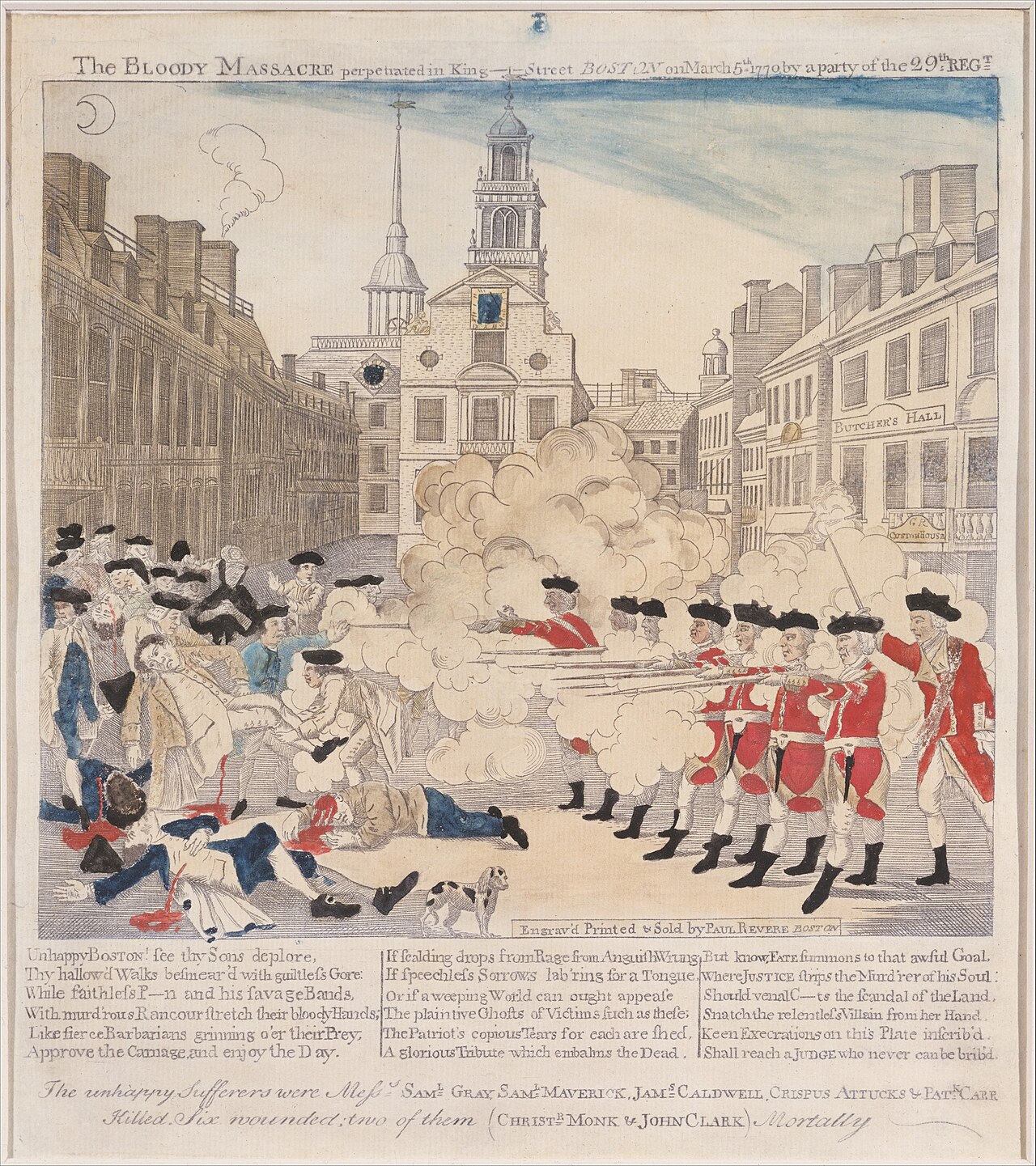
The “Boston Massacre” and the Expanding Hostility for British Forces
The growing, citywide tensions led eventually to the “Boston Massacre” on March 5, 1770. Groups of boys and young men were taunting British soldiers near the Customs House and along streets outside the army barracks, when (according to eyewitness reports), someone in the crowd yelled his protest: “We did not send for you,” he shouted. “We won’t have you here. We’ll get rid of you or drive you away.”
A British officer responded to the expanding confrontation by dispatching a well-armed patrol to protect an isolated sentry at the Customs House, but one of the soldiers was knocked to the ground and military discipline collapsed. Confused by the shouts of the crowd, the clanging of church bells, and the chaotic scuffle around their fallen comrade, angry British soldiers suddenly fired musket shots that killed three people and mortally wounded two others.
Anti-British rage soon forced the governor to withdraw Britain’s regiments to a harbor island and to allow a trial in which two soldiers were found guilty of manslaughter (but lightly punished). Although the military withdrawal temporarily reduced the anti-British anger, political activists sent emotionally charged images of the “Boston Massacre” to other cities and continued to organize militant protests that culminated in the destruction of imported tea on ships in the Boston harbor.
The British reacted to this mounting resistance by passing the “Coercive Acts,” which closed the Boston port, consolidated all political power in the British-controlled governor’s office, and brought British troops back into Boston to repress what one of the king’s supporters called “the most ignorant,” and “despicable characters in creation.”
The permanent placement of British troops in an American city angered political leaders far beyond New England and led to the convening of a first Continental Congress in 1774. The members of this new Congress launched a wider national movement by supporting Boston’s resistance to Britain’s military occupation and proclaiming that the placement of soldiers in a colonial city “without the consent of the legislature of that colony… is against the law.”
This anti-occupation theme would later reappear in forceful clauses of the Declaration of Independence that condemned the king’s “quartering” of armed troops without legislative assent.
Even the sober-minded George Washington responded to the closing of Boston’s port, the military occupation of the city, and the demise of urban commerce with a strong affirmation that “the cause of Boston… now is and ever will be considered the cause of America.”
Bostonians thus made painful sacrifices to resist the British military occupation of their city, but their long political struggle (culminating in the bloody battle of Bunker Hill) eventually forced the British army to withdraw from all of Massachusetts in 1776.
No Kings, No Massacres, and “America 250” in Minneapolis
The present-day opposition to outside armed forces in American cities thus connects contemporary anti-ICE activists with the anti-British activists in eighteenth-century Boston. Despite the always-significant differences in earlier conflicts and historical contexts, the defiant protestors who resisted British troops in eighteenth-century Boston would likely recognize latter-day allies among the anti-Bovino whistle-blowers in twenty-first century Minneapolis.
The unbreakable, historical thread that connects past and present acts of resistance can be found in a question that Sameul Adams posed for endangered Bostonians as they watched British troops occupy their city in 1768. “Will the spirits of the people,” he asked in a local newspaper, “…submit to be governed by the military force?” And the courageous answer for those who remained “unawed by the menace of arbitrary power” would surely be “no.”
A new resistance to “arbitrary power” is now spreading across the United States as America celebrates the 250th anniversary of its Declaration of Independence and as the defenders of “unalienable rights” honor the actions and sacrifices of Renee Good and Alex Pretti.
Although everyone defines the meanings of public action in their own ways, Bruce Springsteen has offered helpful, clarifying words in his newest song about current moral choices in the USA: “We’ll take our stand for this land/and the stranger in our midst…. We’ll remember the names of those who died/on the streets of Minneapolis.”
The conflicts in Minnesota may be replicating some of the struggles and deaths in eighteenth-century Boston, but they are also reaffirming the power of human freedom, human rights, and America’s enduring declaration that all people “are created equal.”

Photo via Lindsay Metivier
Lloyd Kramer is a professor emeritus of History at UNC, Chapel Hill, who believes the humanities provide essential knowledge for both personal and public lives. His most recent book is titled “Traveling to Unknown Places: Nineteenth-Century Journeys Toward French and American Selfhood,” but his historical interest in cross-cultural exchanges also shaped earlier books such as “Nationalism In Europe and America: Politics, Cultures, and Identities Since 1775” and “Lafayette in Two Worlds: Public Cultures and Personal Identities in an Age of Revolutions.”


