
Often attributed to Mark Twain — perhaps mistakenly, since no historical source shows he actually made the statement — “History doesn’t repeat itself, but it often rhymes” is a common and apt refrain when discussing the connection between historical perspectives and current events. By drawing on knowledge of what happened in the past, and why, we are better able to understand the flow and direction of the history collectively created in each new day.
“Past Rhymes With Present Times” is a series by Lloyd S. Kramer exploring historical context and frameworks, and how the foundations of the past affect the building of the future.
No Kings Days Then and Now: From Yorktown to Pittsboro
Americans have begun celebrating the 250th anniversary of the revolutionary war that freed our nation from Britain’s monarchy and eighteenth-century empire.
This historic struggle for national freedom will be remembered across the United States over the coming six years, but America’s founding ideals have already been celebrated in the vast gatherings of more than 7 million protestors on “No Kings Day” in October. These impressive rallies brought together far more anti-monarchical Americans than lived in all the 13 British colonies that declared their national independence in 1776 (about 2.5 million people, including the 20% who were enslaved).
Although history never exactly repeats itself, there was a striking convergence of October events in 2025 because the recent No Kings rallies coincided with the “Victory Day” ceremonies that take place every year in Yorktown, Virginia to celebrate the American-French victory over the British King’s army on October 19, 1781.
The connections between these October events became obvious to me last month as I traveled directly from a large, boisterous No King’s rally at the courthouse plaza in Pittsboro to the commemoration of America’s triumphant No Kings struggle in eighteenth-century Yorktown.
The linked meanings of past and present “No Kings movements” emerged even more clearly, however, after North Carolina’s General Assembly convened later in October to promote the political dominance of an American president who yearns for the power, wealth, spectacles, and palaces of Europe’s most famous kings.
Affirming the self-centered ambitions of this would-be king and speaking like the die-hard Tory legislators who opposed America’s resistance to King George III in 1775, Senator Phil Berger quickly enacted a redistricting plan for North Carolina to expand his party’s Congressional representation and to do “everything we can to protect President [King] Trump’s agenda, which means safeguarding Republican control of Congress.”
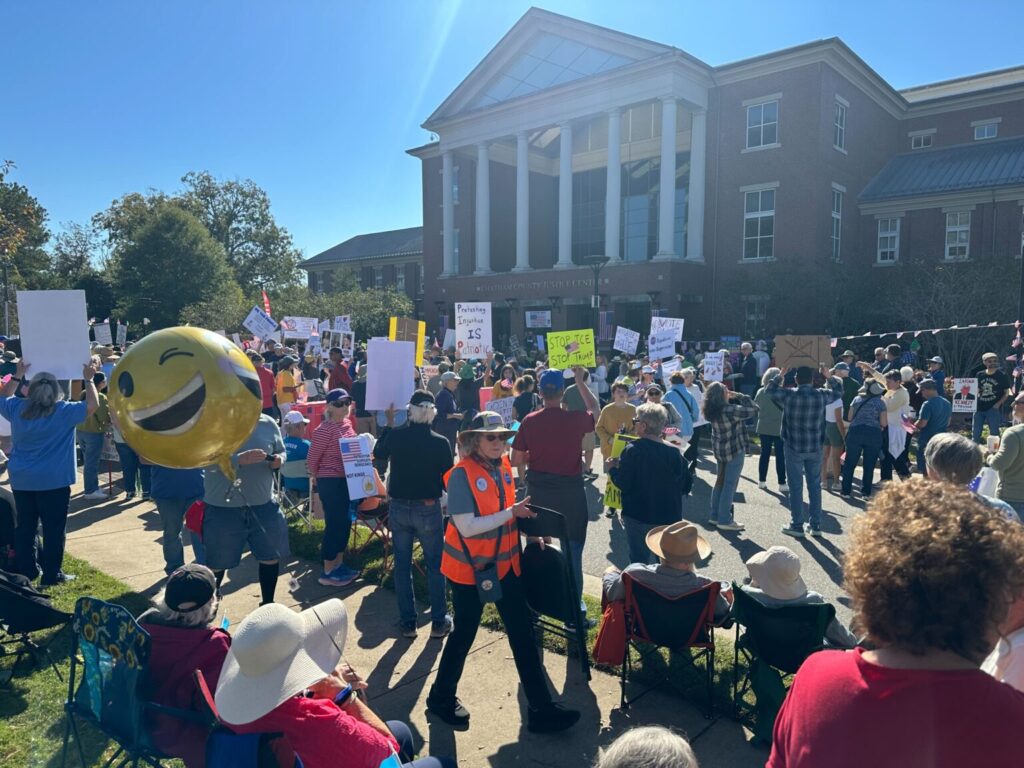
No Kings Rally in Pittsboro, NC, October 18, 2025, Image via Henry Taylor/Chapel Hill Media Group
The “No King” Themes and Legacies of the American Revolution
The annual Victory Day celebrations are usually organized at Yorktown’s National Historical Park, but the federal government shutdown pushed this year’s remembrance to the nearby American Revolution Museum.
Despite this disruption, the commemoration went forward with fife and drum musicians, colorful flags, and well-informed praise for the heroic American and French soldiers who forced the besieged British army to lay down their arms in 1781.
The Jamestown-Yorktown Foundation’s Executive Director, Christy S. Coleman, explained how “diverse peoples” had “helped make America what she is, from the beginning,” and how the multicultural force that defeated the British at Yorktown had advanced the powerful “idea that all men are created equal and endowed by their creator with unalienable rights.”
This revolutionary idea would eventually lead to the abolition of slavery and give later generations what Ms. Coleman called an ongoing “responsibility” to honor the political principles that shaped the Declaration of Independence.
The American-French military victory at Yorktown therefore became a permanently influential political victory for the “No King” theories that guided the complex American campaign for national freedom.
The two most powerful statements of this founding hostility for kings appeared in 1776 when Thomas Paine published his famous pamphlet Common Sense and when the Continental Congress boldly declared that Americans were henceforth “Absolved from all Allegiance to the British Crown.”
Paine famously argued for America’s separation from the British Empire by asserting that the exaltation of a single man violated the “equal rights” of mankind and that “in America THE LAW IS KING. For as in absolute government the king is law, so in free countries the law ought to be king.”
It was therefore simply “common sense,” Paine concluded, to recognize that monarchical systems were “ridiculous,” especially on the American continent where Britain’s king was pursuing his “thirst for arbitrary power.”
Such arguments justified America’s revolutionary war after the Declaration of Independence brought “No Kings” into the national creed that still mobilizes Americans in 2025.
The Declaration’s condemnation of “the present King of Great Britain” introduced a list of specific grievances that demonstrated “a history of repeated injuries and usurpations, all having in direct object the establishment of an absolute Tyranny.”
Violating both the rule of law and the political liberties of the “United States of America,” Britain’s imperial oppression showed the Continental Congress why there should never be a king in self-governing nations. “A Prince whose character is thus marked by every act which may define a Tyrant is unfit to be the ruler of a free people.”
The Declaration of Independence therefore combined broad theoretical claims for human rights with specific complaints about the British monarchy in a “No Kings” message that every American could easily understand.
When the message reached New York City, for example, a militant crowd immediately destroyed a large public statue of King George III, but this destructive attack on the king’s statue also symbolized the wider American attack against his army and governing institutions.
Loyalists and their Critics
The British king’s most loyal American supporters rejected the “No King” arguments of Common Sense and the Declaration of Independence, so America’s anti-British struggle evolved into a brutal civil war. Historians estimate that roughly 20% of the colonial population remained loyalist “Tories”–though the loyalist faction was significantly larger in North Carolina.
Meanwhile, enslaved Black Americans tried to discern which side offered the best opportunities for freedom as they divided between those who fled toward British offers of emancipation and those who participated in the revolutionary movement because they believed that military service would free them from slavery.
The various Iroquois nations also sought to defend their own interests by joining with allies who offered different kinds of support. Oneida and Tuscarora fighters thus served with the American patriot side, whereas Mohawk and Cayuga leaders formed alliances with the British.
This was the divisive, polarizing context in which Thomas Paine published a series of polemical pamphlets with the collective title of The American Crisis. Recognizing that the revolutionary struggle seemed hopeless to many “sunshine patriots” by the winter of 1776-77, Paine conceded that “these are the times that try men’s souls” while also insisting that posterity would long remember those who continued to resist the king.
“Let it be told to the future world,” Paine urged in his call for steadfast action against the king, “… when nothing but hope and virtue could survive, that the city and the country, alarmed at one common danger, came forth to meet and to repulse it.”
He nevertheless understood that loyalists in every colony defended the king because they believed that the British Empire and a strong king would best serve their own economic or political interests.
Although Paine condemned these beliefs as examples of the “servile, slavish, self-interested fear” that created the “foundation of Toryism,” neither his pamphlets nor Washington’s strategic military actions could expel the British and their “servile” American supporters from New York and other port cities before the victory at Yorktown. This decisive battle thus opened a diplomatic pathway to recognition of the United States as an independent republic.
The Marquis de Lafayette, whose small American army harassed British troops across southern Virginia throughout 1781 and whose Continental division held the strong right flank at Yorktown, summarized the new revolutionary optimism after General Cornwallis surrendered.
“The play is over…,” Lafayette wrote to a friend, “[and] the fifth act has just ended. I was a bit uneasy during the first acts, but my heart keenly enjoyed the last one.” The king’s army had lost, which meant that a new self-governing political system could finally emerge and flourish. We now know, however, that another aspiring king has attracted loyalist supporters in our own time, and another volatile “act” is still developing in the endless play of American history.
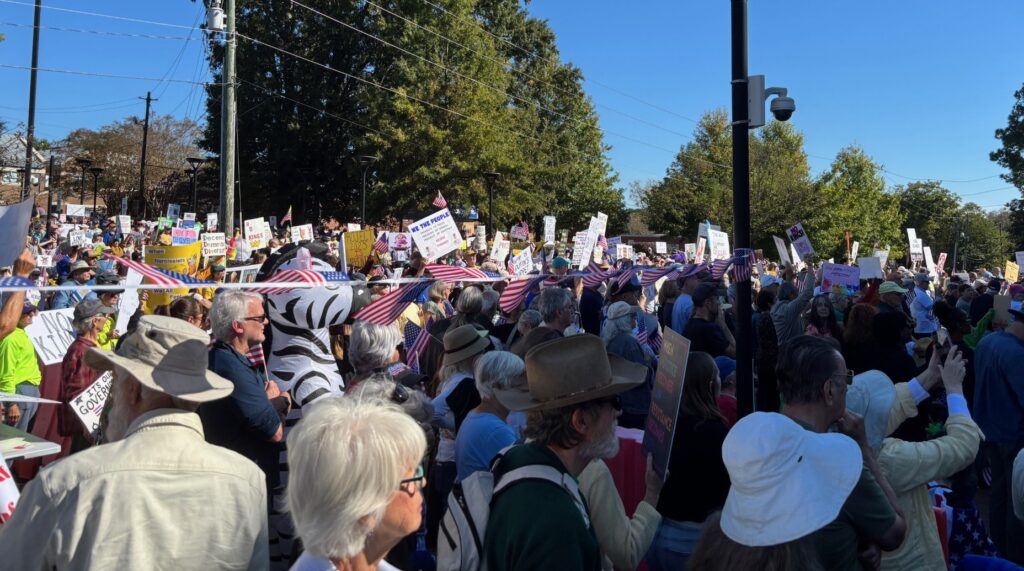
No Kings Rally in Pittsboro, NC, October 18, 2025, Image via Lloyd Kramer
America’s National Identity and the Resistance to Kings
America’s enduring resistance to monarchical leaders connects the ideas and actions of Paine, Lafayette, and the signers of the Declaration of Independence to the anti-king demonstrations in our own time. The historical journey from Yorktown’s battlefield in 1781 to the protest at the Pittsboro courthouse in 2025 has made countless twists and turns, but similar political values have sustained American travelers during every era of this winding public trek.
We can only imagine how those who defeated the king’s forces at Yorktown might respond if they heard the current Speaker of the US House of Representatives condemn today’s No Kings protests as “Hate America” rallies. Or how would they answer a North Carolina Congressman who ignores the meaning of the American Revolution in his complaints about anti-king protestors “hating America so much” that they “skip college football on a fall Saturday?” (Nobody stopped fighting the king to attend football games in October 1781!)
Finally, what might happen if NC Senator Ralph Hise could somehow make a “time travel” visit to eighteenth-century Philadelphia? Would he proudly announce to the Continental Congress that a future president who is replacing the east wing of the White House with a gold-encrusted, royal ballroom “has called on Republican-controlled states” to devise voting plans to ensure his continuing control of Congress and that Hise himself has implemented a congressional redistricting which “answers that call?”
Americans launched a No Kings movement in 1776 to establish self-governing institutions and to defend their human rights against an overbearing British king. We therefore celebrate the 250th anniversary of those events whenever we reaffirm America’s earliest, most valuable political ideals by resisting the monarchical contempt for democratic rights and by challenging the loyalist legislators who accept all their narcissistic king’s demands.

Photo via Lindsay Metivier
Lloyd Kramer is a professor emeritus of History at UNC, Chapel Hill, who believes the humanities provide essential knowledge for both personal and public lives. His most recent book is titled “Traveling to Unknown Places: Nineteenth-Century Journeys Toward French and American Selfhood,” but his historical interest in cross-cultural exchanges also shaped earlier books such as “Nationalism In Europe and America: Politics, Cultures, and Identities Since 1775” and “Lafayette in Two Worlds: Public Cultures and Personal Identities in an Age of Revolutions.”

