

Amelia Riggs stopped by Live & Local last week, following the release of her new album “Creature.”
Listen to the album and purchase it on Bandcamp.
Riggs (née Al) has been a major figure in the Triangle’s music scene for a decade – but this is her first album as Amelia, after coming out as transgender four years ago. Until this summer, she’d been releasing music as Riggings – including 2024’s “Egg,” which along with “Creature” are the first two parts of a planned trilogy.
But the inspiration for “Creature” struck first.
“The album took a couple of years to write and a couple of years to record,” Riggs says. “This one was inspired by this amazing essay by Susan Stryker, ‘My Words to Victor Frankenstein Above the Village of Chamounix,’ about the reclamation of trans rage and the reclamation of rage as fuel and rage as rebirth…
“I read it all in one night, and I emailed her the next day: ‘Hey, I want to make an album inspired by this thing. Do I have your permission to do this?’ And within a few days I get an email back that said ‘yeah, go for it – just give me a copy when it’s done.’”
Stryker is a major figure in transgender theory and activism, and “My Words,” written in 1993, is a seminal work of trans thought. In it, Stryker identifies with Frankenstein’s monster, “torn apart and sewn together again,” viewed as unnatural and therefore horrifying, hounded, ostracized, and filled with rage at being hounded and ostracized. But rather than wanting to be seen as normal, Stryker chooses to embrace her own Other-ness, to reclaim the words ‘creature’ and ‘monster’ not as slurs or insults but as points of pride. (A “creature,” she points out, is simply a “created being,” while the word “monster” derives from a Latin word meaning “divine portent,” a “messenger and herald of the extraordinary.”) And rage itself, far from being negative, can serve as fuel, “the force that moves me,” the “enlivening power of darkness” that enables Stryker to assert herself as herself, against a world that seeks to exclude and impose and suppress.
Click here to read Stryker’s essay.
In “Creature,” Riggs uses Stryker’s insight as a starting point for her own story. Her speakers proudly declare themselves a “miracle of modern medicine,” emerge, fully formed for the first time, with a sense of confusion and wonder (“How am I walking? How does this spine work? How does my heart pump now?”), seek and find the human connection that Frankenstein’s creature never could (“You draw me beautiful – so much I think it’s true”), and finally embrace their own lives and truths amongst a herd that wants to shut it down. (“Given that I’m upright, given that I’m here…why does it matter how I’m walking around? I’m just happy to be out in the sun.”) The process is bloody, violent, and angry, but also positive and affirming – not in spite of the blood and the violence and the rage, but alongside them and because of them.
Follow Amelia Riggs on Instagram.
“I love being trans,” Riggs says. “It’s the greatest thing to have happened to me, finding out that this is who I am and this is how my body works. It has given me much more autonomy over my body. It’s given me much more autonomy over my brain. And it’s allowed me to meet so many wonderful people…
“(But) they’re coming for trans people, so rage helps,” she adds. “Rage helps so much.… It’s so interesting when people who presumably are on your side are like, ‘well, you shouldn’t be so outspoken, you shouldn’t be angry. It’s not good decorum.’ And my response to that is: they hate us anyway. They hate us anyway, and they want us to die. What good is trying to be nice to people who have a knife to our throat? If they already have a knife to our throat, you might as well grab the knife with your teeth and use it on them.”
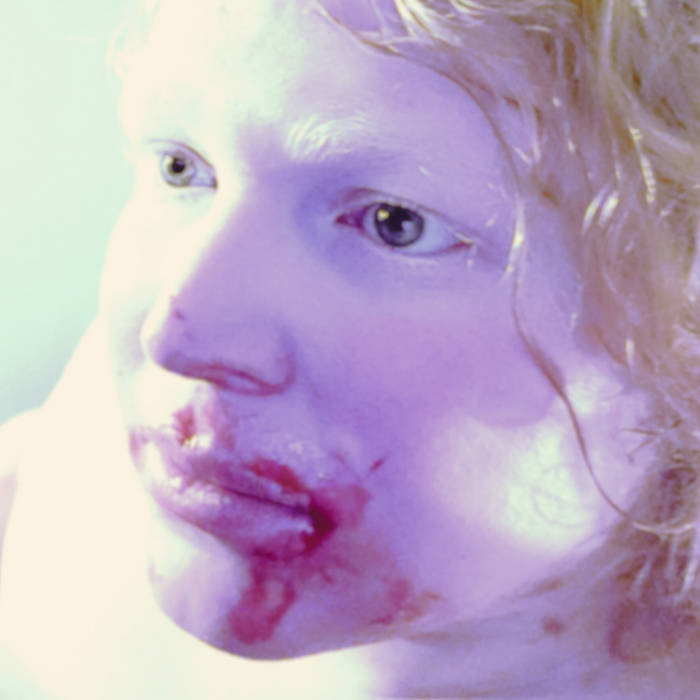
The cover of Amelia Riggs’ “Creature.”
Riggs brings those powerful lyrics to life with her signature sound – dissonant yet soothing, atonal yet melodic, fuzzy yet clear – and an assist from poet Gion Davis and actress Athena Sadler, who read portions of Stryker’s essay along the way. And Stryker’s not the only author whose work gets checked: Riggs also cites Gretchen Felker-Martin’s cathartically bloody genderfluid horror novel “Black Flame” as well as Vladimir Nabokov’s classic “Pale Fire” – which, like “Frankenstein,” features a central character who’s driven by a mad desire to impose his own phony worldviews on the lives of others.
Eviscerating that phoniness – no matter what it takes – is at the heart of what “Creature” is about.
“I feel like there are a lot of people who, for either very good or very evil reasons, feel like the goal is assimilation, to be seen as ‘normal,’” Riggs says. “(But) tearing away the parts of yourself that make you you, in order to make yourself more pleasing to look at, pleasing to talk to – it’s wrapped up in a lot of self-loathing. So I choose not to assimilate. And that’s okay. You don’t have to. You can live your life and do your best to surround yourself with people who don’t care what you look like, how you talk, how you think, how you feel. You can surround yourself with empathetic, kind, good people. You should do that…
“People have a problem with sincerity…but there is still time. You can do whatever you want with your body and figure out what works for you.”
Amelia Riggs is playing live Saturday, December 13, at Perfect Lovers in Durham, starting at 7:30 along with Frank Meadows.

Amelia Riggs stopped by Live & Local to discuss “Creature” and play three songs: “Creature4Creature,” “Talons,” and a cover of Geese’s “Taxes.” Listen:
Podcast: Play in new window | Download
Subscribe: RSS

