
Three Things To Know About Coach Michael Malone at UNC
By David Glenn
Here are three things to know about new North Carolina coach Michael Malone and the search that ultimately led to his official hiring on Tuesday:
1. In at least two ways, Malone’s résumé and compensation immediately put him in the midst of exclusive coaching company.
Looking ahead to the 2026-27 college basketball season, barring any spring or summer surprises, there will be only eight active head coaches who have won at least one NCAA championship: UConn’s Dan Hurley (two), St. John’s Rick Pitino (two), Kansas’ Bill Self (two), Arkansas’ John Calipari, Baylor’s Scott Drew, Florida’s Todd Golden, Michigan State’s Tom Izzo and Michigan’s Dusty May.
Malone, meanwhile, will be the only college head coach who already has an NBA title on his résumé. Just three years ago, he led the Denver Nuggets to the first championship in franchise history, in the midst of an impressive streak during which he produced seven consecutive playoff teams.
The only person ever to win both an NBA championship and an NCAA championship as a head coach is a member of the world-famous Carolina Basketball Family. Larry Brown, who played for and coached under Dean Smith in the 1960s, led the Kansas Jayhawks to the college title in 1988 and the Detroit Pistons to the top of the professional basketball world in 2004.
Interestingly, Malone already has a bunch of things in common with Brown, and UNC clearly believes that its new coach also can — at some point — join Brown in the NBA/NCAA double championship club.
Those are the expectations that come with a six-year, $50 million contract. During the recently completed 2025-26 season, Self was the only college coach who made more (before bonuses) than the $8 million-plus average annual compensation that Malone is scheduled to make with the Tar Heels.
2. Hiring a head coach away from another Power Five program is extremely difficult, even if you’re offering a top-five job, and Carolina officials were reminded of that axiom the hard way.
The Atlantic Coast Conference has been one of the top five leagues in college basketball for a large majority of its 73-year history.
Nevertheless, even the ACC’s top men’s basketball programs rarely have been able to simply poach a sitting head coach from another power conference. The overwhelming majority of the time, the “new guys” end up being either long-time, high-level assistant coaches or successful head coaches from lower rungs in the Division One ladder.
For example, among the ACC’s current 18 member schools, only two — Notre Dame and SMU — hired their current head coaches away from other Power Five programs, and both of those situations involved some unusual circumstances.
Micah Shrewsberry had a successful two-year tenure at Penn State, in the Big Ten, prior to jumping to the Fighting Irish in 2023. Penn State, of course, is not only far more famous for football, its basketball program (only one Sweet 16 since 1955) has virtually no historical significance.
(UNC’s top college targets, on the other hand, were Arizona’s Tommy Lloyd and Michigan’s Dusty May. Both the Wildcats and the Wolverines have long, proud traditions in men’s basketball, and it didn’t help the Tar Heels’ cause — or their timetable — when both coaches made the Final Four this year.)
SMU’s Andy Enfield, meanwhile, had mutually agreed with Southern Cal that a separation, after 11 seasons together, would benefit both parties. The Trojans were on their way to the Big Ten, the Mustangs were on their way to the ACC, and Enfield was coming off an extremely disappointing 15-18 campaign that had much of the USC fanbase in an uproar.
(Again, such details didn’t apply to UNC’s targets. May all along seemed perfectly happy at Michigan, even before the Wolverines captured the NCAA title. Lloyd had some problems with his athletic director at Arizona, which provided a temporary opening for UNC, but those matters were resolved by the Wildcats’ administration in short order.)
Meanwhile, six ACC schools (Boston College, Duke, Florida State, Miami, NC State, Pitt) found their current head coach in the high-level assistant coaching ranks.
BC’s Luke Murray had been an assistant to Hurley at UConn, in the Big East. Duke’s Jon Scheyer, a former player for the Blue Devils, was promoted from Mike Krzyzewski’s staff. FSU’s Luke Loucks, a former player for the Seminoles, had been an assistant in the NBA. Miami’s Jai Lucas came directly from Scheyer’s staff at Duke. NC State’s Justin Gainey, a former Wolfpack player, had been working for Rick Barnes at Tennessee, in the Southeastern Conference. Pitt’s Jeff Capel III, a former head coach at VCU and Oklahoma, spent seven straight years working under Coach K at Duke before his hiring by the Panthers.
The other nine ACC programs plucked their current guy from a so-called low-major or mid-major program, meaning outside the Power Five: College of Charleston (Louisville’s Pat Kelsey), East Tennessee State (Wake Forest’s Steve Forbes), Siena (Syracuse’s Gerry McNamara), Troy (Georgia Tech’s Scott Cross), Utah Valley (Cal’s Mark Madsen), VCU (Virginia’s Ryan Odom), Washington State (Stanford’s Kyle Smith), Wofford (Virginia Tech’s Mike Young) and Wright State (Clemson’s Brad Brownell).
As representatives of one of the top brands in college basketball, UNC officials ultimately believed they would have received a “yes” from several other sitting Power Five coaches, perhaps Iowa’s Ben McCollum (Big Ten) or Vanderbilt’s Mark Byington (SEC), but the more they talked with Malone, the more they believed he was an even better fit for the job.
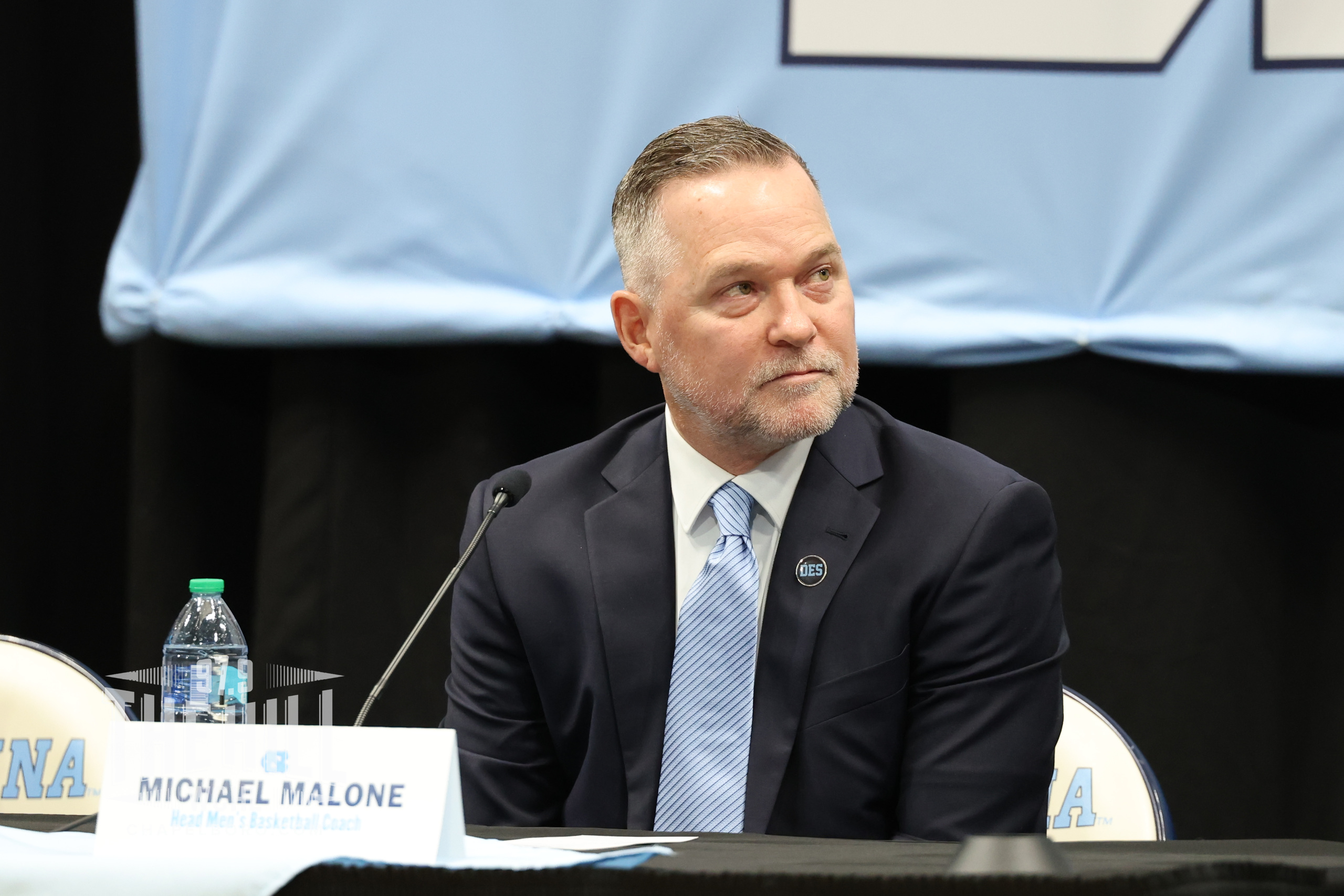
UNC men’s basketball coach Michael Malone listens to a speaker during his introductory press conference. (Photo by Todd Melet/Chapel Hill Media Group.)
3. UNC did not include terms in Malone’s contract that would make it expensive, relatively speaking, if he wanted to leave for another job in a few years.
During UNC’s pursuit of Lloyd and May, and amidst their due-diligence research on a half-dozen other potential candidates, university officials quickly realized that many top college basketball coaches have buyout clauses ranging from $10-$16 million.
Such huge numbers can be a powerful deterrent to potential suitors in today’s marketplace.
Keep in mind: It’s often expensive to pay the buyout of the coach you just fired (e.g., $5 million-plus for Hubert Davis), and there are often additional staff members who (collectively) get millions more in buyout money as going-away presents, too. If, on top of those expenditures, you also have to pay $10-$16 million to help your new coach get out of his previous contract, you can start running low on the resources you need to pay and support the incoming staff.
It would take something truly shocking and extraordinary for either side of the Malone-UNC union to “want out” at any point in the next two years, but looking only that far (two years) down the road, Malone’s contract would require him to pay only $5 million if he wanted to leave for another job in April 2028. That number drops to $3.5 million in less than three years (see below), then a paltry $2 million in four years, then only $500,000 starting in April 2031.
Compared to many of the buyout numbers UNC encountered with other top candidates, such contract terms are extremely favorable to the coach and not very protective at all from the university’s perspective. No NBA team or elite Power Five conference program is going to be scared off by a $2 million or even $5 million buyout.
Malone Buyout Details
(What He’d Owe UNC If He Left Voluntarily)
Now – March 31, 2027: $8 million
April 1, 2027 – March 31, 2028: $6.5 million
April 1, 2028 – March 31, 2029: $5 million
April 1, 2029 – March 31, 2030: $3.5 million
April 1, 2030 – March 31, 2031: $2 million
April 1, 2031 – March 31, 2032: $500,000
On/After April 1, 2032: $0
Nobody wants to talk about such things after a new coaching hire, especially amidst a celebratory press conference and feel-good Carolina Family vibes, but such things could end up mattering a lot just a couple years down the road.
 David Glenn (DavidGlennShow.com, @DavidGlennShow) is an award-winning author, broadcaster, editor, entrepreneur, publisher, speaker, writer and university lecturer (now at UNC Wilmington) who has covered sports in North Carolina since 1987.
Chapelboro.com does not charge subscription fees, and you can directly support our efforts in local journalism here. Want more of what you see on Chapelboro? Let us bring free local news and community information to you by signing up for our newsletter.