
Artificial intelligence is a powerful new technology that comes with a lot of challenges and possible pitfalls — but scholars say if it is used in the right way, it can also enable lifechanging and lifesaving breakthroughs that would not have been possible just a couple years ago.
On campus, researchers at the UNC School of Medicine are trying to facilitate those breakthroughs with a new program they are calling the SHIRE.
“We knew we needed a way to enable UNC researchers to make use of the massive amount of clinical information that we have available, in a very secure and patient privacy-protecting way,” says Emily Pfaff, the co-director of Informatics and Data Science at the UNC School of Medicine.
SHIRE stands for Secure Health Informatics Research Environment. Pfaff says it gives medical researchers a way to sift through mountains of data that previously would have been very hard to access and analyze.
“We can look through databases and try to find patients with rare diseases based on little clues that we can find in the data,” Pfaff says. “But when something’s truly rare, the only place (to find) the information is in the clinical notes that are taken during a doctor’s visit — and until the advent of large language models, it really was pretty difficult to get that data out of that text.”
Click here for more on the SHIRE.
But that text includes a lot of personal information about patients — so feeding it through the standard public AI programs would have created massive privacy violations.
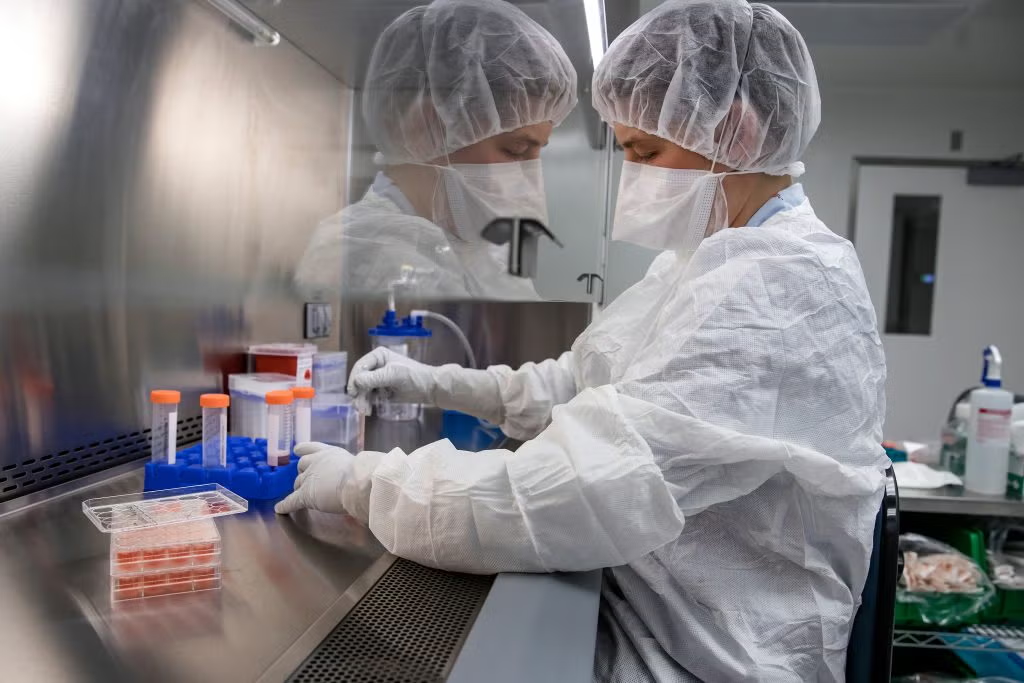
“That’s why we built the SHIRE,” Pfaff says. “We wanted an environment that had high-grade security and lots of really good governance rules, to make sure that when a researcher is working inside that environment, all the data stays inside that environment.”

Emily Pfaff (right) and UNC Vice Chancellor for Research Penny Gordon-Larsen (center) visited with 97.9 The Hill’s Aaron Keck (left) in April for an interview. (Photo by Aaron Keck/Chapel Hill Media Group.)
UNC unveiled the SHIRE publicly last week, but it’s been up and running for a while in a pilot program, and Pfaff says it has already been used in 26 different research studies.
“A great example is a cancer study where the researchers are using (AI) tools to extract information about cancer patients that normally takes a human reviewer hours, months, years to extract on their own,” she says. “You can imagine how long it takes a human to read through very lengthy medical charts, and UNC Health has millions of patients across the state of North Carolina. There’s just no way that a human would be able to consume and use all that information for research — (but) after using the SHIRE, the study team was able to pull a ton of information that would have been otherwise inaccessible.”
And because of that capability, Pfaff says the new tool could make a huge difference in medical treatment, in a wide variety of ways.
“If you identify cancer patients early enough in their trajectory, you may be able to match them with a clinical trial a lot sooner, and clinical trials in cancer can be lifesaving,” she says. “Additionally, there’s a lot of work that needs to be done at a population level with cancer. Let’s say you have a pocket of patients (with) a cancer outbreak that was not expected: these AI tools can enable us to find those pockets quicker, which means that we can do more research into what’s going on there.”
Featured photo via Johnny Andrews/UNC-Chapel Hill.
Chapelboro.com does not charge subscription fees, and you can directly support our efforts in local journalism here. Want more of what you see on Chapelboro? Let us bring free local news and community information to you by signing up for our newsletter.