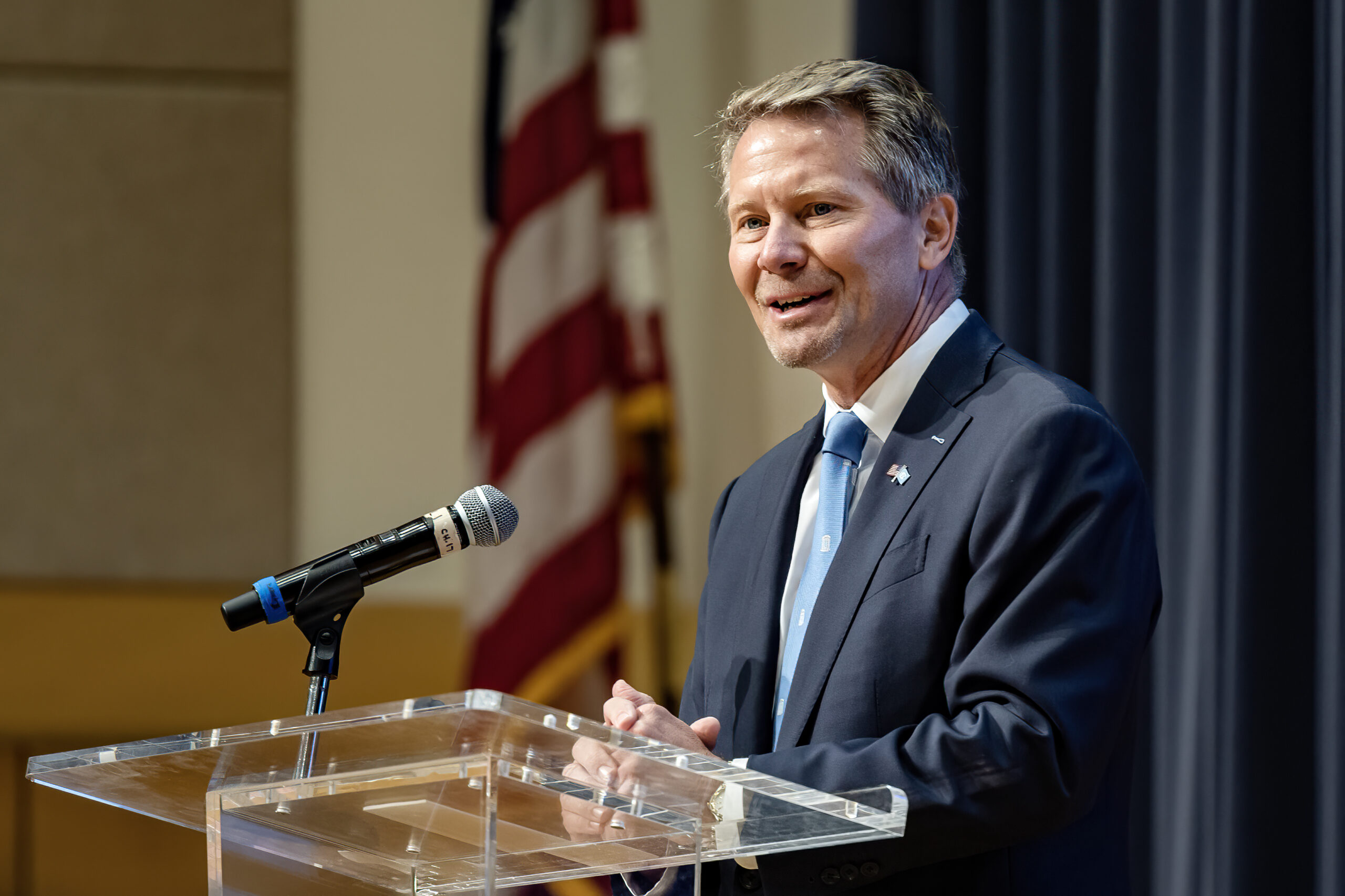
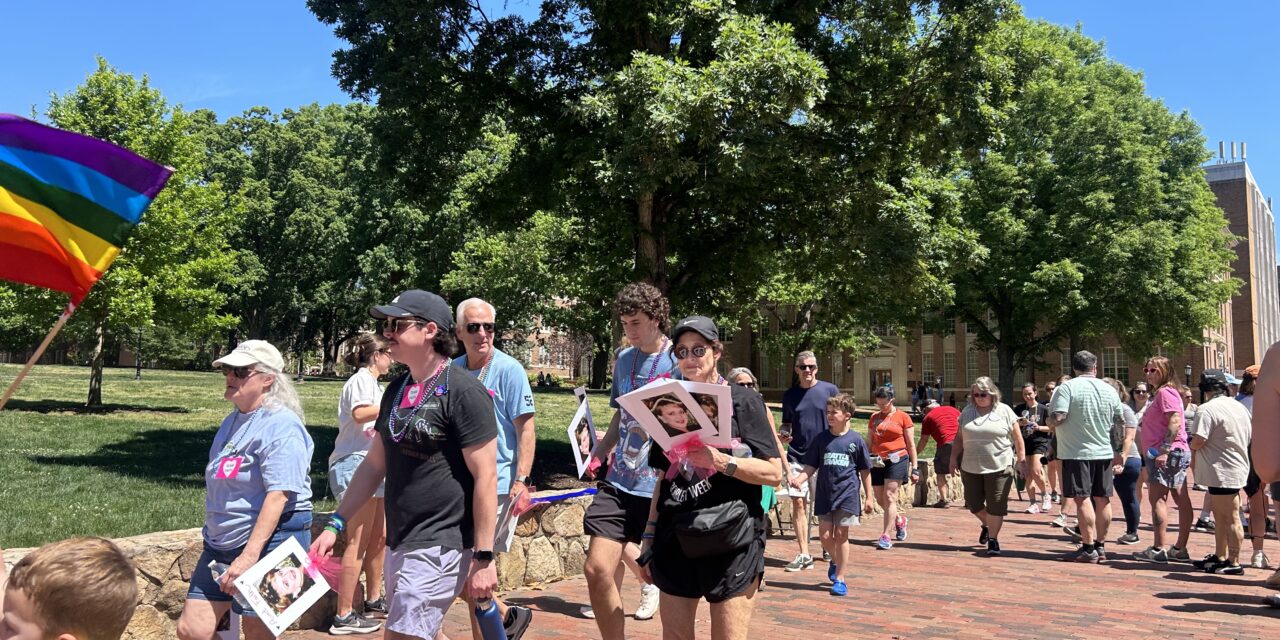
On Saturday, community members and college students alike met on UNC’s campus for a mile-long walk to destigmatize suicide prevention. The event was not only a way to raise necessary funds to help expand local advocacy efforts, but it created a place for those impacted by suicide to connect and heal.
UNC’s annual Out of the Darkness Walk took place on April 18 outside Wilson Library, inviting those with lived experience, people who have lost someone to suicide, and anyone passionate about mental health advocacy to travel the loop by academic buildings and Franklin Street.
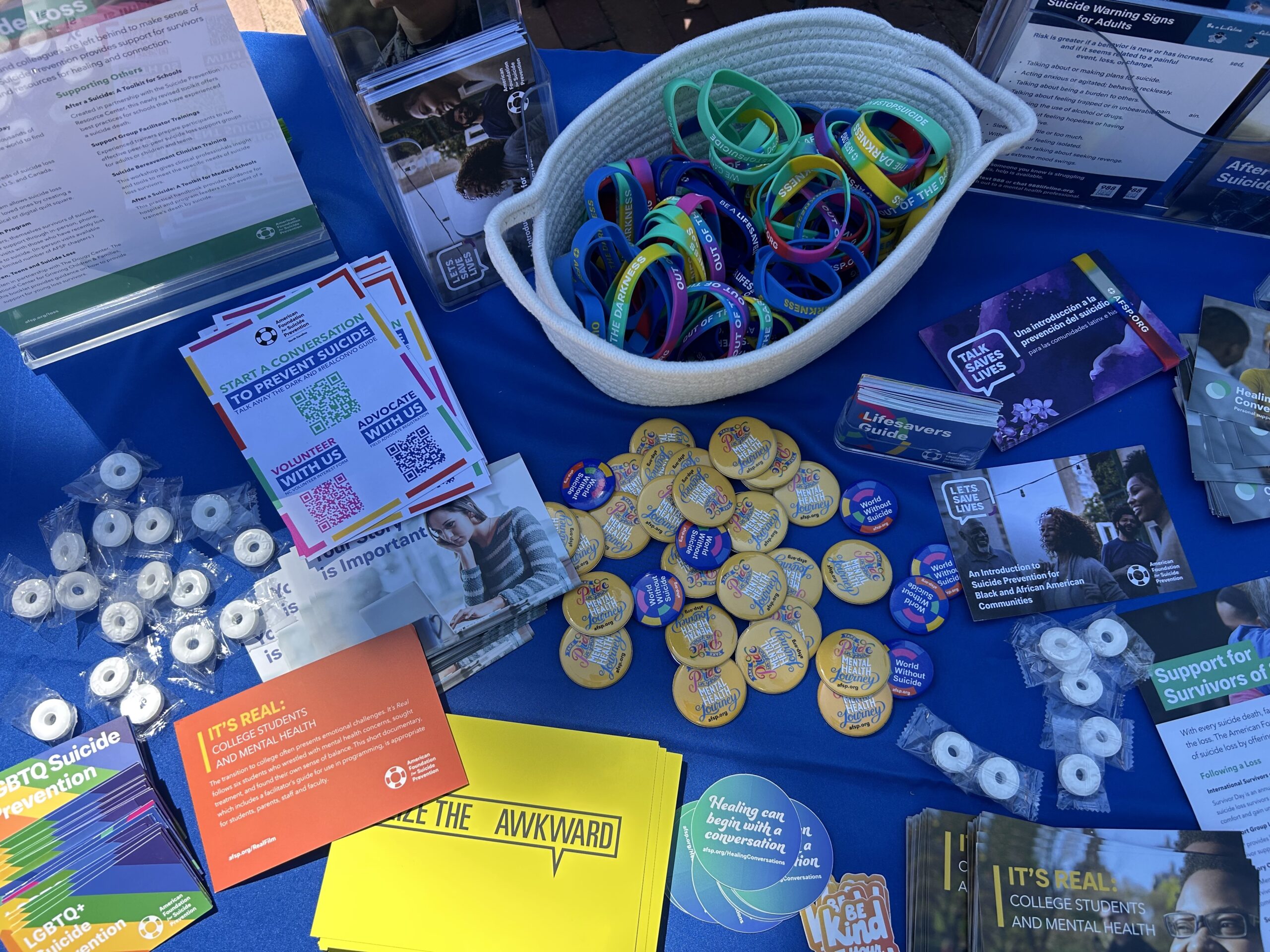
With many wearing t-shirts and buttons donning the names and photos of loved ones, attendees mingled to share stories, write messages of hope on a community board, and learn about campus and community resources from groups like UNC Suicide Prevention Institute, UNC Family Medicine, Orange County’s health and human services team, and the LGBTQ Center of Durham.
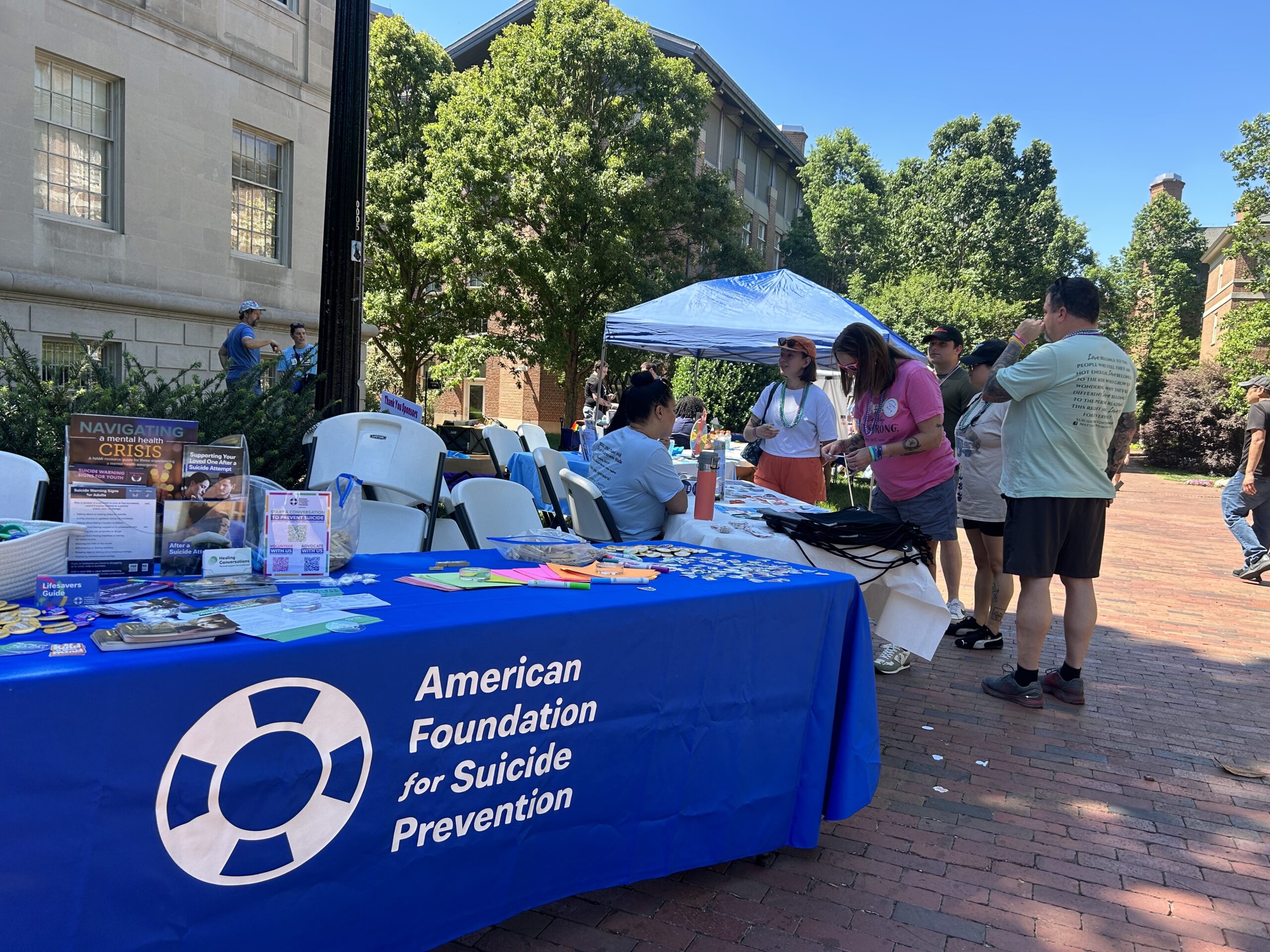
The Out of the Darkness Walk at Polk Place shared mental health resources from organizations like UNC Suicide Prevention Institute, UNC Family Medicine, NAMI Orange County, and The Scrap Exchange. (Photo by Emma Cooke/Chapel Hill Media Group.)
Suicide is the third leading cause of death among those ages 15-24, and event chair Mattie Ellis said the walk helps bring together Carolina’s mental health “ecosystem” in a way that is actually tangible.
“I think a lot of the research that’s done at UNC is not always accessible to the larger student body,” the graduate student said. “And so for walks like this, where we’re inviting faculty, students, community members, it’s a really great way for people to learn about what’s happening sometimes behind the scenes at UNC.”
In partnership with Third Wave Psychotherapy, Chapel Hill Tire, and Prudent Growth, the local Out of the Darkness walk is just one of many hosted each spring at college campuses across the country. It is one of the American Foundation for Suicide Prevention’s primary fundraising initiatives, helping the volunteer organization expand its research, education, and advocacy efforts. An AFSP volunteer, Ellis said the Chapel Hill walk has already raised more than half of its $13,000 goal. The fundraiser will last through the end of the year.
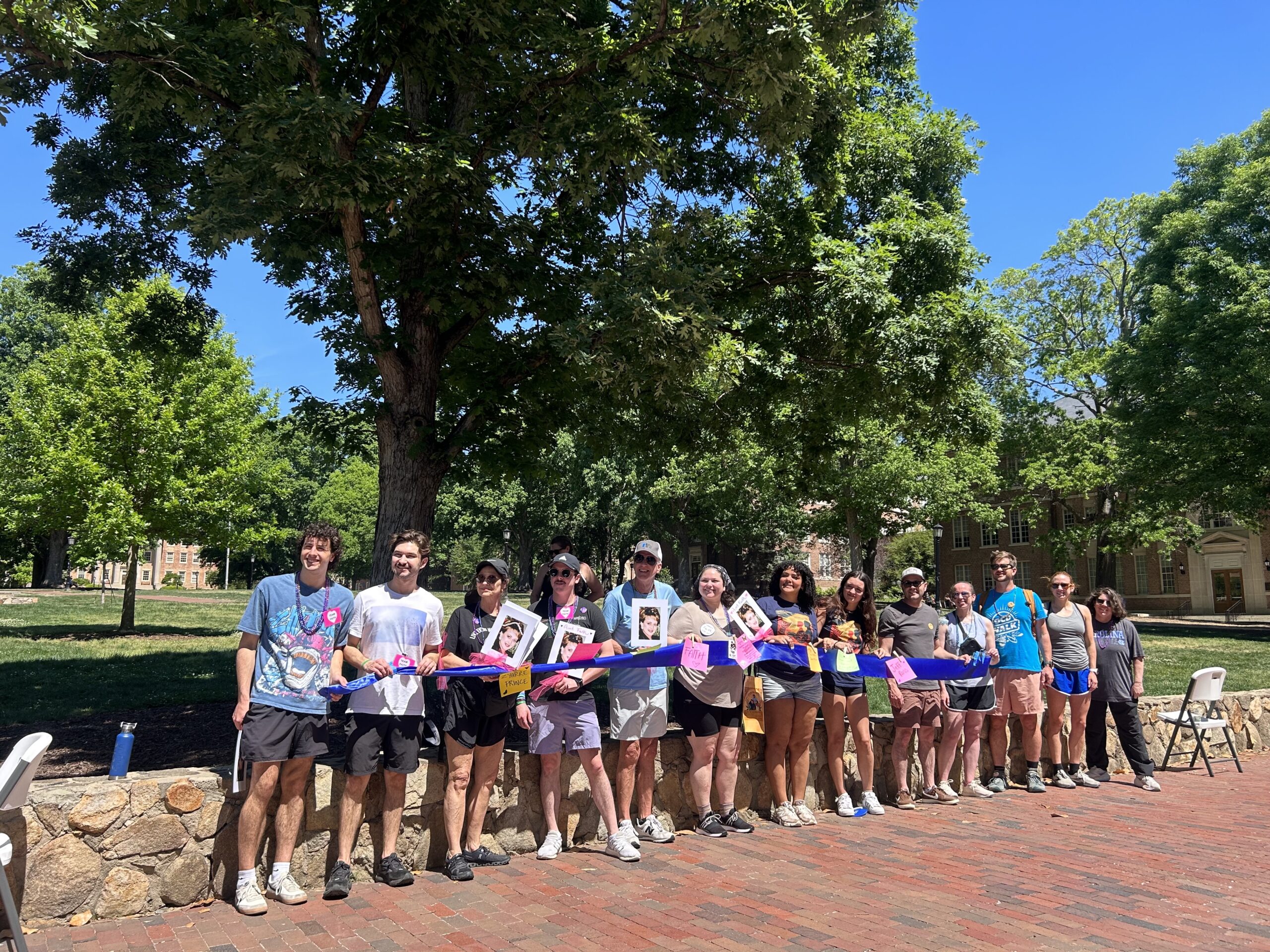
Top fundraisers for UNC’s campus walk. The nationwide campus walks, community walks, and overnight walks take place through the American Foundation for Suicide Prevention. (Photo by Emma Cooke/Chapel Hill Media Group.)
And when you feel like no one understands what you are going through, the campus walks are a space to connect with people who do. Every member of the small crowd wore several strands of colorful beads to show their own connection to the cause, including Peter Brooks who has collected several bundles of beads as a result of attending five of UNC’s suicide prevention walks so far.
“My orange one is for losing my brother, and I also have one for my own attempt,” Brooks said. “For those of us who are in the community, they can look at the bead and go, ‘Oh, okay, well, I’m sorry for your losses. Do you want to talk about it? Or, I’ve had similar losses.’ That’s how folks can reach out and meet each other.”
Among the variety of colors — like gold for the loss of a parent, red for the loss of a spouse, or rainbow beads to honor the LGBTQ+ community — each attendee matched with a dark blue strand in shared support of suicide prevention. Brooks said he attends several walks across North Carolina every year, describing them as a way to both meet new people and get communities involved in the cause.
“I enjoy telling my story,” Brooks said. “It wasn’t easy at first, but hopefully when I tell my story in any kind of forum, somebody will find something in that to try to help themselves out. I’ve leaned on my faith quite a lot. I go to Mount Carmel Baptist Church here in Chapel Hill, and I grew up here. So I know a lot of people [struggle]. My own friends have struggled a lot.”
Every year, the event helps create a safe space for those impacted by suicide. (Photo by Emma Cooke/Chapel Hill Media Group.)
The event even attracted those from outside Orange County. As part of her senior capstone project at Elon University, Sarah Moore said she has visited various campuses, senior centers, and social workers to research what suicide prevention can look like for older adults. She explained how men over the age of 65 have some of the highest suicide rates in the state.
“And a lot of people just don’t know about that,” Moore said. “Or — and what I found through my project — a lot of people don’t care.”
Among that group, Moore said most are in hospice care or have another illness.
“There’s kind of this social thing about like, ‘Oh, out of sight, out of mind, but also they’re going to die anyway,’” Moore said. “And that was just kind of an idea where I saw that, and I [wanted to] challenge that. And I want to look at, ‘Okay, this is something that we know is preventable. We know suicide is preventable,’ and yet, year after year, these rates are rising.”
She described what it is like to see so many communities passionate about the cause.
“Coming here is really powerful, and seeing that everyone cares and everyone is here for a different reason, here for a different person,” Moore said. “That’s really powerful, and also kind of grounds the idea that these aren’t just numbers, these are real people who are going through something so painful that they’re choosing to take their life.”
UNC’s fundraiser for AFSP will remain active through the end of the year. To learn more and donate, click here.
Editor’s Note: If you or someone you know is experiencing a mental health crisis, call the Suicide and Crisis Lifeline at 988 or contact the Crisis Text Line by texting 741-741. The free, private support is available 24/7.
Featured photo by Emma Cooke/Chapel Hill Media Group.
Chapelboro.com does not charge subscription fees, and you can directly support our efforts in local journalism here. Want more of what you see on Chapelboro? Let us bring free local news and community information to you by signing up for our biweekly newsletter.