
To reflect on the year, Chapelboro.com is re-publishing some of the top stories that impacted and defined our community’s experience in 2025. These stories and topics affected Chapel Hill, Carrboro and the rest of our region.
After using it as a key campaign platform in 2024, President Donald Trump pledged his administration would crack down on illegal immigration and conduct mass deportations since taking office at the start of 2025. After strengthening the Immigrations and Customs Enforcement division through massive funding and recruitment, federal operations began to target “dangerous criminals” who are in the country illegally — but the enforcement often included people without criminal records and U.S. citizens. When ICE and Border Patrol agents made their way to North Carolina in November, many in the Orange County community responded by speaking out against the crackdown and voicing their support for immigrant neighbors.
Following coordinated, widespread operations in Los Angeles, Chicago and Portland this summer, the U.S. Department of Homeland Security turned its attention for immigration enforcement toward North Carolina — and, specifically, its two biggest and Democratic-led cities. Named “Operation Charlotte’s Web,” the enforcement action began in Charlotte the weekend of Nov. 15 and saw dozens of people arrested. Before long, the agents began to move east, and Raleigh Mayor Janet Cowell warned residents of their arrival in the Research Triangle on Monday, Nov. 17. For several days, North Carolinians were on edge looking for unmarked cars, agents in camouflage fatigues with tactical vests and weapons.
The Department of Homeland Security reported “Operation Charlotte’s Web” ending in 425 arrests of people —most which happened in the Charlotte area, but dozens reportedly took place around Raleigh and Durham. Those numbers, however, do not reflect how many people in the Triangle or Charlotte were detained or transported to different areas despite being legal citizens, with several news reports and posts on social media showing the aftermath of agents’ mistakes. The scare tactics and disregard of rights drew criticism from many state leaders, including Gov. Josh Stein, who shared a video pointing out some federal agents’ actions being the “exact opposite” of good public safety.
“We’ve seen masked, heavily armed agents in paramilitary garb driving unmarked cars, targeting American citizens based on their skin color, racially profiling, and picking up random people in parking lots and off of our sidewalks,” Stein said on Nov. 16. “This is not making us safer. It’s stoking fear and dividing our community.”
While no arrests were reported in Orange County, the impact of the immigration enforcement operation was clearly felt by community members. Chapel Hill-Carrboro City Schools reported hundreds of students absent on the Tuesday when federal agents began arrests in the Triangle area, representing a steep drop compared to the week prior. Orange County Schools did not publicly share their absentee data, but School Board Member Wendy Padilla told 97.9 The Hill her district saw similar absences and they were largely students from Hispanic families. She said while the numbers slowly improved through the week once ICE’s operation wound down, the fear remained.
“And it’s not only a fear for the Hispanic and immigrant communities, it’s a fear for everyone — including our teachers, other students, our staff,” Padilla said. “And you can still feel it. On Saturday, I went to a Hispanic store and in the back where the butcher is, there were three men just discussing the fear they had [of being detained]. So, [there’s] definitely lots of fear.”
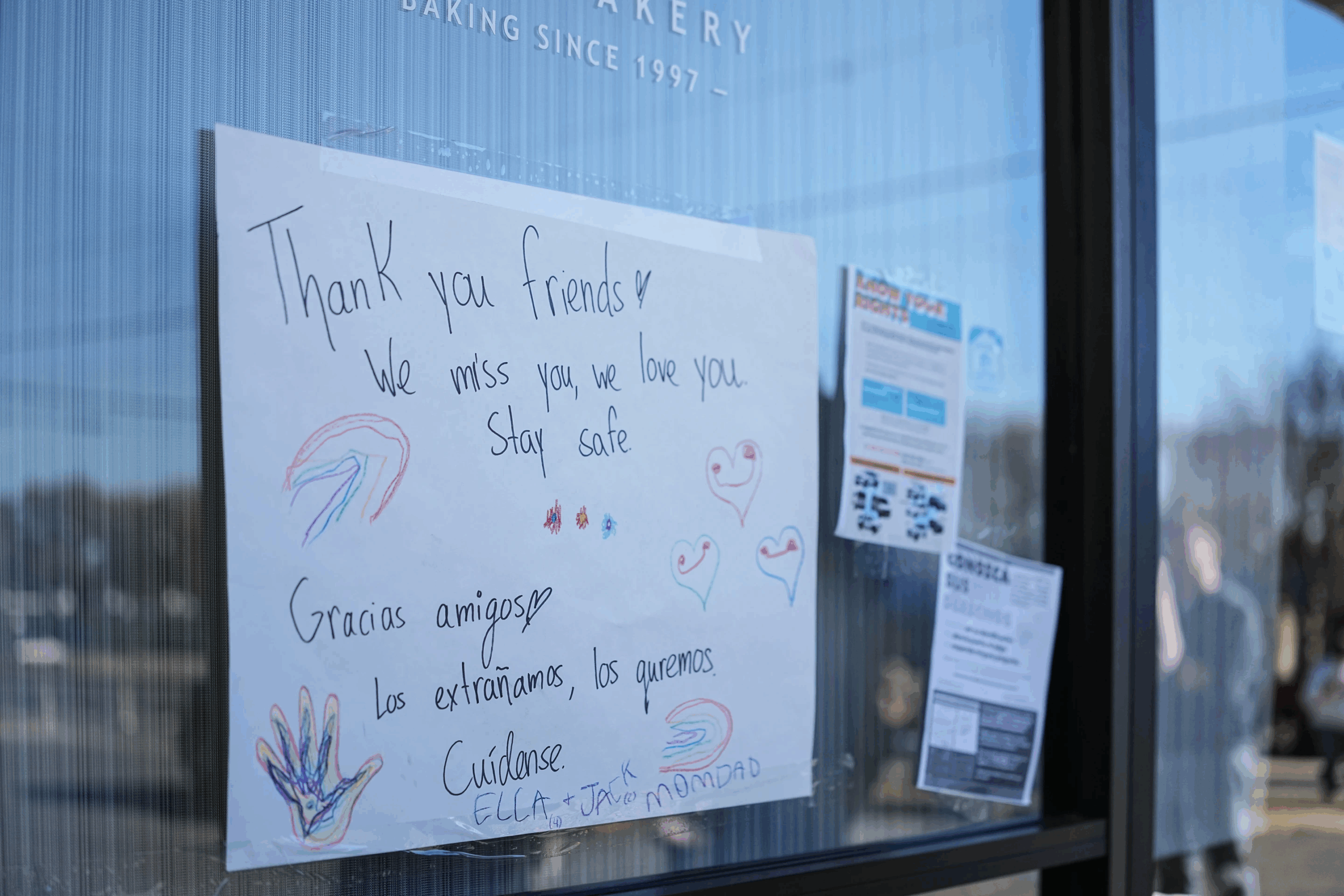
A sign of support is posted outside of Manolo’s bakery which closed amidst federal law enforcement presence, Monday, Nov. 17, 2025, in Charlotte, N.C. (Photo via AP Photo/Matt Kelley.)
Immigrant rights advocates and those in Orange County with connections to organizations like Siembra NC, RadarSafe, and Respuesta Rápida de Durham found themselves busy fielding tips about seeing agents, working to verify their legitimacy, providing resources to concerned community members and coordinating with other groups across the state to share information. Eliazar Posada-Orozco was one of those people and he described only getting a handful of hours of sleep that week to ensure he was available to help immigrant families. Even those who are legal residents were fearful from any rumor shared on social media or unexplained note sent in group chats, largely because agents detained or took people without due process. The lack of consequences for officers who picked up U.S. citizens and racial profiling committed in their process, Posada-Orozco said, raises several serious issues.
“Maybe you are targeting one person,” he said. “But what [these federal officers are then doing] is walk around the neighborhood, then you go around the grocery store, you ride around the town. And if you see someone who looks brown or immigrant, you go and ask them what they’re doing. That is not targeted enforcement.
“We have the misinformation, we have the fear that you’re sewing into the immigrant community – but we also have the fear that you’re sewing and disconnect you’re sewing into the broader community,” Posada-Orozco added. “By saying, ‘We’re going to target all these dangerous criminals, and we weren’t able to catch them,’ not only are you making it even more fearful for communities who are the backbone of our society to go and be able to do their jobs, you’re also making it so that everyone else now fears that community.”
Padilla and Posada-Orozco teamed up with other Latine elected officials and local leaders to pen an open statement advocating for immigrants’ rights and voicing their support of immigrant community members on Nov. 18 shortly after ICE and Border Patrol’s operation expanded to Raleigh. Their open letter — which also offered safety tips, “know your rights” resources and immigrant network numbers to people — quickly garnered more than 130 signatures and more than a dozen organizations’ support. With Posada-Orozco and his peer Cristóbal Palmer’s help, the Town of Carrboro passed a similar resolution that night affirming the local government’s support to immigrant residents and condemning the discriminatory tactics used by federal agents. Orange County’s trio of mayors and the Orange County Commissioners’ chair also issued their own statement of support, while Orange County Sheriff Charles Blackwood and the town’s police chiefs echoed that support and stressed their departments were not involved in the law enforcement operation.
Much of the Triangle business community both suffered from ICE and CBP’s presence and voiced their opposition to spreading fear within the immigrant community. Some took to posting signs on their doors explicitly saying immigration enforcement officers were not allowed to enter without the correct warrants alongside notices of being a Fourth Amendment workplace. Others locked their doors after customers entered and had a system of whistles to let customers know if ICE had been spotted. More, like the Durham and Chapel Hill bakery Guglhupf, took to social media to promote community and highlight the importance of undocumented residents as members of the hospitality industry’s workforce.
The construction and trade industries were heavily impacted, according to president of the Home Builders Association of Durham, Orange, Chatham Holly Fraccaro. She described working with the nonprofit El Centro Hispano that week to drop off food for Hispanic neighbors sheltering in their homes to maximize their safety and seeing many driveways that had work vans with ladders, company logos and more.
“Construction and residential construction is an economic engine of a community,” Fraccaro told 97.9 The Hill. “When we know that the majority of the people building the homes in our community for our neighbors, for our friends, for themselves are Hispanic labor, and they are de-stabilized, then the entire economy of our region is de-stabilized.
“We have all got to come together [and] do not normalize this now-legal racial profiling,” she added. “And I particularly will call on my white neighbors [and] friends to come together. It’s our time to step up so that those who are afraid can find shelter in the rest of us who aren’t going to be profiled [by federal officers.]”
Chapelboro curated a guide of resources for community members to use for either reporting ICE agent sightings, contacting immigrant networks or reviewing your rights when approached by an immigration enforcement officer. View the full guide here.
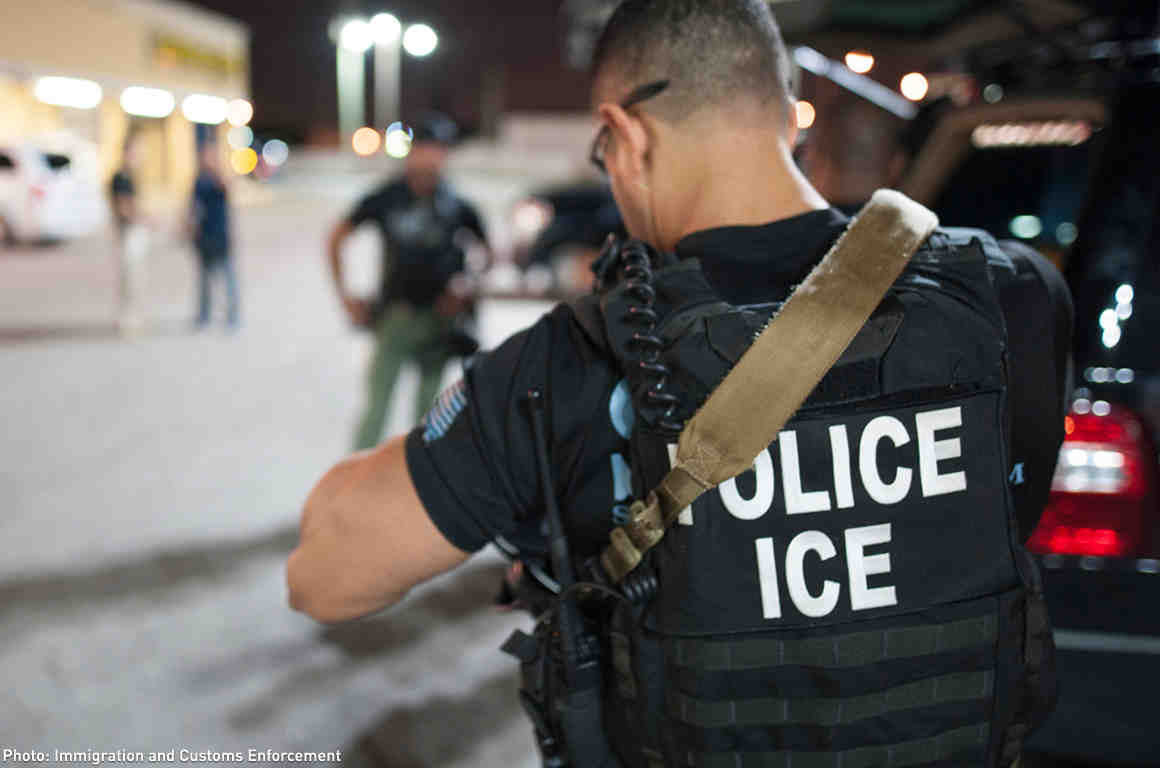
Featured photo via U.S. Immigration and Customs Enforcement.
Chapelboro.com does not charge subscription fees, and you can directly support our efforts in local journalism here. Want more of what you see on Chapelboro? Let us bring free local news and community information to you by signing up for our newsletter.

