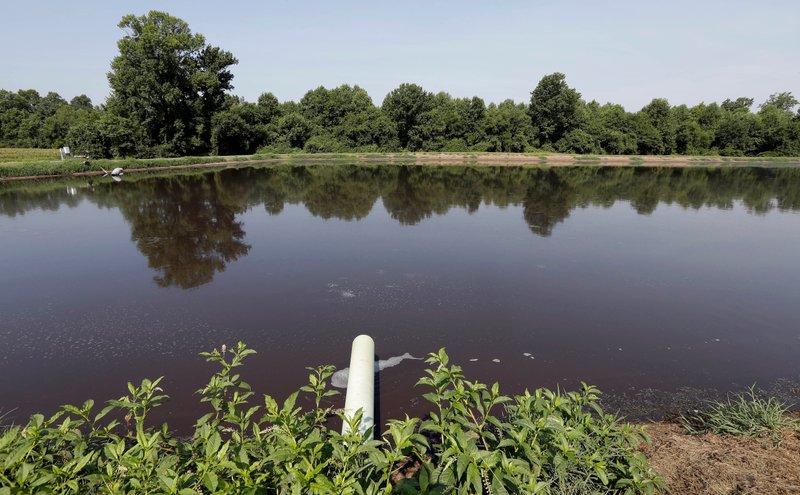
A federal jury decided Friday that the world’s largest pork producer should pay $473.5 million to neighbors of three North Carolina industrial-scale hog farms for unreasonable nuisances they suffered from odors, flies and rumbling trucks
The jury found that Smithfield Foods owes compensation to six neighbors who complained in their lawsuit that the company failed to stop “the obnoxious, recurrent odors and other causes of nuisance” resulting from closely packed hogs, which “generate many times more sewage than entire towns.”
The jury awarded $23.5 million in compensatory damages and $450 million in punitive damages, which will be reduced to $94 million under limits in state law.
The case comes after two previous, related lawsuits rocked agribusiness in the country’s No. 2 pork-producing state. Juries in those two cases awarded damages of about $75 million intended to punish Smithfield, though those amounts also were required to be cut.
North Carolina legislators reacted by adopting new barriers against nuisance lawsuits that all but eliminate the right of neighbors to sue Smithfield Foods or any other agribusiness. Critics billed the legislation as an attack on private property rights in order to protect a well-heeled industry.
U.S. Sen Thom Tillis and U.S. Rep. David Rouzer suggested they might seek national legislation after hearing Friday from agribusiness executives and agriculture officials from North Carolina, Georgia, Delaware and Texas in Raleigh.
“Today’s nuisance lawsuits that are destroying livelihoods and communities in North Carolina are the tip of the iceberg for what is to come absent a well-informed public and good public policy,” Rouzer said in a prepared statement Thursday. “This is a very slippery slope that threatens the very existence of every form of agriculture nationwide.”
The Pender County, North Carolina, farms held thousands of hogs owned by a Smithfield Foods subsidiary. Smithfield was sued because plaintiffs’ lawyers said the company used strict contracts to dictate how farmers raised Smithfield’s animals.
One neighbor who was not part of the lawsuit compared the waste stench to long-dead corpses he found during his career as a police officer and firefighter, news outlets reported. Wesley Sewell testified that he bought his house out of foreclosure without realizing the hog operations were nearby and sometimes fled to another home when the smells were too strong.
Lawyers for the neighbors said Smithfield hasn’t taken measures that would minimize the nuisances, for example by sending trucks along a back road to pick up hogs for slaughter in the middle of the night instead of rumbling past sleeping homes. Nor has the company covered the waste pits or otherwise tried to capture the smell and bacteria resulting from pooling liquefied waste, lawyers for the neighbors said. The company has done that in Missouri and Colorado, attorneys said.
The predominant method of handling hog waste in North Carolina is collecting it in open-air pits that are emptied by spraying liquid excrement on farm fields. The method was banned at new livestock operations in 1997, when industrial-scale hog operations began to be planned near the Pinehurst golf resort two years before it would host the U.S. Open tournament.
Smithfield has continued using the low-cost method because it helps the company produce pork for less than in China, lawyers for the neighbors said. Smithfield is owned by Hong Kong-headquartered WH Group, which posted profits of about $1 billion last year.
The neighbors’ attorney, Michael Kaeske, asked the president of Smithfield’s hog production division last week why the company couldn’t afford to finance technology improvements on the farms that grow the company’s hogs under contracts.
Smithfield’s Gregg Schmidt testified even if the company shelled out the money, there was a risk farm owners couldn’t afford to maintain it for the prices Smithfield would pay.
“The farm would not be sustainable, and in a short period of time it would be out of business,” Schmidt said.
Related Stories
‹

Corporate Tax Cuts, Prediction Market Leeway, and Underfunding Education: Why Orange County's Legislators Voted Against NC's BudgetAll three of Orange County’s state representatives voted against North Carolina's updated budget, citing issues with its contents and construction.

On the Porch: Dr. James Wood - Sports Around the WorldThis Week:
James Wood is currently Professor of Latin American and modern world history at North Carolina A&T State University. He is the author of The Society of Equality: Popular Republicanism and Democracy in Santiago de Chile, 1818-1851 and the co-editor of "Problems in Modern Latin American History: Sources and Interpretations", now in its fifth edition with Rowman and Littlefield. As a Fulbright scholar for Chile in 2016 he was a visiting professor at the Universidad Diego Portales in Santiago (where he observed Chilean student activism up close).
On the Porch: Bill Brown - Art and Science Merge at NCMAThis Week:
Bill Brown joined the North Carolina Museum of Art as a Conservation Intern in 1988. Thirty-two years later he retired from the Art Museum as Chief Conservator. He received his M.A. and Certificate of Advanced Studies in Conservation from State University College at Buffalo, NY in 1989. At the Museum, he established the Art + Science Initiative, a collaborative program with Duke University math and science departments. Bill has a passion for Italian Old Master Paintings of the 14th to 18th century. He works part-time as a conservator in private practice and provides conservation support for the Museum and Gallery collection of old master paintings at Bob Jones University in Greenville, SC . He enjoys retirement with his wife and young adult son.

On the Porch: Nora Gaskin - Conjuring Crime StoriesThis Week:
Author Nora Gaskin is a lifelong resident of the Durham-Chapel Hill area. Her latest is novel is "Lammie Loves Cubby". Nora has a bachelor’s degree in English with Honors in Creative Writing from UNC, and a Masters in English from the University of Washington in Seattle. She spent over 24 years as a stockbroker and financial advisor in the Durham office of a major investment firm. She retired in 2005 to focus on writing. She is the publisher at Lystra Books and Literary Services and the author of three novels and one nonfiction book. She lives and writes in Chatham County, inspired by her native landscape, her husband, and dogs. Her favorite word is "gratitude."
![]()
Therapy Smarts and Sen. Natalie Murdock on How HB696 Impacts Children and Families — On Air Today (June 15, 2026)Founder and CEO of Therapy Smarts Avani Shah and N.C. District 20 Sen. Natalie Murdock speak with 97.9 The Hill on Monday, June 15.
On the Porch: Steven Fenberg - What Funded America's Infrastructure?This Week:
Writer Steven Fenberg discovered Jesse Jones was reputedly the most powerful person in the nation next to President Franklin Roosevelt during the Great Depression and World War II. As chairman of the federal government’s Reconstruction Finance Corporation (RFC)—the nation’s indispensable infrastructure bank—Jones initiated and managed massive New Deal agencies that saved and expanded the nation’s economy and then shifted the RFC’s priority from domestic economics to global defense to fight and win WWII. Fenberg told this remarkable story as executive producer and co-writer of the Emmy Award winning documentary film “Brother, Can You Spare a Billion?” that was narrated by Walter Cronkite and broadcast nationally on PBS. Fenberg then wrote the biography “Unprecedented Power: Jesse Jones, Capitalism, and the Common Good.”

Viewpoints: Constitutional Changes Are Rarely NecessaryConstitutional amendments are supposed to be rare. They are supposed to matter. They are meant to alter foundational principles or governmental structure when absolutely necessary.
On the Porch: Terri Mitchell - Mentoring Women in TechThis Week:
Terri Mitchell is the founder of Accelerate Success, a program to help women develop the confidence, skills, and networks needed to thrive in STEM careers. She is a former IBM executive with more than 30 years of experience in the technology industry. Starting as a graduate of Le Moyne College with a degree in Computer Science, she held leadership roles across hardware, software, and systems businesses, culminating in her role as Vice President and IBM Integration Executive. Following her retirement from IBM in 2018, Terri became a founding member of Triangle Women in STEM and began the Accelerate Success program.
On the Porch: Carl Nordgren - Creativity Can Unite USThis Week:
Carl Nordgren is a best-selling novelist, a teacher, and an imaginal cell. After 25 years as an entrepreneur, he taught Creativity at Duke for 14 years. He’s a two-time TEDx speaker and hosts the weekly radio show ‘Exploring your Creative Genius’ on 97.9 The Hill. His calling is to help each of us and all of us grow our creative capacities and develop our entrepreneurial instincts and behaviors, a calling that informed his book "Becoming a Creative Genius (again)". His new book, "Common Ground for US" continues that work and offers new perspectives on governance and policy making for political and community leaders. You can attend his book launch event at Golden Fig Books in Carrboro on June 4, by clicking the show title above.
On the Porch: Tiffany Muller - End Citizens UnitedThis Week:
Tiffany Muller is the President of End Citizens United. She has helped grow the group into a nationwide organization with more than 4 million members and 1 million grassroots donors. Before leading End Citizens United, Tiffany was Deputy Political Director at the Democratic Senatorial Campaign Committee, where she worked with top Senate races. She also served as chief of staff to two members of Congress, ran a political research firm, and was Vice President of Political Operations at the LGBTQ+ Victory Fund. As a member of the Topeka City Council, she led successful efforts to expand anti-discrimination protections.
›