With North Carolina’s public schools ranking among the least funded in the country — despite the state’s relative economic success — Democratic lawmakers are aiming to find different avenues of funds without legislature allocations.
At the end of April, a group of House and Senate Democrats filed the same bill in each of their respective chambers aiming to turn to the state’s wealthiest residents for help. The Fair Share for Public Schools Act would levy a new tax on all reported income more than $1 million and proceeds would go toward the State Public School Fund. While the bill faces a steep hill to climb for consideration, as Democrats are in the minority and North Carolina’s Republican leadership is de-prioritizing public schools, its sponsors — including District 56 Rep. Allen Buansi — hope the measure will be a step toward creative and equitable ways to address the state’s educational needs.
The Chapel Hill and Carrboro representative joined 97.9 The Hill’s Aaron Keck in studio to talk about the bill and other proposed legislation in Raleigh catching people’s attention.
The transcript below has been edited for clarity and brevity. Listen to the full interview with 97.9 The Hill — which also covered state budget negotiations — here.
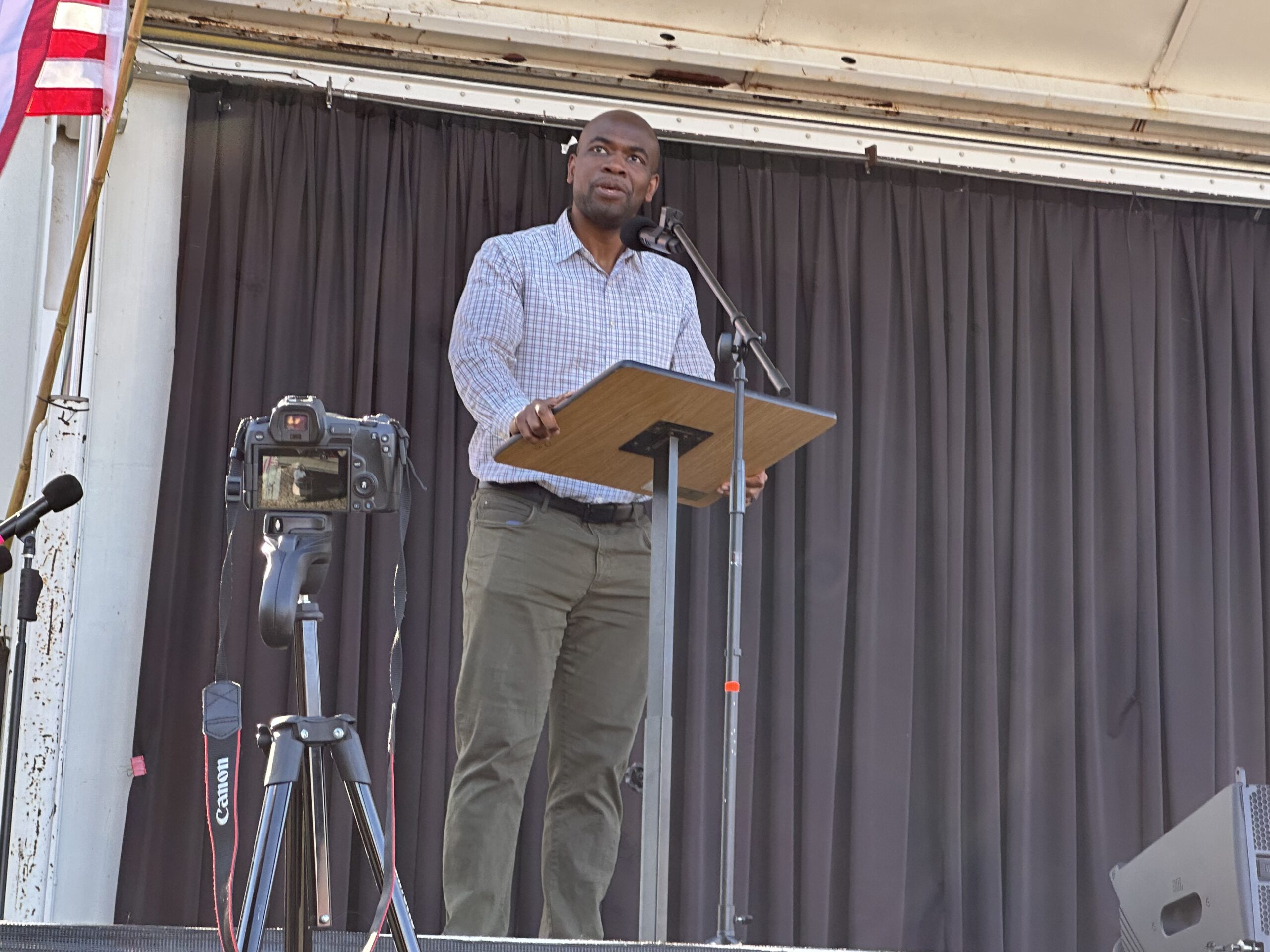
North Carolina House District 56 Rep. Allen Buansi. (Photo via Henry Taylor/Chapel Hill Media Group.)
Keck: Let’s talk about the Fair Share for Public Schools Act — which is a 7% income tax on all income over a million dollars, with all of that money going to the public schools, right?
Buansi: Exactly. We had a press conference earlier this week, and what I said was that we are in a crisis. I mean, all of us know this. Just about a week and a half ago, there was a march in Raleigh of teachers, parents, families, children…all demanding that our state’s General Assembly do its job and fully fund our public schools. We’ve got teachers that are having to work two, three jobs just to make ends meet along with their teaching salary because it’s not enough for them. We’ve got per pupil spending in North Carolina standing at about 49, 50th in the country. That’s unacceptable. And then of course, teacher pay currently ranks 46 out of 50 states.
Personally, I’ve got three children. I’ve got two children who are about to enter kindergarten, I’ve got a child right now in first grade. Those numbers — to me — are unacceptable as a parent. And I know it’s unacceptable in our district to thousands of parents as well as the millions of parents across the state. Also, I’ll say that we’ve got about $13 billion in needed school repairs around the state. Because of all of that, we really need to talk about real solutions to address the funding crisis that we’re in.
And so, this Fair Share for Public Schools Act is a targeted adjustment. It is aimed at specifically helping our public schools — which are closing, which are losing teachers and droves. Even at that press conference, we had millionaires speak on their own behalf about their own desire to do more… to do more to make sure that the children of North Carolina, their futures are secured and to make sure that the workers they employ are also taken care of.
Keck: I was really struck by that [argument] at the local level. Because we’ve been following the Orange County budget talks and Travis Myren the county manager comes out with a budget that’s got a 3.5-cent property tax increase, which is big. And all of the public comments at the meeting earlier this week were, “I’m fine with that, I’m fine with that. Give me money for schools.” That’s what people are coming to the county commissioners about, and I’m sure you’re hearing it at the state level — like, “This is what we need to be spending money on. Let’s do it.”
Buansi: Right. I mean, folks, when they reach out to me and when they’ve reached out to commissioners, they’re not talking about raising taxes just willy-nilly. They’re talking about raising taxes to pay for the services that we all care about… to pay for the services that are good for the kids, good for the people. This is a bill that I know has agenda up a lot of support here in district — but also the reception across the state has been pretty positive as well.
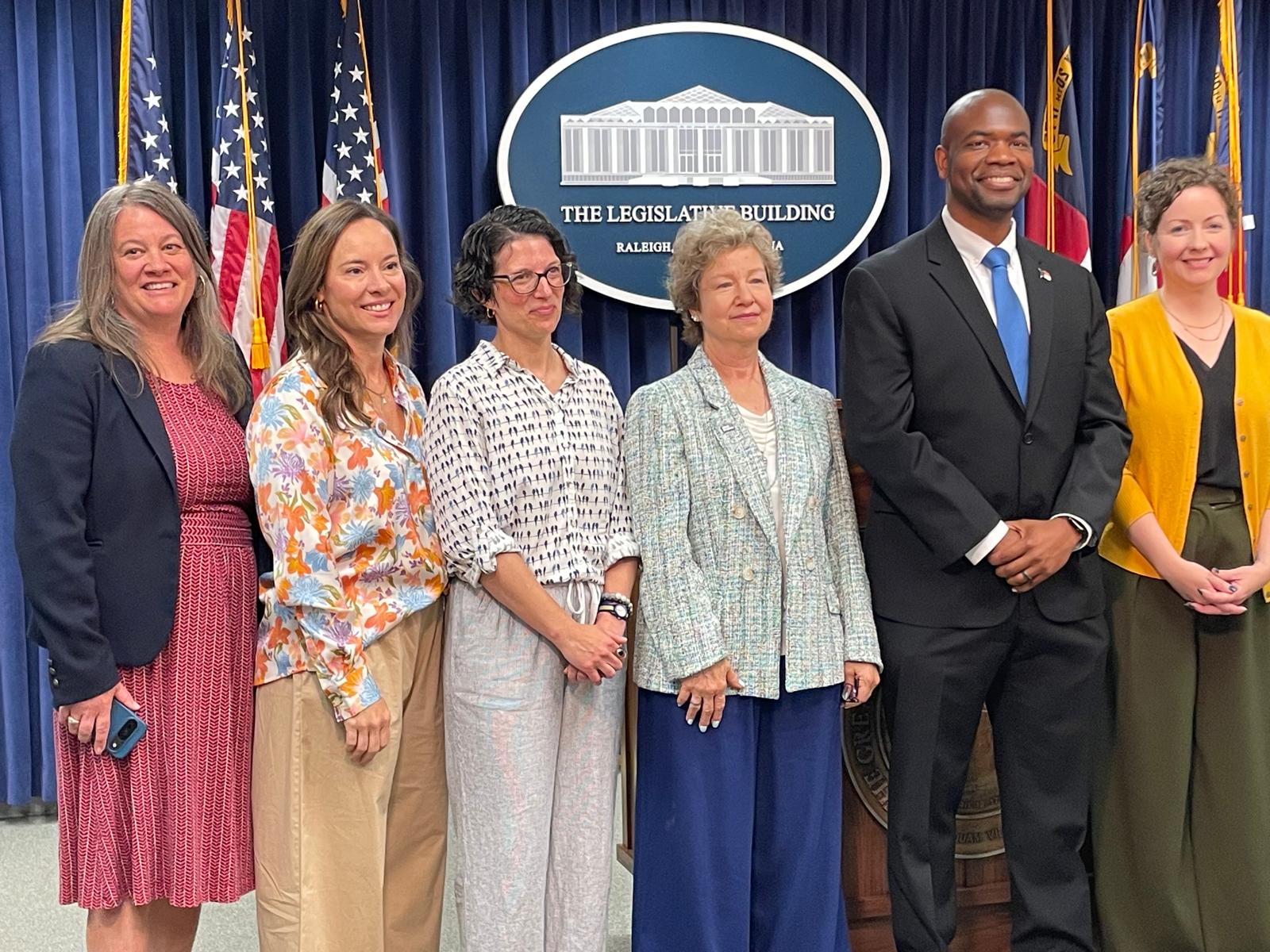
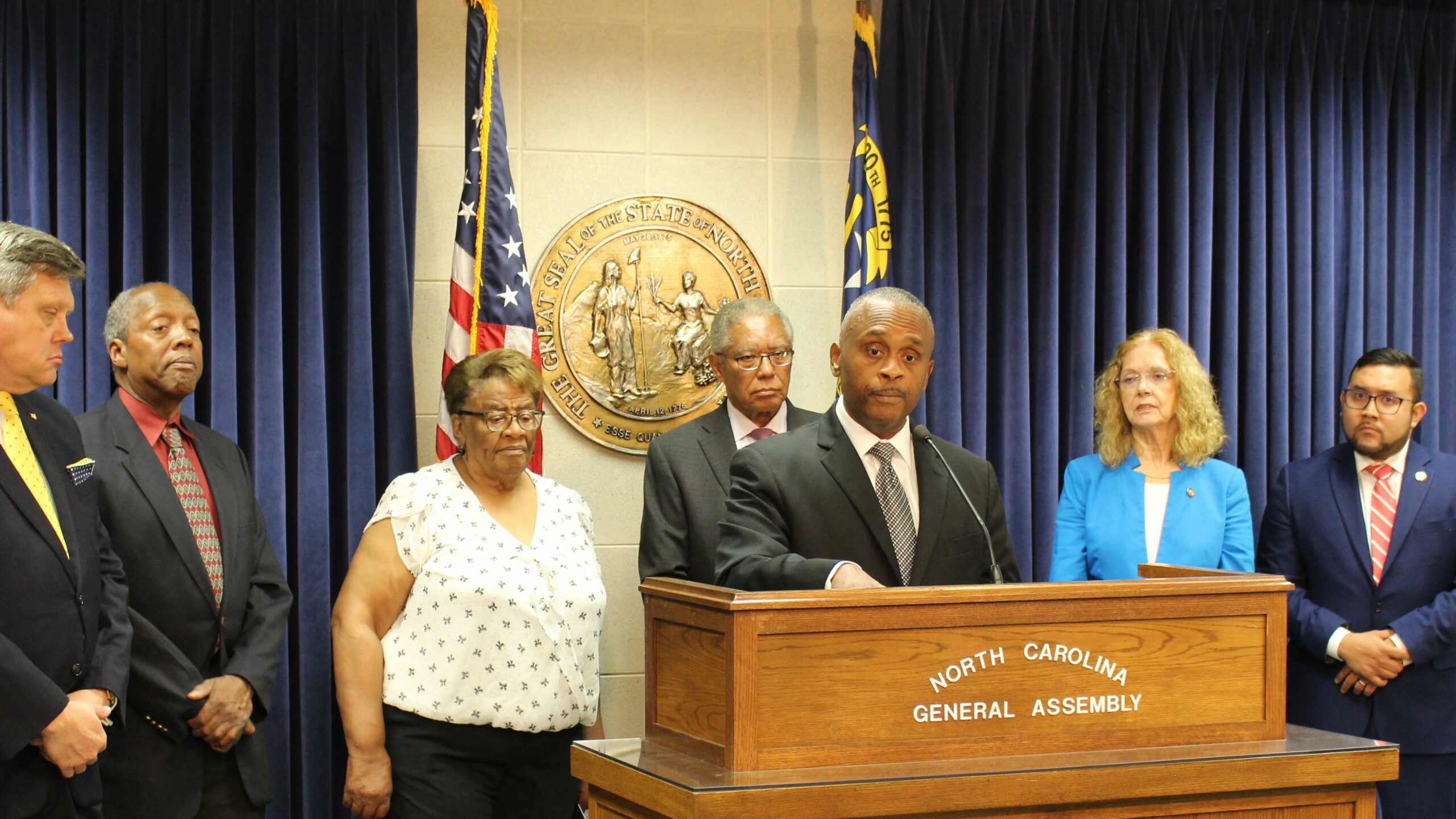
From left: Alexandra Sirota, Executive Director of the NC Budget & Tax Center; Sara Dickinson, parent of public school students; Emily Malpass, a volunteer with Public Schools Strong and the Education Justice Alliance; Monica Lavery of NC Patriotic Millionaire; N.C. Rep. Allen Buansi, House bill co-sponsor; and N.C. Rep. Lindsey Prather, bill co-sponsor. (Photo via Heba Atwa/NC Budget & Tax Center.)
Keck: So, I’m going to guess that there’s a limited chance of this passing this year, because I assume you’re not getting bipartisan support on this in the state House or Senate yet. But what is the next step in order to start moving the dial towards passing it next year or beyond?
Buansi: Unfortunately as you said, there’s not bipartisan support on this one. It’s all Democrats who have signed onto this bill — about 32 Democrats by my last count.
Keck: It’s always difficult for me to try to figure out what to prioritize [when] talking about the state legislature. Like, I think this is a really cool bill. I also know what its chances are of passing, [so] how much do I prioritize and how much do I not? But it’s an important issue, right?
Buansi: It is. And, you know, to a larger point too… last year there was another press conference that Democrats held where we highlighted about 400 bills introduced in the House alone by Democrats that never received a hearing. So, it is par for the course at this point that a lot of Democrat bills just don’t get heard. And that’s really unfortunate, because good ideas can come from both sides of the aisle. And certainly, I do think that this [bill] is an idea very, very much worth considering, very much worth passing. But in terms of the chances moving forward… you know, we’ve got elections coming up in November. I think depending on how those go, maybe we can get some traction on this in the long session of next year.
Keck: And it is also the case that things change even without elections. There were so many years right, when we were talking about Medicaid expansion and nothing was happening…nothing was happening…nothing was happening…and enough people say, “Let’s do something.” And it happens. Right?
Buansi: That is true. There’s always that path… but I prefer something a bit more immediate.
Keck: What other issues are going on in Raleigh that are maybe flying under the radar right now?
Buansi: Well, we’ve had a number of local bills that have come up. Maybe more notably, there is a bill that started out [as] a fairly innocuous bill, but it kind of morphed into something very different. This was a bill that came over from the Senate, which basically would have allowed, I believe, Franklin County to be able to condemn certain properties in another county, in Halifax County. That was problematic on a number of levels, because I can’t think of an instance before in our state history where a county has been allowed to do such a thing with another county’s property or land. And I understand that it had something to do with water systems — but even still, the way that it was rolled out on the floor… it was rolled out in a fashion where there were no committee hearings on that particular change in the bill. There was no discussion about it. And several of my colleagues — I know, Rep. Rodney Pierce out of Halifax County, Rep. Bryan Cohn out of Granville County — spoke strongly on the floor against that provision and against potentially setting a precedent for allowing counties to be able to condemn or take lands from other counties…whatever that purpose might be for. We did get that bill back the following week. They reintroduced it on the floor without those provisions.
I just bring that up so that folks can be aware of the fact that: when it comes to these bills, legislation, and what it has to do with local government control… there are bills coming down the pike that undermine local government control. And [with] me having gotten my start on the Chapel Hill Town Council, knowing the importance of having a town council, having a board of county commissioners that is responsive to the people, it’s really important that people be able to trust and rely that their local governments can respond to them. And those kinds of proposed changes really undermine that. They really undermine the responsiveness of government.
Keck: But it is also the case, and this is a good example, of people raising their voice and saying something can actually move the dial. Like people said something and the provision’s gone.
Buansi: Absolutely. And it wasn’t just those representatives that said something — their constituents, folks around the state and other counties also speaking up, I think that also helped too. And so… even with everything that’s going in General Assembly, even with everything disagreeable that’s going on, folks still ought to know that their voice matters. And that on any given issue, if they speak out — if they get others folks to speak out enough — you can make a difference.
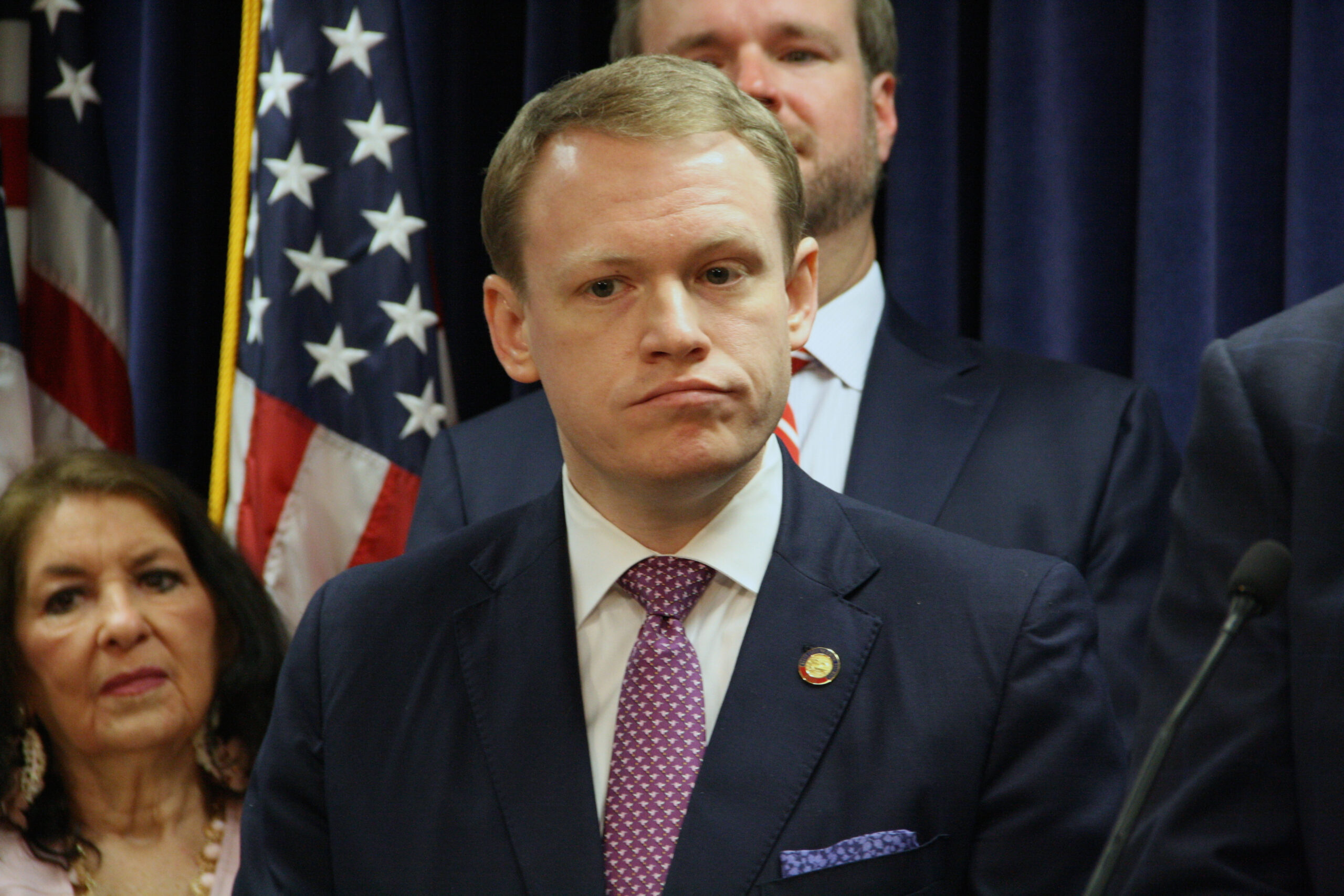
Featured image by Henry Taylor/Chapel Hill Media Group.
Chapelboro.com does not charge subscription fees, and you can directly support our efforts in local journalism here. Want more of what you see on Chapelboro? Let us bring free local news and community information to you by signing up for our newsletter.