A judge ruled against the Town of Carrboro on Friday in the local government’s lawsuit against Duke Energy, which aimed to hold the utility provider accountable for its role in climate change and sought damages suffered by extreme weather events.
Following arguments held in September, Superior Court Judge Mark Davis dismissed the lawsuit, granting Duke Energy’s motion filed last March that argued a lack of subject matter jurisdiction. In his written opinion, Davis said Carrboro did have standing to bring the lawsuit as a property owner seeking damages from “unwanted nuisances and intrusions” onto its property, but the judge ruled that not only were some of Carrboro’s claims preempted by federal law, the argument was so broad that it was “clearly nonjusticiable” thanks to the political question doctrine.
That doctrine — established in the Supreme Court’s ruling of 1962’s Baker v. Carr case — is used to determine whether federal courts have the jurisdiction to rule on a case based on its argument and facts. Judge Davis said, in this case, Carrboro’s claims were “fatally imprecise and lacking in concreteness” when discussing Duke Energy’s fault over climate change and then damages specifically to the town government’s infrastructure. He also said the nature of carbon emissions and their impact on the planet’s atmosphere make it “a futile endeavor” to attribute a specific source of those emissions to a specific impact of climate change.
“It should go without saying that greenhouse gases do not stop at the borders of nations,” wrote Davis, “instead, climate change is caused by the confluence of emissions that have intermixed and diffused throughout the atmosphere on a global scale with natural weather patterns. Thus, even putting aside the unknowable issue of precisely how much influence Duke Energy’s alleged acts of deception had on energy choices made by individual members of the American public, Carrboro’s argument ignores the impacts of fossil fuel-related emissions by billions of persons in other countries throughout the world.”

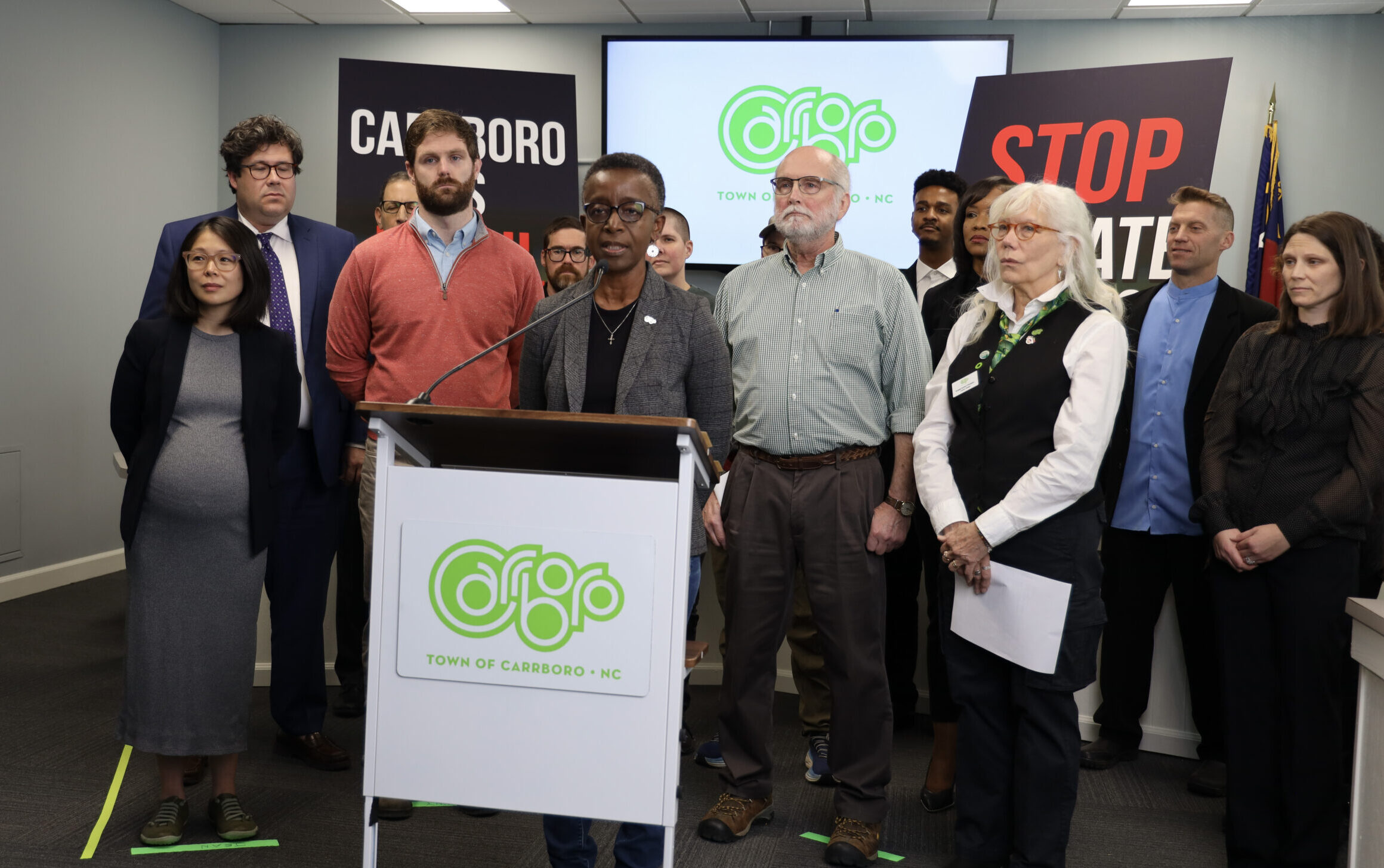
Carrboro Mayor Barbara Foushee delivers remarks at the press conference announcing the town government’s lawsuit against Duke Energy on Dec. 4, 2024. (Photo via the Town of Carrboro.)
When filed in Dec. 2024, the Town of Carrboro framed the lawsuit as necessary over Duke Energy’s “extensive, unreasonable and unnecessary reliance upon fossil fuels in the conduct of its businesses” providing electricity to North Carolina and several other states in the southeastern U.S. Additionally, the lawsuit alleged Duke Energy was aware that fossil fuels “materially exacerbated” global warming and proceeded to deceive the public on both its effects while not incorporating renewable energy options with urgency.
The case was seen as among the first of its kind in the country, where a municipality sought to challenge an energy provider over negative effects from climate change. When asked in Dec. 2024 whether they would take other municipalities’ cases or examples on in its lawsuit, the town’s representation said it would focus on Carrboro’s specific damages. Much of those mentioned in the Sep. 2025 arguments were the local government’s efforts to repair roads damaged by flooding, establish a stormwater infrastructure fund to improve resiliency against flooding, and provide assistance to residents’ rising energy bills.
“While we are disappointed and disagree with the result, Carrboro is evaluating all of its options, including appeal,” read a statement shared by NC WARN Executive Director Jim Warren, who was assisting the Town of Carrboro in its lawsuit.
The town was represented by Matt Quinn of Lewis & Roberts, PLLC in its lawsuit. The Charlotte-based Duke Energy was represented by both Smith, Anderson, Blount, Dorsett, Mitchell & Jernigan, LLP and Baker Botts, LLP.
Editor’s Note: Chapelboro has contacted Duke Energy for a statement on Friday’s decision. This story will be updated further with that information.
Chapelboro.com does not charge subscription fees, and you can directly support our efforts in local journalism here. Want more of what you see on Chapelboro? Let us bring free local news and community information to you by signing up for our newsletter.