
After nearly a decade since the Town of Chapel Hill first launched plans to rewrite its land use management ordinance, or LUMO, a draft plan of the update has arrived.
While the local government has made smaller updates in recent years, this draft — which was shared with the public on July 16 — marks the first comprehensive overhaul of the document in 20 years and aims to change how its residents can live while retaining the community’s spirit.
The Chapel Hill Town Council has prioritized taking a different approach to development in recent years, trying to look more holistically at how neighborhoods or commercial spaces are built instead of project-by-project. The effort birthed guiding documents like a projected housing needs study, a new Future Land Use Map, and the Complete Community Strategy, which lays out how to approach its 2020 Comprehensive Plan.
But while most of those indicate the Chapel Hill officials’ vision, they don’t collectively codify it. That’s where the land use management ordinance comes in, according to Chapel Hill Long-Range Planning Manager Tas Lagoo. The LUMO is what legally dictates zoning and development processes – shaping what gets built where, and how.
“It’s that fundamental, baseline rule,” Lagoo told 97.9 The Hill. “It’s kind of the first book that a developer might open when they’re looking at what’s possible in Chapel Hill. It’s those rules that will begin to embody that Complete Community Strategy…which, they don’t today.”
A key component of Complete Community is building densely, with Chapel Hill wanting to both build up and along transit corridors – while also allowing more gentle density within existing neighborhoods. To achieve the latter, the draft LUMO lays out new allowances for constructing duplexes, triplexes and fourplexes. It also creates a new zoning district which would allow for townhomes, cottage courts, and small apartment buildings on smaller lots near commercial centers.
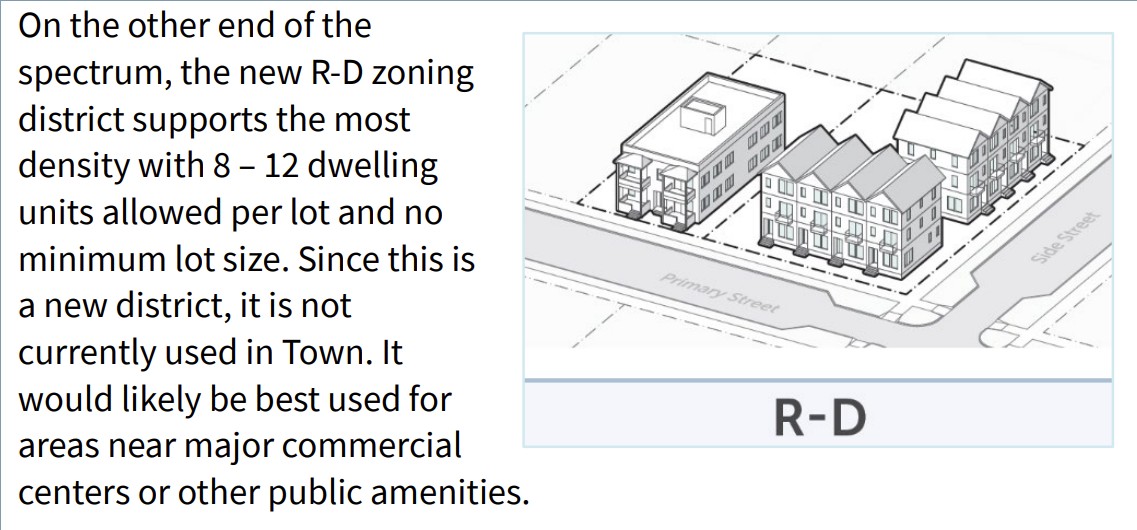
A graphic in the LUMO draft explaining the proposed new R-D zoning type, which would allow for more dense housing types on smaller lots, which would be near commercial spaces. (Photo via the Town of Chapel Hill.)
Chapel Hill Mayor Jess Anderson, who has made addressing “missing middle” housing supply a key component of her policy platform, said she is encouraged by this update in the draft ordinance.
“As someone who grew up in a duplex, I’m very excited to see that typology coming back,” Anderson told 97.9 The Hill. “And particularly given that it’s a historically relevant type of housing in Chapel Hill too. It was very popular, and then people kind of moved away from it.”
In addition to improving housing diversity and supply, the town government said the guiding goals of this draft ordinance include improving user friendliness – for both developers and residents – as well as supporting economic development through improved land use. The proposal includes allowing more small shops or restaurants in residentially-zoned areas along major roads and streamlining the permitting for small businesses, which is meant to encourage openings and cut down on the weeks-long process.
With the town’s vision of becoming more pedestrian-focused, the updated LUMO also lays out new rules to help encourage development to be both publicly accessible and visually appealing. That includes requiring high-density areas to have a certain number of outdoor amenities and updating design standards to better blend with mixed-use spaces.
“We can’t regulate beautiful buildings into existence,” said Lagoo. “But what we can do is prohibit things that we know are really bad for the sort of walkable community that we want to see. Buildings that are set super far back from the street, that don’t meaningfully engage with pedestrians that are hopefully walking or biking nearby.
“We also want to make sure that we’re supporting things like third places,” the town planner added. “Gathering places that have the potential to be public, that can bring people together and give folks an opportunity to see a West Franklin Street or an East Franklin Street [place] as not just somewhere where they’re moving through. They really [should] have an opportunity to stop and smell the roses, so to speak.”
And while much of the LUMO is focused on the built environment, it has provisions about the natural environment too. As another top priority for the rewrite, Lagoo said the draft features several components the staff believe will keep Chapel Hill’s natural areas protected and other areas prepared for extreme weather. The plan aims to maintain the town’s strict stream buffers and Resource Conservation Districts, add requirements for large developments to preserve at least 10% of existing trees canopy, and add shade along pedestrian routes. Lagoo added that while the Chapel Hill Town Council has often pushed builders to have stormwater infrastructure better than just for 25-year storm projections, that preference could ultimately be codified.
“With some exceptions, we’re going to be upping that [stormwater resiliency] standard to a 100-year storm,” Lagoo said. “So, basically requiring much more robust stormwater management from a lot more development in town. That’s, again, only part of the puzzle – we know that there’s a lot of need for broader investments, infrastructure-scale investments in stormwater management. But the part of the puzzle that LUMO can deal with is what sort of requirements are individual developments having to deal with.”
As a draft, residents and community members have ways to potentially bring further changes to the LUMO plan. Through Chapel Hill’s Engage webpage for the project, people can leave comments and questions directly on the document while using search tools to find specific details or reading the high-level summary of the hundreds of pages. Additionally, there are two open houses scheduled at the Chapel Hill Public Library (Monday, August 17 from 12 p.m. to 2 p.m. and Thursday, September 10 from 6 p.m. to 7:30 p.m.) where people can talk directly with town planners.
“Check it out and see how you feel like it will impact things you care about,” Anderson said. “Look at what the proposed changes mean for not just your neighborhood, but across the town. This has to be about meeting the goals of the entire town. But I think people are, hopefully, going to be really curious about, ‘what does this mean for where I live and what are things I’m excited about? What are things that raise concerns or questions?’
“We,” the mayor added, “want to hear all of that.”
That public input will then be incorporated into both staff notes and the draft, which will also be reviewed extensively by a pair of key governmental bodies that will share their own feedback.
“The planning commission and the town council,” said Anderson, “will each hold informal discussions about the draft LUMO before starting their official, legislative process. The planning commission will discuss the LUMO draft at their meetings on August 18 and September 1, and town council will discuss the draft at their work sessions on September 9 and September 16.”
The full draft of the updated LUMO can be found here. The Chapel Hill Town Council is set to take a vote on the rewritten land use management ordinance in November.
Featured photo via the Town of Chapel Hill.
Chapelboro.com does not charge subscription fees, and you can directly support our efforts in local journalism here. Want more of what you see on Chapelboro? Let us bring free local news and community information to you by signing up for our newsletter.