Amid a shortage of affordable housing – both locally and nationally – the Orange County chapter of Habitat for Humanity recently held a summit to discuss how leaders can collectively aim to better address the issue.
On Feb. 5, a few hundred people gathered for the nonprofit’s “Opening Doors” Summit. In addition to Habitat for Humanity staff and board members, elected officials, builders, business partners, housing advocates and UNC figureheads gathered to hear a panel about the constraints around building and funding affordable housing.
The event is an evolution of semi-annual events the local Humanity has hosted in the past to discuss housing policy and the nonprofit’s efforts to provide homes for low-income and middle-class community members. President and CEO of the Orange County chapter Jennifer Player said the goal of this year’s summit was to bring more community stakeholders into the discussion. She told Chapelboro the event might shift to being held every year to drive community conversations and keep the topic of housing front-of-mind.
To help open the “Opening Doors” summit, Player asked those gathered in the room to envision what could be accomplished if attendees leverage their power to spark teamwork to better tackle housing affordability and availability. She asked everyone who is part of the housing continuum to “refuse to rest until everyone in Orange County has a decent place to live.”
“Imagine the impact we could make if each of us committed to collaboration, to partnership, to action after we leave this room,” Player said. “My staff know that I’m an optimist, and I believe we can. I believe that together we can find solutions and open the door to home ownership for more local families. I also believe that together is the only path forward.”
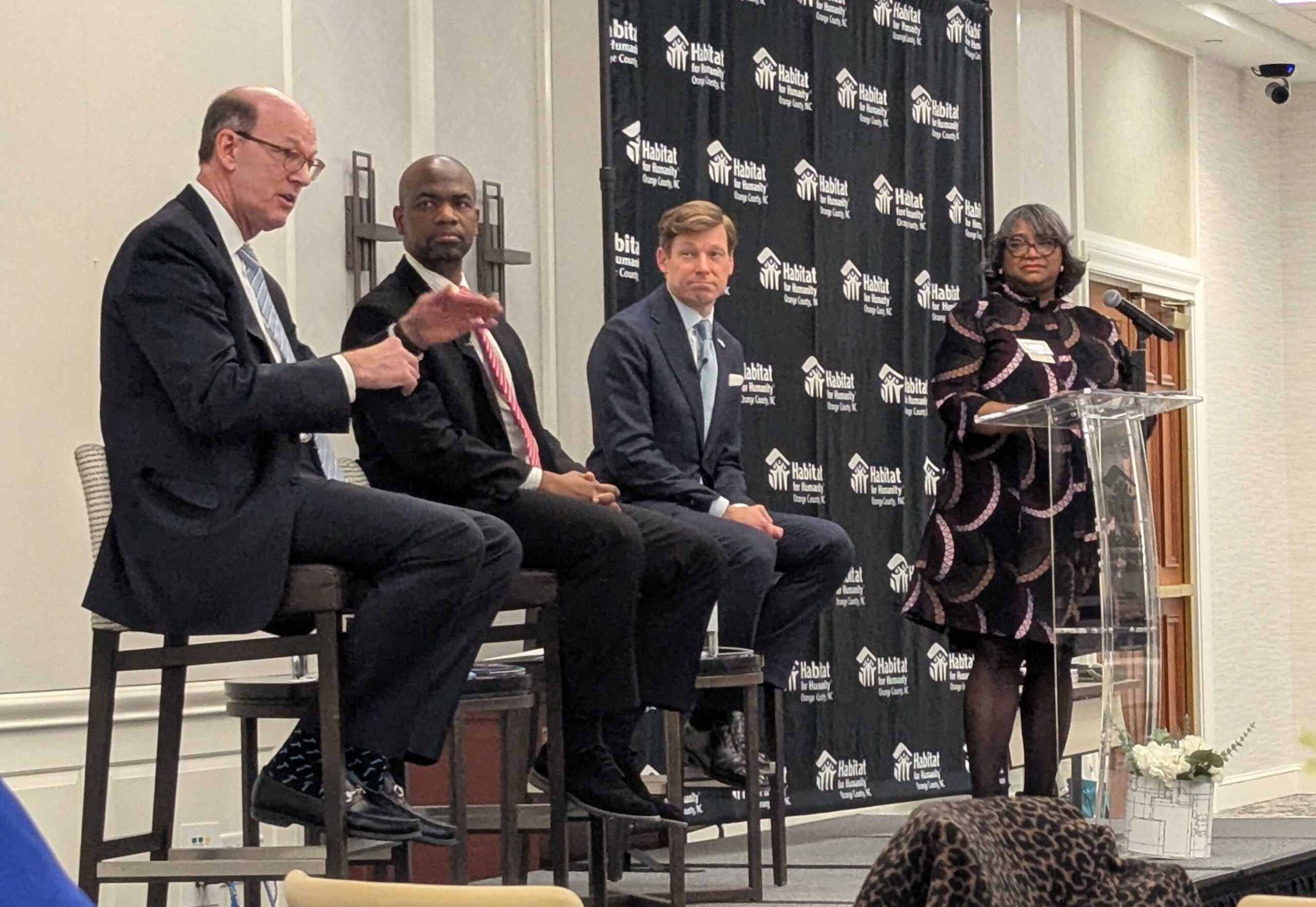
Habitat for Humanity CEO Jonathan Reckford (left) speaks during a panel with N.C. Rep. Allen Buansi (center left) and UNC Chancellor Lee Roberts (center right) at an event hosted by the Habitat for Humanity of Orange County on Feb. 5, 2025. (Photo by Brighton McConnell/Chapel Hill Media Group.)
The lynchpin of the event was a trio of speakers who individually shared their approaches to affordable housing before answering questions as a panel. One of the panelists was national Habitat for Humanity CEO Jonathan Reckford, who is no stranger to Chapel Hill after growing up in the town and attending UNC. Representing a national perspective on the need for housing, Reckford said he believes the widespread interest and need in improving housing supply has turned it from a moral case to an economic one – something experienced locally through the high costs of living, declining enrollment in local schools and workforce trends.
“Housing isn’t a first-order issue for those who have good housing and have never experienced the absence of it,” Reckford told Chapelboro after the summit. “I think now that middle-class families’ children are unable to live in the communities they grew up in, it’s becoming personal for middle class families.
“I think that, hopefully, starts to create both the awareness and the heart to recognize that we’ve got to do more,” he added. “And then we can do it in a way that doesn’t destroy the character of the town…I think there are a lot of myths that we can burst [as we] think about where the housing goes and how we build the housing in a way that allows for smart growth.”
The Habitat CEO said his organization is working to advocate for housing policies encouraging that smart growth, like building targeted density along transit corridors and a variety of housing types since there’s not a “magic bullet” to fixing the supply shortcomings. Reckford also said he believes it helps to see the housing crisis as a problem of distribution of shelter square footage.
“There’s actually enough square footage of housing, but it’s misallocated,” he said. “What we have is a lot of older folks living in way too much housing and a lot of young people without having enough housing. I think we need to think about principles, in some ways, of new urbanism: less square [feet] per person, more common area and shared space, and thinking a little bit differently.”
Reckford said using that philosophy on how to more efficiently use housing space could be done in his hometown. The local governments are looking to incentivize builders to construct homes and are rewriting their land-use policies to update their planning framework for modern needs and constraints. Reckford added that for years, tougher conversations among residents with homes centered on where to build affordable housing and how to find it. Now, those affordability effects are coming home to roost.
One major project that could help provide both more supply and release some existing housing in town is UNC’s future Carolina North development. After unveiling an initial vision for the satellite campus in the prior week, UNC Chancellor Lee Roberts spoke at the housing summit to share details on the future housing component at the former Horace Williams Airport site.
After describing affordable housing as “the key to building a better future” for UNC and the entire state, Roberts said the goal is to add 2,200 undergraduate beds in Phase 1 of the project and a “broad mix” of housing types that could attract graduate students, faculty and staff members. While the exact housing mix will be created once UNC hires and works with a master developer, the chancellor said he sees addressing the local housing crunch as a critical reason to utilize the valuable resource of university-owned land and drive Carolina North forward.
“We’re committed to both a capital ‘A’ affordable component as well as a wide range of workforce and market-rate housing,” Roberts said in the panel. “This is not going to be some gated community with detached, single-family homes. It’s going to be fairly dense.”
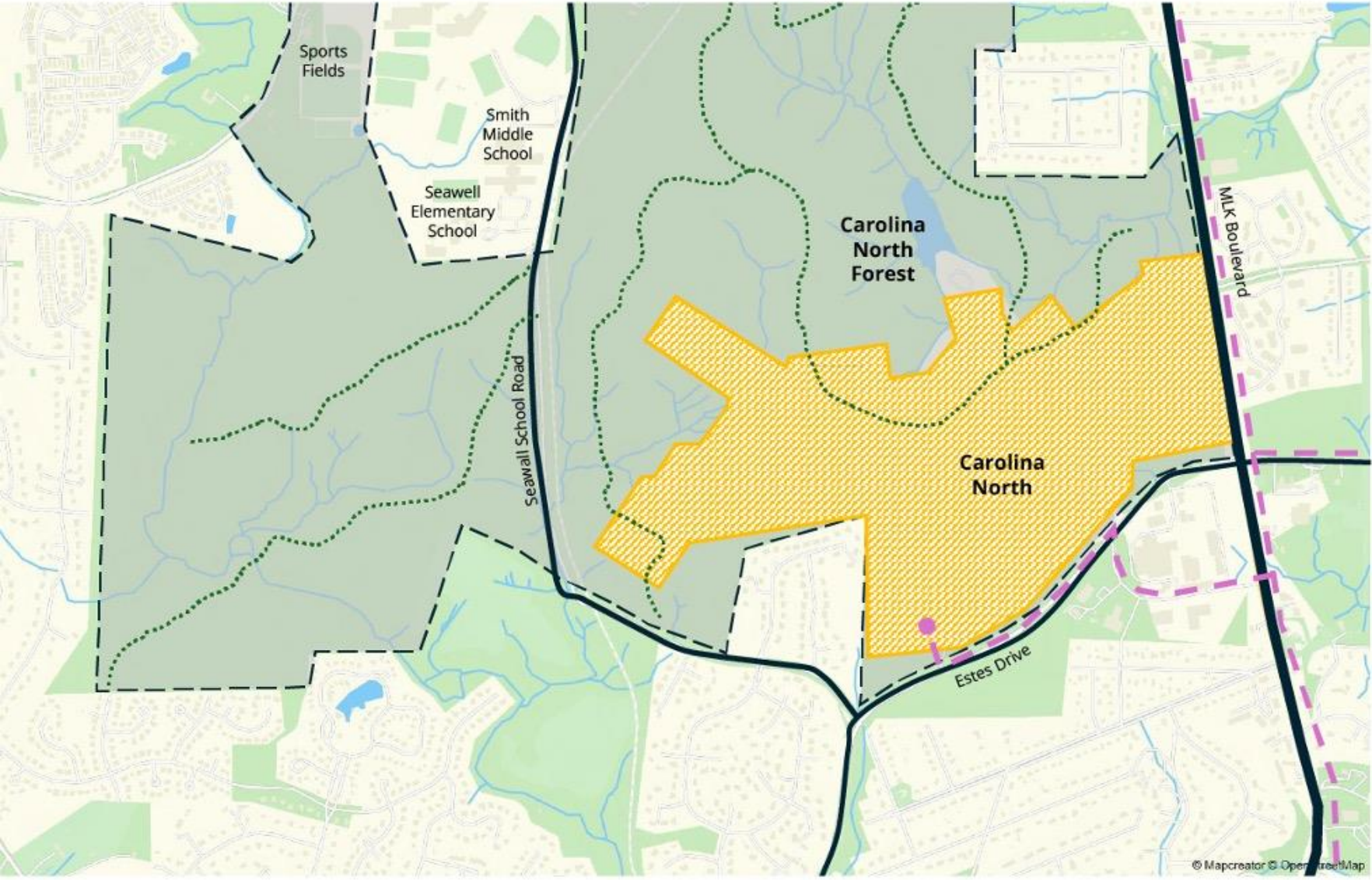
A map displaying the entire Carolina North property in Chapel Hill, with the future development area shaded in yellow. (Photo via UNC-Chapel Hill.)
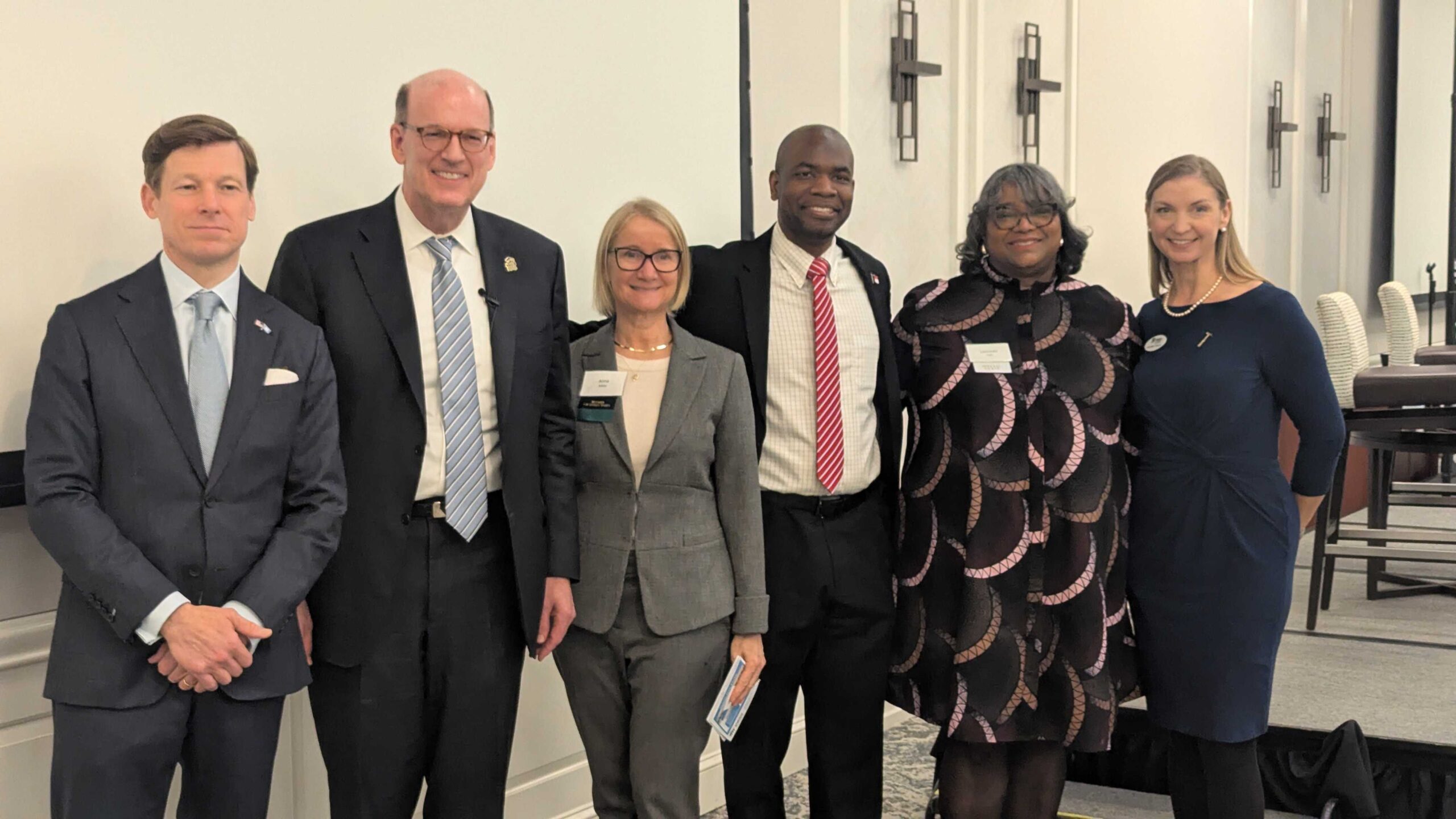
From left to right: UNC Chancellor Lee Roberts, Habitat for Humanity CEO Jonathan Reckford, Orange County Habitat Board Chair Anna Millar, N.C. Rep. Allen Buansi, panel moderator Leoneda Inge, and Orange Habitat President Jennifer Player pose for a photo at the “Opening Doors” housing summit. (Photo by Brighton McConnell/Chapel Hill Media Group.)
Representing the state level of housing efforts is N.C. Rep. Allen Buansi, whose District 56 covers Chapel Hill and Carrboro. He admitted that making meaningful progress at the state legislature in addressing affordable housing is difficult without a state budget – as North Carolina is now six months into the fiscal year and is operating as the final state in the country without an approved budget. Buansi, though, said he wants to continue pressing the issue. He said he’s searching for ways to either use the North Carolina Housing Trust Fund to financially support or expedite projects with integrated affordable housing components. He also said he wants to pass policies that encourage local governments to allow for mixed housing types.
“Your housing story, my housing story, anyone’s housing story is a personal story,” Buansi concluded. “But the thing we should all be about is making sure that folks in this state and our community are not struggling to get housing. Because everyone deserves a home – everyone. You deserve to have a home, because that is foundational to leading a successful life.”
Featured image via Brighton McConnell/Chapel Hill Media Group.
Chapelboro.com does not charge subscription fees, and you can directly support our efforts in local journalism here. Want more of what you see on Chapelboro? Let us bring free local news and community information to you by signing up for our newsletter.