Before moving out of the apartment she’s called home for 14 years and into a hotel, Salima Smith says she was effectively living in a hazardous work zone.
The Elliott Woods resident says in the weeks leading up to her scheduled move-out for renovations, exterior work on the 1970s-era buildings was already underway. Not only was it noisy, smelly and chaotic, Smith says, but it was difficult to get in and out of – as evidenced by an Uber driver she scheduled one morning to travel to a dentist appointment.
“I called the guy, [saying], ‘Hey, the Uber app says you’re here,’” Smith recalls. “He said, ‘I’m in the wrong spot, I’m in a dead end…this is a construction zone.’ [I said,] ‘Oh, sweetheart…you’re not in a construction zone. Just look down this way, you see me waving at you.’ He thought he pulled into a construction zone… God bless that Uber, man, he was so scared. When he answered the phone, you could hear him shaking. And I had to tell him, ‘No, not a construction zone…I live here.’”
Why did the driver think that? Materials ripped off the roofs and walls of the apartment buildings lay to the side in areas undesignated by caution tape or fencing. Construction vehicles took up parking spaces on one side, while moving pods for residents’ eventual departures were on the other side. It was common for residents and children alike to pick up nails in the parking lot, and difficult to navigate around equipment at night with no added lighting.
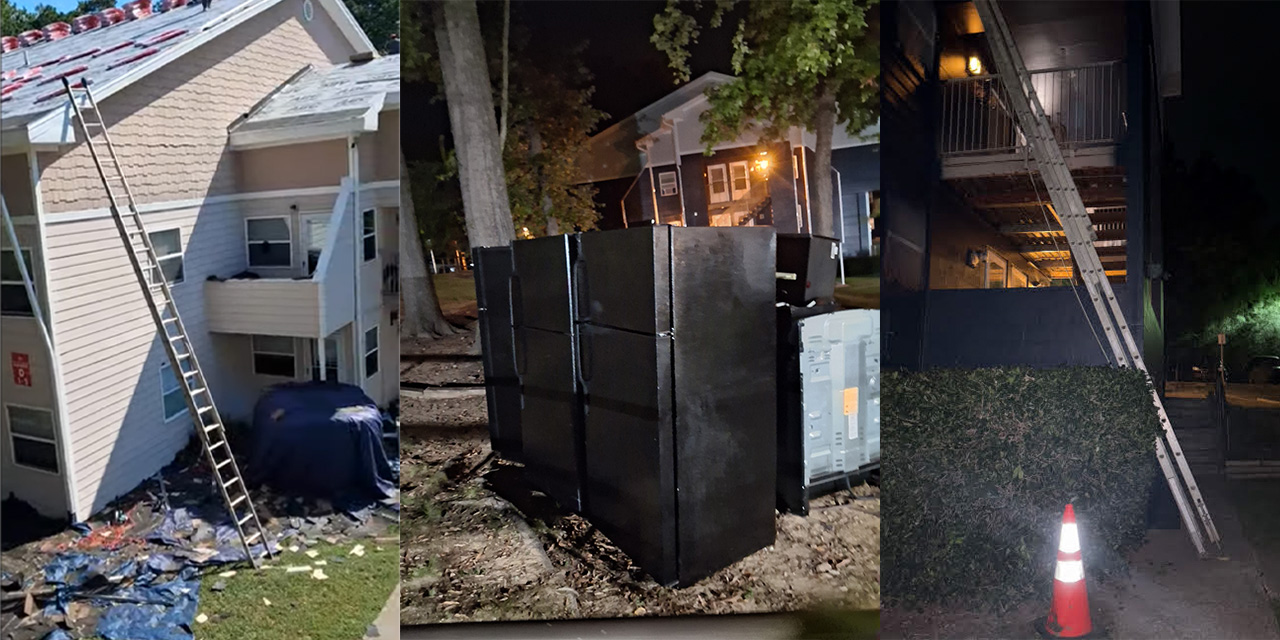
A collage of photos from around Elliott Woods Apartments as exterior renovations took place, including the lack of designated work zones around buildings, as well as interior appliances and work equipment left unattended overnight at the property. (Photos via Salima Smith.)
The fact that exterior work began before residents relocated to a hotel – covered by the property owners – was just one example of several that Elliott Woods residents feel represent the mismanagement of changes happening at the low-income housing neighborhood. In addition to its sister community of Chase Park Apartments of Highway 54, the tenants of 79 units have endured what they call a rocky transition since the local nonprofit INCHUCO sold the properties to Vitus Group. While the sale and renovations are part of preserving the neighborhood as low-income housing, many tenants are questioning the damage done from how the process is being handled to turnover of long-time residents.
Other problems include inconsistent on-site leadership – with the Fayetteville-based Remnant Management placing three different property managers to oversee the communities in the span of four months – and a lack of routine notices. While Vitus says it requires written notice to residents 90, 30 and 14 days before construction work begins, Elliott Woods tenants say they didn’t receive any warning. Additionally, the relocation dates for tenants kept shifting. Smith says her building was told in August that their deadline for moving to the hotel was November 2. On September 29, that date was changed to October 23. On October 6, it was changed again to October 22.
Between those moving targets and knowing how much renovation the old buildings need, Smith says she doubts a smooth return to her home. Already, the hotel stay is taking a toll and additional questions arise of how it will be handled if the renovations do not progress quickly.
“I don’t know what to expect,” she says of what moving back into Elliott Woods will be like. “There’s a part of me that’s expecting a halfway-finished project. They’re saying my return date is December 23… I don’t believe it.”
Laila Bradford won’t be able to return to hers. She moved into Elliott Woods Apartments in 1997 when she was living out of her car – and credits the community with providing stability as she eventually found a job, raised her children and met her husband, Randy. Known to many residents as “Mama Laila,” she’s long organized weekly meetups with the children of Elliott Woods for tutoring, craft projects, field trips and more. Since the transition of residents to the hotels, the meetings have turned into wellness checks and much of Bradford’s attention has been spent working with Chapel Hill-Carrboro City Schools’ transportation team to ensure students are added to bus routes.
Channeling her frustration into action, she says, has been helpful – but it’s left her with little time to emotionally process the fact that she will move out of the neighborhood.
“If we’re not trying to [compose] an email, a letter or working with the kids,” Bradford says, “I don’t feel like for me, personally, that I’ve been able to have that moment [to process]. Because, logistically, it’s been a nightmare for me.”
Distrust among the residents began to build even before Vitus bought the properties. People like Smith and Bradford began to raise alarms over living conditions at the apartment community in 2025 as it began to fall into disrepair and larger maintenance requests went unaddressed. The group then found out that INCHUCO was looking to sell both Elliott Woods and Chase Park Apartments to a new owner. The Seattle-based Vitus closed on the deal in May and held meetings with residents before and afterward to explain how it approaches affordable housing preservation. The 79 units are now reserved for tenants making 60% AMI or less (which would be less than $77,940 per household in Orange County), including 39 units whose residents use Section 8 housing vouchers – meaning some tenants in the two Chapel Hill complexes suddenly do not meet the income limits. Vitus says in those cases, it works with those residents “so these homes remain available to the households the program is designed to serve.”
For many Elliott Woods residents, though, the change caused confusion and intimidation. Several tenants told Chapelboro they were unclear what the threshold was – with some scrambling to get a second job in case they needed extra money, only to find out they exceeded the limit. Multiple reported Vitus and Remnant promised the disqualified tenants they would be offered market-rate leases to be able to return to their units after the renovations. But that latter option was muddled in communication by Remnant’s property management team, which led with surrender papers and a $7,500 check that many former residents took either without realizing it was a relocation incentive or because they needed the short-term cash. Others have since been told the market-rate option isn’t possible because of the waitlist of people wanting to apply for the renovated units.
Photo by Chapel Hill Media Group.
Bradford says her meeting with Remnant came after a stretch of travel and she signed her surrender papers without fully understanding what was happening – at one point, even mistakenly being issued a different tenant’s completed surrender papers by the property manager. She was later able to negotiate with Remnant to remain in her apartment until interior renovations began, but she and Randy had to find a new place to live. It’s still in Chapel Hill and close enough to visit the children at Elliott Woods, but Bradford says the rent is double what they have paid for years.
As a result, the educator says she’s mourning the fact she not only will leave the Elliott Woods neighborhood, but what will become of it when people return.
“It’s something that can’t be imitated and it’s something that can’t be replaced,” Bradford says of her connection with the families. “At first, I kept trying to be positive in my process. I kept saying, ‘I know we won’t be there, but my babies are going to have more.’ And I want my babies to have more.
“But then I hear,” she continues, “they’re not even going to put in [new] screen doors, so parents can’t watch their kids outside. Is that an improvement? Okay, well they replaced some of the toilets at Chase Park, but they didn’t replace all of them…is that an improvement?”
As the move-out date approached and the Elliott Woods residents continued to ramp up their calls of concern, more groups became involved. The Town of Chapel Hill agreed to issue $7 million in bonds to Vitus in March for the “rehabilitation” of both Elliott Woods and Chase Park, making the town responsible for the project until residents move back in and Vitus’ tax credits through the North Carolina Housing Finance Agency kick in. After Smith, Bradford and other residents spoke during a public comment portion of a town council meeting, Chapel Hill Mayor Jess Anderson sent a letter to Vitus leaders on October 13 requesting a meeting between Vitus, Remnant and a contractor. She described that as the first action of “taking whatever steps are necessary now to rebuild trust.” Additionally, the town’s housing director, Alicia Arnold, has visited the Elliott Woods community several times this fall to check in with residents.
Smith and Bradford say they have pushed to be part of meetings going forward between the town government and Vitus, although town staff have said they’d prefer to meet separately.
“We are somebody’s guinea pig,” Smith says. “This is the first time the Town of Chapel Hill is engaging in this kind of agreement where they’re being a bondsman for this sort of [neighborhood]…so we’re their guinea pig. This is a pilot program for them – and it’s going completely left. I don’t know what they’re learning from this, but we are being heavily impacted by it.”
“If we’re not at the table, then we are the lunch,” Bradford says. “And I’m tired of being on the menu.”
Additionally, the advocacy group Orange County Justice United is now working with Elliott Woods and Chase Park residents to help them know their rights, mobilize, and formalize their demands. That included a meeting with the nonprofit, apartment tenants, and members of the neighboring Church of Reconciliation on Tuesday night, with the goal of organizing an even broader, coordinated effort to support the two communities. The group discuss what additional third-party resources could be consulted to navigate both tenants’ rights and determine what Vitus and Remnant can be held accountable for.
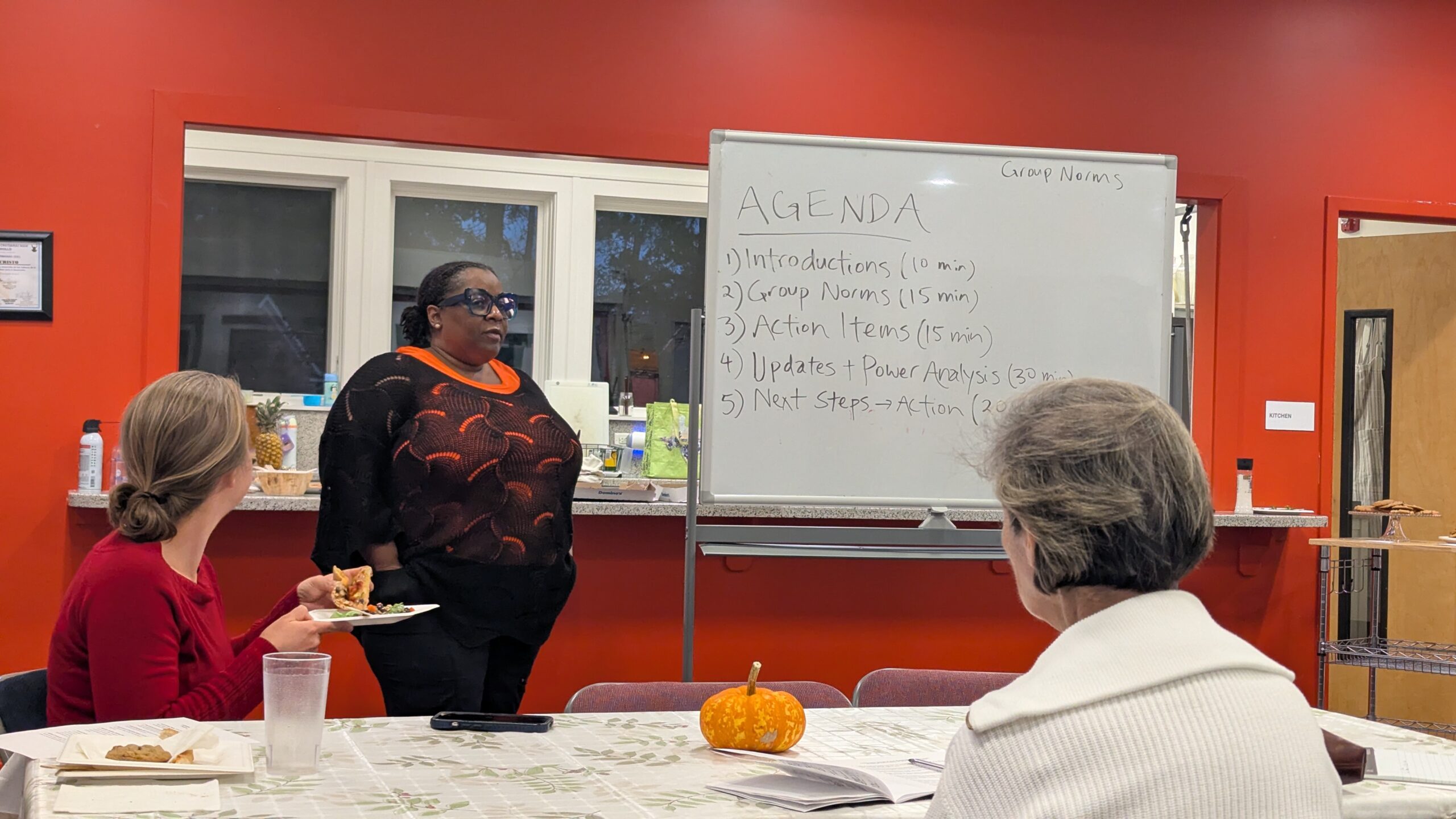
Salima Smith, a long-time Elliott Woods Apartments resident, speaks at an organizing meeting at the Church of Reconciliation on Tuesday, October 27. (Photo by Brighton McConnell/Chapel Hill Media Group.)
For now, the oversight action items brainstormed by residents include issuing a stop-work notice as an administrative audit is conducted of all breach notices and surrender agreements; requiring the 48-hour written notice prior to any construction work; establishing a weekly bulletin from Vitus confirming fixed relocation dates, hotel reservations, and designated management office hours; requiring confirmed relocation and return details when renovations are complete; and installing a resident liaison between tenants, Remnant property management, and Chapel Hill town staff.
For Smith, all the demands boil down to one thing.
“I want the truth – always,” she says. “Just be fully transparent about what you’re doing, when you’re doing it, and how you’re doing it so that people are not continuously harmed. Because what we’re dealing with now is people who are being harmed every single day.”
“We’ve been disrespected long enough,” Bradford adds. “Respect us and treat us like we are people – and not like the building we are coming out of.”
Even though those buildings need significant work to serve residents’ needs, it’s the people inside who make the community what it is. Whenever the people begin to move back into refurbished units, the turnover of tenants means a part of Elliott Woods will never quite be the same.
When reached for comment to confirm details of its responsibilities and relationship with Remnant Management, Vitus Development Manager Evan Laws shared this response regarding the difficulty of transitioning a community to having a specific income cap:
“Vitus recognizes how challenging this transition is, especially for neighbors who have called Elliott Woods and Chase Park home for decades. These communities are more than buildings to the people who live there, and our goal is for as many current residents as possible to stay. Preservation is about protecting a community’s long-term stability. Reinvesting in these properties and maintaining their affordability keeps homes safe, modern, and affordable for decades to come, for residents today and those who follow.“We want to preserve that sense of community residents value in our preservation and renovation efforts. One of the ways we’ve strived to do this is through engagement with the Church of Reconciliation, updating church staff on construction progress and working with them to continue programming that benefits Elliott Woods and Chase Park residents, including community gardening, movie nights, and soup deliveries.”
Chapelboro.com does not charge subscription fees, and you can directly support our efforts in local journalism here. Want more of what you see on Chapelboro? Let us bring free local news and community information to you by signing up for our newsletter.