
A new UNC initiative is working to strengthen global health systems and expand access to care worldwide. In collaboration with the World Health Organization and the Pan American Health Organization, the Center on Social Innovation and Health focuses on raising the vaccination rate, improving access to sexual health and reproductive health services, and working to reach underserved populations by developing new digital health services.
Chapel Hill’s is the newest Social Innovation in Health Initiative (SIHI) to join the global network of hubs working to advance community-engaged, equity-centered innovations in healthcare. Having launched in April, the initiative aims to connect grassroots, community-led efforts to solve urgent health challenges with funding and support.
It is a way for solutions to reach more people, one of the program’s co-directors Liz Chen shared in a university release.
“We’re really interested in finding people who are doing great work,” Chen later told 97.9 The Hill. “Especially those that are not necessarily in government, those who aren’t in higher education, but those that are embedded in communities here in North Carolina, and also in global contexts, and connecting them with the great resources we have at UNC Chapel Hill.
“So we have phenomenal researchers, we have great postdocs, and grad students,” she continued. “But how can we as a university better serve the mission of WHO and PAHO in improving health access and health equity.”

Liz Chen (right) speaking with 97.9 The Hill’s Aaron Keck on June 25. (Photo by Aaron Keck/Chapel Hill Media Group.)
As the North American hub, SIHI-UNC’s core goals include advancing participatory approaches to research and evaluating social innovations and supporting their adaptation across diverse settings. Another effort includes working with ministries of health and regional partners to integrate proven innovations into health systems.
Chen, who is an associate professor at the Gillings School of Global Public Health, said the initiative was in the works for about four years before being officially designated as a collaborative center by PAHO and WHO. She co-directs the program alongside UNC School of Medicine professor Joe Tucker.
“It is an honor to be designated with the level of expertise as a partner that aligns with WHO and PAHO missions,” Chen said. “And we really hope that we are able to network and build capacity and evaluate and contribute to research to help others who do great work in this area already.”
Despite one of the center’s focuses being the development of digital health services, Chen emphasized how innovation does not always merely mean tech-based advancements.
“Some of the programs coming out of [PAHO] region are programs that train community health workers, especially in prenatal care in hard-to-reach areas of the Amazon,” Chen said. “And so there doesn’t have to be tech, there’s just a knowledge transfer and a networking building. And it’s still a new way of doing something.”
The co-director said one of the center’s first priorities is growing that network locally and abroad. This summer, SIHI-UNC is hosting a six-month fellowship program to help participants from around the world deepen their understanding of social innovation. Chen said the members will pair with coaches at other hubs, with the goal of identifying upcoming leaders in healthcare, and in countries interested in building a capacity and infrastructure for social innovations.
Also on campus, UNC will offer a new elective course on social innovation in health, allowing students to learn various methods of social innovation and how to implement them to enhance participation and collaboration within communities. With topic-specific projects, Chen shared how she is particularly interested in exploring the impacts of artificial intelligence on mental and social health. While she said access to technology can be framed as a tool to advance equity in health, the co-director explained the harm it can cause on younger generations — particularly those living in rural areas.
“Especially if your friends don’t live right down the street from you, you might go to GenAI to be able to ask some questions, or look for information, or even socialize, or find affirmation and comfort,” Chen said. “So we need to understand the strengths and the ramifications and think about the social [part] of social innovation. What can humans and people do to foster more connection and address this in the future.”
To hear the full conversation, click here.
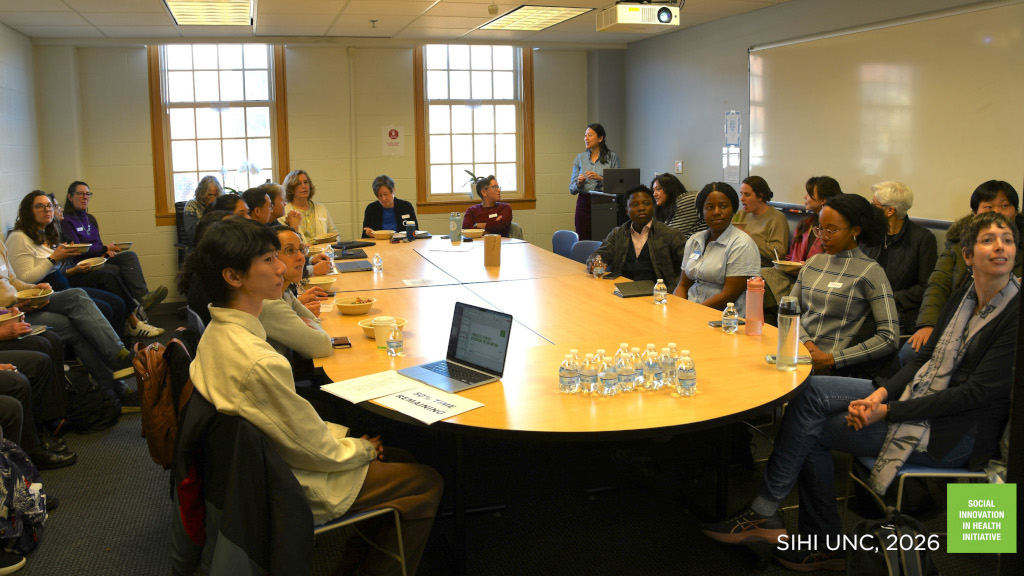
Featured image via SIHI-UNC.
Chapelboro.com does not charge subscription fees, and you can directly support our efforts in local journalism here. Want more of what you see on Chapelboro? Let us bring free local news and community information to you by signing up for our newsletter.