
After ending operations in 2024, nonprofit organization Orange County Living Wage has left a gap in our community’s discussion surrounding what constitutes a “living wage” and what the exact number in our specific area might be. In 2025, a new organization has picked up the torch.
As announced by Orange Democrats in a post written by by Susan Romaine — co-founder of OCLW — and calculated using “the same Universal Living Wage Formula (ULWF) used throughout the nonprofit’s ten-year tenure,” a living wage in Orange County can be estimated at $22.60 per hour, roughly $47,000 per year. If an employer pays “at least half of employees’ health insurance,” that hourly figure reduces by $1.50.
For reference a “living wage,” as the minimum amount of income a worker must earn through employment to afford rent and basic needs — food, transportation, clothing, medicine — without any reliance on additional assistance, public or private. In calculation of a living wage through the ULWF, it is important to note no additional expenses are included. Internet service, cell phone bills, meals at restaurants, gifts or personal purchases of any kind, and any amount of money contributed to savings are not part of the calculation.
The current minimum wage in North Carolina is $7.25 per hour – a number unchanged since 2009, adjusted for inflation or market conditions for nearly two decades. Using data from the Consumer Price Index (CPI) the inflation rate based on yearly averages from 2009 through the end of 2024 represents just above 46 percent change, with $100 of purchasing power equivalent to $146 today.
The 2025 Orange County living wage, as calculated using the ULWF by Orange Democrats, is well above $15.85 per hour calculated by Orange County Living Wage in 2022 and $17.65 in 2024, with most of that jump accounted by increases in rent costs in Orange County and surrounding cities.
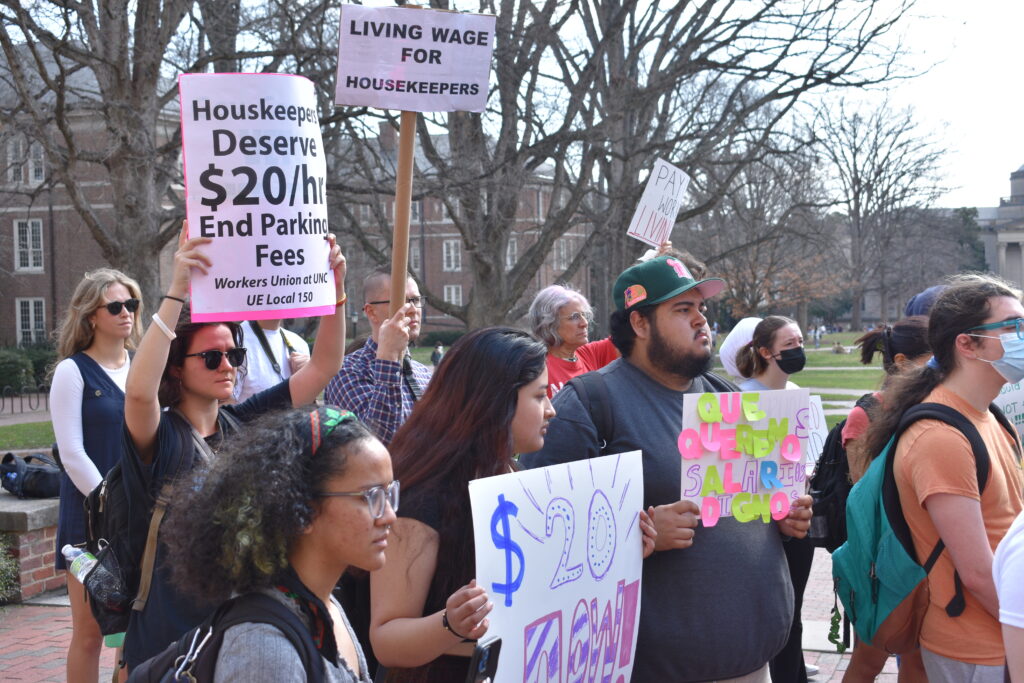
Through 2022 and into 2023, UNC housekeepers and community members demonstrated requesting fair wages and an end to charging employees to park their cars. After months of organizing and deliberation, housekeepers were granted a $0.90 raise per hour, and a reduction in parking fees. (Photo by H’aiasi Chinfloo)
The $22.60 living wage applies to a worker who is single, living in a one-bedroom apartment. As more dependents and family members are added to the equation, the living wages necessary to maintain stability and safety increase in kind. For further information and calculation, the MIT living wage calculator presents these numbers for Orange County across a variety of conditions.
The ULWF is based on the U.S. Department of Housing and Urban Development (HUD) standard suggestion of “no more than 30% of a worker’s gross income be spent on rent.” For an Orange County worker earning an annual salary of $45,000, that puts rent for a one-bedroom apartment at $1,125 — which would be tough to find in Orange County. According to Orange Democrats, “almost one-third of Orange County workers live in and commute from the surrounding counties of Alamance, Chatham, and Durham,” so the Orange County equation was tuned to account for average costs of one-bedroom apartments in the four-county area of Alamance, Chatham, Durham, and Orange.
With a living wage standing at just about triple the minimum enforced by state, and federal, law — Orange County has a long way to go before many residents are able to afford to live here, raise families here, and truly call Orange County home.
Chapelboro.com does not charge subscription fees, and you can directly support our efforts in local journalism here. Want more of what you see on Chapelboro? Let us bring free local news and community information to you by signing up for our newsletter.

