Europe’s push into electric cars is gathering speed — despite the pandemic.
Automaker Volkswagen tripled sales of battery-only cars in 2020 as its new electric compact ID.3 came on the market ahead of tough new European Union limits on auto emissions. And Germany, long a laggard in adopting electric vehicles, saw more people buy electrics in December than opted for previously dominant diesel vehicles.
Those are early signs of what will likely be an upcoming year of increasing market share for electric cars as EU regulations drive their adoption, despite the recession caused by the coronavirus pandemic that has caused the overall car market to shrink.
Volkswagen said Tuesday its namesake brand sold 134,000 battery-powered cars last year, up from 45,000 in 2019.
Including hybrids, which combine an internal combustion engine and an electric motor, sales of electrified cars reached 212,000, up from 82,000 in 2019.
Volkswagen’s announcement comes as the auto industry association in Germany reports that one in four cars sold in the country in December had an electric motor, uptake that was supported by incentives as part of the government stimulus package during the COVID-19 recession.
Battery and hybrid cars took 26.6% of sales that month, running ahead of diesel cars, which had 26.2%. That is also a token of diesel’s steep decline after Volkswagen’s 2015 scandal involving diesel cars rigged to cheat on emissions tests.
Electric cars have so far been a small but rapidly growing slice of the European market.
Automakers in the EU must sell more zero-emission cars in order to meet tougher fleet average limits on emissions of carbon dioxide, the primary greenhouse gas blamed for climate change. Those limits came fully into effect on Jan. 1. Failure to achieve a fleet average of less than 95 grams of carbon dioxide per kilometer driven can mean heavy fines.
Sales have been driven by government incentives, and by an increasing number of new models that — like the ID.3 — were designed purely as electric cars, rather than being converted from internal combustion models.
Demand has been held back by lack of places to charge electric cars, including for people who live in apartment buildings and can’t install a charging box at home. Germany’s auto association, the VDA, said there’s only one publicly available charging station for every 17 electric cars.
California-based Tesla has been a major factor in the electric upswing with its Model 3 and its proprietary network of fast-charging stations.
Related Stories
‹
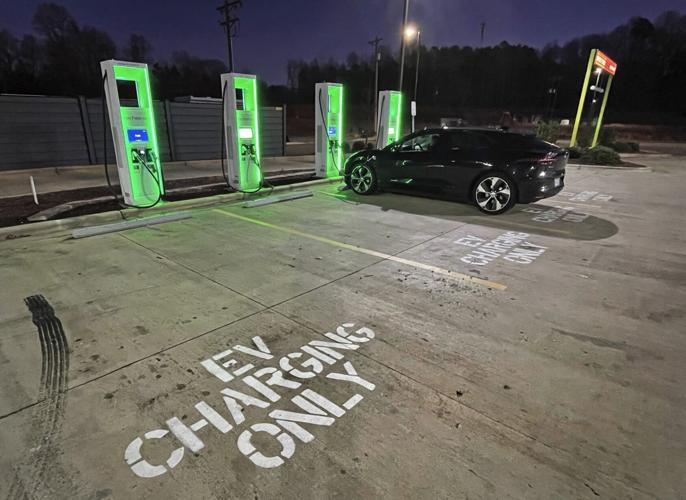
NC Tops 50K EVS; Triad’s Electric Vehicle Pace Trails StateWritten by JOHN DEEM (The Winston-Salem Journal) North Carolina has accelerated past the 50,000 mark for electric vehicle registrations, but EV saturation in the Triad continues to lag behind the state as a whole. Through October, 51,500 plug-in vehicles were registered in the state, according to the N.C. Department of Transportation. Ten Triad region counties […]
Most Major Nations Lag in Acting on Climate-Fighting GoalsWritten by SETH BORENSTEIN For most of the major carbon-polluting nations, promising to fight climate change is a lot easier than actually doing it. In the United States, President Joe Biden has learned that the hard way. Among the 10 biggest carbon emitters, only the European Union has enacted polices close to or consistent with international goals […]

France Records Around 1,000 Additional Deaths as Extreme Heat Breaks European RecordsWorld Health Organization warned that Europe is now the fastest-warming continent and needs to do more to protect its citizens.

What If Just 1 in 10 People Changed How They Eat, Drive, Heat or Shop?Climate change is often viewed as too big an issue for individual action. But when personal choices add up, the impact can be significant.

Town of Carrboro Argues Case in Duke Energy, Climate Change Lawsuit's Initial HearingThe Town of Carrboro presented its legal rationale for continuing a 2024 climate change-focused lawsuit against Duke Energy on Thursday.

The Far Right’s Election Gains Rattle EU’s Traditional Powers, Leading Macron to Call Snap PollsWritten by RAF CASERT, LORNE COOK and SAMUEL PETREQUIN Far-right parties rattled the traditional powers in the European Union with major gains in parliamentary seats, dealing an especially humiliating defeat to French President Emmanuel Macron, who called snap legislative elections. Some ballots in the vote for the European Parliament were still being counted Monday, but the outcome […]
EPA Pollution Limits Aim To Boost Us Electric Vehicle SalesWritten by MATTHEW DALY and TOM KRISHER The Biden administration is proposing strict new automobile pollution limits that would require as many as two-thirds of new vehicles sold in the U.S. to be electric by 2032, a nearly tenfold increase over current electric vehicle sales. The proposed regulation, announced Wednesday by the Environmental Protection Agency, […]
Biden’s Next Climate Hurdle: Enticing Americans To Buy GreenWritten by CHRIS MEGERIAN, HANNAH FINGERHUT and MATTHEW DALY President Joe Biden persuaded Democrats in Congress to provide hundreds of billions of dollars to fight climate change. Now comes another formidable task: enticing Americans to buy millions of electric cars, heat pumps, solar panels and more efficient appliances. It’s a public relations challenge that could […]
![]()
Report: War-Triggered Gas Boom Threatens World Climate GoalWritten by SETH BORENSTEIN The war-inspired natural gas boom is undermining already insufficient efforts to limit future warming to just a few more tenths of a degree, a new report says. Planning and build-up of liquified and other natural gas — due to an energy crisis triggered by Russian’s invasion of Ukraine — would add 2 billion tons of […]

Supreme Court Limits EPA in Curbing Power Plant EmissionsWritten by MARK SHERMAN In a blow to the fight against climate change, the Supreme Court on Thursday limited how the nation’s main anti-air pollution law can be used to reduce carbon dioxide emissions from power plants. By a 6-3 vote, with conservatives in the majority, the court said that the Clean Air Act does not […]
›