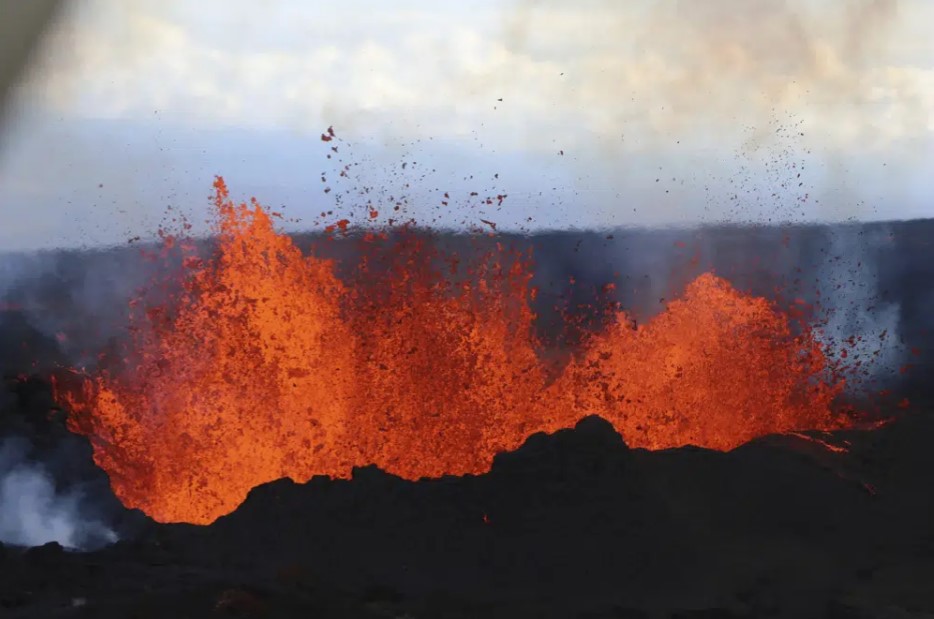
Red-hot lava spewed from a volcano near the Philippine capital of Manila on Monday as tens of thousands of people fled through heavy ash and frightening tremors, and authorities made plans to evacuate hundreds of thousands more for fear of a bigger eruption.
Clouds of ash from the Taal volcano reached Manila, 65 kilometers (40 miles) to the north, on Sunday, forcing the shutdown of the country’s main airport, with more than 500 flights canceled. The airport partially reopened Monday after the ashfall eased.
There were no immediate reports of any deaths or major damage directly blamed on the eruption. A truck, however, skidded out of control on an ash-blanketed road, killing the driver and injuring three companions in Laguna province in an accident police said may have been linked to slippery conditions.
The government’s disaster-response agency and other officials reported more than 30,000 villagers fled their homes in the hard-hit province of Batangas and nearby Cavite province. Officials expected the number to swell.
Some residents could not immediately flee their ash-blanketed villages because of a lack of transportation and poor visibility. Others refused to leave their homes and farms.
“We have a problem — our people are panicking due to the volcano because they want to save their livelihood, their pigs and herds of cows,” Mayor Wilson Maralit of the town of Balete told DZMM radio. “We’re trying to stop them from returning and warning that the volcano can explode again any time and hit them.”
Maralit, whose town lies along the shoreline of Taal Lake, which surrounds the erupting volcano, appealed for troops and more police to stop people from sneaking back to their villages.
After a cleanup and a shift of ash-laden winds away from Manila, officials partially reopened the main airport and allowed planes to take off. President Rodrigo Duterte’s aircraft was able to land in Manila on Monday from his hometown of Davao, his spokesman said, adding he saw the extent of the disaster from the plane.
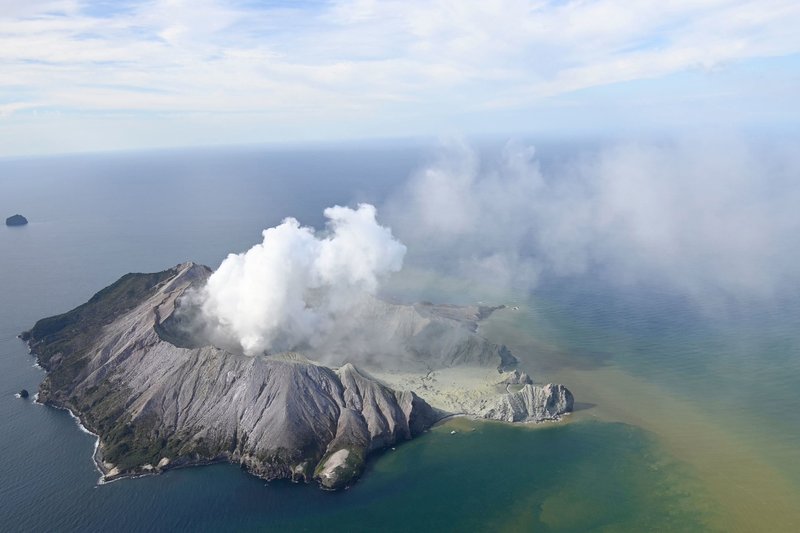
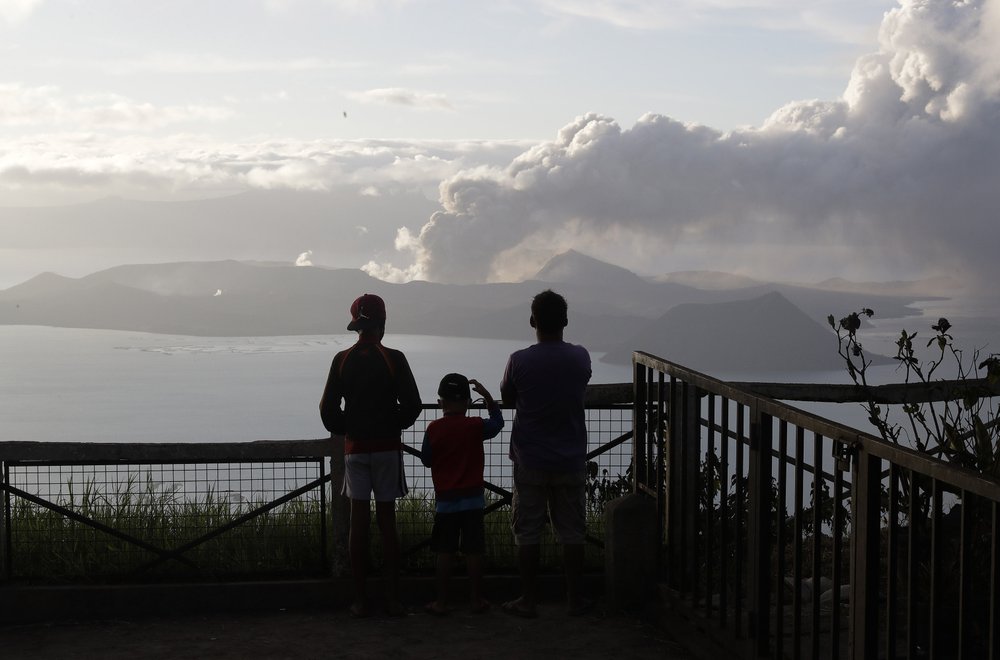
Taal suddenly rumbled back to life on Sunday, blasting steam, ash and pebbles up to 10 to 15 kilometers (6 to 9 miles) into the sky, according to the Philippine Institute of Volcanology and Seismology.
On Monday, the ash and steam column reached a height of 2 kilometers (about a mile), with lava fountains spurting less than half of that height before falling into the lake waters surrounding the main crater. Lava also spurted from another vent north of the main crater, said Renato Solidum, who heads the institute.
Frequent tremors and a buildup of pressure of the 1,020-foot (311-meter) volcano, one of the world’s smallest, however, indicated a major and much more dangerous eruption could still happen, he said.
The government volcano-monitoring agency raised the danger level around Taal three notches on Sunday to Level 4, indicating a hazardous eruption within hours to days was possible. Level 5, the highest, means such an eruption is underway.
The volcano’s last disastrous eruption happened in 1965, when more than 200 people were killed.
Irene de Claro, a mother of four, worried about her father, who stayed behind in their village in Agoncillo while the rest of the family fled.
“My father is missing. We don’t know, too, what happened to our house because the ash was up to our knees, it was very dark and the ground was constantly shaking when we left,” de Castro said at a school in the town of Lemery. “Most likely there’s nothing for us to return to. We’re back to zero.”
The small island where the volcano lies has long been designated a “permanent danger zone,” though fishing villages have existed there for years. Those residents were all evacuated, volcanology officials said, adding that there should be a total evacuation, too, of endangered communities within a 14-kilometer (8.7-mile) radius of Taal.
Government work was suspended and schools closed in a wide swath of towns and cities, including Manila, because of the health risks from the ash.
Taal is regarded as the second-most restive of about two dozen active volcanoes in the Philippines, which lies along the Pacific “Ring of Fire,” a region prone to earthquakes and volcanic eruptions. A long-dormant volcano, Mount Pinatubo, blew its top north of Manila in 1991 in one of the biggest volcanic eruptions of the 20th century, killing hundreds of people.
About 20 typhoons and other major storms each year also batter the Philippines, making it one of the world’s most disaster-prone countries.
Related Stories
‹

White House Says Admiral Ordered Follow-up Strike on Alleged Drug Boat, Insists Attack Was LawfulWritten by AAMER MADHANI and REGINA GARCIA CANO WASHINGTON (AP) — The White House said Monday that a Navy admiral acted “within his authority and the law” when he ordered a second, follow-up strike on an alleged drug boat in the Caribbean Sea in a September U.S. military operation that has come under bipartisan scrutiny. White House press secretary Karoline […]

How the Hot Water That Fueled Hurricane Beryl Foretells a Scary Storm SeasonWritten by SETH BORENSTEIN Hurricane Beryl’s explosive growth into an unprecedented early whopper of a storm shows the literal hot water the Atlantic and Caribbean are in right now and the kind of season ahead, experts said. Beryl smashed multiple records even before its major-hurricane-level winds approached land. The powerful storm is acting more like monsters that […]

Prayers? Bombs? Hawaii History Shows Stopping Lava Not EasyWritten by AUDREY McAVOY Prayer. Bombs. Walls. Over the decades, people have tried all of them to stanch the flow of lava from Hawaii’s volcanoes as it lumbered toward roads, homes and infrastructure. Now Mauna Loa — the world’s largest active volcano — is erupting again, and lava is slowly approaching a major thoroughfare connecting the Big Island’s east and […]
![]()
‘I Cannot Mourn’: Former Colonies Conflicted Over the QueenWritten by CARA ANNA, DANICA COTO and RODNEY MUHUMUZA Upon taking the throne in 1952, Queen Elizabeth II inherited millions of subjects around the world, many of them unwilling. Today, in the British Empire’s former colonies, her death brings complicated feelings, including anger. Beyond official condolences praising the queen’s longevity and service, there is some bitterness about […]
![]()
Three of Tonga’s Smaller Islands Badly Damaged by TsunamiWritten by MOUSSA MOUSSA and DAVID RISING Three of Tonga’s smaller islands suffered serious damage from tsunami waves, officials and the Red Cross said Wednesday, as a wider picture begins to emerge of the destruction caused by the eruption of an undersea volcano near the Pacific archipelago nation. Communications have been down throughout Tonga since […]
![]()
After 3 Tense Months, Spanish Volcano Eruption May Be OverWritten by ARITZ PARRA and BARRY HATTON Residents on the Spanish island of La Palma dared to hope Wednesday that a volcanic eruption is over after almost three months of unnerving daily explosions, earthquakes, rivers of molten rock and a huge ash plume containing toxic gases. The Cumbre Vieja volcano in the Canary Islands off […]
![]()
Small Islands Caught Between Tourism Economy, Climate ChangeWritten by MALLIKA SEN Come visit the Maldives, its president entreated the world at this year’s United Nations General Assembly, moments before switching to an impassioned plea for help combating climate change. The adjacent appeals illustrated a central dilemma for many small island developing states: their livelihoods, or their lives? The United Nations recognizes 38 member states, […]
![]()
‘Huge’ Explosion Rocks St. Vincent as Volcano Keeps EruptingWritten by KRISTIN DEANE and DÁNICA COTO La Soufriere volcano fired an enormous amount of ash and hot gas early Monday in the biggest explosive eruption yet since volcanic activity began on the eastern Caribbean island of St. Vincent late last week, with officials worried about the lives of those who have refused to evacuate. Experts […]

Philippine Volcano Trembles More, Spews Lava Half-Mile HighA volcano near the Philippine capital spewed lava into the sky and trembled constantly Tuesday, possibly portending a bigger and more dangerous eruption, as tens of thousands of people fled villages darkened and blanketed by heavy ash. Government work was suspended and schools were closed in a number of towns and cities, including Manila, because […]
![]()
Lava Gushes from Volcano Near Manila, Tens of Thousands FleeRed-hot lava spewed from a volcano near the Philippine capital of Manila on Monday as tens of thousands of people fled through heavy ash and frightening tremors, and authorities made plans to evacuate hundreds of thousands more for fear of a bigger eruption. Clouds of ash from the Taal volcano reached Manila, 65 kilometers (40 […]
›