
In the spring of 2020, everything changed.
Everything changed first over COVID-19. People worked from home, others lost their jobs. Overnight, our plans changed. Our needs changed. And the organizations we counted on to meet those needs – they had to change as well.
And something else was happening too. The same week North Carolina closed its schools, a woman named Breonna Taylor was shot and killed by police in Louisville. Two months later, George Floyd was killed in Minneapolis. And as people flooded the streets in protest, once again, we realized things had to change.
It’s now been three years since that spring. What have we learned from our experience? What lessons have we taken away? What changes have we made? And which of those changes will last?
“Three Years” is a series by 97.9 The Hill’s Aaron Keck – looking back on our memories and lessons learned from our collective experience, drawn from conversations with numerous government officials, nonprofit heads, scholars and thought leaders in the Chapel Hill-Carrboro community.
Click here for the entire 15-part series.
Listen to Chapter 14:
Chapter 14: The Positives
Orange County health director Quintana Stewart sums up a feeling I think a lot of us have about the last three years: “I feel like I saw the best in a lot of folks,” she says, “(but) I would be remiss if I didn’t say I also saw the worst.”
We can’t talk about the last three years without talking about the politics. We Americans were already polarized before 2020, and COVID only made that worse – in stark contrast even to recent pandemics of the past.
“I was in middle school when the swine flu happened,” says Chapel Hill Town Council member Tai Huynh. “We got vaccinated in school, and I remember…everyone was on the same page. It was like, ‘this is bad, we need to do something fast, we need to protect ourselves.’ No matter what background you came from, we could all agree on the science…
“But with Covid – depending on your political views, you had a starkly different perspective. And that was just crazy to me. My strongest memories are arguing, trying to convince my aunts, uncles, my grandpa that this was a serious threat that they had to take seriously – and it was very much an uphill battle, because media sources were telling them this isn’t a real threat. And not until they saw people they know start dying, did they really start to take it seriously.”
“Did they at that point?” I ask.
“Most of them did,” he says. “I still have some family members that are on that (denial) train to this day. Which is infuriating.”
At the center of it all were public health officials, trying to give objective guidance and sometimes make big decisions in the midst of a very intense political fight.
“I really felt that public health was safe from all the political stuff,” says Quintana Stewart. “I felt like I got caught flatfooted.”
“Do you feel like you did okay in spite of that?” I ask.
“I guess?” she says with a laugh. “I mean, I’m really proud of Orange County. Early on – I don’t know if you remember, but when the governor was doing those early COVID briefings, we were called out for having the large outbreaks in the nursing home, and – oh my gosh, the deaths were just rolling in. And I just remember thinking, ‘oh my God, what am I gonna do?’ But again, supported by a great team, (and) our partners over at UNC, we were able to maintain and get to the point that we are at today.”
“What surprised you?”
“I think I was just really disappointed to see the public health crisis be politicized,” she says. “Because nothing about it was political. The virus didn’t care which political party you belonged to, didn’t care about your race. It was affecting our entire community. I think we’re going to get back to the place where we are trusted and allowed to do our jobs – but yeah, that political thing, it really just threw me for a loop. I just – I never anticipated it would get the way it got.”
It was also intense for officials in the schools, who had to make highly charged decisions about closures and mask policies.
Hillary Mackenzie became chair of the Orange County School Board in July of 2020.
“I think the biggest surprise has been the coupling of COVID mitigation resistance with resistance to equity work,” she says. “Like, Proud Boys showing up in costume to our meetings felt kind of surprising at first.”
“Yeah, what was that experience for you?” I ask.
“It was sort of unbelievable,” she says. “There was one specific, maybe (the) most intense interaction: we had a board meeting in a middle school auditorium, and I would say there were like 40 Proud Boys in there. Moms for Liberty were there. It was incredibly intense – it was one of the few times that I have felt really vulnerable in this work.”
“What happened that you didn’t see coming?”
“I think the gravity of the decision making is one of the things that surprised me most in the moment,” she answers. “There were times that we were approaching a vote to remain virtual or reopen school buildings, where we were hearing from parents of immunocompromised kids who were really scared for their safety, staff members who were pregnant or had newborns at home…so, you know, when you’re talking to people who are really scared for their family and their lives, that’s heavy.
“And then on the other side, you had parents who were first responders, who worked in hospitals (and) didn’t have the choice of going to work or not. And we lean on our public schools so much to provide so many services, but childcare is baked into that – and we heard from people who were going to lose their homes if schools didn’t reopen, because they didn’t have (other childcare) options. And when you’re in a leadership role and weighing how serious people felt and the experiences they were having – it was really heartbreaking and really hard.”
I’m struck by that. “You were hearing that from first responders,” I say. “I think people, even now, look at (a) person who works in a hospital who’s an anti-masker (or) wants the schools to open up as soon as possible, ‘what are they even thinking?’ But that’s what they’re thinking.”
“You know, this issue has been so politicized,” Mackenzie says, “and it’s hard to hear the heart of people. But at the end of the day, I think people were just really suffering. And when folks are experiencing trauma, you don’t always see the most graceful side of them. But it doesn’t mean that what they’re going through can’t resonate, if you’re really listening.
“I remember chairing that meeting in early January and – like, weeping, as I’m running a meeting. And it still is heavy.”
But while the politicization of COVID made things harder for public officials in general, local leaders were able to draw lessons from political fights elsewhere to enact better policies here.
“I learned that (curfews) had really severe consequences in other cities,” says Chapel Hill Mayor Pam Hemminger. “They had tried curfews and it really backfired on them, and it was bad. So we came up with the idea to (just) limit alcohol sales at a certain time, (because) we were noticing the biggest groupings of people were in bars. And it was funny: the governor’s office called us and said, ‘why’d you do this?’ We said, ‘because we learned curfews were bad and we could enforce this.’ And I called a bunch of restaurants to see what time they quit serving food. (They said) 8:30 or 9:00 – so, you know, another hour to eat your meal and have your beverage, but (then) you’re done. That really helped, the learning from each other, until we got a federal government that was willing to tell us stuff.”
And while part of COVID’s legacy must be the polarization and the bad feelings it generated, many of the people I spoke with also identified silver linings, positive things that might not have happened if not for the pandemic.
Chapel Hill, for instance, had a longstanding issue with low sales tax revenue – but that’s less of an issue now because residents started buying things online from their own homes instead of visiting stores out of town.
And surprisingly, the local restaurant scene is, in many ways, more vibrant than ever, because so many people made a commitment to support local restaurants – and stayed in the habit to this day.
“We hated losing the ones we lost, we really did,” says Hemminger. “But we had more restaurants open up during COVID than we lost.”
And Mayor Hemminger says the pandemic even got us some new neighbors.
“That was another thing that surprised us,” she says. “We were just inundated with people who came here from New York City and other big cities. I’ve met five or six families that decided to stay here – they like the environment and they’re working remotely.”
And while COVID had a negative impact in general on our lives and relationships, the positives were present too – a lot quieter, perhaps, but still there.
State poet laureate Jaki Shelton Green taught students on Zoom every day for two years.
“One of the assignments I gave was to write a love letter to COVID,” she says. “And then they got to write a ‘kick COVID’s behind’ letter. What was really, really wonderful was listening to young men in tears saying to me, ‘nobody asked us, no one asked us what we were feeling as kids, what we were going through…’
“The love letter was hard for them. They were like, ‘love letter, are you kidding me?’ I said, ‘well, a lot of good things happened that might not have happened. Think about it.’ I remember a very powerful story that this young kid wrote about his father. He said, ‘the most wonderful thing about COVID for my family was (that) my dad the workaholic was home.’ He said, ‘I never see my dad. Sometimes I feel like my dad, even when he’s not working, just stays at the office…but I’d forgotten how fun my dad was. I’d forgotten what it was like to to play catch in the backyard with me and my little brother.’ He said, ‘we built a barn, we built a backyard fort for my little brother.’
“So to hear these stories of families coming back together – I heard that over and over again,” Green continues. “And then, you know, they had some sad stories about losing grandparents or relatives or neighbors and their own fears. But what’s beautiful to me is to witness how young people are critical thinkers, and needed to talk about it.”
So when all is said and done, what has been the impact of the last three years?
A lot bad, some good – and different for different people, different times and different communities.
Hillsborough Mayor Jenn Weaver says she’s worried the social divisions from the pandemic could be hard to mend.
“My hope is that those aren’t permanent, but I do think that they’re long lasting,” she says, “and I think we have a ton of work to figure that piece out.”
But if Jaki Shelton Green’s approach is right, then in spite of the troubles of the last three years, we can still look forward with hope and gratitude.
“It’s hard to imagine doing this job anywhere else,” Weaver says. “So I feel very grateful to be in this particular place.”
Click here for the entire 15-part series.
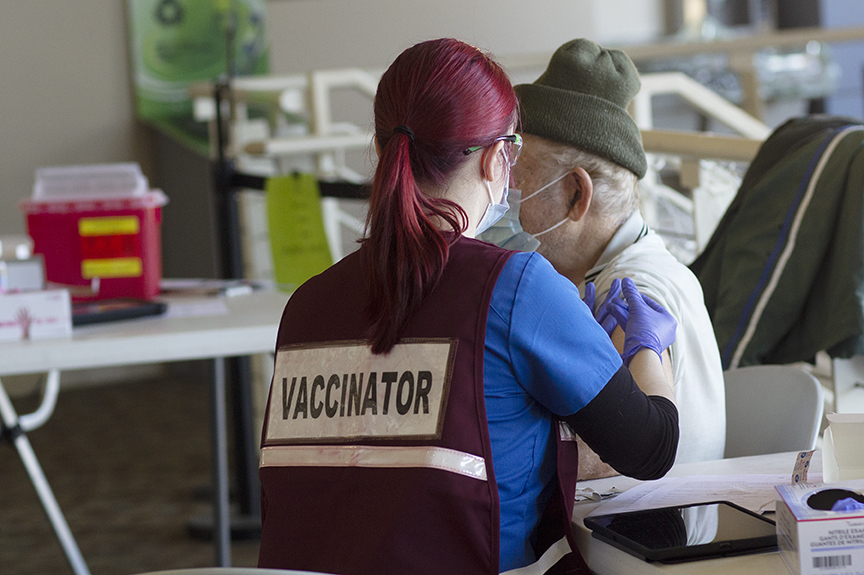
Featured photo: one of the earliest vaccination clinics, in Orange County in January 2021.
Chapelboro.com does not charge subscription fees, and you can directly support our efforts in local journalism here. Want more of what you see on Chapelboro? Let us bring free local news and community information to you by signing up for our biweekly newsletter.

