
Often attributed to Mark Twain — perhaps mistakenly, since no historical source shows he actually made the statement — “History doesn’t repeat itself, but it often rhymes” is a common and apt refrain when discussing the connection between historical perspectives and current events. By drawing on knowledge of what happened in the past, and why, we are better able to understand the flow and direction of the history collectively created in each new day.
“Past Rhymes With Present Times” is a series by Lloyd S. Kramer exploring historical context and frameworks, and how the foundations of the past affect the building of the future.
The authoritarian ambitions and actions of the Trump administration are disrupting and destroying human lives throughout the United States, Latin America, and the Middle East.
America’s illegal war against Iran has become the most recent example of how Trumpism resembles Napoleonic authoritarianism by launching foreign military assaults during a time in which the government continues to arrest and imprison people who live within the nation’s political borders.
Replicating the misjudgments of Napoleon’s (ill-fated) invasion of Russia in 1812, Trump has launched a war that gratifies his own desires for global power and uses Bonapartist impulses to bypass elected governing bodies, ignore complexities within the nation he is attacking, and neglect systematic planning for the setbacks and international chaos that flow from the resistance of people he does not understand.
Amid this widening global conflict, however, the authoritarian “ICE round-up” of immigrants advances in American cities while political leaders and the national media turn their attention to the new war or focus on Trumpism’s other distracting upheavals.
Although the anti-immigrant detention centers and deportations are destroying more lives and human rights than most Americans can comprehend, the current detentions carry historical similarities with the nineteenth-century deportations of Native Americans from states such as Georgia, North Carolina, and Tennessee.
Historical memories cannot change long-ago events, but they can help us understand recurring patterns of repression, even when discussions of past and present injustices might disturb the patriotic beliefs or daily activities of our “normal” American lives.
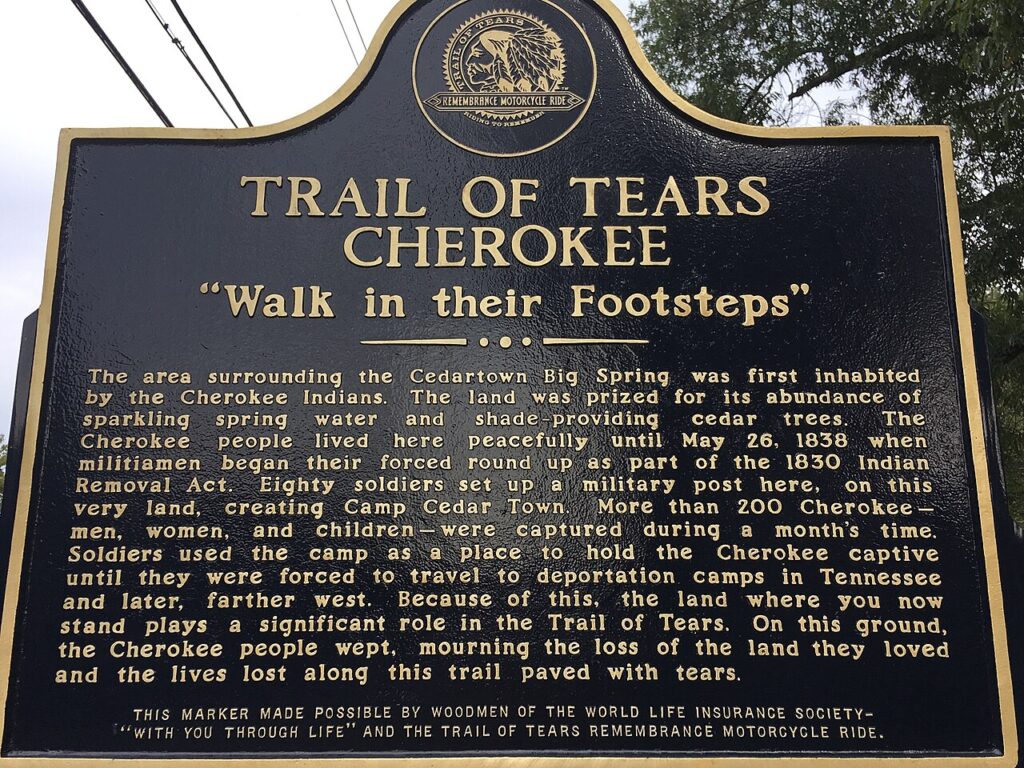
Trail of Tears sign in Big Spring Park (photo via Wikimedia Commons)
ICE and American Detention Camps in 2026
While most Americans have been dealing with their own work, families, friends or financial challenges, the Trump administration has opened more than 100 additional detention centers since coming to power in January 2025.
A well-researched report from the American Immigration Council recently confirmed that the ICE confinement system was holding almost 70,000 people in detention camps by the end of last year. ICE arrests had increased by roughly 600% over a nine-month period; and Congressional funding has provided almost $15 billion per year for building and managing a vast network of detention centers at military bases, special “correctional” facilities, and industrial-style warehouses that are being reconfigured to imprison thousands of future detainees.
The Immigrant Council has also described the national government’s plans to hold up to 135,00 people in the widely scattered detention centers. Such facilities enhance the deportation process because planeloads of immigrants can be sent more efficiently from these imprisonment sites into other countries and because most detainees are separated from lawyers and family members who might otherwise find legal means to block a pending expulsion.
Overcrowded detention centers lack good food, adequate water, proper sewage facilities, and essential health care. Anyone who is confined in such inhumane conditions thus becomes vulnerable to diseases and emotional despair, and family separations or childhood diseases make the confinements especially dangerous for children.
Repressive detentions violate our most important national commitments to human rights and human dignity, but the history of the Cherokee “Trail of Tears” shows how ICE agents have revived some of the most damaging aspects of an earlier American expansionism that forcefully displaced racial and cultural groups who differed from nationalist definitions of “true Americanism.”
The Indian Removal Act and American Detention Camps in 1837
The Cherokee people had long lived in mountainous lands that were brought into North Carolina, Georgia, and Tennessee after the American Revolution. Recognizing how European Americans were rapidly advancing toward these lands, the Cherokee Nation created a new constitution to guide a self-governing national council.
This institutional structure also helped the Cherokees develop their own court system, expand their agrarian and trading economy, introduce a written language for their children’s education, establish a newspaper for their political debates, and assert their ongoing control over lands where they had built their homes.
In short, the Cherokee were living within the kind of self-governing institutions that European Americans were also promoting in their emerging republic. Yet the growing white population wanted the lands and natural resources of Native communities in which racial and social identities diverged from the assertive cultural nationalism that was shaping the expansive political ambitions of the United States.
The US Congress therefore passed the Indian Removal Act of 1830. This far-reaching legislation mandated new “treaties” that would force Native nations to cede their lands to the expanding American states and compel Native people to migrate to distant “Indian territories” in Oklahoma.
Some European American missionaries and humanitarians opposed this expulsion. One of these protestors, Samuel Worcester, was imprisoned for defending Cherokee rights, and his legal arguments for personal freedom and Native rights eventually reached the US Supreme Court.
The Court (surprisingly) reaffirmed the Cherokees’ right to remain on their own lands in Worcester v. Georgia, but President Andrew Jackson and the state governments simply ignored the Court’s ruling and proceeded with plans for the “Indian Removal.”
Despite overwhelming opposition among the Cherokee people, a few leaders decided that departure for the west would be the best strategy for Cherokee survival. They thus signed the “New Echota Treaty” in late 1835, thereby launching a deportation project that remains a tragic historical precedent for expulsion policies down to our own time.
Although a few Cherokee families began to “self-deport” in 1836, General Winfield Scott was given command of roughly 2000 troops who were ordered to remove the recalcitrant Cherokees from their ancestral lands. As Scott’s troops moved into Cherokee communities, he instructed his officers to establish detention camps at military forts, to bring “in as many Indians” as they could “secure at once,” and to move them “under proper escort to the most convenient of the emigrating depots.”
Detention centers were scattered across several states, so the soldiers faced logistical challenges in transporting, feeding, and controlling their unhappy prisoners. One young man named William Cotter, who was employed to bring provisions to the detention camps, later explained how the soldiers seized Cherokees “in the road, in the field, [and] anywhere they found them” in their own communities. “It was a mournful sight to all who witnessed it,” Cotter later wrote in a memoir, “old men and women with gray hairs walking with the sad company.”
Deportations and the Cherokee “Trail of Tears”
General Scott provided public assurances that detainees continued “to enjoy good health” in the detention camps, but the imprisoned Cherokee suffered from diseases, from family separations, and from the psychological distress of losing their valued household possessions.
Children were especially threatened by the spread of whooping cough, so some of the youngest and oldest Cherokees were dying even before the migrant caravans started on their woeful journeys toward Oklahoma. As the detention camps reached full capacity, federal officials organized large-scale and carefully guarded migrations of unhappy people whom the soldiers led across Tennessee, Kentucky, Illinois, and Missouri on foot, in small wagons or (sometimes) in boats.
Many deported people struggled to survive the harsh winter of 1837-38. They were forced to walk through bad weather, exposed to freezing temperatures in makeshift encampments, or placed in wagons with extremely ill fellow travelers. One of the doctors who assisted a caravan of immiserated migrants reported in 1839 that more than 4000 Cherokee (out of roughly 16,000 deported people) had died in the detention camps or in one of the caravans that traveled from the camps into the western Indian territories.
The human costs of these painful migrations suggest why Cherokee storytellers later described this deadly trek as “the Trail of Tears,” though even this grim metaphor fails to convey all the losses that afflicted people from the day they were forced out of their homes to the day they reached the unknown territories in which they had never wanted to live.
The United States ultimately deported about 80,000 Native Americans from eastern states in the period after 1830; and at least 13,000 died in the detention camps or during the difficult western journeys. Federal authorities could never find all the people they wanted to deport, however, and almost 1000 Cherokees escaped by hiding in the most remote mountains of western North Carolina. Their resilient descendants would become the eastern band of the Cherokee nation.
Human Rights, Human Displacements, and Authoritarianism in “America 250”
The current assaults on immigrant communities thus resemble the nineteenth-century detention and deportation of Indigenous people. Ironically, in a time when our nation is celebrating the 250th anniversary of America’s Declaration of “unalienable” human rights, the Trump administration has resurrected the kind of expulsion strategies and detention camps that expedited the “ethnic cleansing” of Cherokees after 1835.
Like Cherokee families in that earlier era, immigrants are living in fear, hiding from armed federal agents, losing their freedom, suffering in detention camps, and facing deportations to distant, unfamiliar lands.
The forced migrations in the 1830s targeted people whose ancestors had lived on the North American continent for millennia, whereas the targeted groups in 2026 have mostly come to the United States within the last 50 years.
The present rhymes with those past times are nevertheless creating new injustices and despair, in part because Trumpism’s anti-democratic authoritarianism connects the inhumanity of detention camps in America with the inhumanity of military violence against other people in different countries across the wider world.

Photo via Lindsay Metivier
Lloyd Kramer is a professor emeritus of History at UNC, Chapel Hill, who believes the humanities provide essential knowledge for both personal and public lives. His most recent book is titled “Traveling to Unknown Places: Nineteenth-Century Journeys Toward French and American Selfhood,” but his historical interest in cross-cultural exchanges also shaped earlier books such as “Nationalism In Europe and America: Politics, Cultures, and Identities Since 1775” and “Lafayette in Two Worlds: Public Cultures and Personal Identities in an Age of Revolutions.”

