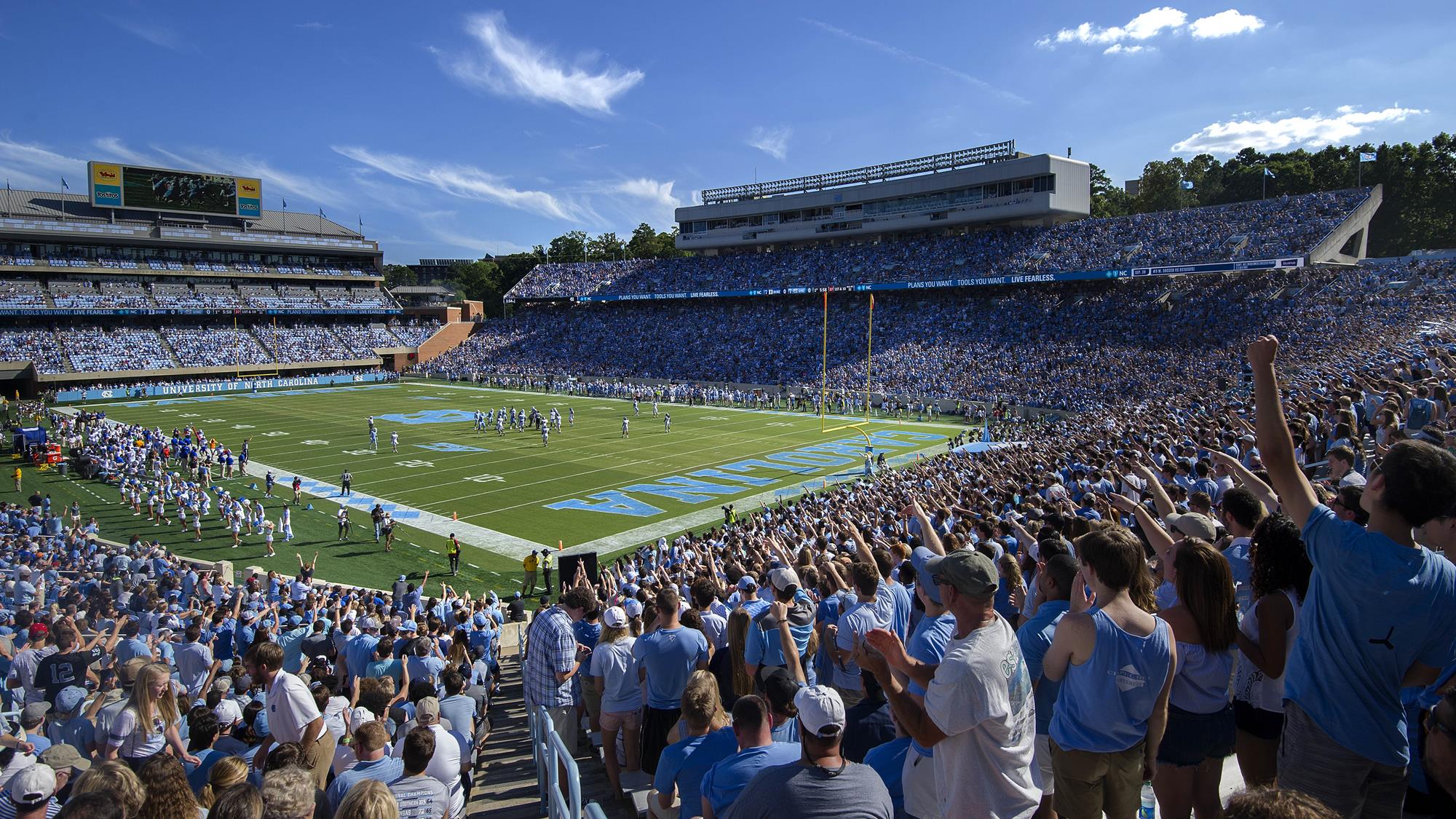
The college sports world has been in flux recently, with major realignment in conference memberships – but at least for now the ACC remains unchanged.
Over the last few months, numerous schools have considered leaving the ACC – including UNC, according to some reports – but none have made any moves yet, in large part because of a “grant of rights” deal (which runs through 2036) that imposes heavy costs on any school departing the conference. An important August 15 deadline came and went without anyone announcing plans to leave the conference – which effectively means every current ACC school has committed to stay in place through at least the summer of 2025.
But with the ACC falling behind the Big Ten and the SEC in terms of per-school revenue, some schools – especially Florida State – have publicly said they will likely leave, grant-of-rights deal notwithstanding, if nothing is done to improve the conference’s financial situation. That’s led to serious discussions about expansion – including just this month, when the ACC reportedly fell just one vote short of asking Cal and Stanford to join the league. (UNC was reportedly one of the ‘no’ votes.)
With all that in mind, 97.9 The Hill’s Aaron Keck discussed the issue with sports expert David Glenn, the author of “Holding Court” on Chapelboro.com. Below is a transcript of their conversation on Wednesday, August 16, which has been lightly edited for clarity.
Click here to listen to their conversation.
Aaron Keck: August 15 came and went with no movement from any school, including Florida State. Are you surprised or not surprised by that?
David Glenn: I’m not surprised. You know, we’ve been through about ten rounds of “the ACC is falling apart” headlines over the last few years, and every time those headlines have been wrong…
With each passing year, the cost to leave the ACC does go down between now and 2036, (so) at some point this membership is either going to contract or expand – and maybe even soon, with ongoing discussions about Cal and Stanford and maybe even others. No surprise this year, (but) heading into next year’s August 15th deadline, ACC fans are going to have to get used to this – unless the money matters change in a way that pacifies schools like Florida State and Clemson.
Keck: And the feeling is that Florida State’s going to have to be pacified in some way, and presumably that’s by expansion. Cal and Stanford were discussed, Southern Methodist was in the conversation – and your (most recent) column focuses on a couple of schools that are closer to home, App State and ECU, which are not really in the conversation. Why is that? And should they be?
Glenn: For a long time I’ve heard questions, even accusations, especially from East Carolina fans, that UNC or NC State or somebody else was putting up these roadblocks to prevent them from ever getting an invitation to the ACC. But the bottom line is that the world has changed a lot, when it comes to how conferences are formed and how they’re reshaped. Decades ago, of course, being close to other schools was a high priority, right? Back then you were traveling in buses, and physical proximity was viewed as a positive. We have turned that idea upside down in the TV era, because – for example, the way the ACC makes money, through its ACC Network, (is by) charging (a higher) rate in states that have ACC members, and an incredibly low rate in other states. So when ACC officials get together with their TV partners and discuss expansion: number one, those TV partners want higher profile schools. Stanford and Cal are two of the best academic institutions in the country, (and) they’ve been members of the PAC-12 for a long time, a Power Five league, whereas App State and ECU have not. But more important financially: if you expand to California, where those two schools are located – or Texas, where SMU is located – you’re flipping millions of TV households, who right now are paying nickels per month for the ACC Network, to paying more than a dollar per month. (And) if you flip millions of households, that starts adding up to a lot of money.
So it’s nothing personal against ECU or App State. Those are fine football programs and good institutions, (but) both the TV partners and the other ACC members simply have no interest in adding a fifth or sixth school in North Carolina – especially when a lot of (non-NC) schools think that four is already too many!
Click here to read Glenn’s “Holding Court” column about conference realignment.
Keck: I hadn’t really thought about the extent to which money and revenue goes up – not just from adding schools outside the existing ACC states, but also from scheduling games with national appeal, as opposed to just regional appeal. And that’s a great incentive to try to pull a school like Cal or Stanford in. Of course the disincentive is all the travel costs – not just for football, but also cross country and baseball and swimming and diving and all these other sports that get thrown under the bus with these big football arrangements. I spoke with UNC Chancellor Kevin Guskiewicz a couple days ago – obviously he wasn’t saying a whole lot about the behind-the-scenes conversations, but it has come out that UNC was one of the schools opposed to adding Cal and Stanford, and based on what he said, it sounds like the travel concern, especially for the non-revenue sports, (must have been) one of the driving factors behind their opposition.
Glenn: No doubt. You can’t only look at increases in revenue with expansion, you have to look at your increase in cost. And it’s not only a financial cost, it’s a mental and emotional cost, burdening student-athletes with long trips. The ACC is (already) widespread…but it’s not coast to coast the way it would be (by) adding two schools near the Pacific to something called the Atlantic Coast Conference.
And it’s been interesting to see who votes which way, because – whereas we’re right to say that with August 15 passing, nobody can leave before 2025, Florida State and Clemson could (still) announce anything at any time. Florida State, Clemson, UNC and NC State, those are the schools that are voting ‘no’ on expansion. But we know that Florida State and Clemson are the two schools making the most noise (about leaving). And if either Clemson or Florida State had offers prior to the deadline from the Big Ten or the SEC, they would have gone. And that’s an alarming situation for the ACC. They’ve changed their revenue-sharing model to reward postseason success, for the first time in 70 years, (and) that’s at least a little more potential revenue for Clemson and FSU. And they’re discussing changing the TV revenue model based on TV eyeballs, which Clemson and Florida State had (also) wanted. But when the vote is 11-4 and you only need (one more vote) to pass an expansion, that means (if) one school changes its mind, expansion can (happen) very quickly,
Keck: So as we’re talking about deciding to expand: obviously money and revenue is a big factor, the concern about travel is a big factor. But what else is a big factor? Everyone always talks about academic fit – “is UNC a better fit for the Big Ten or the SEC; Cal and Stanford are good academic schools” – but to what extent does that actually matter, when it comes to selecting schools? I’m also reading “oh, West Virginia would be a great fit for the ACC,” but that’s a school that just shut down all their foreign language departments.
Glenn: It’s a great question. Here’s my bottom line. When athletic directors get together, they typically talk in financial terms – but the ultimate vote is in the hands of university presidents. And whereas most fans don’t care about that academic stuff, most administrators might care a little bit. (And) when you get to the university president level, they do care about academics. It’s not mere coincidence that the Big Ten’s membership is almost all AAU members, which is a prestigious academic organization. UNC is an AAU member, Virginia is as well, (and) those two have been targets of the Big Ten in the past.
(But) it’s a tricky question to answer, because university presidents (are) smart enough to know that their first priority has to be finances. They have to think financially first. But they do care academically. Some in the ACC will argue, “hey, Florida State was not a great university when it joined the ACC, and it’s a pretty good university now. It’s a top 20 public university nationally. Louisville was lesser academically, (and) it’s a better version of itself now.” But when the money gets big enough, I find that most people are willing to let academics play a secondary role. TV money, football money specifically, has become the tail wagging the dog.
Keck: And with that in mind, I’ve read think pieces asking: at what point do we start thinking about separating college football from everything else, and just (creating) one big national league with no conferences, like they do in the pros, and (keep) the conferences as they are for all other sports? This is starting to appeal to me more and more, considering how much football is driving the ship, and how much these non-revenue sports are getting pulled along, unwittingly and to their detriment.
Glenn: I think that is one of the greatest questions in the history of college athletics. And I’m not kidding when I say that. I just talked with legendary Duke coach Mike Krzyzewski, and we talked about this topic exactly, and the long story short is: way back in the 1980s, the NCAA used to sell TV rights to college football games itself. In other words, it wasn’t the ACC selling the ACC’s rights, or the Big Ten selling the Big Ten’s rights – the NCAA centrally was selling all the TV rights. Well, some schools didn’t like that, took the NCAA to court, and won. And remember, the NCAA does not get money from the sport of football. 98 percent of the NCAA’s budget comes from a single sport, and that’s men’s basketball. So football already has been kind of separate under the NCAA umbrella. The NCAA makes rules for games and recruiting and eligibility and other things, but football has been semi-separate from all the other sports for decades…
So somebody, some NCAA commissioner or powerful president, should have (suggested) exactly what you just suggested: “Hey, let’s stick to the century-old concept that in most sports we should play schools located near each other that have similar academic mindsets – (and) with football mattering so much and paying the bills (for) many of those other sports, let’s just treat it differently in every way. And I think fans might have some indigestion: “my school’s a member of this conference in all but one sport.” Of course, change causes indigestion in most people. But with the benefit of hindsight, there is no doubt in my mind that (this is) one of the greatest missed opportunities in the history of NCAA sports.
Photo via Joshua S. Kelly/USA TODAY Sports.
Chapelboro.com does not charge subscription fees, and you can directly support our efforts in local journalism here. Want more of what you see on Chapelboro? Let us bring free local news and community information to you by signing up for our biweekly newsletter.