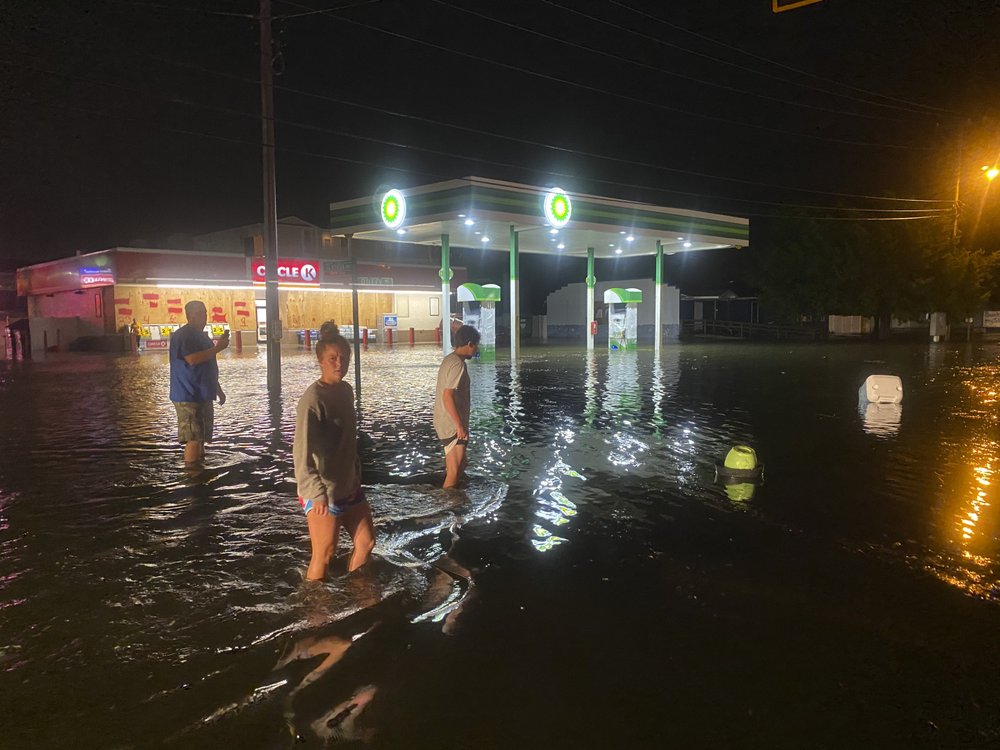
Tropical Storm Isaias spawned tornadoes and dumped rain during an inland march up the U.S. East Coast on Tuesday after making landfall as a hurricane along the North Carolina coast, where it piled boats against the docks and caused floods and fires that displaced dozens of people.
Royce Potter, a fifth-generation seafood purveyor and owner of Potter’s Seafood in Southport, said he rode out the storm on a boat docked near his business after he got the impression from forecasters that his area would be spared.
“They got this wrong,” he said, visibly shaken. “I’ve ridden storms out here for years.”
Instead, the storm surge and wind gusts left dozens of boats piled up against the docks, and many decks facing out on the water were smashed. People were out Tuesday morning raking debris or picking it up with their hands and dropping it in trash cans.
The hurricane’s eye moved over land near Ocean Isle Beach, North Carolina, just after 11 p.m. on Monday with maximum sustained winds of 85 mph (136 km/h), and its top winds dropped to 70 miles per hour (117 km/h) by early Tuesday. But forecasters said hurricane-force gusts were likely in the Chesapeake Bay region, and tropical storm conditions were expected across New England Tuesday night.
“We don’t think there is going to be a whole lot of weakening, we still think there’s going to be very strong and gusty winds that will affect much of the mid-atlantic and the Northeast over the next day or two,” Robbie Berg, a hurricane specialist with the National Hurricane Center, told The Associated Press.
At least two tornadoes were confirmed by the national weather service, near Kilmarnock, Virginia, and Vienna, Maryland. As the heavy rains and wind felled trees, power outages spread Tuesday. More than 650,000 customers lost electricity, most of them in North Carolina and Virginia, according to PowerOutage.US, which tracks utility reports.
Isaias (pronounced ees-ah-EE-ahs) toggled between tropical storm and hurricane strength throughout its path to the U.S. coast, killing two people in the Caribbean and trashing the Bahamas before brushing past Florida.
Some coastal communities in North Carolina and Virginia woke to significant damage, mostly east and north of where the hurricane’s eye struck land.
On North Carolina’s Oak Island, deputies had to rescue five adults and three children after the storm hit, causing damage along the beachfront and knocking electricity and sewer facilities offline, authorities said.
The storm set off flooding and sparked five home fires in Ocean Isle Beach, North Carolina, Mayor Debbie Smith told WECT-TV, and firefighters from Horry County, South Carolina crossed the state line to help out, their spokesman, Tony Casey, told The Associated Press.
Further up the coast, about 30 people were displaced by a fire at a condominium complex in Surf City, news outlets reported. It wasn’t immediately clear if the fires were connected to the storm. No injuries have been reported.
And in Suffolk, Virginia, near the coast, multiple homes were damaged by falling trees, and city officials received reports of a possible tornado. A fire station downtown sustained damage including broken window. A photo posted by city officials showed a pile of bricks lying next to a damaged business.
Coastal shops and restaurants had closed early in the Carolinas, where power began to flicker at oceanfront hotels and even the most adventurous of beachgoers abandoned the sand Monday night. The National Hurricane Center warned oceanside home dwellers to brace for storm surge up to 5 feet (1.5 meters) and up to 8 inches (20 centimeters) of rain in spots.
“All those rains could produce flash flooding across portions of the eastern Carolinas and mid-Atlantic, and even in the northeast U.S.,” said Daniel Brown, senior hurricane specialist. A tropical storm warning extended all the way up to Maine, where flash flooding was possible in some areas on Wednesday.
The center was moving over southeastern Virginia before daybreak, on a path to remain near or along the coast of mid-Atlantic states and continue across the northeastern United States later into the evening. Strong winds and heavy rainfall were expected to spread northward along the mid-Atlantic coast Tuesday morning.
As the storm neared the shore, a gauge on a pier in Myrtle Beach recorded its third highest water level since it was set up in 1976. Only Hurricane Hugo in 1989 and Hurricane Matthew in 2016 pushed more salt water inland.
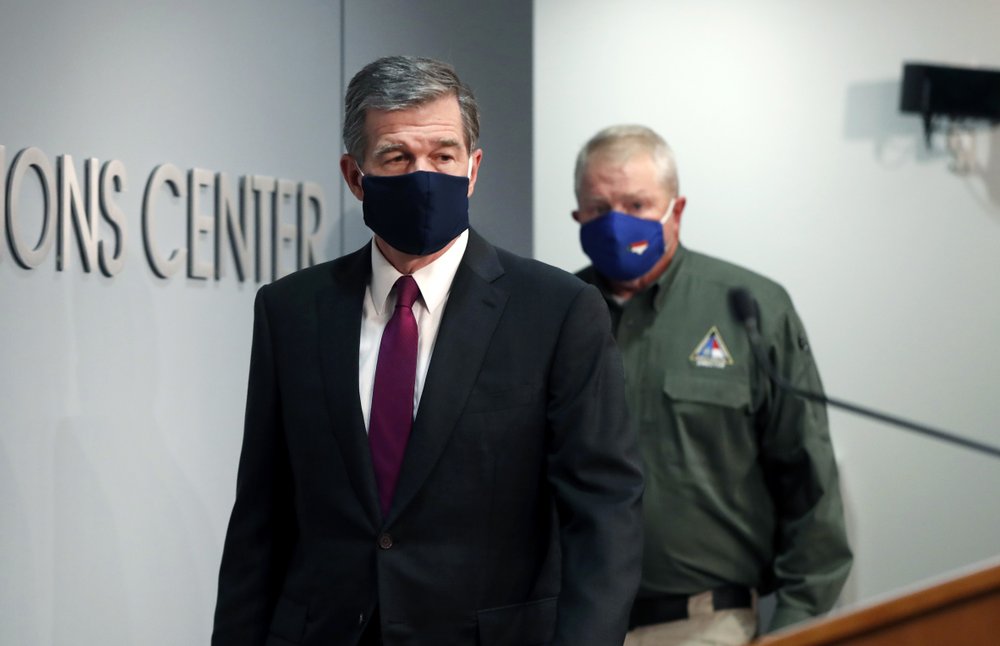
North Carolina Gov. Roy Cooper urged those evacuating to turn to shelters as a last resort, citing coronavirus risks and the need to operate shelters at reduced capacity to allow for social distancing.
“Whether it’s labeled a tropical storm or a hurricane, you should take this storm seriously, and make sure your family is ready,” Cooper said.
Featured image via Jason Lee/The Sun News via AP
Related Stories
‹

NC Governor: Hurricane Brings ‘Double Trouble’ With VirusNorth Carolina Gov. Roy Cooper declared a state of emergency on Friday to help prepare for Hurricane Isaias, which he said will bring atypical challenges given the longstanding COVID-19 crisis. The emergency declaration, running concurrently with the one for the coronavirus in place for months, will help state and local governments respond more nimbly to the storm, […]

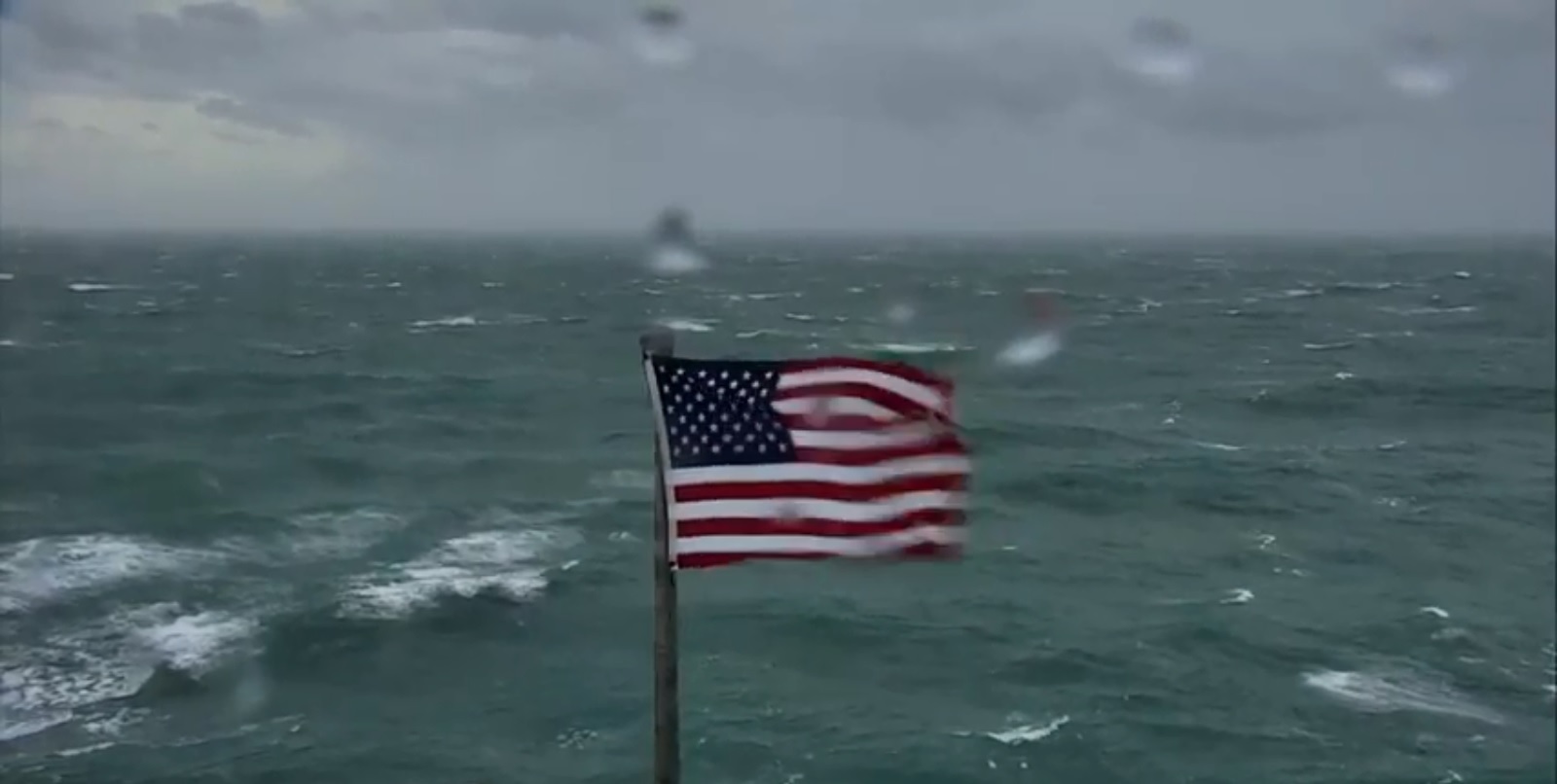
North Carolina's 'Frying Pan Tower' Showing Hurricane Dorian's ApproachLast year, once of the most resonating images of Hurricane Florence in North Carolina was the gradual destruction of the American flag flying high on “Frying Pan Tower” off the Outer Banks close to Cape Fear. This year, as Hurricane Dorian approaches the North Carolina coastline while moving up the Eastern seaboard, the cameras at […]
![]()
4th Time in 4 years: It's Hurricane Evacuation Time in USIt’s become a hurricane-season ritual in the Southeast: When a storm threatens, coastal residents board up homes, load up SUVs and fill highways where the traffic lanes are reversed to offer a speedy escape inland. For some people, Hurricane Dorian is the fourth storm they have had to flee in four years. Forecasters are not […]

On the Porch: Bill Brown - Art and Science Merge at NCMAThis Week:
Bill Brown joined the North Carolina Museum of Art as a Conservation Intern in 1988. Thirty-two years later he retired from the Art Museum as Chief Conservator. He received his M.A. and Certificate of Advanced Studies in Conservation from State University College at Buffalo, NY in 1989. At the Museum, he established the Art + Science Initiative, a collaborative program with Duke University math and science departments. Bill has a passion for Italian Old Master Paintings of the 14th to 18th century. He works part-time as a conservator in private practice and provides conservation support for the Museum and Gallery collection of old master paintings at Bob Jones University in Greenville, SC . He enjoys retirement with his wife and young adult son.

On the Porch: Nora Gaskin - Conjuring Crime StoriesThis Week:
Author Nora Gaskin is a lifelong resident of the Durham-Chapel Hill area. Her latest is novel is "Lammie Loves Cubby". Nora has a bachelor’s degree in English with Honors in Creative Writing from UNC, and a Masters in English from the University of Washington in Seattle. She spent over 24 years as a stockbroker and financial advisor in the Durham office of a major investment firm. She retired in 2005 to focus on writing. She is the publisher at Lystra Books and Literary Services and the author of three novels and one nonfiction book. She lives and writes in Chatham County, inspired by her native landscape, her husband, and dogs. Her favorite word is "gratitude."
![]()
Therapy Smarts and Sen. Natalie Murdock on How HB696 Impacts Children and Families — On Air Today (June 15, 2026)Founder and CEO of Therapy Smarts Avani Shah and N.C. District 20 Sen. Natalie Murdock speak with 97.9 The Hill on Monday, June 15.

On the Porch: Steven Fenberg - What Funded America's Infrastructure?This Week:
Writer Steven Fenberg discovered Jesse Jones was reputedly the most powerful person in the nation next to President Franklin Roosevelt during the Great Depression and World War II. As chairman of the federal government’s Reconstruction Finance Corporation (RFC)—the nation’s indispensable infrastructure bank—Jones initiated and managed massive New Deal agencies that saved and expanded the nation’s economy and then shifted the RFC’s priority from domestic economics to global defense to fight and win WWII. Fenberg told this remarkable story as executive producer and co-writer of the Emmy Award winning documentary film “Brother, Can You Spare a Billion?” that was narrated by Walter Cronkite and broadcast nationally on PBS. Fenberg then wrote the biography “Unprecedented Power: Jesse Jones, Capitalism, and the Common Good.”

Viewpoints: Constitutional Changes Are Rarely NecessaryConstitutional amendments are supposed to be rare. They are supposed to matter. They are meant to alter foundational principles or governmental structure when absolutely necessary.

On the Porch: Terri Mitchell - Mentoring Women in TechThis Week:
Terri Mitchell is the founder of Accelerate Success, a program to help women develop the confidence, skills, and networks needed to thrive in STEM careers. She is a former IBM executive with more than 30 years of experience in the technology industry. Starting as a graduate of Le Moyne College with a degree in Computer Science, she held leadership roles across hardware, software, and systems businesses, culminating in her role as Vice President and IBM Integration Executive. Following her retirement from IBM in 2018, Terri became a founding member of Triangle Women in STEM and began the Accelerate Success program.

On the Porch: Carl Nordgren - Creativity Can Unite USThis Week:
Carl Nordgren is a best-selling novelist, a teacher, and an imaginal cell. After 25 years as an entrepreneur, he taught Creativity at Duke for 14 years. He’s a two-time TEDx speaker and hosts the weekly radio show ‘Exploring your Creative Genius’ on 97.9 The Hill. His calling is to help each of us and all of us grow our creative capacities and develop our entrepreneurial instincts and behaviors, a calling that informed his book "Becoming a Creative Genius (again)". His new book, "Common Ground for US" continues that work and offers new perspectives on governance and policy making for political and community leaders. You can attend his book launch event at Golden Fig Books in Carrboro on June 4, by clicking the show title above.
›