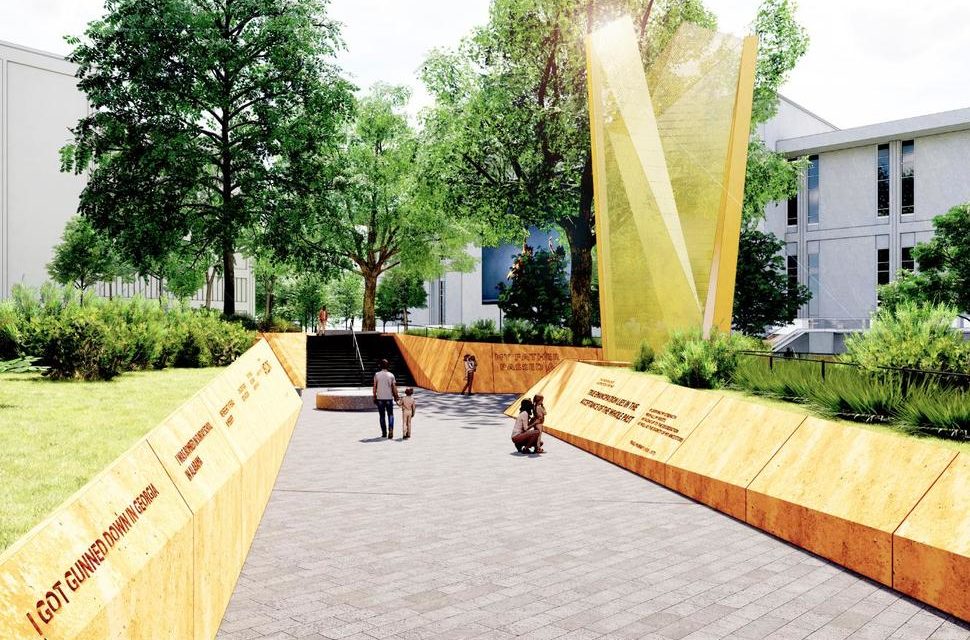
A gleaming abstract sculpture that’s lit from within will be the centerpiece of a new park honoring the contributions of African Americans to North Carolina that’s been in the planning stages for more than a decade.
The state Historical Commission approved the new design for Freedom Park on Wednesday. The park will be located on a 1-acre site between the state legislature and the Governor’s Mansion in Raleigh.
Inspirational quotes from African Americans from North Carolina will be engraved on walls along walkways that lead to the 48-foot-tall Beacon of Freedom sculpture.
“Our public art and our public spaces define who we are as a society, as a community,” Freedom Park board member Reginald Hildebrand told the commission. “They proclaim what we believe, what we value and what we aspire to achieve. This will be especially true for Freedom Park.”
Plans for the park began in 2002, and an architect was chosen in 2004. But the Great Recession dampened fundraising, and supporters learned that potential donors found the design’s focus on slavery too depressing, board member Reginald Hodges said Wednesday.
The park’s board sought new proposals, focused on uplifting designs, in 2016, Hodges said. Phil Freelon of Durham, who designed the Smithsonian’s National Museum of African American History and Culture, and his firm, Perkins and Will, were chosen to design the new Freedom Park.
Months before the NMAAHC opened, Freelon was diagnosed with amyotrophic lateral sclerosis, also known as Lou Gehrig’s disease, a degenerative neurological disease that leads to total paralysis. Despite the illness, he accepted the Freedom Park project. He died in July at the age of 66.
“It was our great hope that Phil Freelon would be able to be present for the groundbreaking and dedication,” Hildebrand said. “As you know, he passed recently at the height of his accomplishments with the Smithsonian museum and he could have done anything with the limited time he knew he had left. He chose to invest it in this project in North Carolina, his home.”
Contributions followed Freelon’s name and the new design. The proposed state budget includes $1.5 million for the park, provided that’s matched by $1.7 million in private donations. Park board member Kel Landis said in a telephone interview that the donations exceed the $1.7 million target.
The design includes no monuments; the walls carry no quotes from people outside North Carolina. The walls will be made of precast concrete and tinted to resemble the red clay of North Carolina, said architect Michael Stevenson of Perkins and Will.
One quote located in a prominent place comes from John H. Wheeler, president of Mechanics & Farmers Bank from 1952 to 1978 and a founder of the Durham Committee on Negro Affairs: “The battle for freedom begins every morning.”
“We think that really sets the tone as you enter the park,” Stevenson said.
Meanwhile, the beacon will be designed in a shiny metallic so that it’s lit from both the inside and the outside, he said. As it reaches toward the sky, it will represent “a brighter future for everybody,” he said.
A groundbreaking for the park is planned for December. Stevenson estimated that completing it will take about a year.
Rendering by Perkins and Will via AP
Related Stories
‹

Postal Service Work To Comply With Trump’s Executive Order Is Rushed and Sloppy, a Whistleblower ContendsThe U.S. Postal Service is poised to launch a hastily built, error-riddled computer system that could jeopardize the process of mail voting.

Longtime Chatham County Educator Wins $10 Million Lottery PrizeThe North Carolina Education Lottery office revealed that Jean Johnson, who teaches in Chatham County, is the winner of a $10 million prize.
![]()
Theodore Nollert on North Carolina's Budget Corrections Bill and Its Process – On Air Today (August 26, 2026)Theodore Nollert — the directory of policy for Carolina Forward and a Chapel Hill Town Council member — joins 97.9 The Hill's Brighton McConnell on Wednesday, August 26.
UNC Health Expands, Rebrands Venture Capital Efforts of Emerging TechThe statewide healthcare system announced Rex Health Ventures platform is now UNC Health Ventures and will use $125 million to invest in emerging health tech companies.
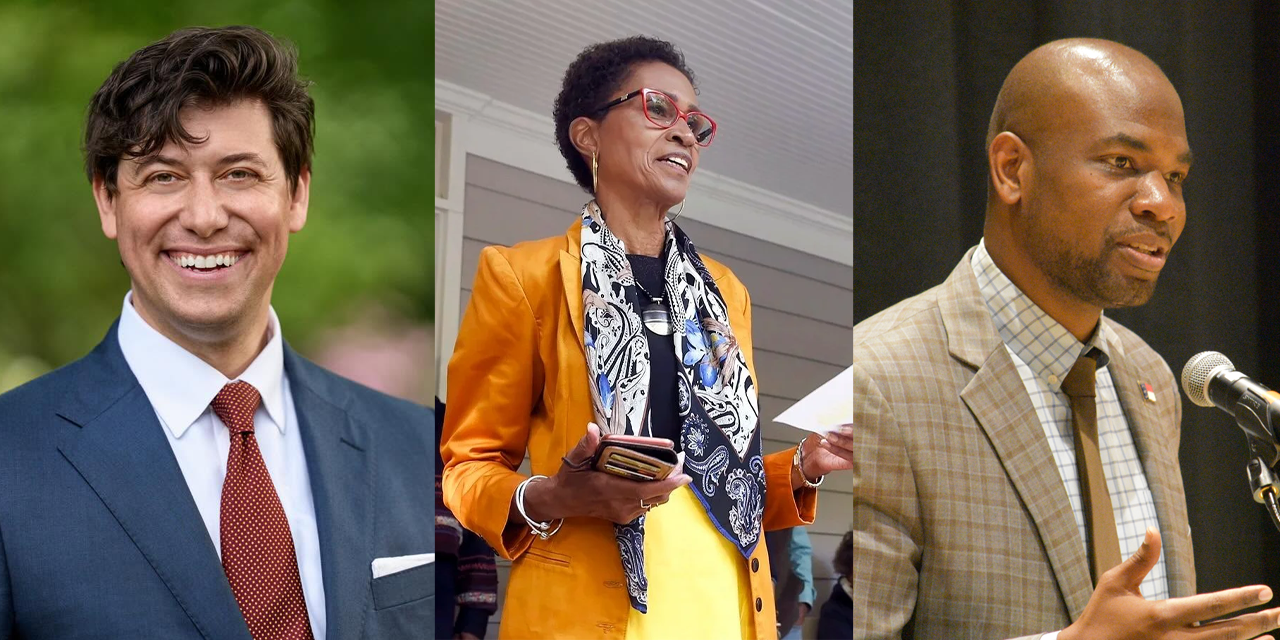
Corporate Tax Cuts, Prediction Market Leeway, and Underfunding Education: Why Orange County's Legislators Voted Against NC's BudgetAll three of Orange County’s state representatives voted against North Carolina's updated budget, citing issues with its contents and construction.

On the Porch: Dr. James Wood - Sports Around the WorldThis Week:
James Wood is currently Professor of Latin American and modern world history at North Carolina A&T State University. He is the author of The Society of Equality: Popular Republicanism and Democracy in Santiago de Chile, 1818-1851 and the co-editor of "Problems in Modern Latin American History: Sources and Interpretations", now in its fifth edition with Rowman and Littlefield. As a Fulbright scholar for Chile in 2016 he was a visiting professor at the Universidad Diego Portales in Santiago (where he observed Chilean student activism up close).
On the Porch: Bill Brown - Art and Science Merge at NCMAThis Week:
Bill Brown joined the North Carolina Museum of Art as a Conservation Intern in 1988. Thirty-two years later he retired from the Art Museum as Chief Conservator. He received his M.A. and Certificate of Advanced Studies in Conservation from State University College at Buffalo, NY in 1989. At the Museum, he established the Art + Science Initiative, a collaborative program with Duke University math and science departments. Bill has a passion for Italian Old Master Paintings of the 14th to 18th century. He works part-time as a conservator in private practice and provides conservation support for the Museum and Gallery collection of old master paintings at Bob Jones University in Greenville, SC . He enjoys retirement with his wife and young adult son.

On the Porch: Nora Gaskin - Conjuring Crime StoriesThis Week:
Author Nora Gaskin is a lifelong resident of the Durham-Chapel Hill area. Her latest is novel is "Lammie Loves Cubby". Nora has a bachelor’s degree in English with Honors in Creative Writing from UNC, and a Masters in English from the University of Washington in Seattle. She spent over 24 years as a stockbroker and financial advisor in the Durham office of a major investment firm. She retired in 2005 to focus on writing. She is the publisher at Lystra Books and Literary Services and the author of three novels and one nonfiction book. She lives and writes in Chatham County, inspired by her native landscape, her husband, and dogs. Her favorite word is "gratitude."
![]()
Therapy Smarts and Sen. Natalie Murdock on How HB696 Impacts Children and Families — On Air Today (June 15, 2026)Founder and CEO of Therapy Smarts Avani Shah and N.C. District 20 Sen. Natalie Murdock speak with 97.9 The Hill on Monday, June 15.
On the Porch: Steven Fenberg - What Funded America's Infrastructure?This Week:
Writer Steven Fenberg discovered Jesse Jones was reputedly the most powerful person in the nation next to President Franklin Roosevelt during the Great Depression and World War II. As chairman of the federal government’s Reconstruction Finance Corporation (RFC)—the nation’s indispensable infrastructure bank—Jones initiated and managed massive New Deal agencies that saved and expanded the nation’s economy and then shifted the RFC’s priority from domestic economics to global defense to fight and win WWII. Fenberg told this remarkable story as executive producer and co-writer of the Emmy Award winning documentary film “Brother, Can You Spare a Billion?” that was narrated by Walter Cronkite and broadcast nationally on PBS. Fenberg then wrote the biography “Unprecedented Power: Jesse Jones, Capitalism, and the Common Good.”
›