

By Keith T. Barber, Chatham News + Record Correspondent
The Northeast Chatham Wastewater Study Commission has unanimously adopted a “problem statement” to help clarify its goals in addressing rapid growth in the 90-square mile area adjacent to the U.S. 15-501 corridor, stretching from the northern city limits of Pittsboro to the Orange County line.
The commission’s March 1 meeting was the second of five scheduled gatherings of the 11-member study group.
“The growth in NE Chatham County is undeniable, and Chatham County’s current strategy for managing wastewater in this area is not sustainable long-term,” the statement reads. “The current approach has well-documented problems and is not considered an adequate solution for the future.”
Chatham County Planning Director Jason Sullivan began the virtual meeting with a PowerPoint presentation to discuss the county’s unified development ordinance and development activity in the study area. Sullivan provided commission members with an overview of Plan Chatham, which was adopted by county officials in 2017. He described Plan Chatham as “a comprehensive plan that provides a strategic guide for future decisions,” regarding development in the county over the span of the next 25 years.
Under Plan Chatham, the county has designated specific areas for specific uses, including areas for conservation, parks and protected lands, as well as areas for compact residential development, Sullivan said.
At the conclusion of Sullivan’s presentation, commission member Liz Rolison inquired about the existence of a master wastewater plan for the county.
“So there really isn’t a master wastewater plan for the entire county?” Rolison asked.
Chatham County Manager Dan LaMontagne responded that at present there was no master wastewater plan for the county. Sullivan added that the last study commissioned by Chatham County on developing a master wastewater plan was performed nearly 30 years ago.
“We need to have a wastewater strategy that will work long-term,” Rolison said. “What I hear people saying is the solutions used in the past are not working.”
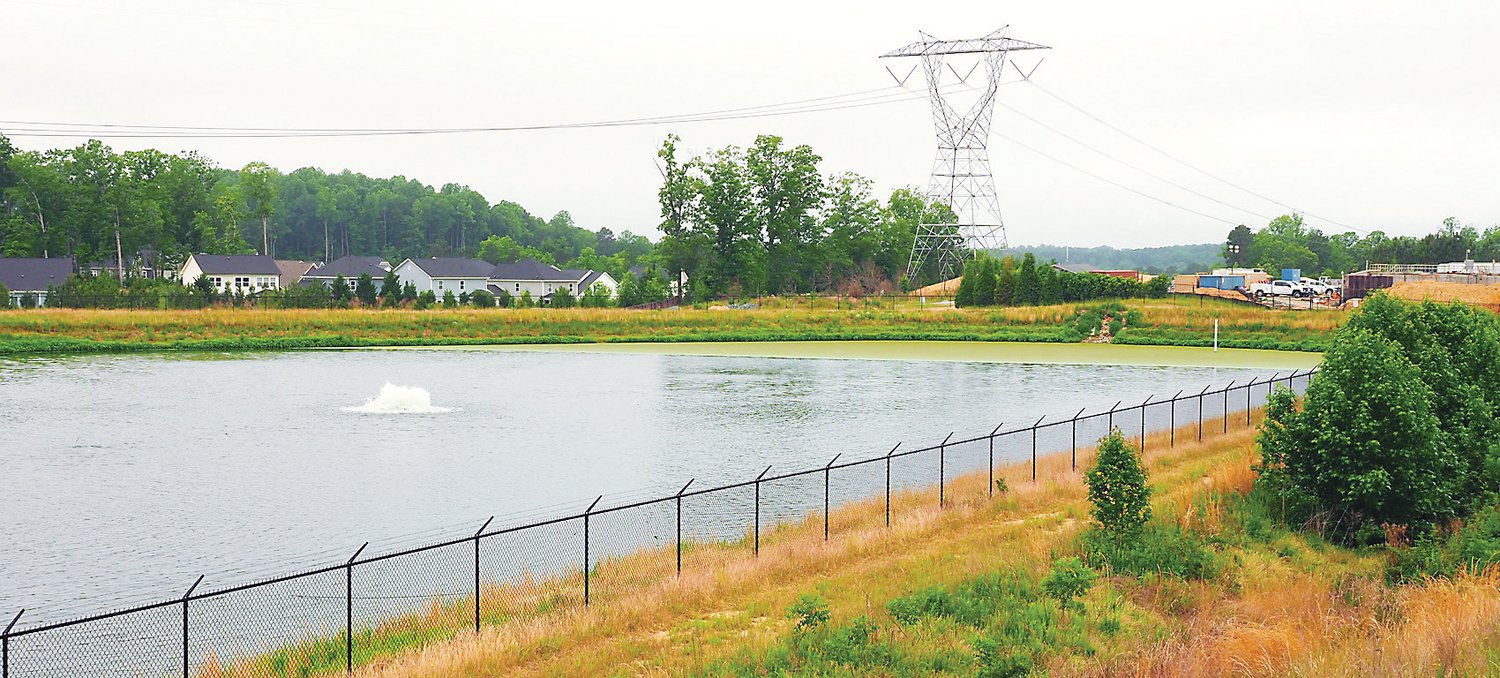
Briar Chapel’s wastewater treatment plant (top right) is centrally located amid several homes. Frequent sewage leaks and near-constant odors have devalued properties nearest the facility. (photo by Kim Hawks
Rolison cited numerous violations of N.C. Dept. of Environmental Quality standards at a number of privately-owned “package facilities” in Chatham as evidence of the importance of developing a master plan for wastewater in the county. In addition, the county’s limited wastewater capacity has impacted growth potential. (Chatham Park has its own — the planned community’s half-million-gallon Decentralized Wastewater Reclamation Facility converts Pittsboro’s wastewater to non-potable water to be used for agricultural, industrial and landscaping applications.)
Commission member Denise Nowak said there was poor oversight at many of the package wastewater facilities in the county, and expressed concern over potential damage to the environment, including the pollution of surface waters.
“The lack of oversight is the biggest concern with regard to wastewater package facilities,” Nowak said. “When they violate the rules, it’s not a huge financial burden to pay a fine to the state.”
During its next meeting, commissioners will discuss a number of subjects, including exploring the option of continuing with the county’s policies regarding privately-owned package sewage treatment facilities. The meeting will be held at 6 p.m. on March 28.
Chapelboro.com has partnered with the Chatham News + Record in order to bring more Chatham-focused stories to our audience.
The Chatham News + Record is Chatham County’s source for local news and journalism. The Chatham News, established in 1924, and the Chatham Record, founded in 1878, have come together to better serve the Chatham community as the Chatham News + Record. Covering news, business, sports and more, the News + Record is working to strengthen community ties through compelling coverage of life in Chatham County.

