

“Viewpoints” is a place on Chapelboro where local people are encouraged to share their unique perspectives on issues affecting our community. If you’d like to contribute a column on an issue you’re concerned about, interesting happenings around town, reflections on local life — or anything else — send a submission to viewpoints@wchl.com.
Theme Park Dreams: A Chapter in the Story of Daniel Boone Village
A perspective from JS Braun
Cover photo from The North Carolina Collection Photographic Archives. Wilson Library, University of North Carolina, Chapel Hill.
Special thanks to Scott Dickson, Jon Carter, and Jennifer Poole.


The past itself, as historical change continues to accelerate, has become the most surreal of subjects – making it possible, as Benjamin said, to see a new beauty in what is vanishing. From the start, photographers not only set themselves the task of recording a disappearing world but were so employed by those hastening its disappearance.
– Susan Sontag
Standing in various iterations since the 1960s under the ownership of the Freeland family, Hillsborough’s Daniel Boone Village was once a bustling roadside attraction theme park nicknamed “Tweetsie East” – a rival of Western North Carolina’s Tweetsie Railroad. It featured a wax museum, motel, cafeteria, zoo, ice rink, and a functioning, full-sized train. There was also a large amphitheater which hosted household-name celebrities like Loretta Lynn and Jerry Lee Lewis. As the land was handed down through generations, it grew distant from its heyday and faded into near obsolescence. In more recent years, the land has been repurposed as an antique mall, a trailer park, and a home to multiple businesses and groups including a balloon and party supply shop, restaurants, a dance studio, multiple outdoor gear stores, the Republican Party of Orange County, and Hillsborough Youth Athletic. The land was sold in 2018 to Collins Ridge partners, the owners of a new townhome subdivision, under the name Daniel Boone LandCo LLC, and then to its current owners, DBC54 LLC in October 2020. Daniel Boone Village’s final businesses shut their doors in early 2019 to make way for new development which will likely include both commercial and residential space with plans to connect the site to the nearby Collins Ridge neighborhood. Many artifacts from the theme park were auctioned to collectors in May 2018, and some structures of historic value were moved. The buildings all stood vacant until the entire site was demolished in early 2022, leaving only the few chain businesses along the main road.
1/28/2021 – Original field notes edited for clarity
Early this morning I awoke to snow and decided to take a trip back to the theme park to see whether it’s still accessible, hoping that the early hour along with the inclement weather would reduce the chances of getting into trouble. It was almost exactly the way I remembered it from my last visit – doors unlocked, windows broken, buildings stripped, and many items removed, including some walls and basic fixtures, likely done by the construction company to dissuade squatters, partying, and vandalism. Some hasty-looking graffiti was sprinkled throughout many of the buildings. I was saddened to see so many things I had previously observed nearly intact now needlessly ransacked, especially the big log cabin that’s now all but unrecognizable, and the ice rink that no longer feels like a private hideaway. Still, I was very happy to explore again and to venture farther into things that I hadn’t yet seen, such as a few of the smaller log cabins.
As I walked through the parking lot, I saw a pickup truck drive in and figured that if I was going to be confronted, I may as well communicate my relative innocence and ongoing curiosity about the location. I waved, and the driver pulled up. He was an older white man in
a black military cap with well-groomed facial hair. To my surprise, he later told me he was 82 years old! That day, he was filling in for the woman who usually comes by to look after the park’s feral cat colony, as she had not been feeling well. I explained that I’m a photographer who has loved the area for years, and that I’m sad to see the site being transformed into another suburban housing development.
It seemed that he was somewhat hard of hearing which left me feeling as though I was yelling at him. We discussed our origins for a while; he told me he lived nearby off route 70 for a while, but, like me, was born and raised in downtown Durham. He spoke of growing up during World War II and about his attempt to spontaneously travel to Korea, only to be stopped by his mother who informed officials that he was still a young teenager at the time. This all arose from our discussion about the development of the land, which he said was likely paused until the economy recovers from the Covid-19 pandemic. “Donald Trump has destroyed this economy,” he said without any hesitation. He added that the landowners had not yet sold even one of the houses-to-be.
I usually try to avoid any talk of politics with strangers, especially people I run into while exploring the American South, but I was more than ready to agree with him on that point. He then added that he had to cut off his own children because they are in favor of Trump and could not be reasoned with. He had no idea how they turned out the way they did because they had not been raised with those beliefs. He spoke for a while about the differences in the way information is relayed today, as opposed to when he was growing up. Back then, he said, there were few reliable sources of new information, and people tended to accept that as fact. Everyone tuned into the radio, and every organized group of people had one regardless of their background, but now anyone can read anything on the internet and choose what to believe and what to disregard. “My mother was never the kind of person to speak ill of anyone, but I remember her telling me about Adolf Hitler, ‘Someone needs to kill him.’” He seemed to feel the same way about Trump, stating that Trump was following exactly along Hitler’s path.
Politics aside, he claimed to have known the original owner of Daniel Boone Village and confirmed my suspicion that there never was any real rhyme or reason to the place. He estimated a time before the park was built, “75 years ago,” which I assume is an estimate, and said in the beginning the owner simply started building whatever came to mind. It was really a pleasure speaking with him, and I hope to find him again and speak to others who know more about the park’s history. Before he drove off, he advised, “If anyone asks, tell ‘em you’re here to feed the cats.”
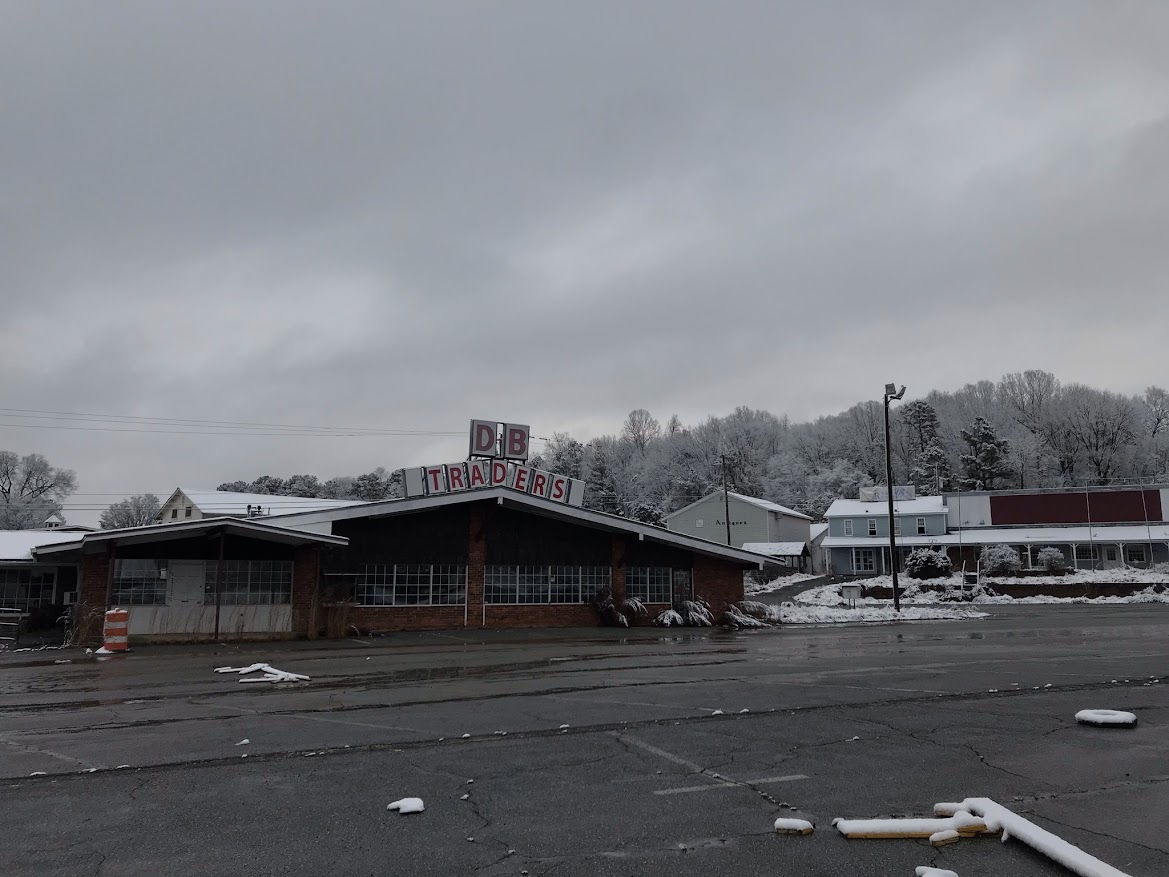
“Trading Post”
Once a cafeteria in a bustling pioneer-themed amusement park, once one storefront of many in a small-town antique mall, once an empty monument to a kitschy landmark from an era lost to time, now a wasteland razed and leveled in preparation for the next suburban housing development, the image of its final months accessible only through memory and photographs. It’s 8:16AM. Alone in the frigid light of a late January sunrise, taking in the scenery of the elusive central North Carolina snowfall, wandering the remnants of the theme park while knowing very well that it would be the last time. The first visit without companions, with only the goal of capturing moments and taking it all in while it still stands. The old black SUV waits patiently in the Waffle House parking lot. I’ll stop for a black coffee to-go on my way out. Gravel and ice crystals crunch beneath well-loved secondhand hiking boots, the oversized green army jacket found in an abandoned house somewhere southwest of Raleigh keeping the cold at bay. The Trading Post is merely the entryway to a transient Southern dreamscape.
“A photograph is only a fragment, and with the passage of time its moorings come unstuck.” (Sontag 2011, 56).
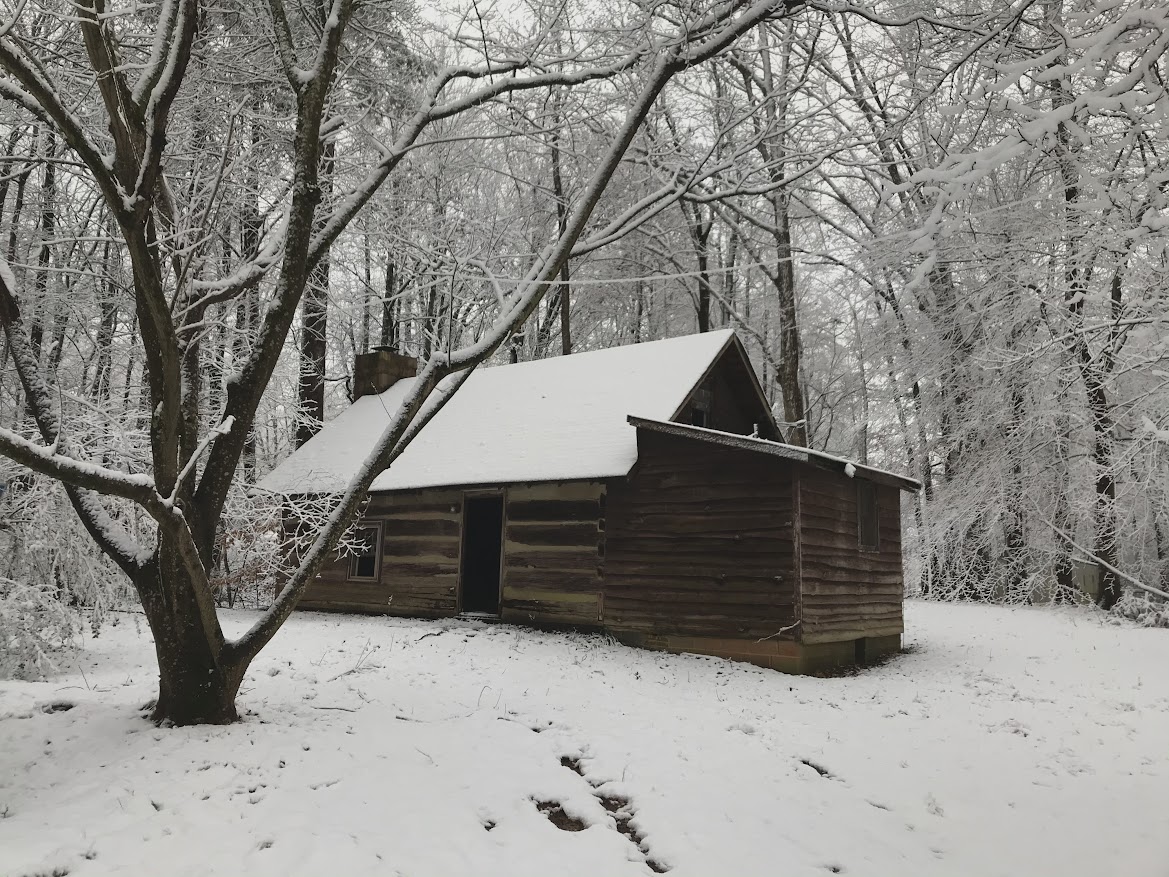
“Isolation”
Equally striking in summer and winter, the little cabin shares property lines with the Jack Freeland house tucked far back in the woods. Lived in time after time, seemingly, with wall art, a lamp, chairs, canned goods, bowls, and a broken plastic bong remaining among the piles of clutter, garbage, and decay. As of 2014, one of the nearby trailers was still inhabited and this cabin belonged to a man who went by “Wendy” and his elderly pit bull, Red. Wendy’s is the only firsthand story I’ve managed to recover of someone who lived in Daniel Boone Village. Who lived in the beige, wood-paneled trailer with the Ghostbusters VHS tape, zombie warning sign, Bud Lite Platinum box, and handmade gender reveal poster? Who was Booker, the man I only know from his death notice taped to the front door of his old home, another cabin not far from here? Who was the recipient of the typed-and-printed letter from their mother I found in the theme park bathroom-turned-abandoned homeless camp? Who slept in the second story loft of the ice rink? Whose phone numbers were scrawled all over the walls of the bedroom at the back of the blue- grey trailer? Why did everyone eventually leave? My footsteps the only thing disturbing the snowfall, my memory here only beginning the summer before my senior year of high school, my collection of photographs presumably the final form of documentation before Daniel Boone Village becomes a conglomeration of hotels, commercial space, and housing.
“Whatever the case (with regard to myself, my motives, my fantasy) I want to live there en finesse. For me, photographs of landscaped (urban or country) must be habitable but not visitable.” (Barthes 1982, section 16).
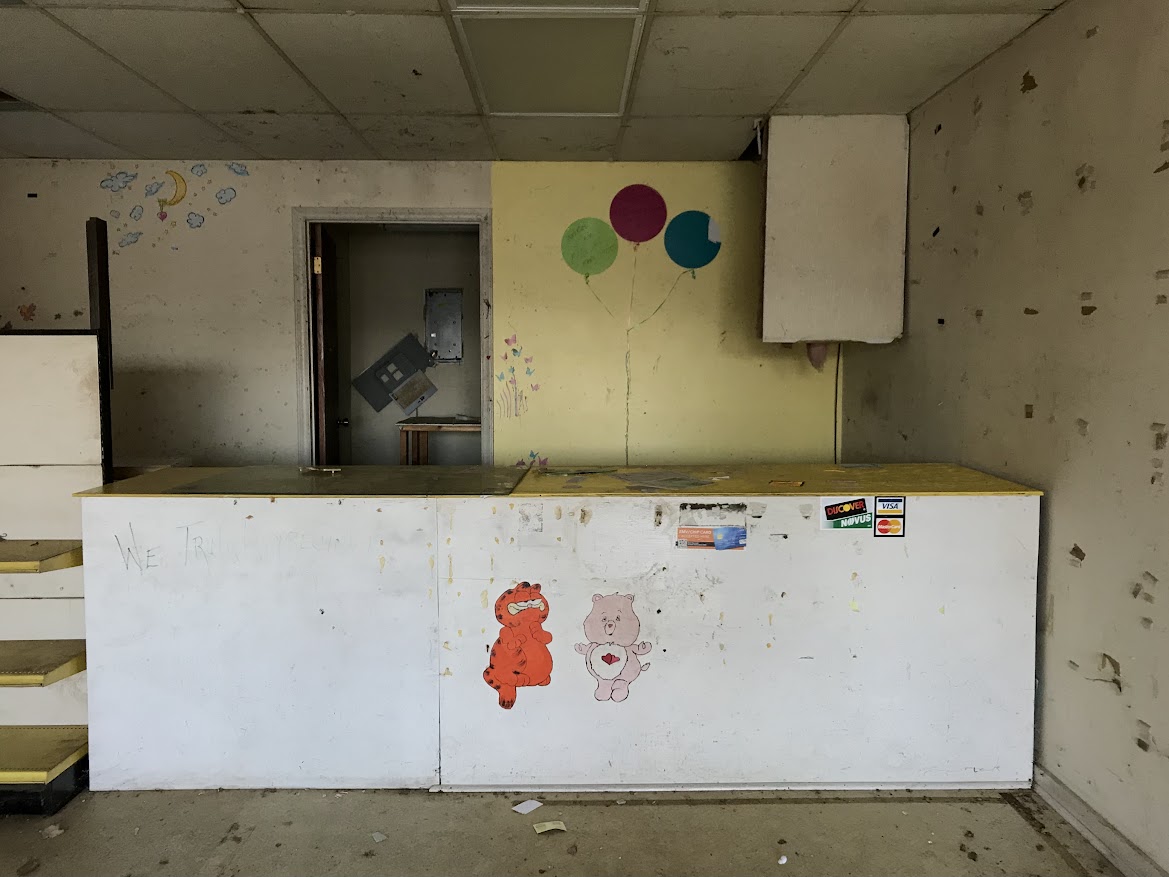
“Good Times”
A photo of this room from a 2018 article in The News of Orange County shows an old woman with white hair, a gold necklace, silver rings, and a French manicure. She stands at the desk, smiling, a plush Beanie Baby dog in her hands. In July 2019, the storefront stood out to me with its farewell message: “Thank you for 33+ years.” Next door, a custom embroidery shop could be found to the right, and an optometrist to the left. An image from May 2017 haunts Google Maps, showing the storefront speckled with sunlight filtered through the trees, streamers
and pinwheels adorning the sidewalk, potted plants and flowers against a wooden fence, and a flag hanging above the door announcing: “We’re open, y’all!,” it announces. A brief summer rain has wet the pavement beneath the green tin roof. A plastic bucket catches condensation from a window air conditioning unit. Three years and seven months later, the organized chaos of party supplies is long gone from this room, but hand- painted artwork and faded messages of customer appreciation remain. It’s 8:49AM.
“We are compelled to find the inconspicuous place in which, in the essence of that moment which passed long ago, the future nestles still today, so eloquently that we, looking back, are able to discover it.” (Benjamin 2015, 66-67).
A photo of this room from a 2018 article in The News of Orange County shows an old woman with white hair, a gold necklace, silver rings, and a French manicure. She stands at the desk, smiling, a plush Beanie Baby dog in her hands. In July 2019, the storefront stood out to me with its farewell message: “Thank you for 33+ years.” Next door, a custom embroidery shop could be found to the right, and an optometrist to the left. An image from May 2017 haunts Google Maps, showing the storefront speckled with sunlight filtered through the trees, streamers
and pinwheels adorning the sidewalk, potted plants and flowers against a wooden fence, and a flag hanging above the door announcing: “We’re open, y’all!,” it announces. A brief summer rain has wet the pavement beneath the green tin roof. A plastic bucket catches condensation from a window air conditioning unit. Three years and seven months later, the organized chaos of party supplies is long gone from this room, but hand- painted artwork and faded messages of customer appreciation remain. It’s 8:49AM.
“We are compelled to find the inconspicuous place in which, in the essence of that moment which passed long ago, the future nestles still today, so eloquently that we, looking back, are able to discover it.” (Benjamin 2015, 66-67).
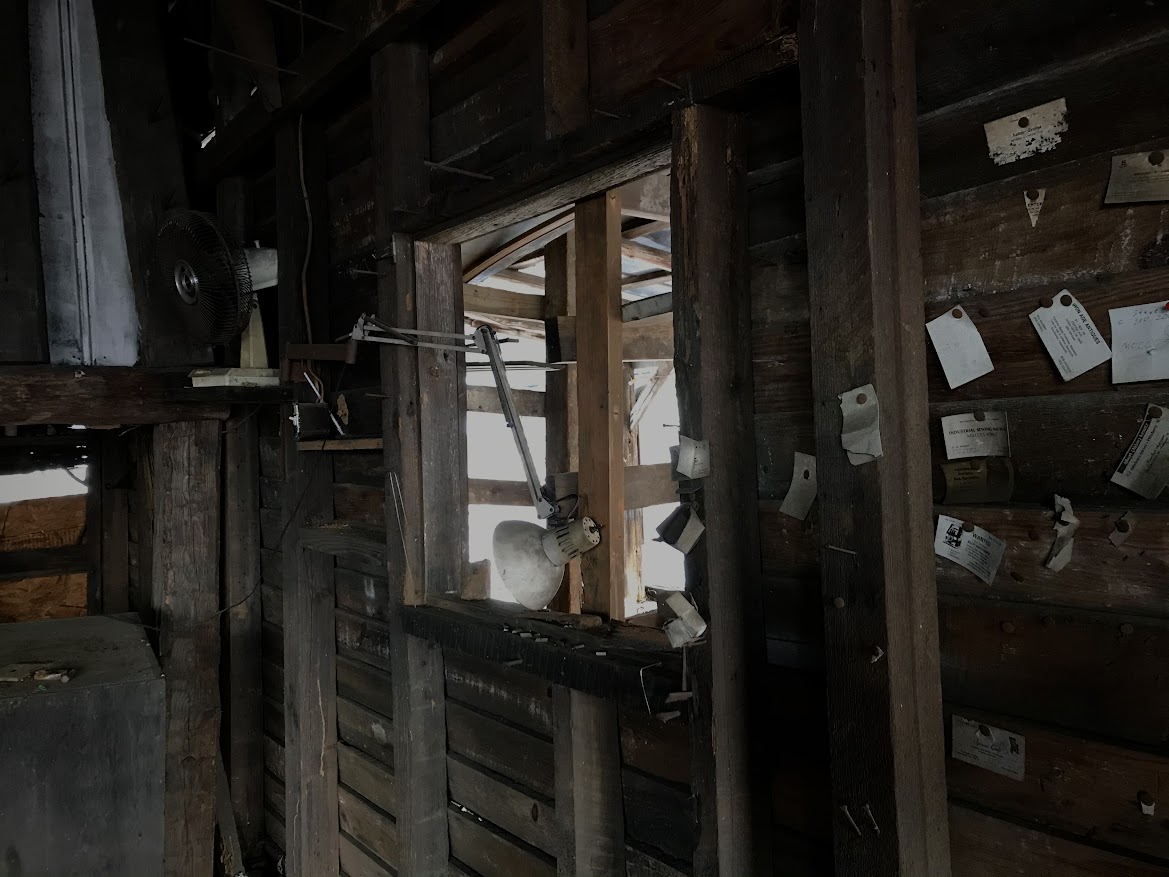
“The Blacksmith’s Calling Cards”
“BLACKSMITH,” reads the outside of the weathered wooden building. A now-outdated map tells me its official name was “Vulcan’s Forge,” and it stood on the corner of Antique Street and Village Street. The rickety wood-and-metal windmill teeters a few doors down. The Forge is a brief shelter from the cold, though the doors and windows are long gone. What might one have seen or purchased here 50 years ago? Who was the Blacksmith? Where has their work gone? An electric fan sits in the corner, a comfort in the sweltering midsummer. A sign outside advertises work in copper and brass, along with antique reproductions and repairs. There is more, though it is illegible from a grainy photograph taken in 2018. Remnants of light fixtures lean and dangle from crumbling cords. I’d passed this building many times throughout the years but had never stopped to pay the Blacksmith a visit. Business cards and flyers litter the walls, words, names, dates, and numbers obscured by soot and dust: “WANTED: SLOT MACHINES,” “INDUSTRIAL SEWING MACHINES,” “IRON AGE ANTIQUES,” “Payne’s Power Tools,” “NORDAN’S WELDING,” “RULDRICH RESTORATIONS,” “Blacksmith Welding Service,” “North Carolina Department of Transportation,” “Louisiana Antique Slot Machines,” “Antique Trunks.” “Steve.”
“Photographs are, of course, artifacts. But their appeal is that they also seem, in a world littered with photographic relics, to have the status of found objects – unpremeditated slices of the world.” (Sontag 2011, 54).
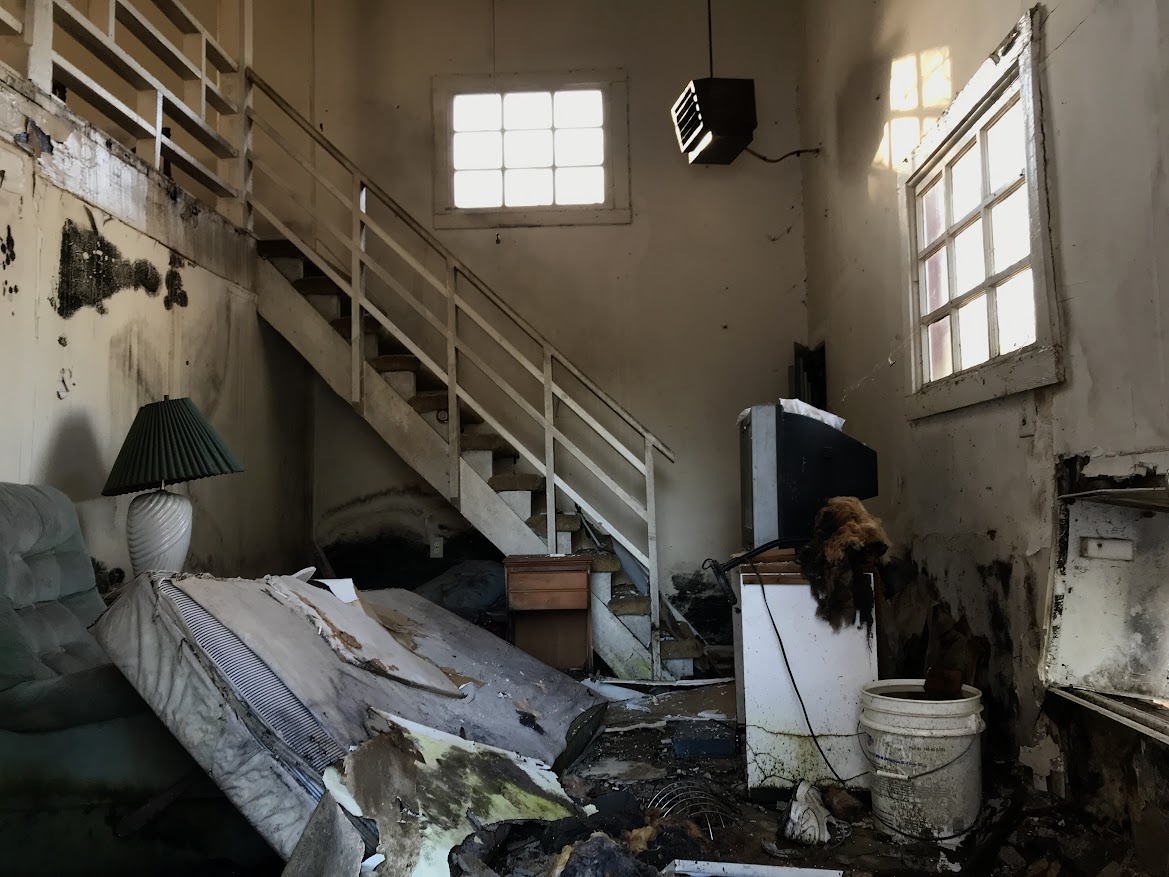
“Death Notice”
Decay takes over Booker’s former home. The hot, humid summers and rapid freeze-thaw cycle of winter have not been kind to it. Black mold blossoms in corners and along railings. The door swings ajar. It’s 9:09AM and the morning light shines on the living room, sketching ephemeral patterns along the walls. Nearby is the strip of buildings where the man in the truck likely stopped to feed the cats. Despite its well-deserved reputation as a literary town and its wealth of historic and archaeological landmarks, for most, Hillsborough is just a stop off I-85. McDonald’s, Waffle House, Taco Bell, and a small, inconsequential Shell gas station placed next to the kitschy statue of the theme park’s namesake. Booker worked at this Shell for over 35 years. The notice I discovered on his door on March 11, 2019, read:
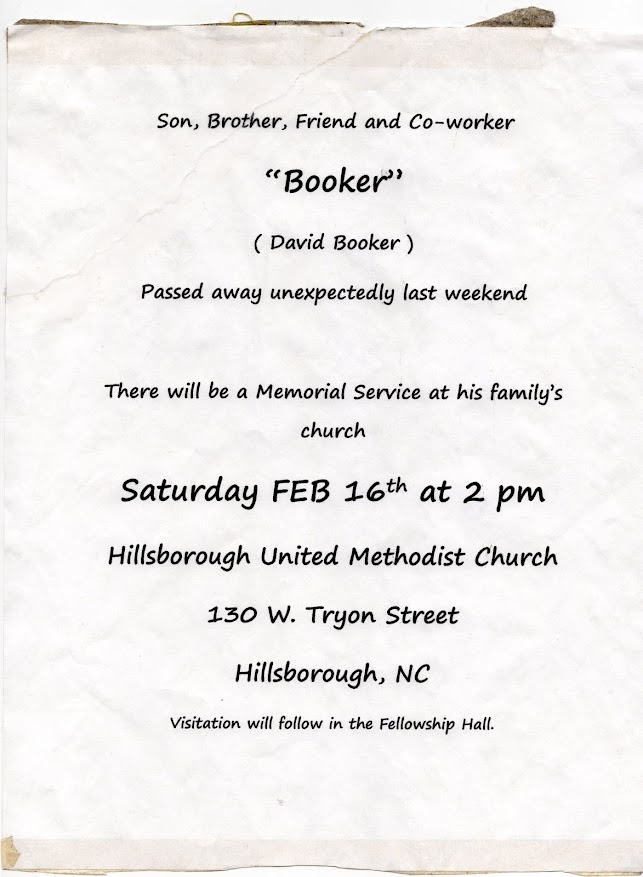
I may not have known him, but I nonetheless feel a sort of camaraderie. A shared fondness for this region of North Carolina, memories of the same places. Reading through his obituary and tribute wall solidifies his presence in my mind. His community remembers him as a good friend, always willing to help check your tire pressure and oil and to talk about anything from humor to serious insight. I shut the door on my way out.
“The effectiveness of photography’s statement of loss depends on its steadily enlarging the familiar iconography of mystery, mortality, transience.” (Sontag, 52).
“Home Improvement”
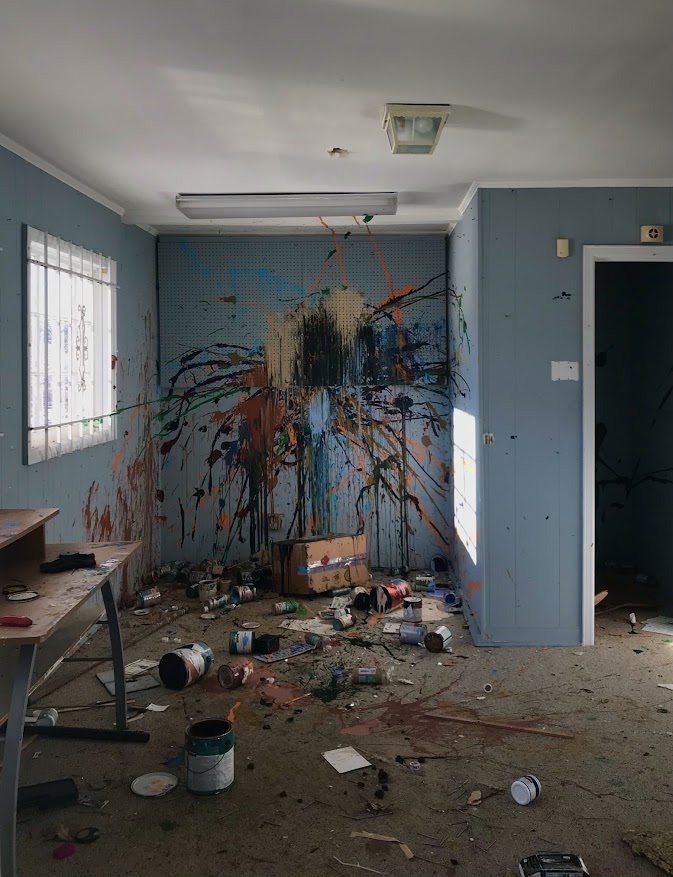
A moment captured through an iron-barred window in a locked door, across a precarious, ice-coated walkway above the theme park’s large indoor event space. Some of the only evidence that someone had passed through before me and had found a way inside. I’d later sell the rights to use this photo to a friend as album artwork for a music project. An open letter to the original artist, whom I have either collaborated with or plagiarized:
Who are you? Have you happened upon this place by chance, only passing through, or are you a local, as I am? Have you also spent your weekends, summers, and holiday breaks exploring Daniel Boone Village through its final stages of decay? Was this an impulsive moment of destruction, of release, of vandalism, or do you consider yourself an artist? Did you hope someone would see it? Whatever your intention, I am happy to have stumbled upon your work. This explosion of color in an otherwise weathered, grey landscape accents it beautifully. I am moved by the passion, the energy, and the ambiguity, the haphazard splatters and discarded paint cans. The wall alone could not contain the power of this artwork and as such it has burst at the seams, reaching up to the ceiling, to adjacent walls, and running down to the floor like an invasive vine. This photo, and as such, your artwork, was worth $75 to someone. I hope you like experimental metalcore.
“In principle, photography executes the Surrealist mandate to adopt an uncompromising egalitarian attitude toward subject matter (Everything is ‘Real’) In fact, it has – like mainstream Surrealist taste itself – evinced an inveterate fondness for trash, eyesores, rejects, peeling surfaces, odd stuff, kitsch.” (Sontag 2011, 61).
“Hall of Fame”
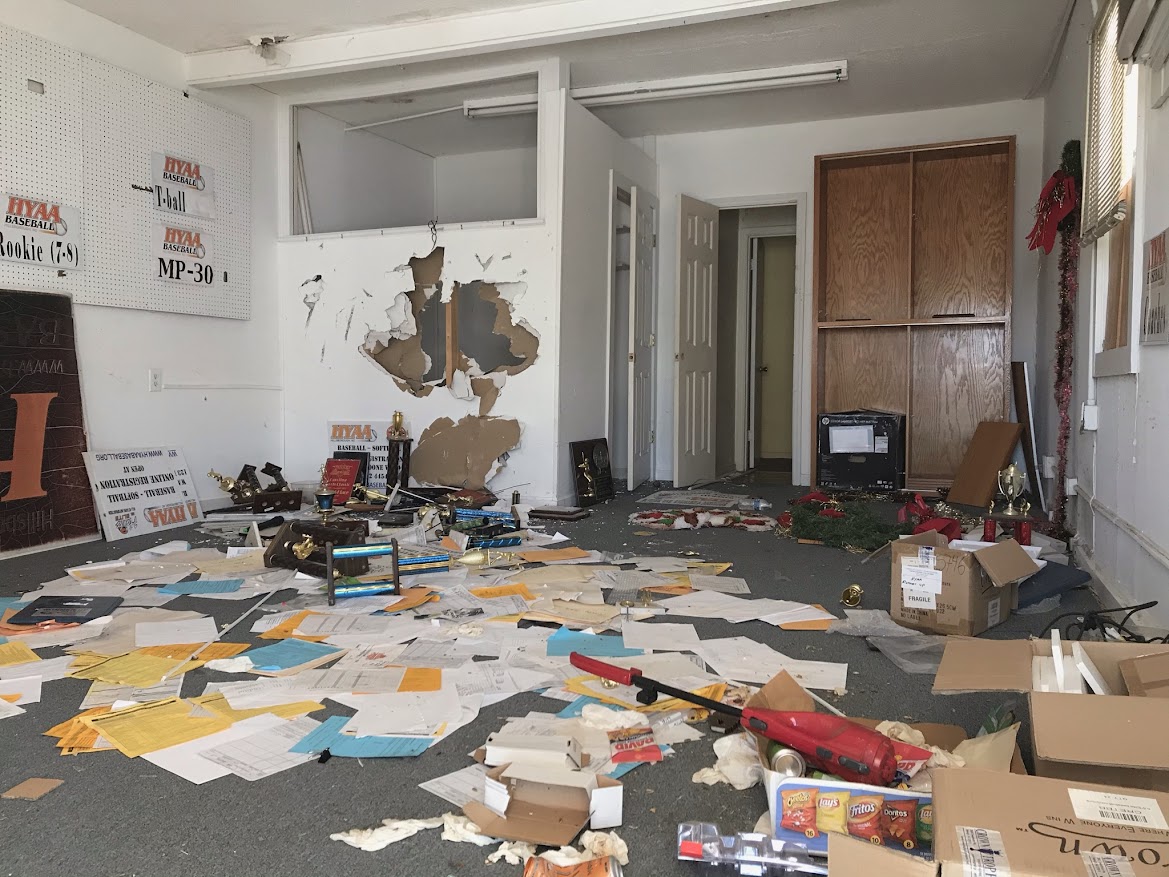
Movement within this space is visible only in its aftermath. Objects move, doors open and close, lock and unlock, walls become canvases, a previously locked garage comes open to reveal a room filled with Raggedy Anne dolls. Trophies neatly organized in a corner now strewn about in a pile of papers and discarded Christmas decorations. Buildings all around the theme park ransacked, stripped of most objects, damaged with random holes, and their exteriors numbered in orange spray paint, likely by developers to discourage squatters, partiers, and explorers. After the final businesses closed in early 2019, the only visible movement past the few businesses along the main road came from cars looping around through the parking lots and the Good Samaritans coming to care for the feral cat colony taking up residence towards the back of the antique mall. I pass a row of rusted mailboxes, a crumbling barn, hollowed-out antique stores, and a little wooden house once home to a Mexican restaurant. It’s 9:29AM, and the light has changed. The grey lingering from the overnight snowstorm has erupted into a bright, relentless blue. The snow has already begun to melt, the parking lot punctuated with miniature tide pools. Melted snow soaks through the worn boots and two pairs of socks. The black SUV in the Waffle House parking lot has remained patient, and the coffee is always hot.
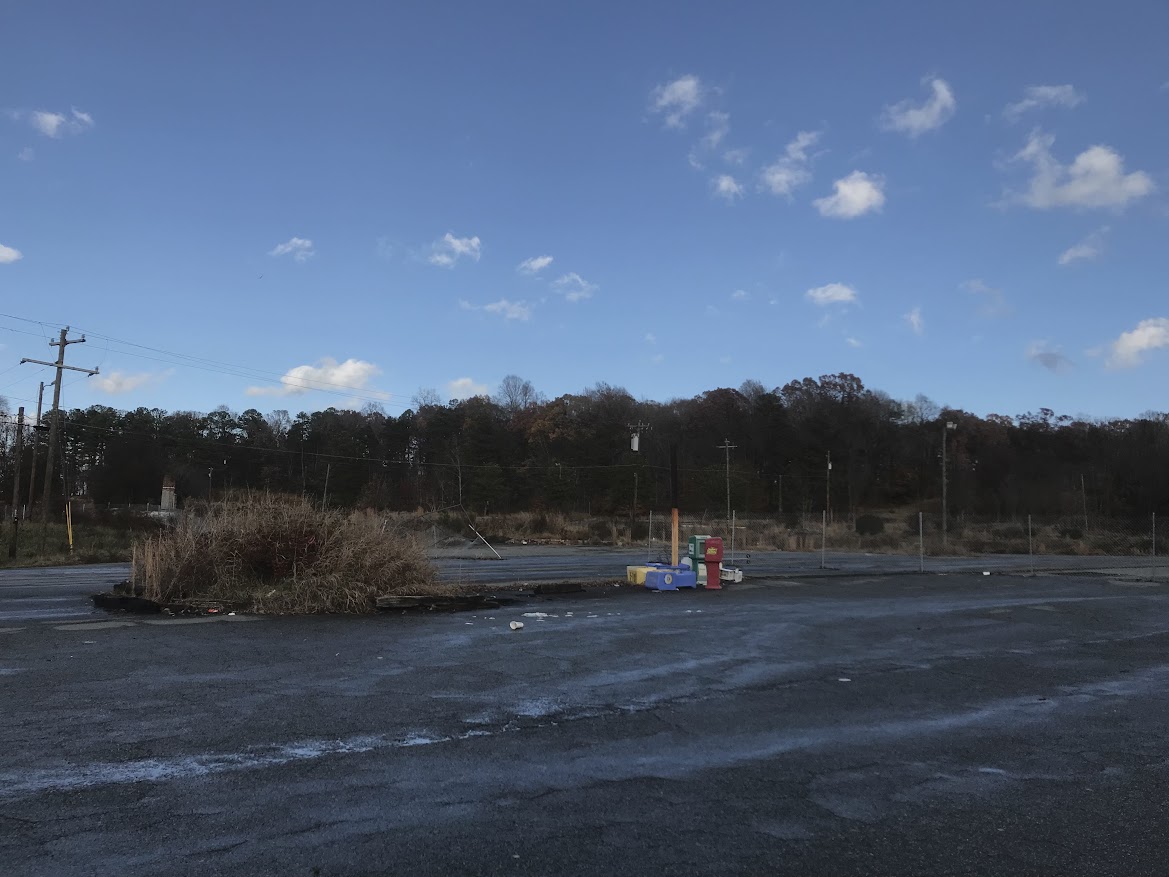
November 27, 2022.
References
Barthes, Roland. Camera Lucida: Reflections on Photography, translated by Richard Howard. New York: Hill and Wang, 1981.
Benjamin, Walter. “Small History of Photography.” In On Photography, edited by Esther Leslie. London: Reaktion Books, 2015.
Dickson, Scott. “The Daniel Boone Railroad – The Lost Train of Hillsborough, NC,” Tar Heel Trains, WordPress, January 3, 2009, https://tarheeltrains.wordpress.com/2009/01/03/the-daniel-boone-railroad-the-lost-train-of-hillsborough-nc/.
Fahey, Kelly. “Hillsborough’s Daniel Boone Village Sells,” Chapelboro.com, October 1, 2018, https://chapelboro.com/news/development/hillsboroughs-daniel-boone-village-sells.
Hamlin, Jeff. “Balloons Above Orange Closes,” The News of Orange County, November 21, 2018, https://www.newsoforange.com/news/article_d40d8db6-f8d8-11e8-ae8a-bfde6eadc1ad.html.
North Carolina Collection Photographic Archives. Wilson Library, University of North Carolina, Chapel Hill. Sontag, Susan. On Photography. New York: Picador, 2011. First published 1977 by Farrar, Straus, Giroux.
Tucker, Jonathan H. “Living in the Boonies,” Indy Week, Metro Publisher, June 4, 2014, https://indyweek.com/guides/best-of-the triangle/living- boonies/.
Visit Hillsborough. “Postcard – Daniel Boone Village,” n.d., https://hillsboroughgiftshop.square.site/product/danielboone/35.
Wray, Charlotte. “Daniel Boone Village Sold,” The News of Orange County, updated September 13, 2018, https://www.newsoforange.com/news/article_105a449a-b6bb-11e8-a8cb-ab3dad30da10.html.
“Viewpoints” on Chapelboro is a recurring series of community-submitted opinion columns. All thoughts, ideas, opinions and expressions in this series are those of the author, and do not reflect the work or reporting of 97.9 The Hill and Chapelboro.com.

