By SORS Volunteer Margot Lester
“As pre-hospital medical professionals, SORS volunteers have seen firsthand over and over how hard it is to help someone in cardiac arrest if the people around them don’t start CPR right away,” notes Caroline Williams, who leads South Orange Rescue Squad’s (SORS) Community Education Division. “In 2006, a group of us at SORS decided to offer free CPR training to our neighbors, the people who could make the biggest difference. Since then, we’ve taught around 15,000 people. Maybe you are one of them?!”
To have the most significant impact, SORS wanted the program to be available to people regardless of their ability to pay. (Most organizations charge a fee to cover materials and time.) The team earned a grant from the Strowd Roses Foundation to buy manikins and AED training units, and sent several SORS volunteers for American Heart Association CPR and first aid instructor certification. Donations from the community also help keep classes free.
“We taught our first community CPR class to the ushers and staff at UNC’s Memorial Hall on August 16th, 2006, and have never looked back!” Williams says. SORS offered between 55 and 85 CPR and first aid classes a year until the pandemic forced us to limit classes to healthcare professionals only. Trainings were gradually ramping up after restrictions eased in 2022; then demand unexpectedly spiked.
“After Damar Hamlin suffered a cardiac arrest live on national television during an NFL game in 2023, the public’s awareness and demand for CPR classes skyrocketed,” she recalls. “We taught 139 classes to 1,600 people that year and we’ve continued offering more than 100 classes per year ever since.”
See when our next community class is scheduled or request a private training.
Providing the level of training you want
SORS offers CPR classes for every level:
- 4 C’s (check, call, compress, connect) for super fast just-the-basics instruction
- Family and Friends for full training
- Heartsaver for people who need or want certification
- Basic Life Support for healthcare professionals
Participants learn on responsive manikins that have red, yellow, or green lights to indicate how well you’re doing compressions. “We’ve found this helps students make corrections right away and learn high-quality CPR faster,” she says. SORS also has infant manikins (minikins!) so participants can learn how to help babies, too. We also practice various first aid techniques, including administering NARCAN(R).
Review our step-by-step instructions for giving CPR!
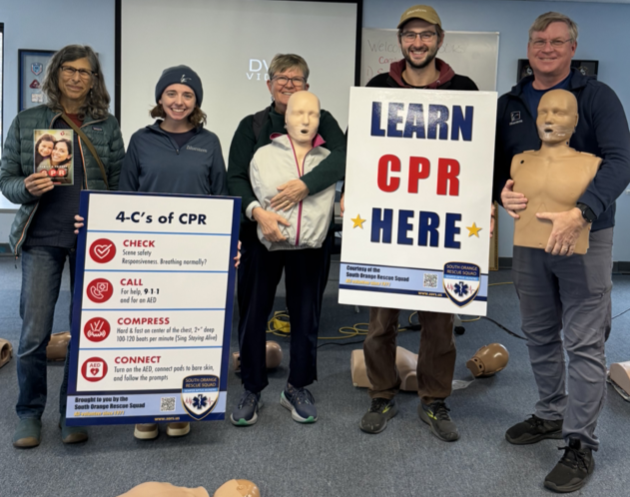
Businesses and nonprofits like Bluestem Conservation Cemetery engage with SORS to provide CPR and first aid training for their employees and volunteers. Photo: SORS
Improving availability and access
SORS has evolved our training to increase the availability of and access to health services and care, an important factor in reducing harmful social determinants of health and health inequities.
To remove language barriers, we work with organizations to integrate live translation into our sessions. “For something as important as life-saving skills, we all want to learn in our native language,” Williams says. We’ve partnered with El Centro Hispano for several years to teach CPR classes in Spanish 3 or 4 times annually. SORS volunteers also taught a class with translation into Karin and Burmese.
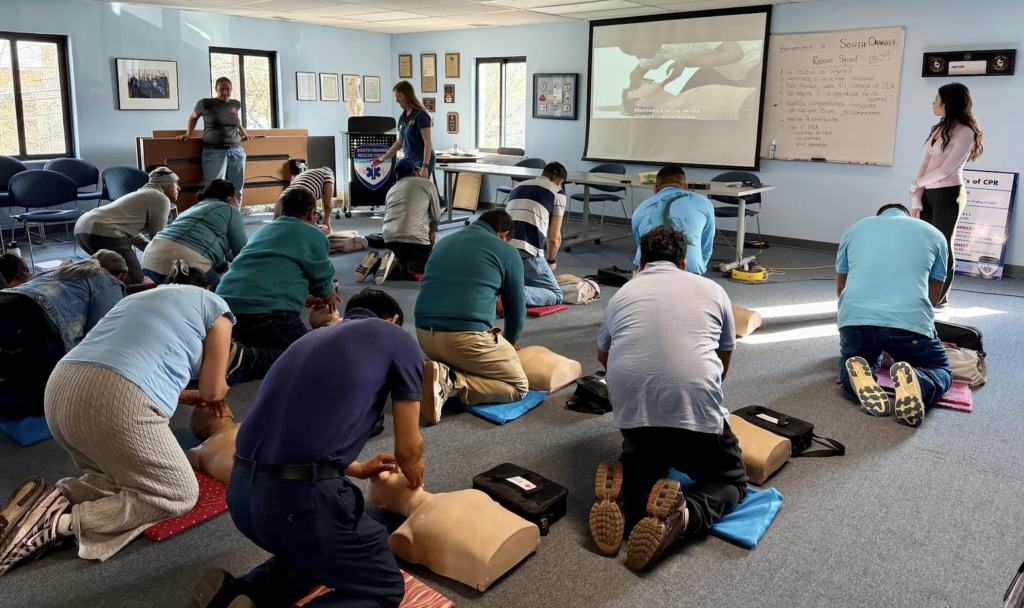
El Centro Hispano and SORS collaborate on Spanish-language CPR classes that remove barriers to training and prepare community members to act.
Research shows that people are less likely to perform CPR on people of color and women, so the Squad has been intentional in counteracting that. We’ve done trainings at the Jackson Center and for the Alpha Kappa Alpha, Mu Omicron Omega Chapter, to build capacity in the Black community. And to help people feel more comfortable giving CPR to women, we purchased womankins — anatomically correct practice torsos — with another SRF grant.
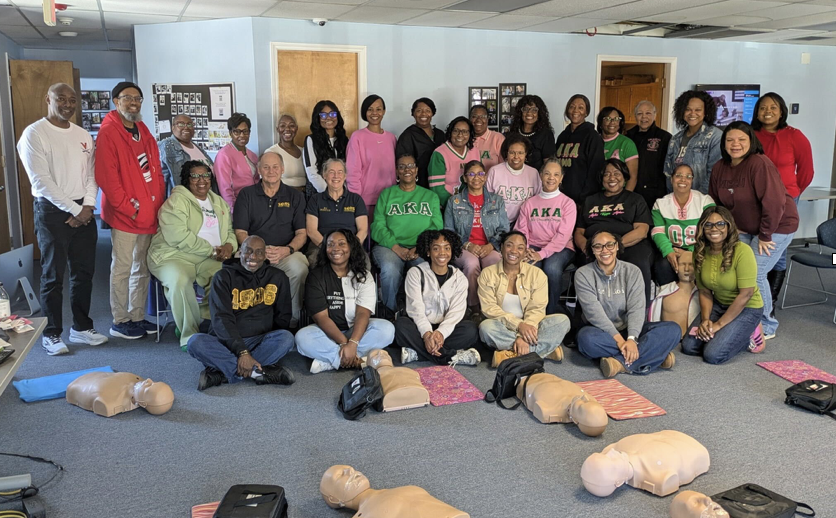
Members of the Alpha Kappa Alpha, Mu Omicron Omega Chapter hosted a training with SORS to prepare members to give bystander CPR and expand the community’s capacity to respond in emergencies.
Boosting emergency preparedness
“We want to help our neighbors feel more prepared for and confident in emergencies,” Williams notes. “Bystanders can be major difference-makers, providing crucial care until EMTs can get there.”
In addition to our free classes, we do 4Cs demos at local events and fairs, helping more community members — including kids — learn how to respond. And we added a new class, Stop the Bleed, earlier this year that covers bystander tactics to help someone who’s bleeding badly. This is important since rapid and uncontrolled blood loss is the leading cause of death from potentially survivable injuries.
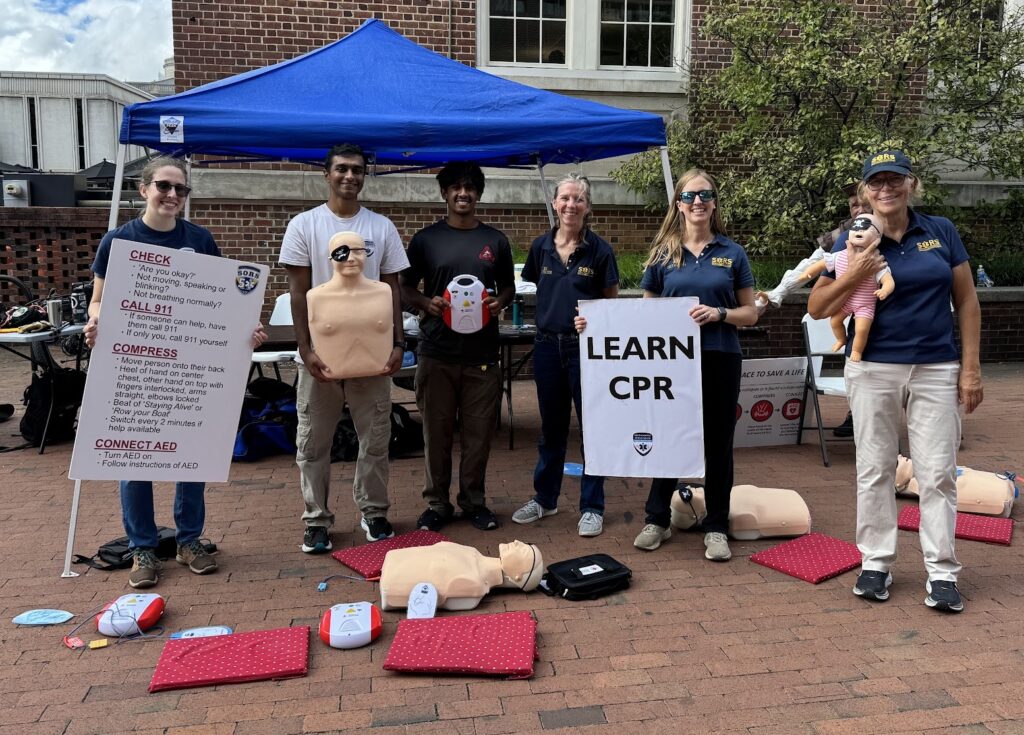
Members of the Community Education Division provide CPR instruction at our station in Carrboro and at local events like UNC Preparedness Day (which coincided with Talk Like a Pirate Day, hence the eye patches!).
“We enjoy teaching emergency preparedness to everyone from local businesses and departments at UNC to local nonprofits, scouts and churches; from summer camp counselors and daycare professionals to new parents and grandparents; and from doctor and dentist offices and the Orange County Health Department to local fire and EMS professionals,” Williams confirms. “Consider joining a class with us. It could help you save a life!”
As a 501(c)3 organization, SORS counts on grants and donations from community members to keep our programming free. Even small gifts make a difference! Please consider donating today. Thank you!
All photos courtesy South Orange Rescue Squad.
 The South Orange Dispatch is a monthly column on Chapelboro by the South Orange Rescue Squad: an all volunteer, 501c3 non-profit providing EMS and technical rescue services in the Carrboro-Chapel Hill area of Orange County since 1971.
Chapelboro.com does not charge subscription fees, and you can directly support our efforts in local journalism here. Want more of what you see on Chapelboro? Let us bring free local news and community information to you by signing up for our biweekly newsletter.

