

97.9 The Hill and Chapelboro.com have partnered with NC State Extension Master Gardener℠ volunteers of Orange County for “Playing in the Dirt,” a monthly column providing information and inspiration to gardeners of all skill levels! Check back on Chapelboro each month for a new subject – from our gardens to yours!
Mushrooms: The Weird and Wonderful Cleaners of Our Forests and Fields
By Guest Author: Sönke Johnsen, PhD, Duke University Dept. of Biology
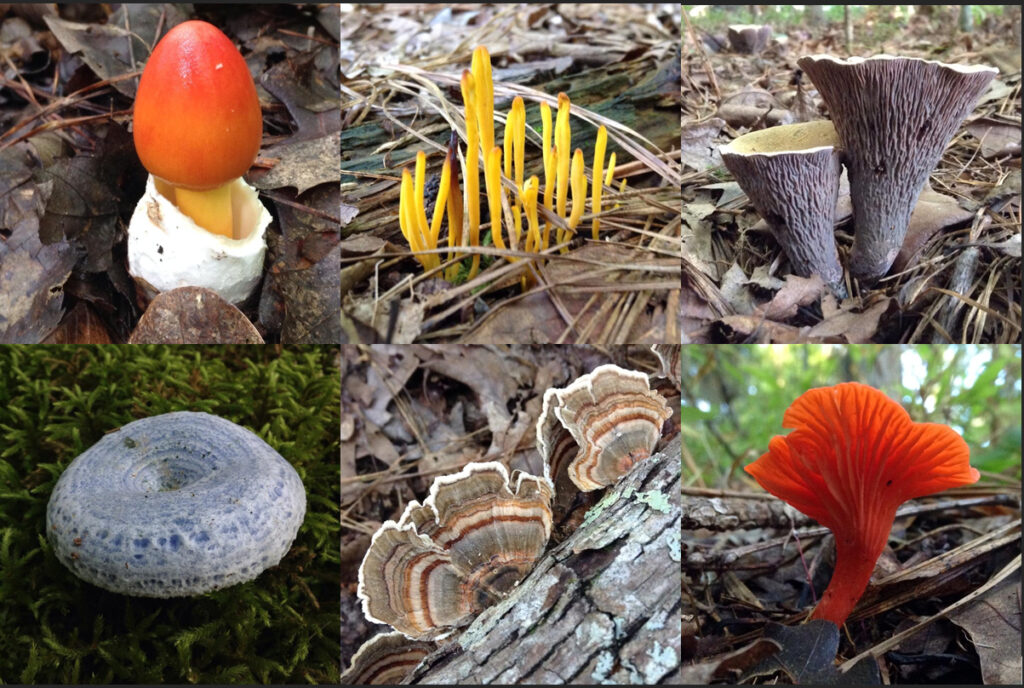
A small sample of the diversity of mushrooms in our local Piedmont woods. Top row, left to right: Amanita jacksonii (American Caesar), Clavulinopsis sp. and Gomphus clavatus (pig’s ear). Bottom row, left to right: Lactarius indigo (indigo milk cap), Trametes versicolor (turkey tail) and Cantharellus cinnabarinus (cinnabar chanterelle). All photos courtesy of Jill Soha.
What Is the Weird and Wonderful Mushroom?
Mushrooms are a type of fungi, a kingdom of millions of species that evolved in the oceans a billion years ago and then colonized land 500 million years later. The group fungi are as diverse as the kingdom is large, ranging from a honey mushroom colony that covers 2,200 acres of Oregon forest and weighs 35,000 tons to molds, pathogens and the yeast you use to make your bread. They are more closely related to animals than plants and eat their food rather than make it from sunlight as plants do.
There are about 14,000 species of mushrooms — fungi generally with a large fruiting structure we see above-ground (what we think of as “a mushroom”) together with an underground web of filaments called the mycelium. Mushrooms emerge so that the mycelium can reproduce by releasing spores. In a way, a field of mushrooms is like a buried apple tree with only the fruits above ground.
Fungi species fall into two divisions: Ascomycota, which contain the mushrooms, truffles and morels, and also non-mushrooms like baker’s yeast; and Basidiomycota, containing nearly all the other familiar mushrooms. Basidiomycota also include many species of Cryptococcus, a genus of yeast that causes lung and brain infections in immuno-compromised people. These two divisions split and evolved independently so long ago (about 500 million years) that a morel mushroom is as similar to your grocery store button mushroom as we are to a starfish.
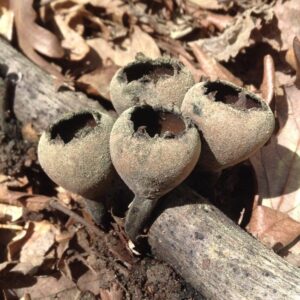
Urnula criterium (devil’s cup). (Photo by Jill Soha.)
What Do They Do?
Put simply, fungi are voracious eaters. Whether the fungus is yeast eating the sugar in your dough, mold colonizing the forgotten bread on your counter or a parasitic mushroom decimating a forest, the life of a fungus is spent sitting and eating. While we know of 200 species that are carnivorous, trapping and/or poisoning nematodes and other tiny animals to eat, the vast majority of fungi are vegans. Some eat living plants, which is considered a form of parasitism. Most, however, either eat dead plants or live in a symbiotic relationship with them, both being important for fields and especially for forests.
Fungi that eat dead plants can be considered the forest’s cleaning service — they are one of the few organisms that can digest lignin and cellulose, the main components of wood. The next time you walk through the woods, look at old fallen tree trunks. If they look broken apart into softer brown chunks, then they are being eaten by a fungus that digests cellulose. If the wood is broken apart but white, it may be being eaten by fungi that can digest both cellulose and lignin. The important thing is that without these fungi, you would not be walking through the forest at all because the piles of un-decayed wood and leaves would be well above your head. Even more importantly to the trees themselves, the nutrients in the dead wood and leaves would not be returned to the soil to nourish the trees and the forest would eventually die.
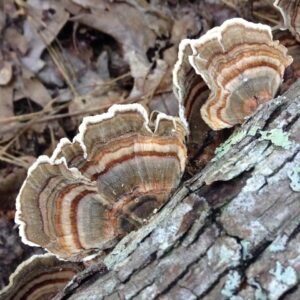
Trametes versicolor (turkey tail). (Photo by Jill Soha.)
A large number of fungi, known as mycorrhizal, do not eat dead wood but instead live in a partnership with living trees. These fungi interact with the root tips of the trees on a microscopic level to improve the tree’s ability to absorb water and nutrients. Without this help, many trees would not get enough to thrive. In return, the fungi receive sugars from the trees. This partnership is common and is the reason so many of the mushrooms we see in the woods are found within 25 feet of an established tree — they’re connected to the tree’s roots via the mushroom’s mycelium, like a secret handshake.
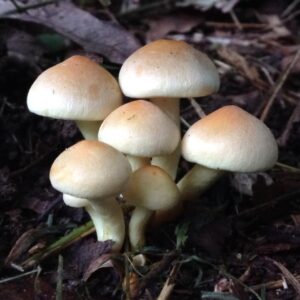
Hypholoma fasciculare (sulphur tuft). (Photo by Jill Soha.)
Amanita Muscaria — the Quintessential Mushroom
If one were to choose the mushroom that has had the greatest hold on the human imagination, it would have to be this red one with white spots, found in children’s drawings, fairy tales and even implicated in certain Christmas traditions. First, it is beautiful, with its stately red cap covered in white flakes that are remnants of the membrane that covered the mushroom when it was first formed. Underneath the cap is a dense radiating set of thin white layers known as gills. These are the structures that hold the reproductive spores that will drop when the mushroom reaches maturity.
Second, this mushroom is a member of the fascinating genus of mushrooms known as the Amanita. These are common in central Carolina forests and often the largest mushrooms you will see. Most Carolina Amanita species are white and seem to be untouched by the insects that devour other mushrooms, possibly because an unknown number of Amanita species are toxic. While some of the most dangerous are tasty, they will cause terrible stomach pains and lead to death by liver and/or kidney failure a few days later. Amanita muscaria itself seldom kills, but you may wish it did, because being poisoned by it is intensely unpleasant.
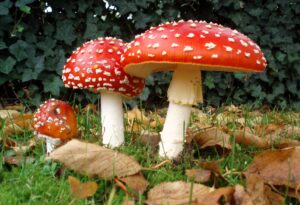
Amanita muscaria (fly agaric). These specimens are from Europe; the ones in our woods in the Piedmont tend to have orange rather than red caps. (Photo by Onderwijsgek under a Creative Commons License.)
Finally, Amanita muscaria is connected to certain Christmas traditions. Not only is it red and white and found near evergreen trees, but it also appears to have been used as an intoxicant by Siberian shamans. Reportedly, they first fed the mushrooms to reindeer to partially detoxify them and then drank the reindeer’s urine for its hallucinatory effects. Apparently one of the hallucinations was that one could fly. Something to think about as the holidays approach!
Final Caution
Mushrooms are beautiful and are safe to pick, hold and smell, but you should never put one in your mouth unless it is identified in person by an expert in local mushrooms. It’s also a good idea to wash your hands after handling them. Many deadly species look just like edible ones, and many species look different in different places. You cannot just use a book, and you cannot just send an expert a photo.
Want to Know More?
Recommended by Dr. Johnsen:
- Bessette, A. E., Bessette, A. R., and M. W. Hopping (2025). A Field Guide to Mushrooms of the Carolinas (Southern Gateways Guides). The University of North Carolina Press.
- Bessette, A. R., Roody, W. C. and A. E. Bessette (2007). Mushrooms of the Southeastern United States. Syracuse University Press.
NC Extension Resources:
- Mushrooms in Turf: Don’t Be Afraid of the Fairy Rings, Amanda Bratcher, Lee County Extension.
- Mushrooms – Foraging for Wild Mushrooms Safely, Jeffrey Cates, Forsyth County Extension.
- The Incredible Edible Mushroom, Robeson County Extension.
- Mushrooms, NCSU Extension (with additional resources linked).
PLANNING FOR THE HOLIDAYS!
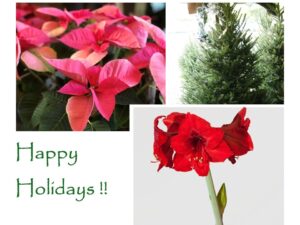
Questions about caring for your holiday tree and decorative plants?
Take a look at previous Playing in the Dirt articles and the included resources, Care for Cut and Living Christmas Trees and Enjoy Your Holiday Plants After the New Year.
Need the perfect gift for any plant lover or ecologist?
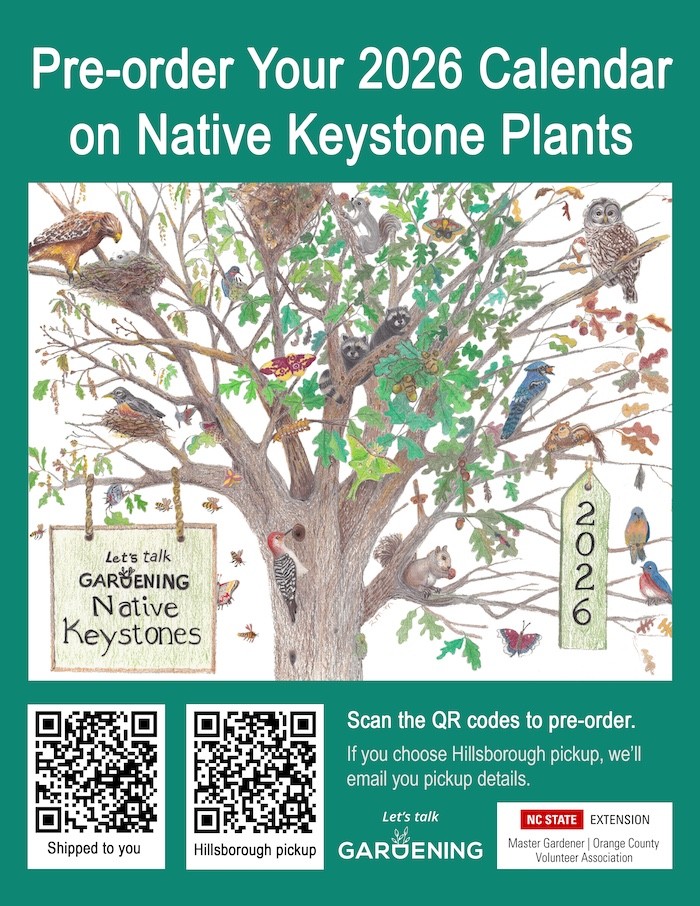
The 2026 calendar created by Orange County Master Gardeners is now available to preorder! Beautiful cover art and stunning garden photos bring native plants to life throughout the year.
This year’s theme, “Native Keystones,” highlights plants that support entire ecosystems in your yard. Each month features a different native superstar, from oaks and dogwoods to asters and bee balm. These keystone plants provide essential food and habitat for wildlife and the calendar offers easy-to-follow gardening tips for each season.
Calendars are $24 each. All proceeds support our projects providing gardening education and information to our community.
How to order:
With shipping: https://www.paypal.com/ncp/payment/4XBC3YV8HV95G
Pickup in Hillsborough: https://www.paypal.com/ncp/payment/YRTGZT4XJAVN8
(You’ll get an email with details.)
More from Master Gardenener Volunteers of Orange County:
Have a plant or garden question? Email us at ocmgardeners@gmail.com or phone 919-245-2061 (leave message).
Visit our website: TheOrangeGardener.org.
Subscribe to our monthly newsletter: The Garden Buzz.
Follow us on Facebook: Our page is NC State Extension Master Gardener volunteers, Orange County.
Follow us on Instagram: @orangencmastergardeners
Chapelboro.com does not charge subscription fees, and you can directly support our efforts in local journalism here. Want more of what you see on Chapelboro? Let us bring free local news and community information to you by signing up for our newsletter.

