
Often attributed to Mark Twain — perhaps mistakenly, since no historical source shows he actually made the statement — “History doesn’t repeat itself, but it often rhymes” is a common and apt refrain when discussing the connection between historical perspectives and current events. By drawing on knowledge of what happened in the past, and why, we are better able to understand the flow and direction of the history collectively created in each new day.
“Past Rhymes With Present Times” is a series by Lloyd S. Kramer exploring historical context and frameworks, and how the foundations of the past affect the building of the future.
The North Carolina General Assembly recently allocated state funds to build a monument and statue that will honor the evangelist Billy Graham on the grounds of the state’s historic capitol building in Raleigh.
Although state officials placed another statue of the Reverend Graham at the U.S. Capitol’s Statuary Hall in 2024, Representative John Torbett (R-Gaston County) has promoted the creation of this new monument “to celebrate those people who did great things” and to ensure that “kids can learn” why Graham was a world-famous North Carolinian.
This plan for a new statue has provoked me to reflect on the meaning of courage, partly because I once had a memorable conversation with Dr. Graham about President Richard Nixon and partly because brutal assaults on immigrants and other attacks on democratic political rights are now forcing Americans to recognize the dangers of resisting repressive power.
Pervasive desires for personal safety or deep fears of public criticism prevent most people from taking courageous actions, but there have always been exceptional individuals who challenge social injustices and authoritarian governing systems.
Public discussions at the Chapel Hill Public Library and the Flyleaf bookstore have recently focused on a few such people through conversations about new books by Zaakir Tameez (Charles Sumner: Conscience of a Nation) and by the North Carolina authors Timothy B. Tyson and Mary D. Williams (Mahalia Jackson: Moving on Up a Little Higher).
Tameez describes Senator Sumner’s courageous opposition to slavery during the 1850s and his Congressional efforts to build a multiracial democracy. Tyson and Williams carry the history of this long struggle into the twentieth century by showing how Mahalia Jackson courageously enriched the movement for Black equality with her powerful singing voice from the 1940s to the 1970s.
The Meaning of Courage
Courage emerges in diverse actions that can range from military and political courage to religious, professional, intellectual, artistic, and medical courage. In most general terms, courage influences human societies and institutions whenever people take risks that endanger their own well-being or future safety.
The outcomes of risky actions are always uncertain, so courageous individuals and groups make mistakes because they can never know the unexpected consequences of complex choices. Brave people define themselves by what they do and not simply by what they say.
Courageous people thus change history through both obscure and dramatic public actions. Martin Luther nailed his resistance to religious corruption on a church door; American patriots signed their resistance to the British Empire on a Declaration of Independence; and Martin Luther King, Jr. defined his resistance to racist segregation in a Letter from a Birmingham jail. This kind of courage is praised in our own time as “speaking truth to power.”
Senator Sumner Advocated a Multiracial Democracy
Charles Sumner (1811-1874) became a lawyer in Boston and served as a senator from Massachusetts over the last 23 years of his life. He was the first lawyer to argue for “equality before the law,” and by the early 1850s he was proposing that slavery should be permanently banned from all territories in the western United States.
Sumner insisted that anti-slavery politicians must take risks and embody three essential qualities: “The first is backbone: the second is backbone; and the third is backbone. When I see a person talking loudly against Slavery in private, but hesitating in public,… I say, he wants backbone.”
Sumner entered the US Senate and used his own strong backbone as he denounced the spread of slavery into Kansas and vilified slaveholding senators who mocked all arguments for equal human rights.
An enraged Congressman from South Carolina responded violently to this anti-slavery oratory with a brutal beating in the Senate chamber that badly injured Sumner and galvanized the new Republican Party’s hostility for slavery after 1856.
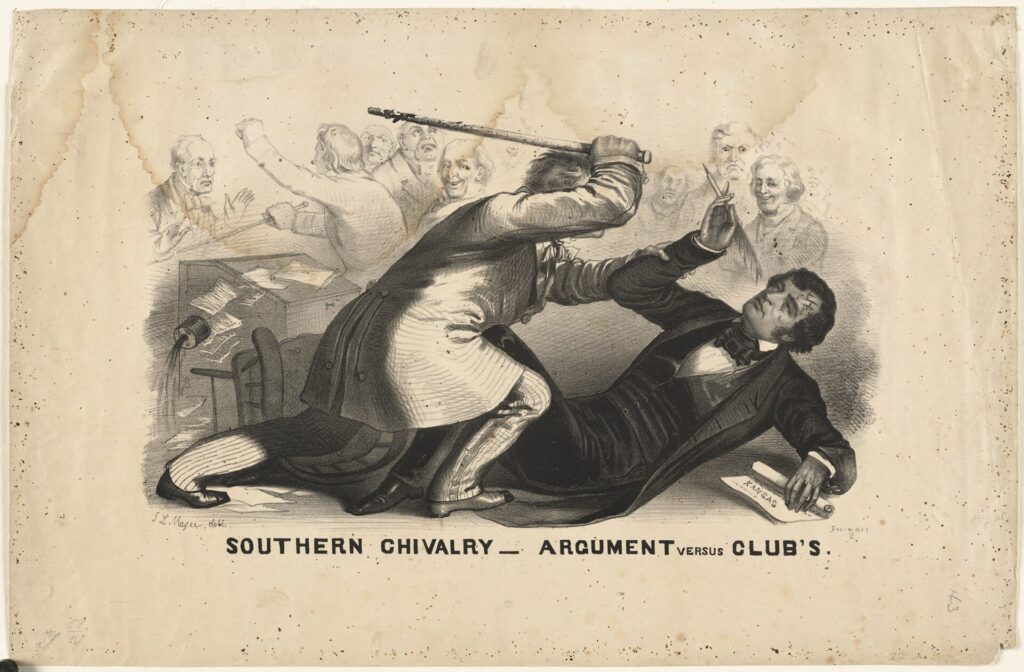
The attack on Charles Sumner by Congressman Preston Brooks in the Senate Chamber, May 22, 1856. (1856 Lithograph by John L. Magee, Boston Public Library)
Returning eventually to his Senate seat, Sumner pushed President Lincoln toward the Emancipation Proclamation and supported new laws and Constitutional amendments that abolished slavery, established birthright citizenship, and affirmed equal voting rights for all male citizens. Sumner could be vain or insulting, but his courageous denunciations of slavery and his steadfast defense of equal Black rights made him a public leader whom Tameez calls the “conscience of a nation.”
Mahalia Jackson Sang for Human Equality
Mahalia Jackson (1911-1972) was born into a poor Black neighborhood of segregated New Orleans that was still excluded from the multiracial democracy that Sumner had envisioned. She found her creative niche in this community among musicians at Black churches before moving to Chicago in 1931 and becoming a popular gospel singer. As Tyson and Williams explain in their excellent book, Jackson’s southern Black Christianity firmly asserted that all people were equal in the eyes of God; and she believed that everyone must also be “equal before the law.”
By the late 1940s, she was becoming famous through popular recordings of gospel songs such as “Move on Up a Little Higher,” which strongly suggested that Black Americans must move higher in their earthly education and political rights before they eventually moved to a higher heavenly sphere.
Jackson gradually developed her personal wealth and fame, but she also used her extraordinary singing voice to support Black voter registration and the Montgomery Bus Boycott that overturned a racist system of public transportation. She became a close friend of Martin Luther King, Jr., with whom she later partnered for musical events that raised money for arrested “Freedom Riders” across the South, voter registration campaigns in Alabama, and the March on Washington in 1963—where Jackson sang to the vast crowd before Dr. King famously summarized his dream for racial equality.
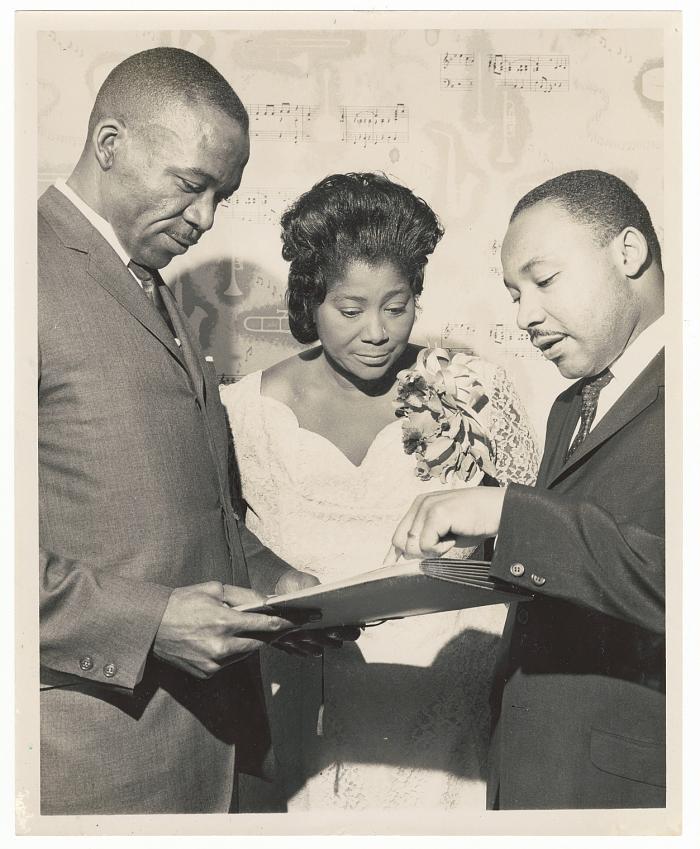
Mahalia Jackson in an undated photograph with Dr. Martin Luther King, Jr. and an unidentified man. (Collection of the Smithsonian National Museum of African American History and Culture, Gift of Paul & Claire Blumenfeld)
Although she faced threats of violence, Jackson insisted that nothing could break her commitment to the Civil Rights Movement, “If they kill me for freedom,” she told one interviewer, “then I’ll be buried in the land of the free.”
Jackson suffered setbacks in the struggle for equal rights and mourned deep losses such as the murder of Dr. King, but she courageously continued to speak for social justice and to express her Christian faith at religious services that expanded their social-political messages far beyond the themes of Billy Graham’s Crusades.
Billy Graham Praised Richard Nixon
The Christian faith of Billy Graham (1918-2018) flowed as deeply as the faith of Mahalia Jackson, but Graham made different political choices. He did not join the clergy who marched for Civil Rights in Montgomery, Birmingham, Selma or Washington, DC; and he avoided public actions that might have alienated his admirers who opposed the Civil Rights Movement and anti-war demonstrations during the 1960s.
My own opposition to the Vietnam War nevertheless became the public issue that brought me briefly into contact with Dr. Graham. I was attending a small Presbyterian college near Knoxville in May 1970 when he launched one of his large, ten-day Crusades at the University of Tennessee’s football stadium.
I grew up in a patriotic, religious family with strong roots in eastern Tennessee, yet I had come to believe that the Vietnam War was destroying democratic political traditions as well as Christian moral values—especially after President Nixon sent US troops into Cambodia and the National Guard killed antiwar protestors at Kent State University.
I therefore decided to demonstrate my opposition to Nixon’s policies when I learned that Billy Graham had invited the president to his Knoxville Crusade, and I went into the stadium with protestors whose signs simply stated the Sixth Commandment: “Thou shalt not kill.”
I sat quietly throughout the service, but a few protestors shouted profanities when Dr. Graham introduced Nixon as a peacemaking president and when Nixon himself thanked the stadium’s “silent majority” for their support.
As the service was ending, I was suddenly arrested by plainclothes police officers and taken with others to the Knoxville jail on charges of disrupting a religious service and shouting obscenities. A family lawyer soon bailed me out of jail, but then the president of my college happened to ask Dr. Graham at a community event if he would like to meet a couple of the arrested protestors.
I still appreciate his response, because Dr. Graham agreed to meet privately with me and my also-arrested friend before the Crusade’s final service. This conversation remains a vivid memory because I was a young student who naively assumed that the famous evangelist would understand how Nixon had used the Crusade for his own political purposes.
But Dr. Graham viewed the event very differently, and I remember how he stressed his close friendship with the President while he explained that Nixon’s participation in the Crusade offered confirmation of shared religious beliefs.
This conversation showed me that Dr. Graham did not want to raise moral questions about Nixon’s military policies or to seek opportunities for speaking “truth to power.” I never forgot my meeting with the famous Christian preacher, but I could also never forget that Dr. Graham lacked the public courage of other religious leaders who bravely supported controversial movements for racial justice and peace in Vietnam.
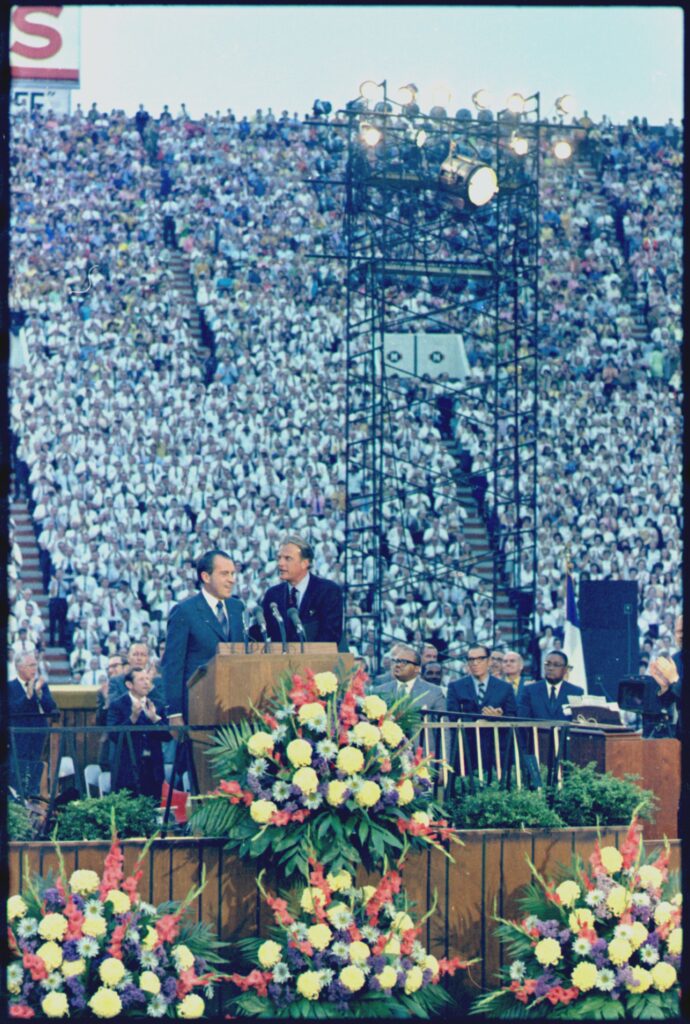
Billy Graham with President Richard Nixon during Graham’s “Crusade” at the University of Tennessee football stadium, May 28, 1970.
Should Statues Honor Courageous People?
I now understand more clearly why it is difficult for both public figures and fearful citizens to speak courageously against powerful politicians and governing institutions. As I read about the actions of people in previous generations, however, I find that Charles Sumner, Mahalia Jackson, and religious leaders like Dr. King went far beyond Billy Graham in taking courageous public risks.
A new statue of Dr. Graham will soon stand on state grounds in Raleigh, but I hope other North Carolinians (including the leaders of Black struggles for equal rights) will also be recognized with future monuments. These statues should honor the most courageous advocates of social justice and the bravest defenders of vulnerable people.
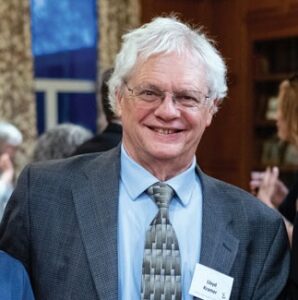
Photo via Lindsay Metivier
Lloyd Kramer is a professor emeritus of History at UNC, Chapel Hill, who believes the humanities provide essential knowledge for both personal and public lives. His most recent book is titled “Traveling to Unknown Places: Nineteenth-Century Journeys Toward French and American Selfhood,” but his historical interest in cross-cultural exchanges also shaped earlier books such as “Nationalism In Europe and America: Politics, Cultures, and Identities Since 1775” and “Lafayette in Two Worlds: Public Cultures and Personal Identities in an Age of Revolutions.”

