

Next Up for Much-Improved UNC — Duke, ACC’s Toughest Schedule
By David Glenn
This is going to be interesting.
On the one hand, North Carolina just survived a major midseason crisis — one that included alarmingly porous defense and three losses in a four-game stretch — by putting together a brilliant four-game winning streak, highlighted by an 85-80 victory at nationally ranked Virginia.
On the other hand, UNC (18-4, 6-3 ACC) now faces by far the toughest remaining regular-season schedule in the entire Atlantic Coast Conference, bookended by a visit from #4 Duke (21-1, 10-0 ACC) on Saturday (6:30 p.m., ESPN) and a rematch against the Blue Devils in Durham on March 7.
In between those much-celebrated deals with the Devils, the Tar Heels’ other seven remaining regular-season games include daunting road trips to Miami and NC State (each projected as an NCAA Tournament participant) and a challenging three-game homestand against Louisville, Virginia Tech and Clemson, which also rank in the top half of the 18-team league standings. A road trip to volatile-but-talented Syracuse also remains on the Heels’ dangerous docket.
If the Tar Heels continue to grow, thrive and win over this next month or so, they will head to the ACC Tournament in Charlotte in mid-March with lots of confidence and as one of the favorites for the ACC championship, an achievement that has eluded Carolina for almost a full decade (2016) at this point.
If the Tar Heels repeatedly falter against this higher caliber of competition, they could easily slide down to eighth or ninth place in the conference standings, which is typically an uncomfortable vantage point, both at the ACC Tournament and on Selection Sunday.
To the credit of fifth-year UNC head coach Hubert Davis, his staff and his players, the Tar Heels appear to have a much sturdier foundation than they had just a month ago, when only some of the following building blocks were in place.
In theory, this firmer foundation will bode well for the Heels’ performance in the coming weeks, against the toughest remaining schedule in the ACC.
1. The dominance of All-American forward Caleb Wilson.
Although the past has shown repeatedly that UNC teams led by a freshman inevitably experience a wild ride, Wilson has lifted the Tar Heels with — no exaggeration — one of the best rookie campaigns in the program’s illustrious history.
Carolina has had dozens of All-American players over the past 100-plus years, but only one was a freshman: relentless forward Tyler Hansbrough. A 6-foot-10, 215-pound forward with pogo stick-style leaping ability, Wilson plays with levels of energy, fearlessness and intensity that are reminiscent of Hansbrough, who led the Tar Heels to a 23-8 record, a second-place ACC finish and an NCAA Tournament bid as a rookie in 2005-06.
Stunningly, Wilson (16) already has surpassed Hansbrough’s record (14) for the most 20-point games by a UNC freshman. If Wilson can sustain or improve his sensational averages of 20 points and 10 rebounds per game, he even will finish above Carolina’s current record-holders in those categories — Hansbrough (18.9 ppg in 2006) and Antawn Jamison (9.6 rpg in 1996), who authored two of the other greatest freshman seasons in program history.
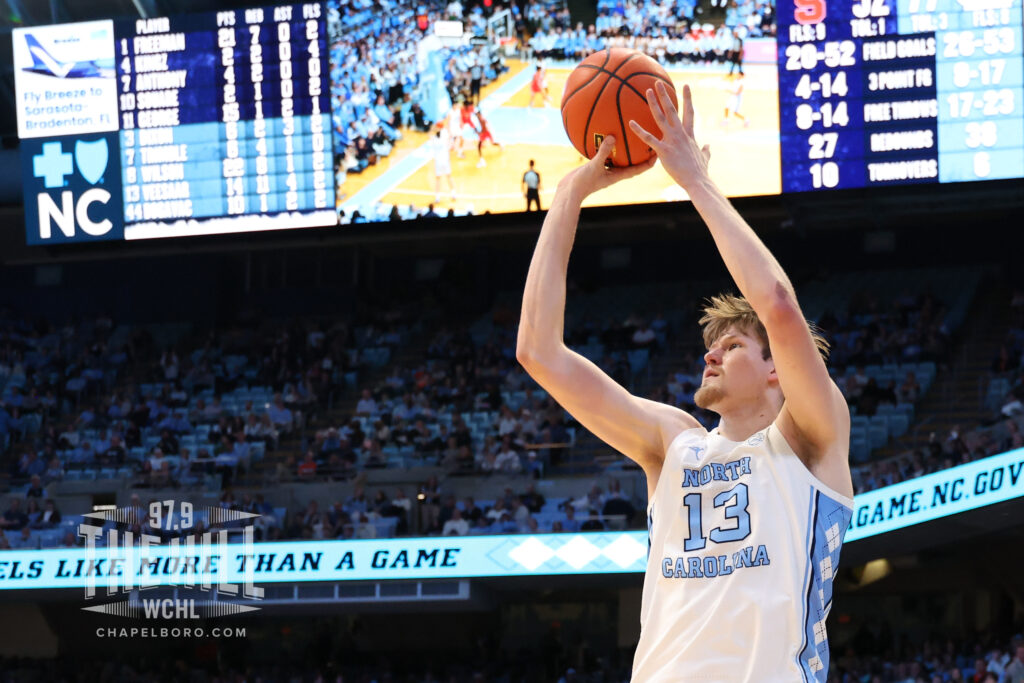
2. The blossoming of All-ACC center Henri Veesaar.
Just as it’s fair for Davis’ many critics to point out examples of UNC players who ended up performing better — sometimes much better — elsewhere (e.g., Caleb Love at Arizona, Elliot Cadeau at Michigan, Cade Tyson at both Belmont and Minnesota), it’s equally fair to add Veesaar to the growing list of players who didn’t become the best version of themselves until they played for Davis in Chapel Hill.
The success stories of Brady Manek (2022), Harrison Ingram (2024), Cormac Ryan (2024), Jarin Stevenson (2026) and Veesaar are worth telling, too.
(photo via Todd Melet)
Veesaar, who rarely started during his three years at Arizona, may be the best example of Davis signing and developing a transfer who truly blossomed under his tutelage.
During his three years at Arizona, Veesaar started only five games. During his first three-plus months in a Carolina uniform, Veesaar has started all 22 of the Tar Heels’ games, helped his new team top a top-15 national ranking, firmly established himself as a first-team All-ACC candidate, and entered the conversation as a potential first-round draft pick.
Through games of Feb. 3, only two players ranked among the ACC’s top 10 in scoring, rebounding, field goal percentage and blocked shots: Veesaar and Wilson. Veesaar, who averaged about six points and three rebounds per game for Arizona, is averaging about 17 points (ninth in the ACC) and nine rebounds (fifth) for the Tar Heels, while shooting 62 percent from the field (second) and blocking 1.3 shots per game (eighth).
3. The leadership and two-way play of senior guard Seth Trimble.
In a college basketball world that has a growing number of 23-year-old freshmen (seriously), Trimble is a true throwback — a 21-year-old senior.
In a college sports era overflowing with transfers now competing for their second, third or fourth university, Trimble once again is a classic — a four-year player for the Tar Heels. In the entire ACC, there are only two other scholarship seniors who are still competing for the same program they signed with out of high school: Clemson guard Dillon Hunter and Stanford guard Benny Gealer.
At a time when the NCAA tries desperately to remind everyone that only a very small percentage of college athletes end up making a living in their sport, Trimble may have the best of both worlds. He’s on track for a UNC diploma, he has benefited greatly from the NCAA’s new rules regarding revenue-sharing and Name-Image-Likeness compensation, he already owns a Ben & Jerry’s ice cream shop on Franklin Street in Chapel Hill, and he’s virtually assured of a lengthy professional basketball career (most likely overseas) if that’s what he ultimately wants.
Most importantly for this year’s Tar Heels, since returning from his nine-game injury absence, Trimble has been a rock-solid, two-way presence in a UNC backcourt that has far less talent — and many more moving parts — than its star-studded frontcourt. He’s the Tar Heels’ third-leading scorer (14 ppg) and rebounder (4 rpg) and their top perimeter defender, he has helped inspire the team’s bounce-back from its defensive woes, he has been unselfishly willing to defer to Wilson and Veesaar, and — when needed (e.g., at Virginia) — he has come up with huge clutch plays at both ends of the floor.
4. The promotion of steady freshman point guard Derek Dixon.
Despite the stellar performances of Wilson, Veesaar and Trimble, it became clear long ago that this UNC team wasn’t going to have a chance at its loftiest goals unless the rest of its backcourt started playing better.
Sure enough, that has happened over the past two weeks, perhaps spurred by Davis’ promotion of freshman Derek Dixon to the starting point guard role.
A 6-5, 200-pounder from Vienna, Va., who competed at the high school level in a very challenging league in Washington, D.C., Dixon supplanted junior Kyan Evans as UNC’s “PG1” midway through the team’s West Coast trip to play Stanford and California.
Since the Tar Heels’ return from that 0-2 trip, they are 4-0. They have played much better defense. They have reduced their turnovers. They have increased their pace. They have found more easy buckets, including on the fastbreak. Dixon has been instrumental in all of those things.
A seemingly unflappable personality, Dixon already seems to understand that what his team needs from him is far more about defense, composure, intelligence and mental/physical toughness than it is about big numbers, although the Tar Heels certainly don’t mind his impressive ball-handling stats (seven assists, one turnover at UVa) and superb 3-point shooting results (41 percent) thus far.
5. The readiness and unselfishness of other rotation players.
Every great team needs role players who understand and accept their roles, and getting to that point is rarely a smooth, uncomplicated journey.
Everyone wants playing time. Most like when the ball ends up in their hands. Who doesn’t enjoy scoring?
This UNC team is at its best, though, when Wilson and Veesaar are the top two options, and when everyone else takes his personal version of smart, high-percentage shots, whether that ends up being two attempts or 10. The best example of this phenomenon could be a different guy in each game.
UNC’s lone example of this year’s ACC-wide international theme, junior guard Luka Bogavac gradually has made the difficult adjustment from European basketball to American hoops (more physical, quicker defenders). Over his last six games, after a slow start in Chapel Hill, he has looked a lot more like his sharpshooter self: almost 12 points per game, 40 percent on 3-pointers, 87 percent from the free throw line.
Dixon, Evans (adjusting from 25-plus minutes per game to often 10 or fewer), Stevenson (sensational second half at UVa), sophomore guard Jonathan Powell (a valuable 3-point shooter and rangy defender) and junior guard Jaydon Young (four consecutive starts but wildly varying minutes played) are going through their own versions of trying to balance personal production with a team-first approach.
With all of this in mind, what’s the best advice for UNC fans moving forward?
Buckle up. The rest of this season is probably going to be another wild ride.
 David Glenn (DavidGlennShow.com, @DavidGlennShow) is an award-winning author, broadcaster, editor, entrepreneur, publisher, speaker, writer and university lecturer (now at UNC Wilmington) who has covered sports in North Carolina since 1987.
Chapelboro.com does not charge subscription fees, and you can directly support our efforts in local journalism here. Want more of what you see on Chapelboro? Let us bring free local news and community information to you by signing up for our newsletter.

