

In-State Talent Pipeline Is Flowing, but Will UNC Football Capitalize?
By David Glenn
In the 1990s, when Mack Brown was building a couple of the best college football teams in the history of North Carolina (meaning the entire state), he did an amazing job of signing a large percentage of the top in-state high school prospects while also strengthening his foundation with lots of out-of-state talent.
Back then, Brown always tried to cultivate positive relationships with North Carolina’s high school coaches, and he was effusive in his praise for them, but he also knew that — generally speaking — higher-caliber football was being played in states far more famous for their high school football.
Hence, on Brown’s 1996 (10-2) and/or 1997 (11-1) teams, which both finished in the top 10 of the national polls, there were key UNC players from Alabama (linebacker Kivuusama Mays), California (quarterback Chris Keldorf), Florida (linebacker Keith Newman), Georgia (center Jeff Saturday), Illinois (punter Brian Schmitz), Mississippi (kicker Josh McGee), New Jersey (defensive end Mike Pringley), Pennsylvania (safety Omar Brown, running back Jonathan Linton), South Carolina (defensive tackle Vonnie Holliday) and Virginia (cornerback Dre Bly).
Countless times during his first tenure with the Tar Heels, Brown watched players from other gridiron-happy states beat out even highly rated in-state prospects for starting roles in Chapel Hill.
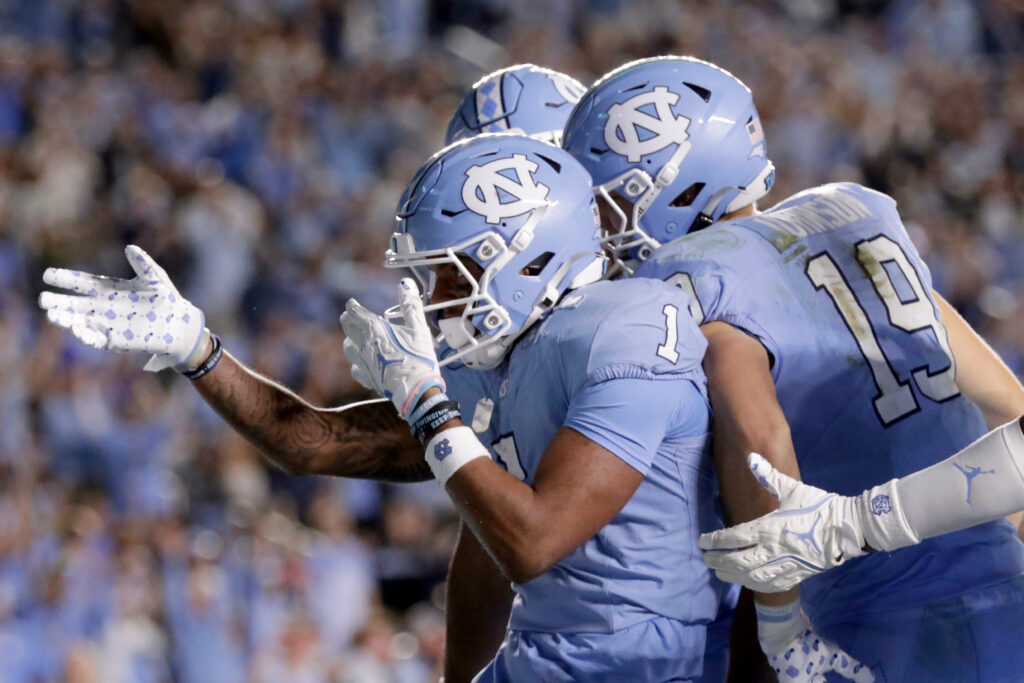
North Carolina wide receiver Jordan Shipp (1) celebrates his touchdown with tight end Jake Johnson (19) during the second half of an NCAA college football game against Duke, Saturday, Nov. 22, 2025, in Chapel Hill, N.C. (AP Photo/Chris Seward)
Meanwhile, many in-state college coaches privately wondered whether the football culture in North Carolina — a state far more famous for basketball, NASCAR and other sports — would ever catch up to what they witnessed in various parts of the Midwest, Deep South, Texas or even the West Coast.
It’s not that North Carolina’s high school ranks weren’t producing great prospects. On those 1996 and/or 1997 Carolina teams, the other key players included in-state signees such as wide receivers Octavus Barnes and Na Brown, tight end Alge Crumpler, defensive tackle Russell Davis, defensive end Greg Ellis, running back Leon Johnson, linebacker Brian Simmons and cornerback Robert Williams.
Overall, however, the feeling lingered that lots of out-of-state college football programs were building from firmer foundations, mainly because of the higher-caliber high school football being played in those other states at the time.
With that unpleasant theme in mind, and given the Tar Heels’ failure to produce another top-10 team over the past 28 years, it’s time to report some good news.
North Carolina’s football culture definitely has improved, even to the point where its high school ranks now produce the fifth-most National Football League players, behind only legendary, long-time gridiron superpowers Texas, Florida, California and Georgia.
Going all the way back to the 1980s and perhaps longer, the most productive high school football talent pipelines haven’t changed. From time to time the order has changed, but it’s been the same four states every single time: Texas, Florida, California and Georgia.
This year, the North Carolina high school football pipeline is #5 in terms of producing the most NFL players (as measured by opening-week rosters), and that is a much-needed positive sign that reflects an improved gridiron culture in the Old North State, especially as UNC and the state’s other major college football programs have been mostly mediocre or worse in recent times.
It’s always important to point out in these conversations that pure demographics — just sheer population numbers — explain much of this stuff.
For example, the only three states with more than 20 million people each are California, Texas and Florida. It definitely helps that high school football has — to varying degrees — become so ingrained in the cultures of those three huge states, which all have warm climates and multiple generations of true passion for the sport, but it starts with those enormous population numbers.
That’s also part of why it’s so exciting to see North Carolina rise all the way up to #5 on this list. Yes, like Georgia, the Old North State is one of the 10 most populous states in the country, with an estimated population of approximately 11 million people. But right now Georgia and North Carolina are both producing far more NFL-caliber players than every other state with a similar population, and that can’t possibly be a bad sign.
Here are the specific 2025 NFL numbers by state:
Rank/State—High School Products In NFL
(2025 Opening-Week Rosters)
1. Texas—199
2. Florida—179
3. California—143
3. Georgia—143
5. North Carolina—70
6. Louisiana—59
7. Ohio—57
8. Illinois—55
8. Michigan—55
10. Alabama—52
Looking ahead, this impressive development provides at least some room for the hope that one or more North Carolina-based programs can become more relevant on the national scene at some point soon.
Although UNC coach Bill Belichick and his staff must spend an extraordinary amount of time evaluating high-end players in a relatively new talent pipeline (the NCAA transfer portal), they also must find their own version of Brown’s in-state/out-of-state balance on the high school recruiting trail.
Interestingly, all five of the Tar Heels’ 2025 All-ACC honorees represented states known for high-quality high school football: defensive end Melkart Abou Jaoude (New Jersey; #11 in NFL players), linebacker Khmori House (California), wide receiver Jordan Shipp (North Carolina), linebacker Andrew Simpson (California) and kicker Rece Verhoff (Ohio).
On National Signing Day (today), Belichick was expected to sign at least five well-regarded in-state prospects: defensive lineman Trashawn Ruffin, edge rusher Zavion Griffin-Haynes, offensive tackle JB Shabazz, linebacker Jayden Griffin-Haynes and kicker David Green.
Impressively, the Tar Heels also were expected to sign one or more highly ranked prospects from other proven football hotbeds, including Alabama (wide receiver Keeyun Chapman, defensive tackle Vodney Cleveland and safety Jamarrion Gordon), California (cornerback Jaden Jefferson and offensive lineman Jonah Rodriguez), Florida (cornerback Kenton Dopson), Georgia (quarterback Travis Burgess), Louisiana (safety Julian Burns), Michigan (athlete CJ Sadler), New Jersey (athlete Nyqir Helton, cornerback Xavier Jackson and cornerback Julian Peterson), Ohio (defensive back Jakob Weatherspoon), Pennsylvania (linebacker Ashton Blatt and cornerback David Davis), Texas (linebacker Calvin Thomas) and Virginia (cornerback Jaziel Hart).
 David Glenn (DavidGlennShow.com, @DavidGlennShow) is an award-winning author, broadcaster, editor, entrepreneur, publisher, speaker, writer and university lecturer (now at UNC Wilmington) who has covered sports in North Carolina since 1987.
Chapelboro.com does not charge subscription fees, and you can directly support our efforts in local journalism here. Want more of what you see on Chapelboro? Let us bring free local news and community information to you by signing up for our newsletter.

