

Amidst Changing Times for Rookies, Cadeau Among ACC’s Top Freshmen
By David Glenn
The impact of freshmen in major college basketball has changed a lot over the years.
Until the 1972-73 season, with some wartime exceptions, NCAA rules prohibited freshmen from playing varsity basketball at all. Instead, the collegiate newcomers played a single season on their respective schools’ unpublicized freshman teams, then had a maximum of three years of eligibility on the varsity.
In the 1970s, 1980s and 1990s, although freshmen were eligible and occasionally stars (e.g., Phil Ford, Magic Johnson, Ralph Sampson, Wayman Tisdale, Patrick Ewing, Shaquille O’Neal, Kenny Anderson, Antawn Jamison), all but the very best college rookies typically had to wait their turn behind proven upperclassmen, during an era when early jumps to the NBA were far less common and the “one-and-done” concept hadn’t yet taken over the sport.
As more elite college players left school early, college basketball became younger and less experienced overall, and — perhaps predictably — more freshmen made high-level impacts.
In the first 61 seasons of ACC basketball (including 42 seasons during which freshmen were eligible), there were 63 ACC Players of the Year, counting one tie and one split vote (back when the coaches and media voted separately). The honored player was usually a senior (34 times) or a junior (21), occasionally a sophomore (eight), and never a freshman.
In a reflection of the changing times, just in the last nine years, three freshmen have earned the ACC Player of the Year honor: Duke center Jahlil Okafor (2015), Duke forward Marvin Bagley III (2018) and Duke forward Zion Williamson (2019).
Underlining the same trend nationally, from the 1950s into the early 2000s, no freshman had ever captured the National Player of the Year honor. In the last 17 years, there have been three such players: Texas forward Kevin Durant (2007), Kentucky center Anthony Davis (2012) and Duke’s Williamson (2019).
Over the last two years especially, thanks largely to an NCAA-wide, COVID-related bonus eligibility season and stay-in-school financial incentives related to new Name-Image-Likeness rules (which started with the 2021-22 season), college basketball again has become an older and more experienced game. It is not unusual to see 23-, 24- and 25-year-old players.
Sure enough — and perhaps predictably — the impact of freshmen, generally speaking, again looks a lot more like it did decades ago, with rare superstars and few big-time contributors.
Last year’s 15-man All-ACC squad included 13 graduate students, seniors and juniors but only one freshman. That was Duke forward Kyle Filipowski, the league’s Rookie of the Year, who was voted onto the All-ACC second unit.
This year’s All-ACC team will have a similar theme. The top candidates include fifth- or sixth-year seniors (UNC center Armando Bacot, Clemson guard Joe Girard, NC State guard DJ Horne, Pitt forward Blake Hinson, Boston College forward Quinten Post), an extraordinary group of traditional, single-school seniors (UNC guard RJ Davis, Clemson forward PJ Hall, Virginia guard Reece Beekman, Duke guard Jeremy Roach) and several experienced transfers (Miami senior forward Norchad Omier, Wake Forest junior guard Hunter Sallis, UNC junior forward Harrison Ingram, Wake Forest senior forward Andrew Carr), among just a handful of others.
The only sophomores likely to make this year’s All-ACC squad are Filipowski and Syracuse point guard Judah Mintz, and it will be a surprise if more than one freshman makes the team.
In stark contrast, during one very recent five-year stretch, five Duke freshmen made the five-man All-ACC first team: Bagley (2018), Williamson (2019), RJ Barrett (2019), Vernon Carey Jr. (2020) and Paolo Banchero (2022).
With that quickly changing world in mind, perhaps it’s not a surprise that some of the most highly touted ACC freshmen aren’t playing much at all this season.
Duke forward Sean Stewart, a McDonald’s All-American and consensus top-15 high school senior, is averaging only 7.8 minutes and 2.4 points per game. Duke forward TJ Power, a top-25 signee, is averaging only 6.8 minutes and 1.9 points per game. Louisville center Dennis Evans, a member of the United States U-17 Junior National Team and a top-30 recruit, averaged only 9.1 minutes and 1.6 points per game before being sidelined by injury in December.
Meanwhile, only six ACC freshmen have started 15 or more games so far this season: North Carolina point guard Elliot Cadeau, Pittsburgh point guard Carlton “Bub” Carrington, Notre Dame point guard Markus Burton, Georgia Tech point guard Naithan George, Duke wing guard Jared McCain and Georgia Tech forward Baye Ndongo.
(Side note: Further showcasing a college basketball theme that was far less common decades ago, Carrington is an 18-year-old freshman and one of the 10 youngest players in Division One men’s basketball, while Ndongo — also a freshman — is already 21 years old.)
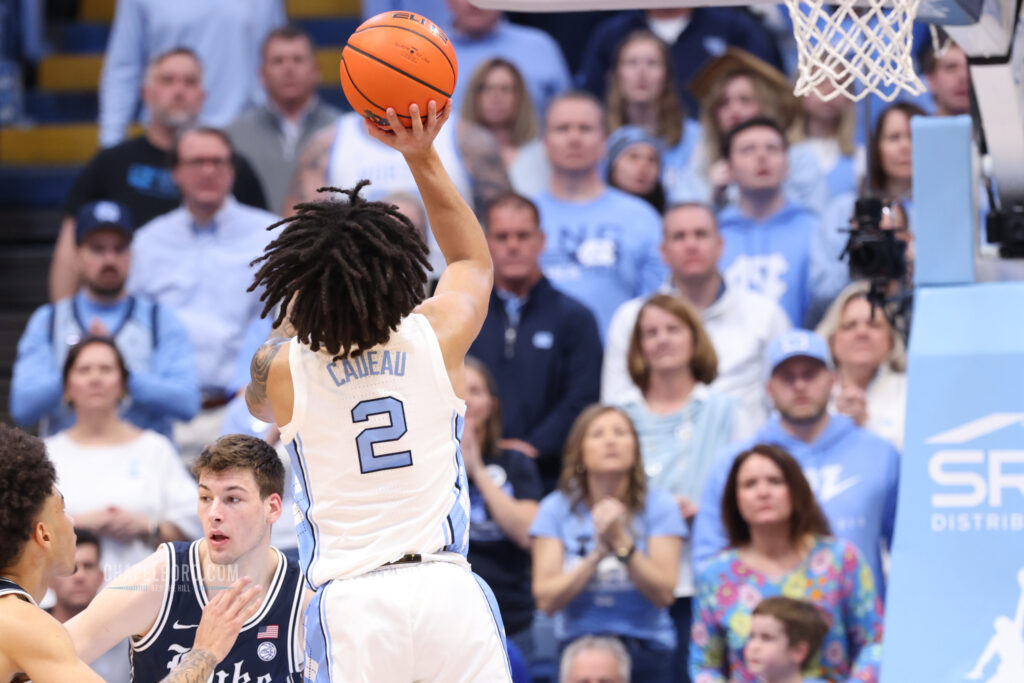
Image via Todd Melet
Both Carrington (33 mpg, 14 ppg, 5 rpg, 4 apg, 40% FG, 83% FT, 29% threes) and McCain (30 mpg, 13 ppg, 4 rpg, 2 apg, 45% FG, 85% FT, 39% threes) likely will receive significant support in this year’s ACC Rookie of the Year balloting, which will take place at the end of the regular season. Burton (33 mpg, 16 ppg, 3 rpg, 4 apg, 42% FG, 82% FT, 30% threes) leads all ACC rookies in scoring, but he also has far more turnovers than any player in the league, while playing for an 8-16 Notre Dame team that’s tied for last in the conference standings.
Among the ACC’s best freshmen, only McCain and Cadeau (the two highest-rated signees to join the league this season) play for teams that are virtually certain to qualify for the 2024 NCAA Tournament, which likely will help their candidacies for postseason honors. After all, the ultimate measuring stick is how much you help your team win games.
Cadeau, who entered UNC one year earlier than originally expected but is already 19 years old, has more modest numbers (24 mpg, 8 ppg, 2 rpg, 4 apg, 43% FG, 65% FT, 19% threes) than a few of the ACC’s other top rookies, but his overall value to the Tar Heels has been extraordinary, according to the eye test, some basic stats and at least two intriguing metrics.
The EvanMiya.com website publishes an “adjusted team efficiency margin” statistic, which measures a team’s offensive and defensive efficiency, adjusted for the strength of the opponent, with and without a particular player on the court.
Among more than 150 ACC rotation players, Cadeau is third in this statistic, alongside more predictable players such as all three of his All-ACC-caliber teammates — Davis, Bacot and Ingram — as well as Duke’s Filipowski and Roach. According to the raw numbers, the Tar Heels play much better offensively when Cadeau is on the court (compared to when he’s not), and the Heels play much better defensively when Cadeau is on the court.
Similarly, according to numbers provided by Adrian Atkinson (@FreeportKid on Twitter/X), the two UNC players with the greatest on-court/off-court efficiency differentials during conference play are Davis (+18.6) and Cadeau (+15.8), followed by Bacot (+8.1). While Davis’ efficiency differential is only +6.1 when Cadeau is on the bench, that same number skyrockets to a stunning +25.7 when Cadeau is on the court with Davis.
Cadeau’s most obvious value to the Tar Heels comes as a ball-handler and passer. His 24 minutes per game enable Davis to play in his more natural wing guard position during their long stretches together (Davis’ shooting percentages are significantly higher when Cadeau is in the game), and Cadeau’s solid assist-turnover ratio (better than 2-to-1) is something the Heels glaringly lacked during their disappointing/disastrous 2010, 2020, 2021 and 2023 seasons.
UNC coach Hubert Davis also praises Cadeau for his driving and scoring ability.
“He’s elite in terms of being able to get to the basket,” Davis said. “It doesn’t matter what kind of defense; his ability to get to the paint and be able to score is just at a high level.”
While Cadeau has struggled at times with his shooting, both from the free throw line and 3-point range, he recently has improved in both areas. Entering the Tar Heels’ Feb. 13 contest at Syracuse, he had made 18 of his last 22 free throw attempts (82 percent), and he broke a six-week-long 3-point drought by converting a pair of threes during his season-best 19-point outburst in the Heels’ recent 75-72 win at Miami.
“I’ve told him, when you’re wide-open, have the confidence to be able to knock it down, because your head coach has the confidence, and I think it’s going down, so shoot it,” Davis said. “And those two threes that he had, and one in the first half and one the second half, it was just really huge for us. We needed everything that we could to be able to win against Miami on the road.”
While Cadeau (the preseason ACC Rookie of the Year) appears unlikely to claim that honor, he’s certainly a legitimate candidate for the league’s five-man All-Freshman team.
The Tar Heels’ most recent honorees in that category came in 2021, when both forward Day’Ron Sharpe and guard Caleb Love were selected.
Point guard Cole Anthony (2020), point guard Coby White (2019), forward Justin Jackson (2015), center Kennedy Meeks (2014), point guard Marcus Paige (2013), forward Harrison Barnes (2011) and point guard Kendall Marshall (2011) are Carolina’s other most recent All-Freshman honorees. Barnes was the Tar Heels’ most recent ACC Rookie of the Year.
 David Glenn (DavidGlennShow.com, @DavidGlennShow) is an award-winning author, broadcaster, editor, entrepreneur, publisher, speaker, writer and university lecturer (now at UNC Wilmington) who has covered sports in North Carolina since 1987.
Chapelboro.com does not charge subscription fees, and you can directly support our efforts in local journalism here. Want more of what you see on Chapelboro? Let us bring free local news and community information to you by signing up for our biweekly newsletter.

