
Hurricanes’ Stanley Cup Title Worth Celebrating In Style
By David Glenn
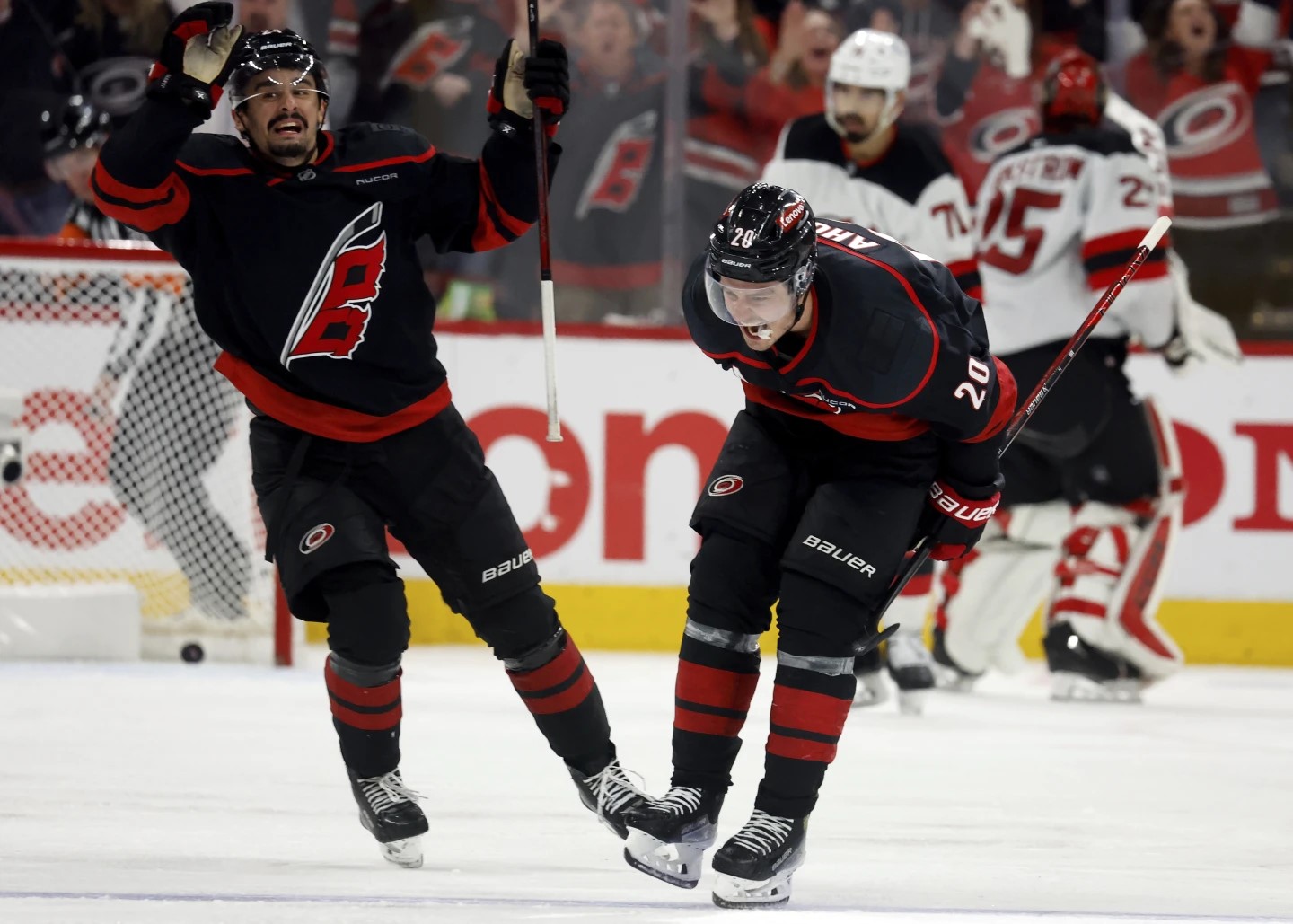
When the Carolina Hurricanes captured the franchise’s first Stanley Cup, in 2006, two ensuing celebrations combined to attract about 38,000 fans.
Twenty years later, when the Canes again reached the National Hockey League’s mountaintop, the team’s spectacular parade in Raleigh on Saturday drew an estimated 180,000 fans, a number that represented almost three times the population of Chapel Hill.
“I’m in shock,” said Rod Brind’Amour, the team’s captain in 2006 and its head coach this year. “It doesn’t happen very often, but I’m just kind of speechless.”
A number of other details behind Carolina’s 2026 crown might leave hockey fans at a loss for words, too.
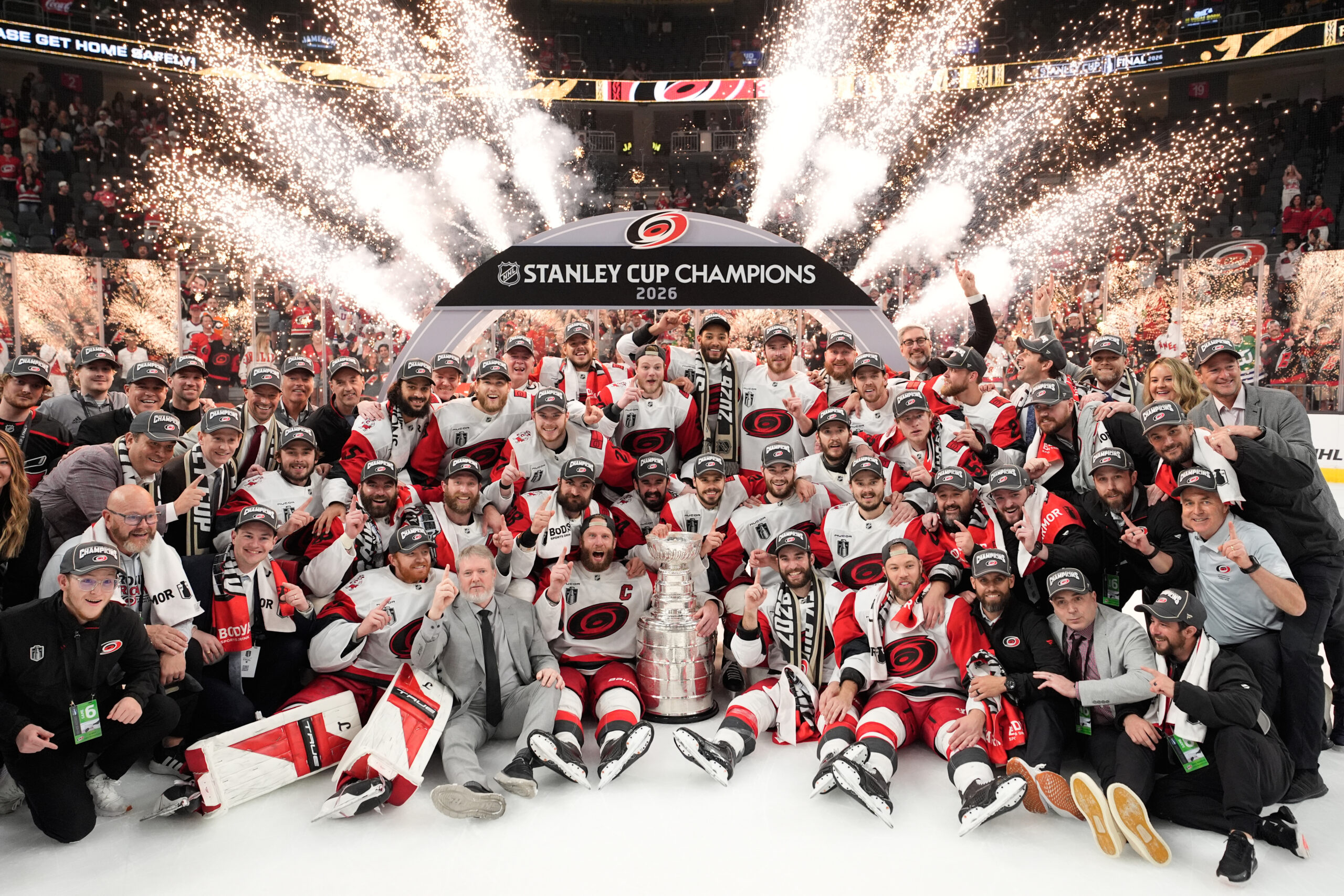
The Carolina Hurricanes pose for photos after a win over the Vegas Golden Knights in Game 6 of the NHL hockey Stanley Cup Final series, Sunday, June 14, 2026, in Las Vegas. (Photo via AP Photo/John Locher.)
1. The Hurricanes’ 16-3 playoff record marked the second-best in the 40-year history of the NHL’s modern postseason format.
Throughout their sensational eight-year stretch under Brind’Amour and team owner Tom Dundon, during which the Hurricanes have made the playoffs every year, they nevertheless have had plenty of critics.
Some observers simply didn’t like the aesthetics of the Canes’ possession-oriented style. Others respected the Canes’ work ethic, intensity and consistency but wondered if their grind-it-out approach had an inherent ceiling that would always leave them a step or two short of a championship.
For seven years, the skeptics kept adding evidence for their case. This year, though, the Canes earned the ultimate verdict — with one of the most dominant playoff performances, record-wise, of the past 40 years.
Subjectively speaking, some of the Hurricanes’ critics are still howling. They say the team’s road to the Stanley Cup (4-0 over Ottawa, 4-0 over Philadelphia, 4-1 over Montreal, 4-2 over Vegas) was easy, that the Canes were lucky to avoid potential opponents such as Colorado (which had the league’s best regular-season record) and Florida (which eliminated Carolina from the postseason twice in recent years but missed the playoffs entirely this season), etc.
Objectively speaking, though, the Canes can simply point to their 16-3 record and say — accurately — that it was the second-best single-season playoff mark of any NHL team since 1987, when the league expanded its postseason format such that it required the champion to capture four consecutive best-of-seven series.
The 1988 Edmonton Oilers, led by hockey “GOAT” Wayne Gretzky, went 16-2 on their way to the Stanley Cup 38 years ago. That legendary campaign came at the end of a record-setting five-year stretch in which the Oilers won four Stanley Cup titles.
2. The Hurricanes just won the Stanley Cup without the benefit of either a $10 million player or a top-10 team payroll.
Whereas Dundon repeatedly has shown that he (in stark contrast to the franchise’s previous owner) is willing to spend aggressively to attract or retain key players, despite Carolina’s small-market status, the Hurricanes just won the Stanley Cup with a more modest financial approach.
“I don’t think in terms of budget. I think in terms of value,” Dundon said. “Where we see value, we’ll pay for it. Sometimes that means we’ll spend to the salary cap, and we’re OK with that. Sometimes the money works out differently. We’ll do whatever it takes, within the rules. We just want to win.”
During the 2025-26 season, when the NHL salary cap was $95,500,000 per team, the Hurricanes spent about $85 million on player salaries. That number ranked just 12th in the 32-team league. In a related category, known as total cap allocations, the Canes ranked 27th at about $87 million, and only one of the five teams below them made the playoffs.
Similarly, almost 20 individual NHL players counted $10-$14 million toward their team’s salary cap. Whereas franchises such as Edmonton, Florida, Toronto, Vegas (i.e., Mitch Marner at $12 million and Jack Eichel at $10 million) and the New York Rangers each had multiple players with cap hits of $10 million or more this season, the Canes had nobody in that financial category.
They won it all anyway.
3. A 27-year-old NHL rookie, plucked from the league’s waiver wire last October, went from postseason backup to Stanley Cup-clinching goaltender.
In 2006, Carolina’s thrilling run to the Stanley Cup included the unforgettable story of a sensational goalie. This time, there were two such tales.
The easier-to-remember part from 20 years ago is that 22-year-old rookie Cam Ward made so many huge saves for the Hurricanes that he ultimately received the Conn Smythe Trophy as the league’s postseason MVP. The harder-to-remember aspect is that Ward actually began the playoffs as the team’s backup netminder, behind veteran Martin Gerber; Ward entered the fray with the Canes in desperation mode, after they had lost their first two postseason games.
This time, both 36-year-old veteran Frederik Andersen and 27-year-old rookie Brandon Bussi left their fingerprints all over the Stanley Cup with their distinctive performances for Carolina between the pipes.
Andersen, who has played in the NHL since 2013 and has represented his native Denmark in major international competitions since 2010, contributed to his first major championship at any level by going 12-1 (with league-best statistics and analytics to that point) through Carolina’s first three playoff series before struggling in the finals against Vegas.
Enter Bussi, whose personal Cup story sounds like a fairy tale. The overwhelming majority of hockey players who fail to reach the NHL by the age of 27 either opt to play in a lesser league overseas or abandon their professional dream altogether. Instead, just within the past 12 months, Bussi’s path went like this: minor-league goalie in the Boston organization, free-agent signee for Florida, waived by the Panthers, claimed (last October) by Carolina, opening-night backup for the Hurricanes, most frequently used regular-season starter (31-6-2 record!) by the Canes, playoff backup who didn’t see a single minute in the team’s first 15 playoff games, playoff savior midway through the championship series against Vegas.
Bussi overcame a massive overtime blunder in a Game Three loss at Vegas to lead the Hurricanes to three consecutive victories, capped by his Cup-clinching 3-0 road shutout of the Golden Knights in Game Six.
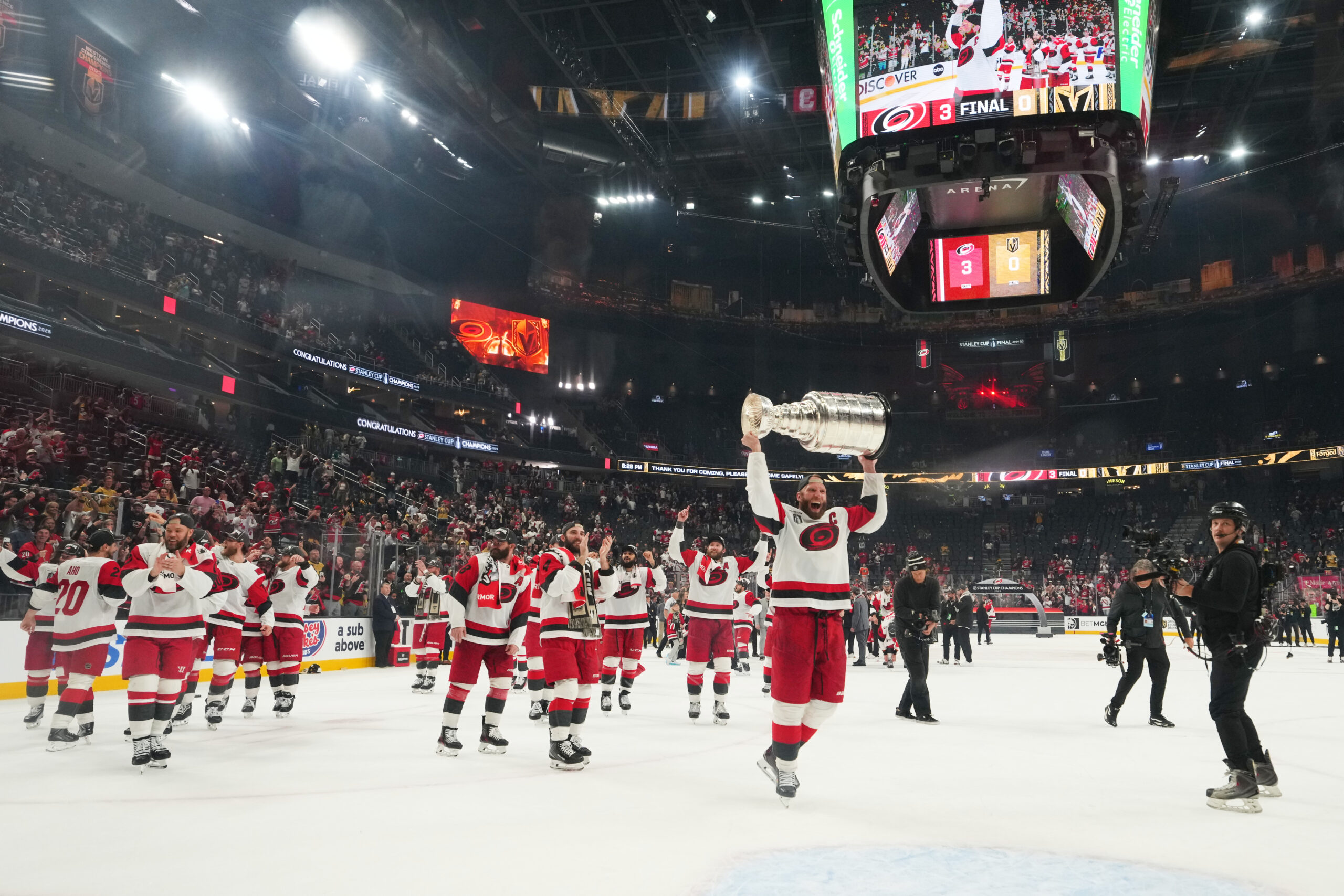
Carolina Hurricanes center Jordan Staal (11) lifts the Stanley Cup after a win over the Vegas Golden Knights in Game 6 of the NHL hockey Stanley Cup Final series, Sunday, June 14, 2026, in Las Vegas. (AP Photo/Candice Ward)
4. The franchise’s long-term Achilles heel — lack of scoring depth — became one of its greatest strengths this season, including in the playoffs.
Three times in the previous seven seasons, Carolina’s campaign had ended in the Eastern Conference championship series, largely because the team ran out of offensive productivity against high-caliber opponents and/or especially hot goaltenders.
In those “Final Four” series against Boston (2019) and Florida (2023, 2025), the Hurricanes had averaged only about 1.6 goals per game, a measly number that made it virtually impossible for them to advance to the final round.
This year, even though the Canes’ top regular-season scorers (i.e., Seth Jarvis, Andrei Svechnikov, Sebastian Aho) once again were kept mostly under wraps by opponents’ top lines during the playoffs, the team never ran out of offensive firepower.
Center Logan Stankoven led Carolina, and ranked third in the league, with 11 postseason goals. Team captain Jordan Staal and high-flying offseason acquisition Nikolaj Ehlers had eight playoff goals each, and Staal earned postseason MVP honors with his off-the-charts leadership and brilliant two-way play. Stankoven’s linemates, Jackson Blake and Taylor Hall, led the Canes in playoff points with 20 and 19, respectively.
“That’s the thing I love about it: It’s not about one player,” Brind’Amour said. “And hockey is that, right? Hockey is a team sport. It’s the ultimate team sport. And, yeah, it’s nice to have those superstar players, but we got them in different ways, and it showed.”
5. A bunch of key players became better versions of themselves only after playing in the Hurricanes’ system.
Both goaltenders, Andersen and Bussi, definitely fit this description. Many skaters did, too.
Plenty of critics believed that Stankoven and Blake were too small to become big-time NHL contributors. Many wondered if Staal (37), Andersen (36), Hall (34), crafty, high-IQ defenseman Shayne Gostisbehere (33) and charismatic fan-favorite grinder Jordan Martinook (33) would still be able to keep up with younger, highly skilled players in an incredibly fast-paced sport. Answer: definitely yes.
When the Hurricanes traded last summer for New York Rangers defenseman K’Andre Miller and immediately signed him to an eight-year, $60 million contract extension, they heard a lot about his shortcomings. His physicality never matched his extraordinary size. It wasn’t always easy to see his competitive fire, even how much he cared. Even if Miller is an adequate defenseman, they said, the Hurricanes are paying him more than he’s worth.
In the Hurricanes’ system, however, all of those players have flourished. That says a lot of good things about Brind’Amour, Ivy League-educated general manager Eric Tulsky (who acquired Bussi, Ehlers, Hall, Miller and Stankoven in recent years) and the team’s extraordinarily healthy locker-room culture.
6. In another NHL rarity, almost every key player from the Stanley Cup champions already is under contract for next season.
Amazingly, even as the Hurricanes raised the Stanley Cup in Las Vegas, they already had almost every key player from this year’s team signed for the 2026-27 campaign, with many of them under contract well into the future.
On Saturday, during the team’s on-stage session in front of the fans in Raleigh, Tulsky announced a new two-year contract for one of the team’s only pending free agents, depth forward and tough guy Nicolas Deslauriers.
Otherwise, the only lingering loose ends are one restricted free agent (third-pairing defenseman Alexander Nikishin) and two unrestricted free agents, Andersen (who may opt to retire) and depth defenseman Mike Reilly.
Such a firm foundation sets the Canes up nicely for next season. The team also still has more than $11 million in remaining salary-cap space, should Tulsky want to add a new player or two via free agency.
As a result, it’s easy for fans, coaches and players to remain optimistic.
Asked if his recent Stanley Cup victory might encourage him to retire this summer, Staal responded quickly: “No. I want another one.”
 David Glenn (DavidGlennShow.com, @DavidGlennShow) is an award-winning author, broadcaster, editor, entrepreneur, publisher, speaker, writer and university lecturer (now at UNC Wilmington) who has covered sports in North Carolina since 1987.
Chapelboro.com does not charge subscription fees, and you can directly support our efforts in local journalism here. Want more of what you see on Chapelboro? Let us bring free local news and community information to you by signing up for our newsletter.