

By Hannah McClellan, Chatham News + Record Staff
Chatham commissioners heard an annual update from the county’s Climate Change Advisory Committee at the board’s meeting Monday night, ahead of the climate committee’s upcoming Dec. 20 presentation which will include 10 recommendations for the county.
Committee co-chairperson Charles Cooper presented the group’s report for the fiscal year 2020-21. The committee was formed in 2015.
“Our mission has been the same since the inception of the committee,” Cooper told the board. “Our purpose is to make recommendations to the board of commissioners and others with respect to likely climate change impact and also with respect to mitigation and adaptation strategies.”
With significant development and population growth expected in Chatham over the next 20 years, the county is not immune from the impacts of climate change. The committee specifically looks at regenerative agriculture practices and retention of the county’s tree cover, along with the reduction of emissions and carbon neutral green building standards.
A 2019-20 Chatham greenhouse gas inventory carried out by the county showed small decreases in most emission categories from the year prior, the News + Record previously reported, likely due to COVID-19. That study showed an increase in CO2 equivalent emissions from 2019 to 2020 in transportation (40.4% to 42.7%) and decreases in commercial (9.2% to 8.8%), residential (20.2% to 19.5.%) and industrial (21.7% to 20.5%) emissions.
With an entirely Democratic board, the county is perhaps uniquely positioned to invest in practices and adopt policies that mitigate negative impacts of climate change. Even so, Chatham County is limited in what it can do because of state jurisdiction, as well as low emissions levels from the county government itself. Still, local officials and leaders are pushing for creative solutions, by adding solar panels to its buildings, buying electric or hybrid electric cars as old ones need replacement and installing two electric vehicle stations — one in Pittsboro and one in Siler City.
In addition to looking for more renewable energy resources, local leaders are looking toward more sustainable practices such as modified development ordinances, stormwater runoff mechanisms and clean drinking water. On Monday, Cooper said the climate committee also prepared a tree protection ordinance model for the commissioners to consider.
“We’re running up against the same barriers and challenges that everyone else is running into,” Cooper said. “Especially in governance of our country as a whole state and our locale and that’s this acceleration of climate effects — it’s moving faster than experts predicted in many ways. That’s really requiring more and more, all the way down to more and more of our committee. But what we’ve tried to do to deal with the overload is to focus our attention on two different areas, one having to do with storing carbon, in soils and trees, through regenerative agriculture, and also in the electrification of transportation.”
The county’s greenhouse gas inventory showed that transportation in Chatham is the largest contributor to emissions by far, nearly double the next-highest sector, industrial.
Part of the climate committee’s 10 recommendations, to be presented to the board next month, is for the county to become a “carbon negative” county, rather than a “carbon neutral” one.
The county’s greenhouse inventory showed emissions exceeded 900,000 CO2E, with an estimated 1.1 CO2E removed by carbon sinks. (The committee’s estimate was made “with significant uncertainty,” the presentation said.)
“But to sustain that is going to be a real, huge challenge,” Cooper said, “because with development coming in, that is likely to be able to push out some of our carbon sinks, in other words, displace trees, and farmland and so forth, while at the same time increasing the amount of emissions that are involved in transportation.”
Commissioner Diana Hales suggested that the board discuss the county’s climate change strategy at its mid-year retreat in January, using the comprehensive land plan as a guide. Commissioner Jim Crawford also supported raising climate change discussions at that meeting, adding the Unified Development Ordinance being developed by the county could help create a more sustainable future standard.
“… This is a board that could get that made the standard — future boards probably are helpful, because I think young people get it, right,” Crawford said. “But the earlier we get things rolling, the easier it should be going forward. Obviously, we’ve got to make up for lost time and close the gap, maybe during the budget retreat, to look at some actual policies and some commitments under these 10 general recommendations.”
“I would say the only question I hear from young people regarding it is, ‘Why aren’t you idiots doing anything?’” Chairperson Mike Dasher added with a laugh before moving to the next agenda item of the meeting. “That’s the one I get the most from my young people.”
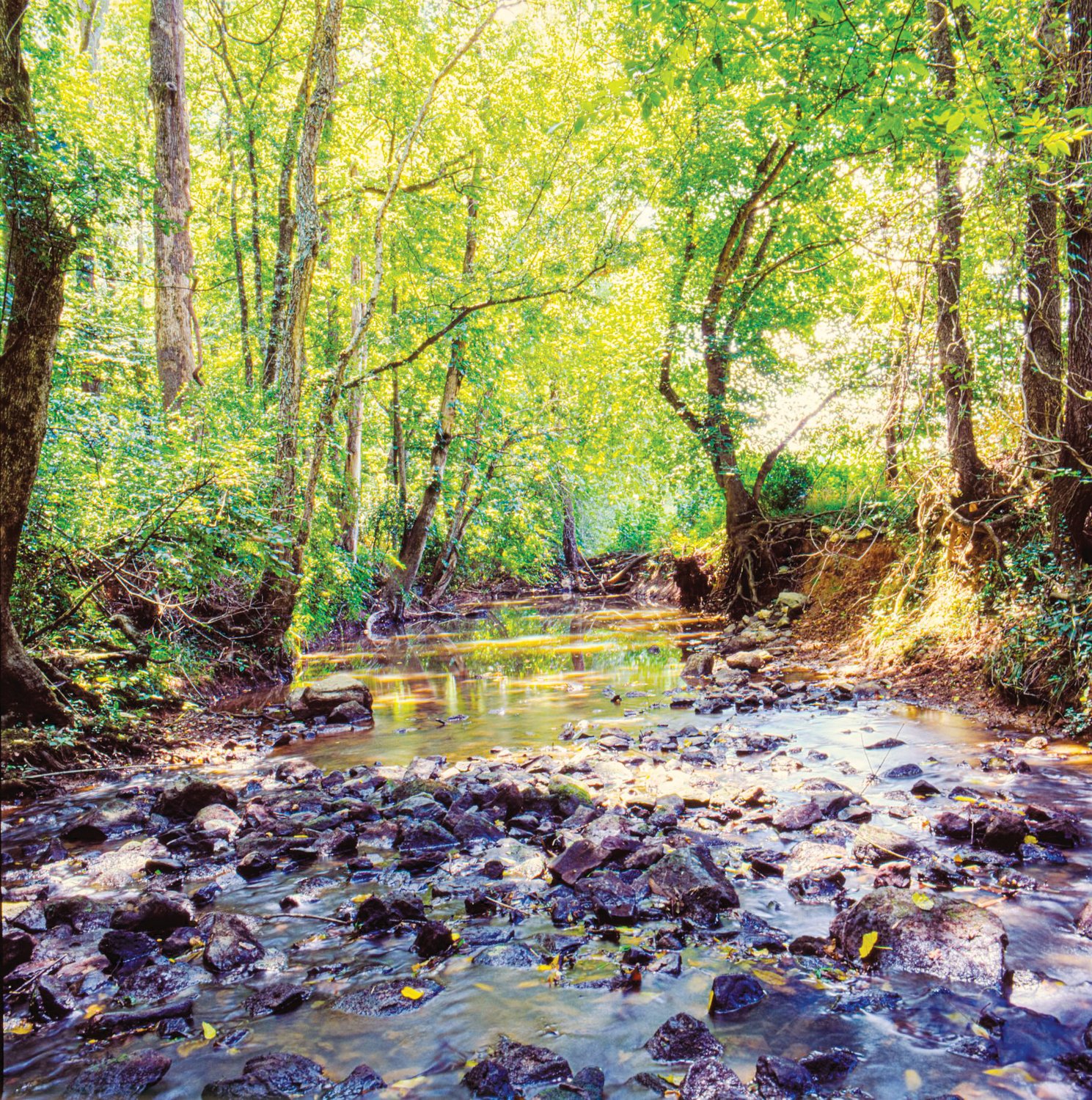
As the impacts of climate change continue to be felt on a national scale, Chatham County is not excluded. Local officials are planning ahead by looking for more sustainable wasterwater practices, development and energy. Pictured here is the Hickory Mountain Township in Chatham.
FY 2023-2029 Capital Improvements Plan
Assistant County Manager Bryan Thompson gave the first presentation to the board regarding the 2023-29 Capital Improvements Plan (CIP), which is a seven-year plan for updated every year to plan for projects the county anticipates which cost more than $100,000.
The presentation was a “high-level overview” of the proposed CIP, Thompson said. A more detailed presentation will be made to the board at its Nov. 16 work session. The plan includes updates to current county projects as well as new proposals.
“The CIP is not a budget, it is a plan. I emphasize that because even as a staff when we work on the CIP, we have to remind ourselves of that,” Thompson told the board. “However, the CIP does inform what the upcoming operating budget will look like, so the decisions made through the CIP process will have an impact on the operating budget itself.”
Of the current CIP projects, the proposal includes the following updates: increasing the budget for the Chatham County Schools new Central Services building by nearly $1.5 million and $2 million for the Emergency Operations Center relocation, along with anticipated savings of $1.2 million for the finishing out of cell blocks at Chatham County’s Detention Center.
“We start this process on a staff level earlier than this, but bring it before the board and the public in November,” Thompson said, “so we can have a couple of meetings, workshop with the driven goal of having an adopted CIP by the end of December as we move into the operating budget (in early January).”
You can view the recommended plan here. A public hearing on the proposed CIP is scheduled for Nov. 15 at 6:00 p.m.
Introduction to ordinance amendments
Commissioners also heard an informational item on county ordinance amendments to comply with Senate Bill 300, a criminal justice reform law approved by Gov. Roy Cooper and state lawmakers in September. The board will vote on the changes at its Nov. 15 meeting.
That bill promotes the recruitment of officers with diverse backgrounds, requires early intervention mechanisms in the case of police excessive force or misconduct and furthers independent investigations of police shootings. It also limits local laws criminalizing poverty and requires a first appearance in court within 72 hours of someone being arrested.
The Chatham document amended chapters 90, 91 and 130 of Chatham ordinances, clarifying penalties and which ordination violations are punishable by a misdemeanor.
The amended chapter 90 of the code, on penalties, removed a link saying that “a misdemeanor punishable by a fine not to exceed $50 or imprisonment for 30 days or both in the discretion of the court.”
The ordinance will become effective Dec. 1.
During the board’s 4 o’clock work session, it went into closed session pursuant “to discuss matters relating to the location or expansion of industries or other businesses, including agreement on a tentative list of economic development incentives that may be offered by the public body,” according to the meeting agenda.
Chapelboro.com has partnered with the Chatham News + Record in order to bring more Chatham-focused stories to our audience.
The Chatham News + Record is Chatham County’s source for local news and journalism. The Chatham News, established in 1924, and the Chatham Record, founded in 1878, have come together to better serve the Chatham community as the Chatham News + Record. Covering news, business, sports and more, the News + Record is working to strengthen community ties through compelling coverage of life in Chatham County.

