

Story via David Menconi, Down on Copperline, Orange County Arts Commission
Writing books is a popular side-hustle for musicians, with Josh Ritter, Mountain Goats frontman John Darnielle and the late Kinky Friedman among the many artists to have published books other than first-person memoirs. Nevertheless, Avett Brothers bassist Bob Crawford’s current authorial star turn is unusual. He makes his book debut with an accessibly written but impressively weighty biography of the sixth President of the United States, “America’s Founding Son: John Quincy Adams, From President To Political Maverick” (Zando Books, 352 pages, $28).
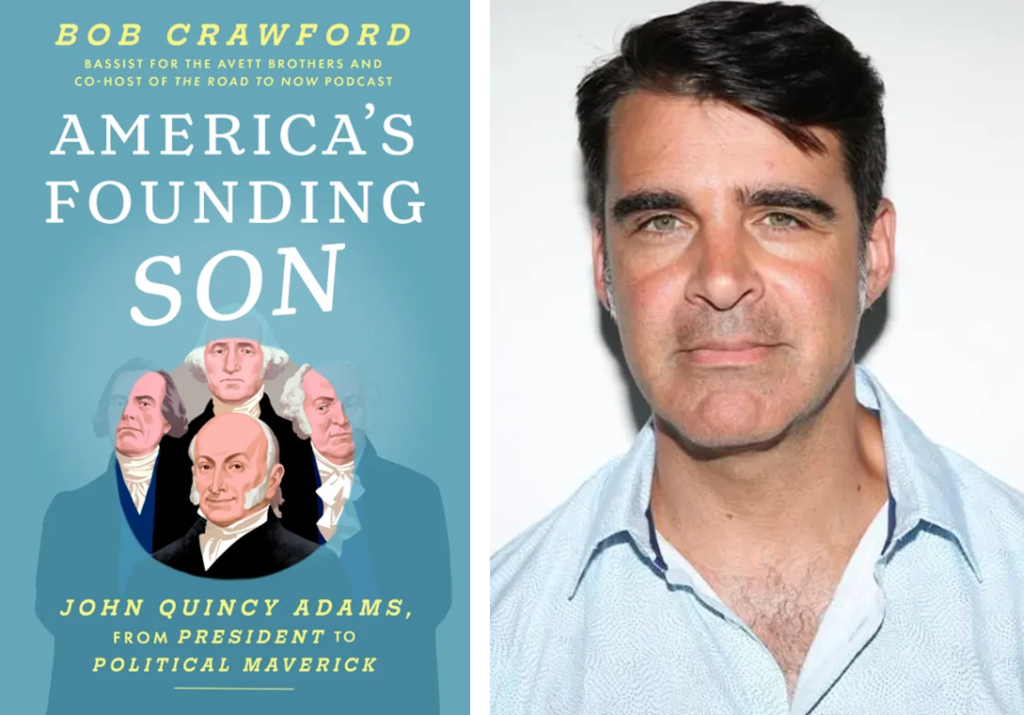
With jacket-blurb endorsements from documentary filmmaker Ken Burns and other noted historians, “America’s Founding Son” has picked up strong reviews and solid sales since its publication in March. That makes Crawford’s schedule even busier than usual, as he balances bookstore events with Avett Brothers tours. He’ll be off the road from the latter long enough to do a reading this month on his home turf, May 26 at Chapel Hill’s Flyleaf Books.
“It’s been an amazing thing, a joy to work on and I’m still excited about it,” says Crawford, who has lived in Orange County since 2010. “It feels almost surreal to conceive of something like this, work on it and turn it into a real thing. Everybody thinks they have a book in them, but it’s still a rare thing to undertake and see it through.”
With a Master’s degree in history, Crawford is no dilettante. He has been an active podcaster for the past decade, most notably with “The Road to Now,” an acclaimed podcast that “explains the history behind important events and outstanding individuals of today’s world.” Researching a six-part podcast series on Adams a few years back convinced Crawford that “Old Man Eloquent, the OG Political Maverick” was a subject worthy of a book.
The project took about three years, including further research, interviews and writing. Adams’ own writings made up a large part of the research materials – he left behind an incredible 14,000 pages of diary entries.
“I did a lot of the work on the road, during the day before shows,” Crawford says. “I made big timelines on poster-boards covered with post-it notes, which I even took on the road a few times. Another friend who has done a lot of ghost-writing showed me pictures of hotel room walls covered with post-it notes from when he was writing something. I could relate.”
Nearly 180 years past his death, Adams remains one of the most unique characters in the history of American politics. He grew up around politics, as his father John Adams was the second U.S. President (immediately following George Washington). After serving as Senator and Secretary of State, John Quincy’s 1824 election to President made the Adamses the first father-son presidential tandem in history (the only other is the Bushes, George H.W. and George W.).
Following his one presidential term, John Quincy subsequently became the only President to serve in Congress afterward. His 18 years in the U.S. House of Representatives covered most of the 1830s and ’40s, an era when the issue of slavery was starting to boil over in the decades leading up to the Civil War. It was a momentous time, and Adams served as bipartisan conscience of the government.
“John Quincy Adams was such a keen observer of human nature,” Crawford says. “No matter what political party a candidate came from, he’d take them apart. He really saw through the politician’s charade, which was a game he did not want to play. It’s why he was a one-term president. He didn’t capitalize on the power of the executive branch to hand out spoils, and not playing that game doomed him politically. But he was a great observer of the game, which continues to this day. There are few if any John Quincy Adams among us now.”
Asked who might be a modern-day equivalent to John Quincy Adams, Crawford cites Liz Cheney, Bernie Sanders and the late John McCain as politicians of a similar maverick stripe, willing to stand up against their own party even at great personal cost.
“He really did see himself as representing the union rather than just one party or district,” says Crawford. “He was all about public service. His wife and son pressured him, telling him that serving in Congress would be a demotion after being President. But he saw it as his duty. It’s important to think of him as a public servant, not just a failed one-term president. He was not perfect, but he was almost self-righteously moral.”
There are of course many similarities between now and 19th-century America, in that both are hyper-partisan eras.
“Knowing that we’ve been here before gives me comfort, but it doesn’t give me peace,” says Crawford. “What I learned from writing this book isn’t that history repeats, but that human nature doesn’t change. No matter how good technology gets or how advanced we are in certain areas of existence, the human heart does not move. We are still capable of enormous good, and enormous evil.”
Bob Crawford and David Menconi will discuss Crawford’s book “America’s Founding Son: John Quincy Adams, From President To Political Maverick” at 5:30 p.m. on Tuesday, May 26, 2026 at Flyleaf Books, 725 MLK Jr. Blvd. in Chapel Hill. For details, see flyleafbooks.com.
(Story and all photos via Orange County Arts Commission)
 Chapelboro.com has partnered with the Orange County Arts Commission to bring more arts-focused content to our readers through columns written by local people about some of the fantastic things happening in our local arts scene! Since 1985, the OCAC has worked to to promote and strengthen the artistic and cultural development of Orange County, North Carolina.

