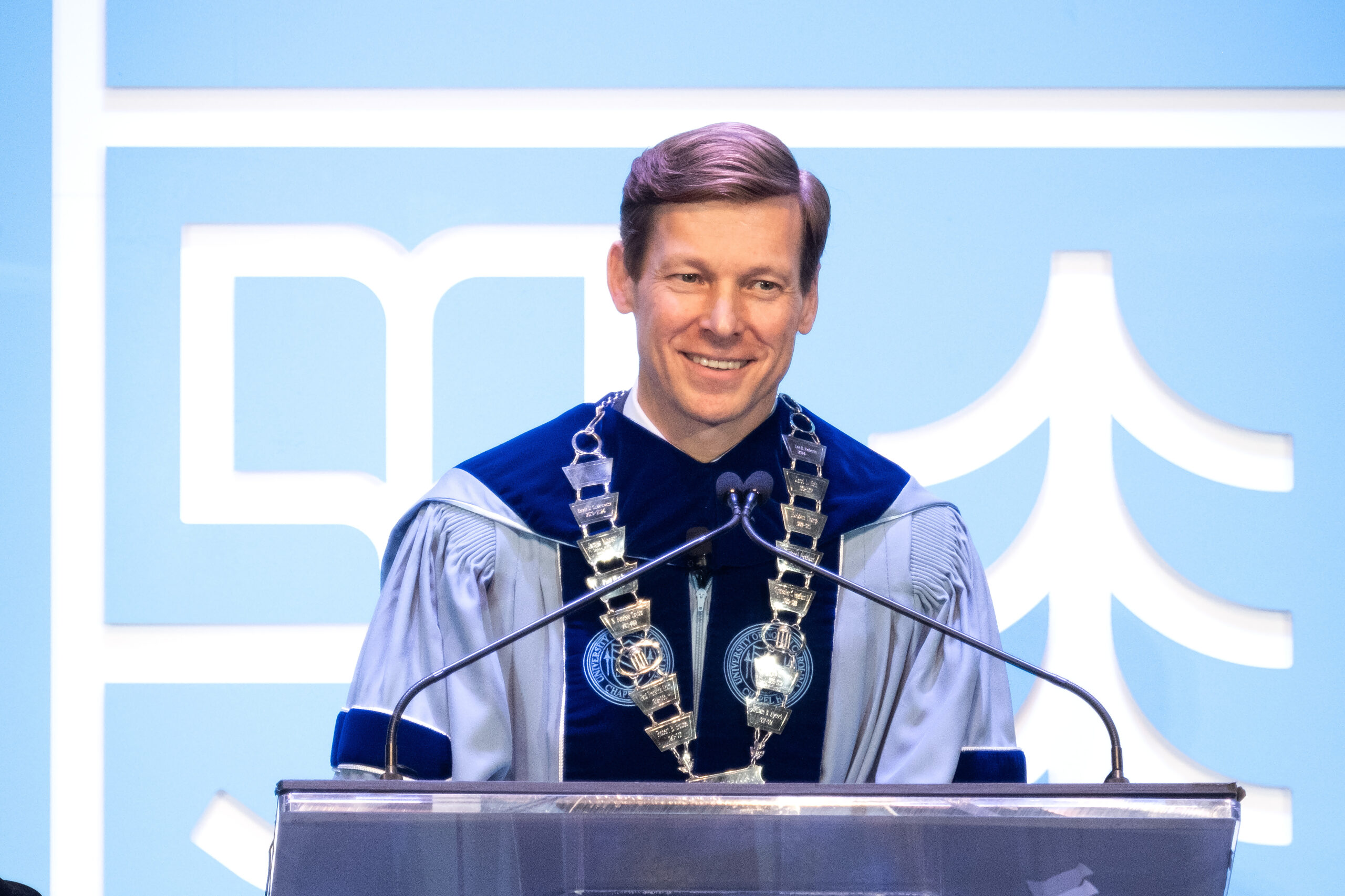
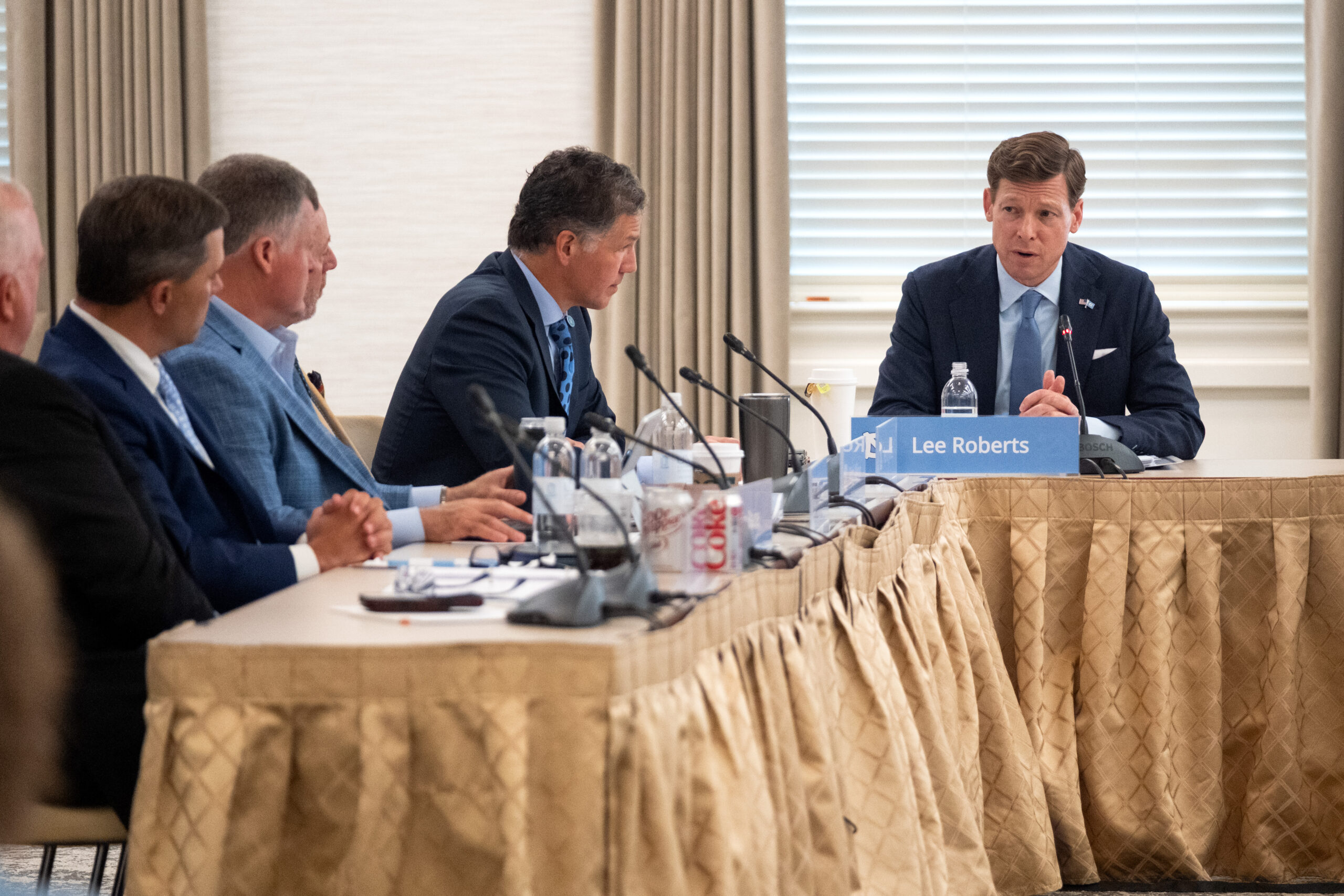
Returning from an extended summer break — which saw board members skip a regular meeting in May — the UNC Board of Trustees and university leadership met this week for updates ahead of a new academic year.
Chancellor Lee Roberts, members of his administration and university trustees gathered at the Rizzo Conference Center in Chapel Hill on Wednesday and Thursday morning. The committee reports and full business meeting featured substantive agenda items for the campus community, including details on ongoing spending cuts, fundraising totals for the past fiscal year, and which low-enrollment degrees could be discontinued.
Here are some highlights from the meetings, as well as Roberts’ comments to local media after Thursday’s open session.
Four Degree Programs Facing Elimination Amid Low Enrollment
The Board of Trustees tasked the provost’s office with conducting a review of UNC’s 275 degree programs and 64 instructional departments to measure enrollment and interest. Provost Magnus Egerstedt, who joined the university in March, helped finish that effort and presented its results to the trustees during Wednesday’s University Affairs Committee.
Egerstedt said staff based its review around one key metric: whether the number of degrees awarded or the number of student credit hours taught per department had decreased by 20% or more in the last five years. That finding turned up small groups of both degrees and departments — and after sifting through to determine whether the programs were small or the decreases were an anomaly, the review landed on adjusting resources for eight departments and pausing four degree programs.
Those four are graduate degrees for Digital Curation and Management from the School of Information and Library Sciences; Curriculum and Instruction from the School of Education; and both Environmental Sciences and Engineering, as well as Health Policy and Management, in the School of Public Health.
The pause in the degree programs will allow the few remaining students in the tracks — only four in total — to earn them before the university considers eliminating them. Egerstedt stressed to the board that they may not be automatically discontinued, with the pause allowing his office and the respective departments to have time to explore either revamping or consolidating the degree.
While flagged departments are not going to be paused, Egerstedt did say his office is having continued conversations and looking at opportunities to “right-size” their operations compared to their enrollment and student credit hours. Those departments are:
- Germanic and Slavic Lang Lit (undergraduate)
- Music (undergraduate and graduate)
- Women’s and gender students (undergraduate)
- Art History (graduate)
- Romance Studies (graduate)
- Department of African, African American, and Diaspora Studies (undergraduate)
- History (undergraduate)
- Genetics in the School of Medicine (graduate)
Egerstedt said while the departmental conversations are difficult to have, he wants this type of review to become a regular — if not annual — process to better get a sense of what the student population is interested in pursuing on campus.
“I really liked this [exercise] because…ultimately, we need to make sure we recruit faculty that can serve our students,” said the provost. “We need to make sure we recruit faculty that can go after the big, important research questions that we can also get funding for. And we need to make sure we recruit faculty that also help serve our commitment to the state. So, the process we have in place now captures that. We also have a continuous program evaluation that I’m personally excited about because it will allow us to, year after year, adjust to what is happening…not only among student interests, but also in the broader higher ed landscape.”
UNC Finance Director Shares Spending Cuts Updates
Not only is the program and departmental review driven by campus interest, but the Board of Trustees’ initial request came from a desire of limit the university’s spending. In January, the board passed a resolution asking for UNC to cut back on administrative spending by $25 million. UNC is a massive institution, touting a $4.5 billion annual operating budget — but both its trustees and its chancellor have made streamlining finances a priority amid sweeping changes to higher education funding models on a national scale.
During Wednesday’s Budget, Finance and Infrastructure Committee meeting, UNC Finance Director Nate Knuffman presented to the board how it plans to achieve that. He said between the ongoing ServiceFirst initiative to trim administrative positions and centralize operations, and examining campus units, there were enough vacancies and redundancies to reach the threshold. The goal is for impacted offices and administrators to figure out how to best redistribute work, targeting October 1 as when staff would move into “shared service centers.”
“As we implement these $25 million of reductions, and as we eliminate those vacancies,” said Knuffman, “I think you’ll see a sizable reduction in terms of administrative positions. It does impact our administrative spending… We view that this is really a strong demonstration of our legitimate effort to try to operate more efficiently.”
The administrative cuts are just the latest push UNC has made in the last two years aimed at scaling back spending and improving efficiency. A $70 million reduction was sought thanks to inconsistent state funding, federal research cuts and more — much of which are going into effect in the current fiscal year. The Board of Trustees’ resolution came as the Roberts’ administration was already beginning to identify and implement cuts as part of ServiceFirst. Knuffman said on Wednesday that roughly 70% of the cuts (or $17.5 million) came from the ServiceFirst consolidation.
Roberts shared thoughts on both Wednesday and Thursday about the work to trim the university’s spending, telling board members the directive to cut $25 million from administration work was a “tremendously powerful tool” and “stiffened the backbone of the organization to try to find the savings.” He also stressed that as the university is focused on growing its student body and continuing a high quality of services to the campus — which several trustees asked whether those efforts would be impacted — making these changes will help long-term.
“It’s important to recognize that we re-invest those savings into our strategic priorities,” he said. “Those include faculty hiring, renovating labs and classrooms, and campus safety. I often say to people, ‘Would you rather spend money on outdated IT and HR systems? Or would you rather spend it on our strategic priorities?'”
“We are investing in the enterprise through this process,” Knuffman added in his own comments. “It feels a little disjointed because we talk about the administrative savings a lot. But it’s an input into budget availability, which then gets disproportionally distributed. The largest area that received funding were academic units in terms of enrollment growth support, so really [it is] disproportionately going to address faculty hiring. Also, for AI, for startup, for faculty, for building renovations in key areas.”
Ackland Art Museum Set to Explore Expansion, ‘Arts District’ Options
While the board made little discussion of its during the Budget, Finance and Infrastructure Committee meeting and during the Thursday meeting’s vote of approval, the group gave the Ackland Art Museum advanced planning spending authority to seek expertise on a potential $70 million, 40,000-square-foot expansion to the museum. The goal, Roberts said in comments on Thursday, is to not only bolster the ongoing work and exhibition of the Ackland — but to activate the backside of the building near Porthole Alley and create an emphasis there on the arts.
“If you think about walking from Porthole Alley on Franklin Street, up past the Ackland…then you have the music [education] building, the arts [education] building, and then you get to Memorial [Hall],” said Roberts. “We really have an arts district there, if you think about it – we just haven’t talked about it that way or programmed it that way. But we intend, with the expansion of the Ackland, to build an arts district there in that corridor. And we have also really tried to upgrade and expand the role of the arts within the university structure.”
That latter effort includes creating a vice provost for arts and culture position, which is held by Elizabeth Engelhardt. Engelhardt helps connect with all visual and performing arts functions at the university — like the Ackland, Carolina Performing Arts, Playmakers Theater, and others — to each work in congruence and compliment each other.
“We’re in the early days,” Engelhardt said of this expansion project. “We can really figure out what does it mean to bring our existing strengths together. What does it mean to really tie it to our academic mission? But how do we create a space that is really in conversation with the citizens of Chapel Hill, with the artistic energy around the state of North Carolina. That’s what we imagine building in the district — and it’s exciting to be at this place, where we can really think about an Ackland that is an anchor for that and really befits the strength of its collections.”
The project, according to Roberts and UNC Finance Director Nate Knuffman, will be entirely funded by donations. The $1.5 million being used to fund the study and recruitment of potential designers is fully grant-funded.
UNC Rakes In Second-Best Fundraising Totals for 2025-26
Vice Chancellor for Development Michael Andreasen brought a positive update from the university’s fundraising team, as it recently finished the fiscal year. The preliminary numbers show UNC received just more than $606 million in new philanthropic commitments, a 28% increase over FY2025 and 40% increase over FY2024, with $472 million in cash.
Andreasen said even though the university received 17 donations of $5 million or more, he said the bottom line came predominantly from a high volume of donors — not one massive gift dragging the amount up. Although, Margaret Ann Bollmeier of the UNC Health Foundation briefly spoke to the board to share the story of how the university development team turned a 30-year relationship with a donor into a $20 million gift to the Lineberger Cancer Center’s cellular immunotherapy program. Bollmeier said the person, who wants to remain anonymous, did not graduate from UNC nor is a patient of the cancer center and ended up giving after the development team strategically taught him the importance of the CAR-T cell therapy done through the program.
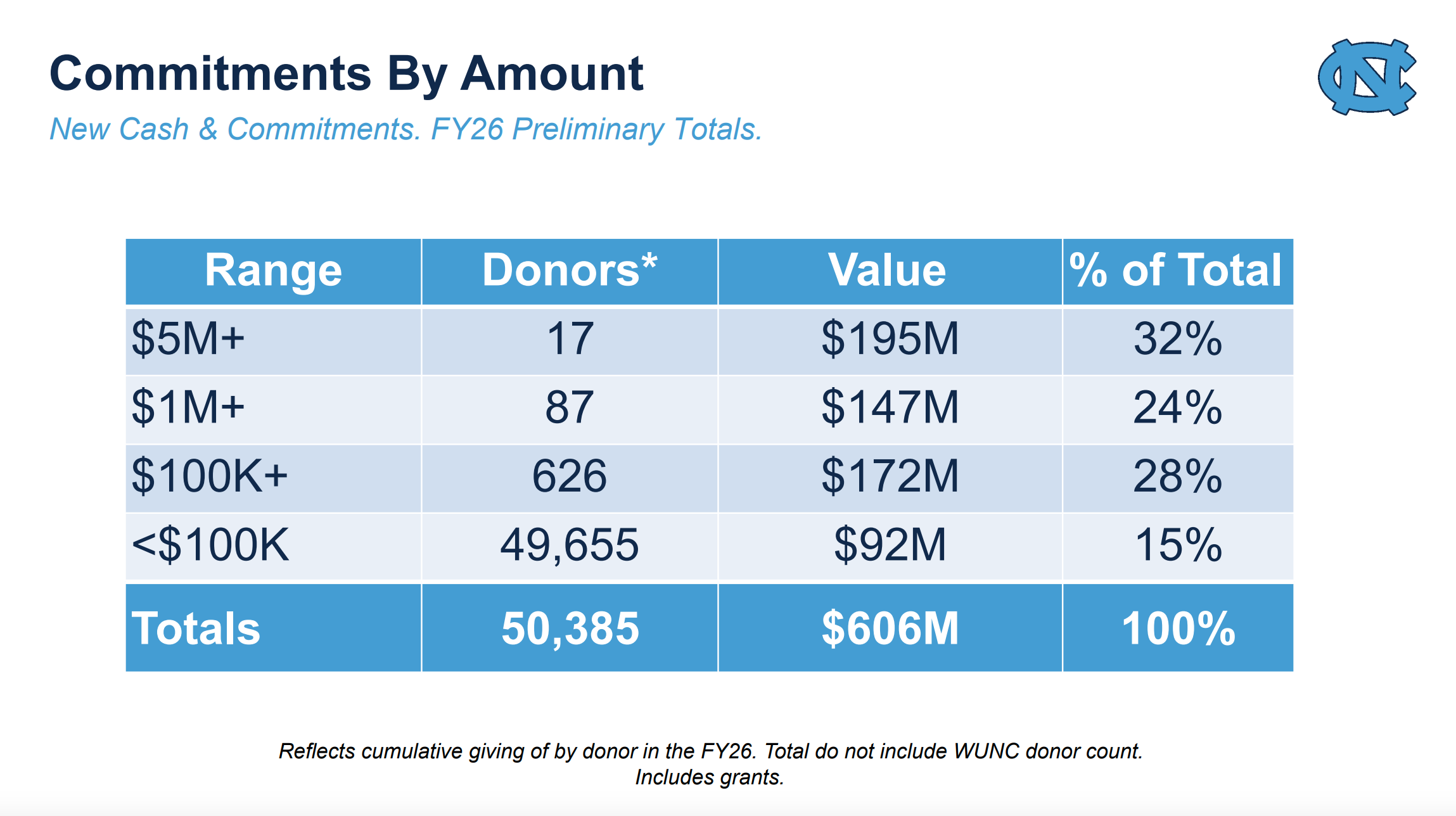
A slide from University Development showing preliminary totals and amounts of financial gifts to UNC in Fiscal Year 2026, as presented to the Board of Trustees on July 30, 2026. (Photo via UNC-Chapel Hill.)
Roberts said he feels that the positive fundraising report is “enormously gratifying” and a “validation of the strategic direction” UNC is taking despite it being such uncertain times for higher education. Especially, he added, in a year when the university is not in a capital campaign.
Andreasen added that with a new staffing model proposed and expected to be approved by the Board of Trustees, the university can expect to see a “modest” increase in the upcoming fiscal year, hopefully followed by substantial ones after the new staff and structure is able to settle into their roles. He added that the official totals from Fiscal Year 2026 will be presented to the board during its September meeting.
New Board Members Sworn In
A pair of Board of Trustees members took their oaths of office on Thursday morning to formally join the body. UNC Student Body President Devin Duncan was sworn in as an ex-officio member, with North Carolina Supreme Court Associate Justice Allison Riggs administering the proceedings. Although he visited the board’s March meeting after his election to the student leadership role and had already spent time with the trustees, Duncan said he saw the actual swearing-in ceremony as an important step in representing his peers.
“This is the public commitment,” the rising junior said of taking the oath. “It’s a public commitment of using sound judgement, serving faithfully, placing the responsibility of this office and the ability to serve on this board above your own [interest] and that’s certainly something I’m honored to do, and thankful to be able to do it alongside each of you.”
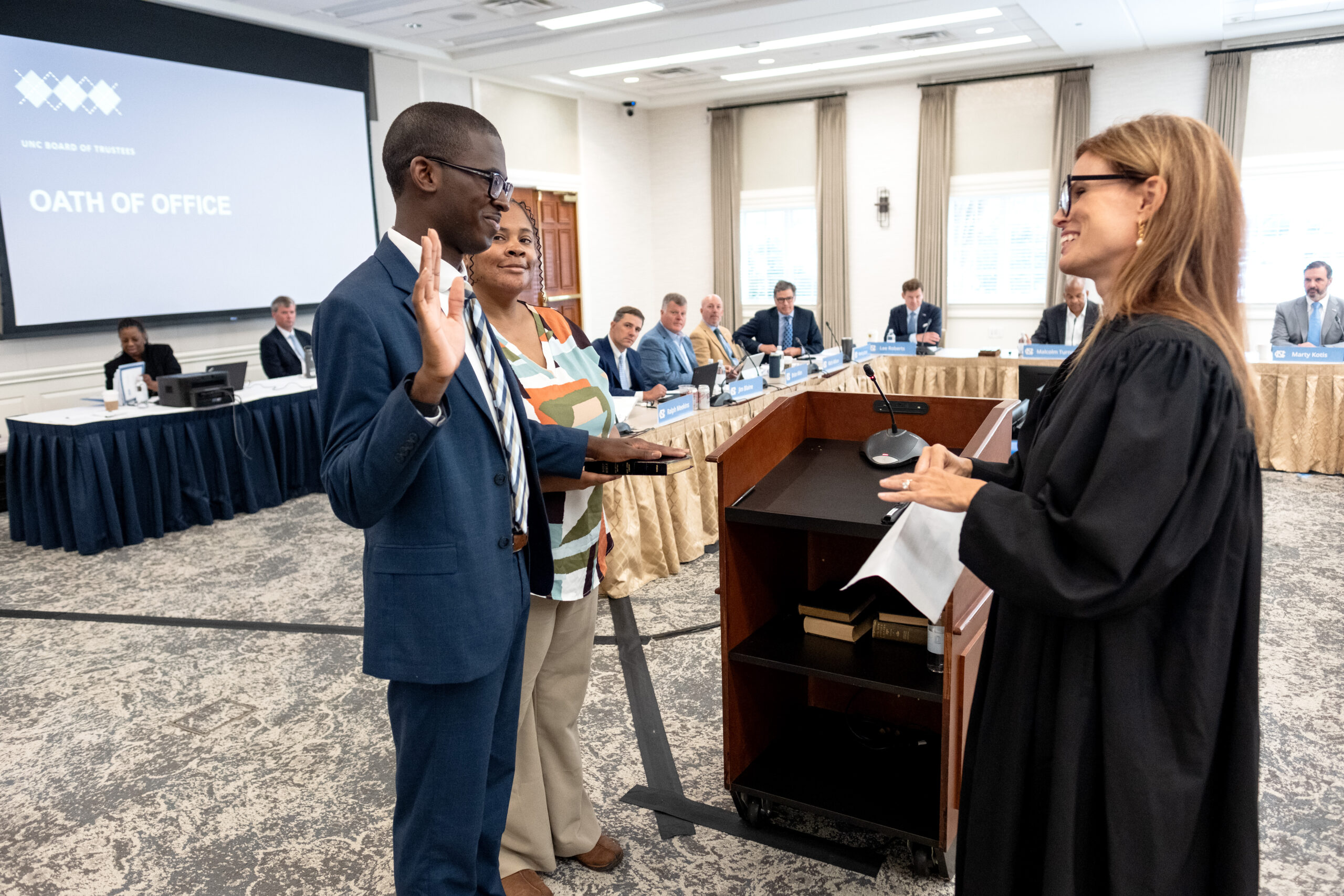
NC Supreme Court Justice Allison Riggs administers the oath of office to UNC Student Body President Devin Duncan during the UNC Board of Trustees’ full board meeting held at The Rizzo Center on July 30, 2026. (Photo via Jon Gardiner/UNC-Chapel Hill.)
Also sworn in was Dr. Kristin Baker, a psychiatrist and former North Carolina House representative, who was tapped in June to fill the vacant seat left by John Preyer’s resignation earlier in the year. Baker took her oath of office with her family around her, with the oath administered by North Carolina Supreme Court Associate Justice and UNC Kenan-Flagler Business School professor Tamera Barringer.
Additionally, as the board enters a new academic year, trustees voted to approve the current trio of officers in their roles. Malcolm Turner will continue to serve as chair, with Ramsey White as vice chair and Marty Kotis as the board secretary.
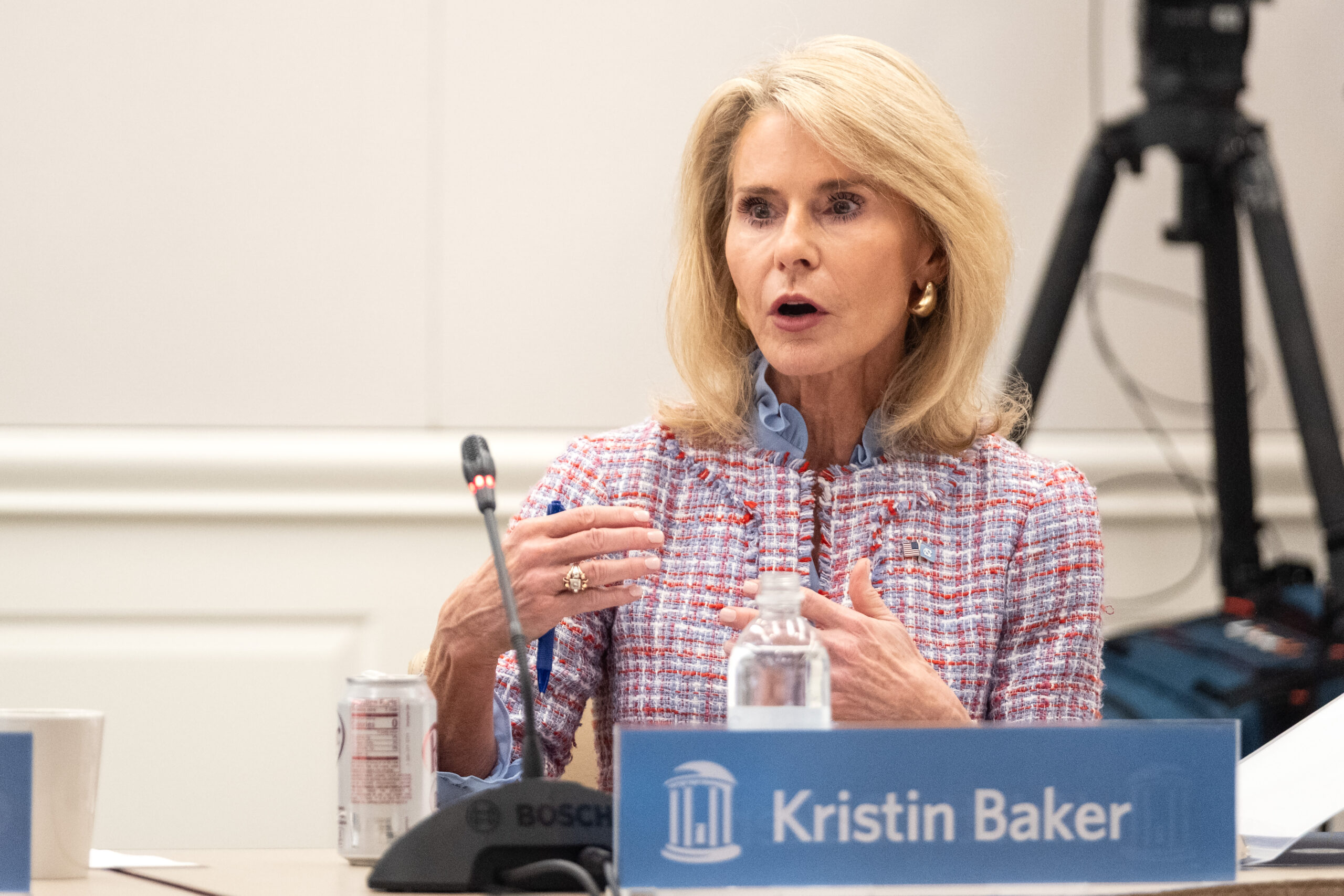
New UNC Trustee Kristin Baker makes remarks during Thursday’s Board of Trustees meeting on July 30, 2026. (Photo via Jon Gardiner/UNC-Chapel Hill.)
Lombardi’s Administrative Leave, Investigation Looms Over Meetings
While the trustees’ focus on Wednesday and Thursday were on many other matters, much of the outside discussion was about UNC football. Not because of the program holding its first practice of the season on Thursday — but because of its general manager Michael Lombardi being put onto paid administrative leave on Monday and the university launching an investigation into a reported HR complaint.
Roberts addressed the issue during a media scrum amid Thursday’s board meetings, saying his leadership team “learned of some concerns last week” and began an investigation.
“If something has gone wrong, we want to know about it,” the chancellor told gathered reporters. “If something needs to be fixed, we will be sure to fix it. There’s a standard of excellence here that all of us are entrusted with adhering to.
“I’m disappointed that we’re talking about this,” he added to close his remarks. “We should be focusing on our student-athletes, their success on the field, and on all of the wonderful things that happen at this university every day… And so, it’s distressing to me and everyone else in the administration entrusted with leadership at this remarkable university that this is something we have to spend time on.”
Livestream video of the UNC Board of Trustees’ committee meetings on Wednesday can be watched here on YouTube, and the board’s full meeting can be watched here.
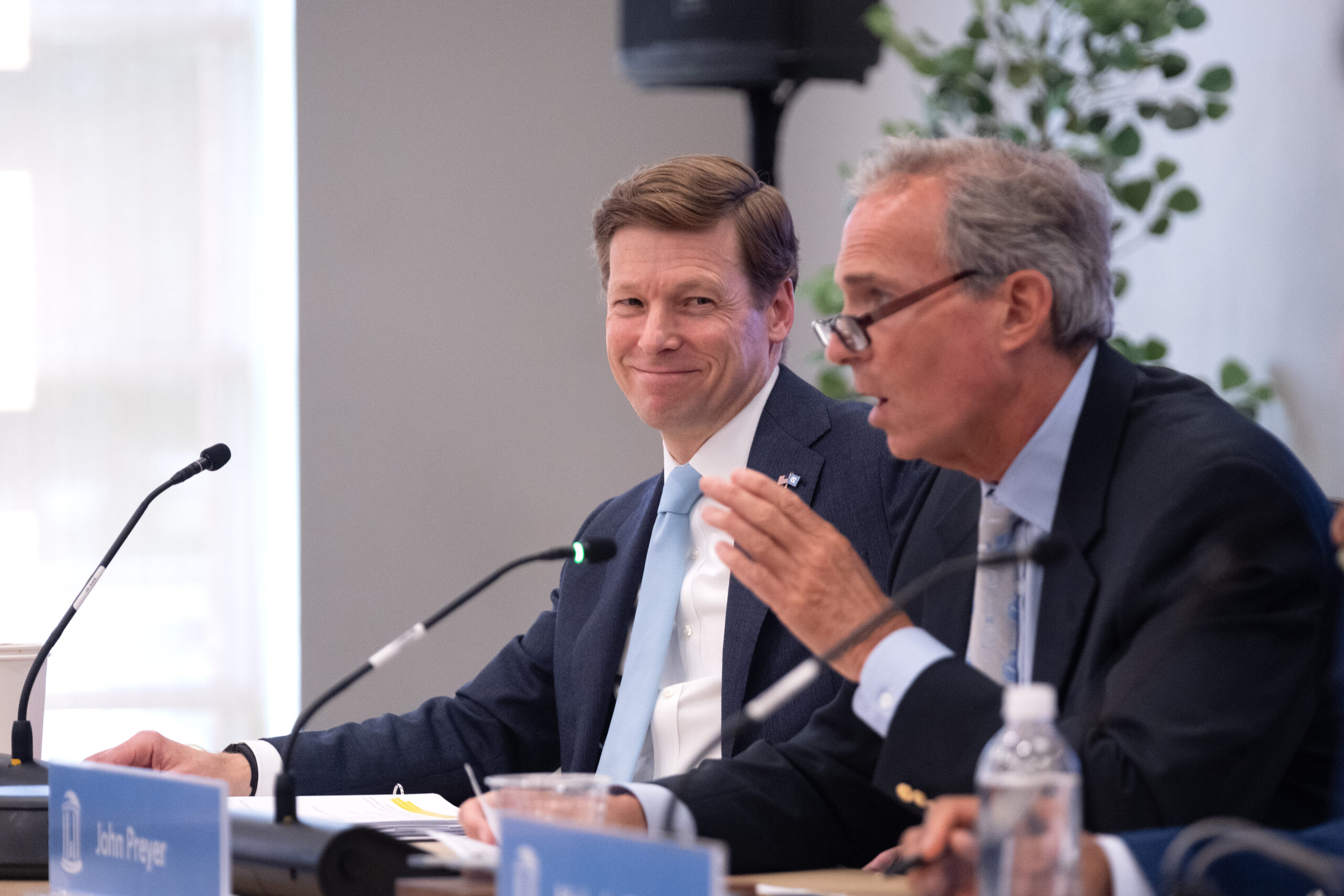
Featured photo via Jon Gardiner/UNC-Chapel Hill.
Chapelboro.com does not charge subscription fees, and you can directly support our efforts in local journalism here. Want more of what you see on Chapelboro? Let us bring free local news and community information to you by signing up for our newsletter.