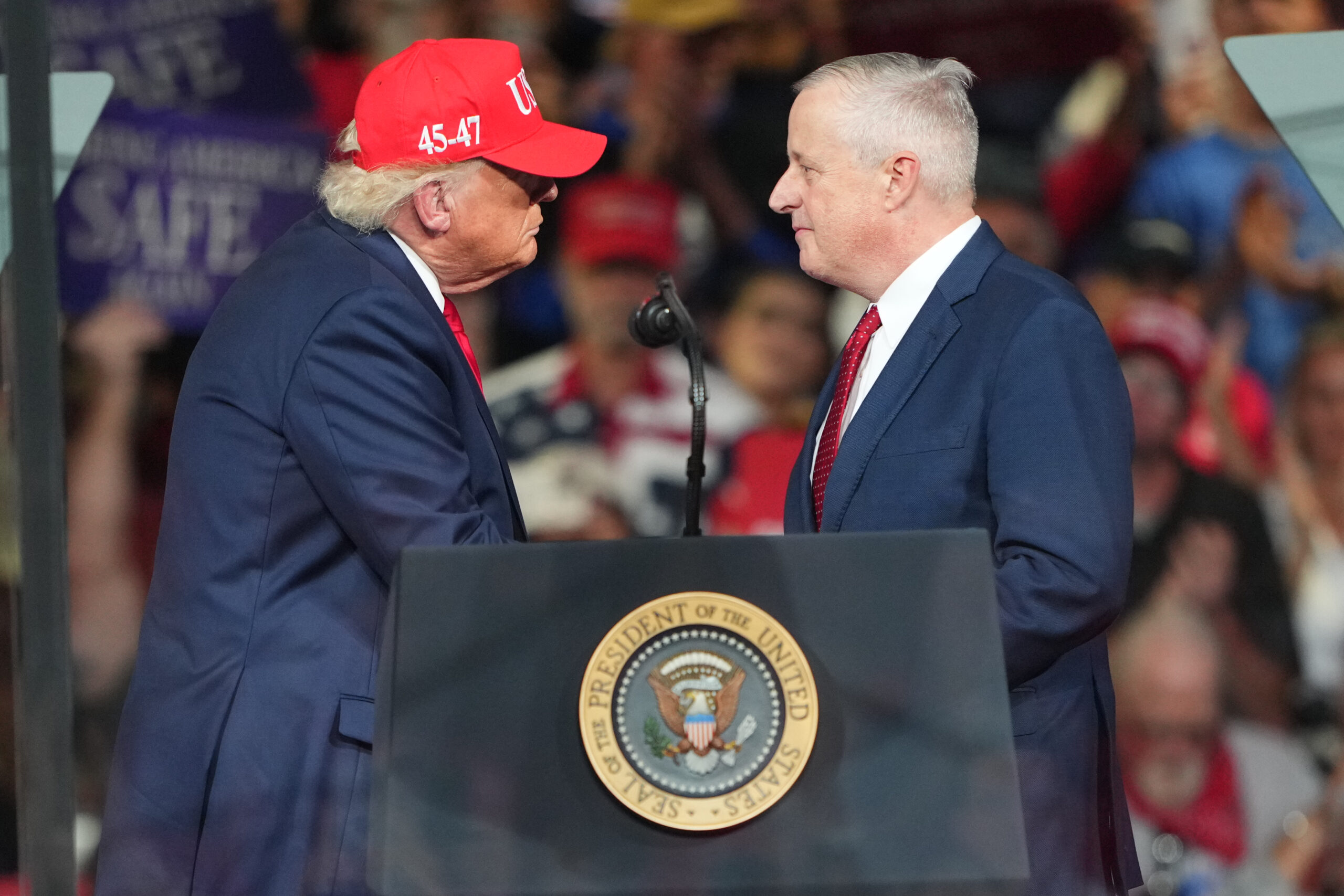
Political adversaries for the past two years, Democratic Gov. Roy Cooper and a top Republican legislative leader are now rare allies on whittling down North Carolina public schools’ construction and repair needs.
House Speaker Tim Moore and Cooper want to put a public education construction bond package on the 2020 ballot and have been traveling around the state separately drumming up support. That puts them at odds with Senate Republicans, who approved a bill last week to build more by spending more money from existing tax revenues, rather than issuing debt that would be repaid plus interest through the 2040s.
Moore and Senate leader Phil Berger downplayed the speaker’s alliance with Cooper, saying they’re still quite unified on a conservative agenda this decade that’s resulted in lower tax rates, less regulation and expanded school choice.
“I have a great deal of respect and a lot in common in terms of philosophy with Sen. Berger and with the Senate,” Moore said in an interview. “We are generally aligned on most issues, but there are differences.”
But this school bond partnership, with backing from legislative Democrats and House Republicans, exemplifies the increased leverage Cooper has after November election gains weakened the GOP’s majorities so they no longer hold veto-proof control.
During his State of the State address Monday, Cooper is expected to call on legislators to support the bonds and expand Medicaid through the federal health care overhaul law — something Berger opposes but Moore hasn’t fully closed the door on.
Choosing between a $1.9 billion bond package backed by Moore and many Democrats and the “pay-as-you-go” plan from Senate Republicans comes as state educators estimated in 2016 there were $13 billion in public school building and infrastructure needs through 2026.
“I really am happy that they’re having this discussion,” said Pat Thomas, chairwoman of the Onslow County school board. The district is in the middle of a 10-year building plan to address student growth and Hurricane Florence caused $60 million in damage to buildings.
Historically, buildings have been the responsibility of local districts, with state lottery funds helping in recent years. Occasionally the General Assembly has put statewide construction bonds on the ballot. The last such referendum occurred in 1996, and supporters say another is long past due.
Senate Republicans, who have been averse to new debt, say their proposal is better because construction money comes directly from the state’s annual tax revenues and would get to districts sooner than bonds. They estimate raising the portion already going into a special capital fund will help generate $2 billion for K-12 schools over the next nine years.
An annual government debt affordability report released last month suggests the bond package would squeeze out much of the state’s self-imposed limits on debt capacity.
“It maxes out the credit card,” Republican bill sponsor Sen. Harry Brown of Onslow County said during last week’s debate. “That’s why the bond makes no sense in this case. That’s why pay-as-you-go makes sense.”
But Cooper and Moore contend traditional borrowing is more predictable and not subject to legislators changing their minds on providing construction cash.
An analysis by Cooper’s budget office said setting aside additional cash now for construction would mean less for immediate needs like teacher raises, pre-kindergarten and environmental protections. And additional debt wouldn’t send the state’s borrowing above fiscally unsound levels, the budget office report says.
“Skimming money that should go to teacher pay raises and other school funding is like using your gas money to buy a car,” Cooper said in a news release last week criticizing the Senate’s proposal. “A successful school bond is a smarter way to do business.”
Senate Republicans say they can fashion a budget that provides funds for both teacher pay and school construction, and that it’s the bond package interest — perhaps $1.2 billion over time — that would siphon away money for education.
Berger said he “wouldn’t read too much” into Cooper and Moore being on the same side in this matter, but added that senators will be hard pressed to support any compromise with a bond component.
Still, he said, “it’s early in the session. We’ve got a ways to go, and I’ve seen bigger chasms than that (closed) in the past.”
Related Stories
‹
![]()
Meeting Between Cooper, GOP Leaders Fails to Narrow ChasmA face-to-face meeting on Friday between North Carolina Democratic Gov. Roy Cooper and the legislature’s top Republicans didn’t narrow the chasm separating their respective state budget views. Cooper, House Speaker Tim Moore, Senate leader Phil Berger and Democratic legislative leaders met at the Capitol building for almost an hour. Separate statements from Cooper’s office and […]
![]()
House Budget-Writers Offer No-Debt School Construction PlanSome key North Carolina House Republicans are floating a plan to set aside billions of tax dollars for public education and state agency construction and for rural broadband without additional debt. Budget chairmen Dean Arp of Monroe and Jason Saine of Lincolnton among others filed the bill on Tuesday, just days after the House overwhelmingly […]
![]()
Moore, other House Republicans Unveil $1.9B Bond ProposalNorth Carolina House Speaker Tim Moore says borrowing money to pay for public school construction is the way to go because it offers certainty to local governments about how much money they’ll have at their disposal for projects. Moore and other House Republicans unveiled on Thursday a $1.9 billion debt proposal, authorized only if voters would […]
![]()
In Address, Cooper Pitches School Bonds, Medicaid, Storm AidSpeaking to a legislature and electorate now more favorable to his party, Democratic Gov. Roy Cooper on Monday pressed lawmakers to better fund public education, expand Medicaid and help rural North Carolina through more broadband access and Hurricane Florence aid. During his second biennial State of the State address, Cooper made a soft sell for […]
![]()
NC House Bill Targets Orange County School Construction FeesOrange County currently charges an “impact fee” on developers to pay for a portion of the cost of providing public services to the proposed development. But a new bill in the North Carolina General Assembly could end that. Impact fees in Orange County are used for school construction or expansion. But earlier this week, Representative […]

On the Porch: Lisa Sorg - Data CentersThis Week:
Lisa Sorg is the North Carolina reporter for Inside Climate News. A journalist for 30 years, Sorg covers energy, climate environment and agriculture, as well as the social justice impacts of pollution and corporate malfeasance.
She has won dozens of awards for her news, public service and investigative reporting. In 2022, she received the Stokes Award from the National Press Foundation for her two-part story about the environmental damage from a former missile plant on a Black and Latinx neighborhood in Burlington. Sorg was previously an environmental investigative reporter at NC Newsline, a nonprofit media outlet based in Raleigh. She has also worked at alt-weeklies, dailies and magazines. Originally from rural Indiana, she lives in Durham, N.C.

On the Porch: Holly Lux-Sullivan - Walking You HomeThis Week:
Holly Lux-Sullivan of Heartwood Death Doula & Bereavement Care is a trusted end-of-life guide, grief counselor, and board-certified chaplain with 18 years of experience supporting people through illness. She is a respected death doula whose passion is caring for those at life’s margins, particularly during severe and terminal illness, and normalizing conversations about mortality. An ordained Unitarian Universalist minister, she serves people facing the end of life across central North Carolina. HeartwoodDeathDoula.com

'Worried For Our Future': Authors React to Removal Attempt of LGBTQ+ Books from CHCCS Elementary LibrariesNorth Carolina legislators are pushing to remove 63 LGBTQ-themed books from CHCCS elementary schools, saying they violate state law for being available in libraries.

On the Porch: Deana Joy - Child Abuse in NCThis Week:
Deana Joy has spent her career working in the nonprofit sector with victims of crime. She began by working with victims of sexual violence then, in 2006, she was promoted to Executive Director of a local Children’s Advocacy and Sexual Assault Center. In 2014, Deana began working as the CEO of Children’s Advocacy Centers of North Carolina, the state chapter for Children’s Advocacy Centers (CACs). In 2017, Deana became a national accreditation site reviewer for National Children’s Alliance, the accrediting body of Children’s Advocacy Centers. Deana currently serves as the Chair of the Children’s Justice Act for the Governor's Crime Commission and is on the NC Human Trafficking Commission, the NCDHHS Safety Design Team, the central region Citizen Review Panel, and the statewide Mass Violence Committee.

Morinaga Celebrates Completed Mebane Expansion and 'Sweet Partnership' With North Carolina, Orange CountyThe Japanese candy company Morinaga held a ribbon-cutting ceremony Tuesday to celebrate the opening of its expansion Hi-Chew plant in Mebane.
›