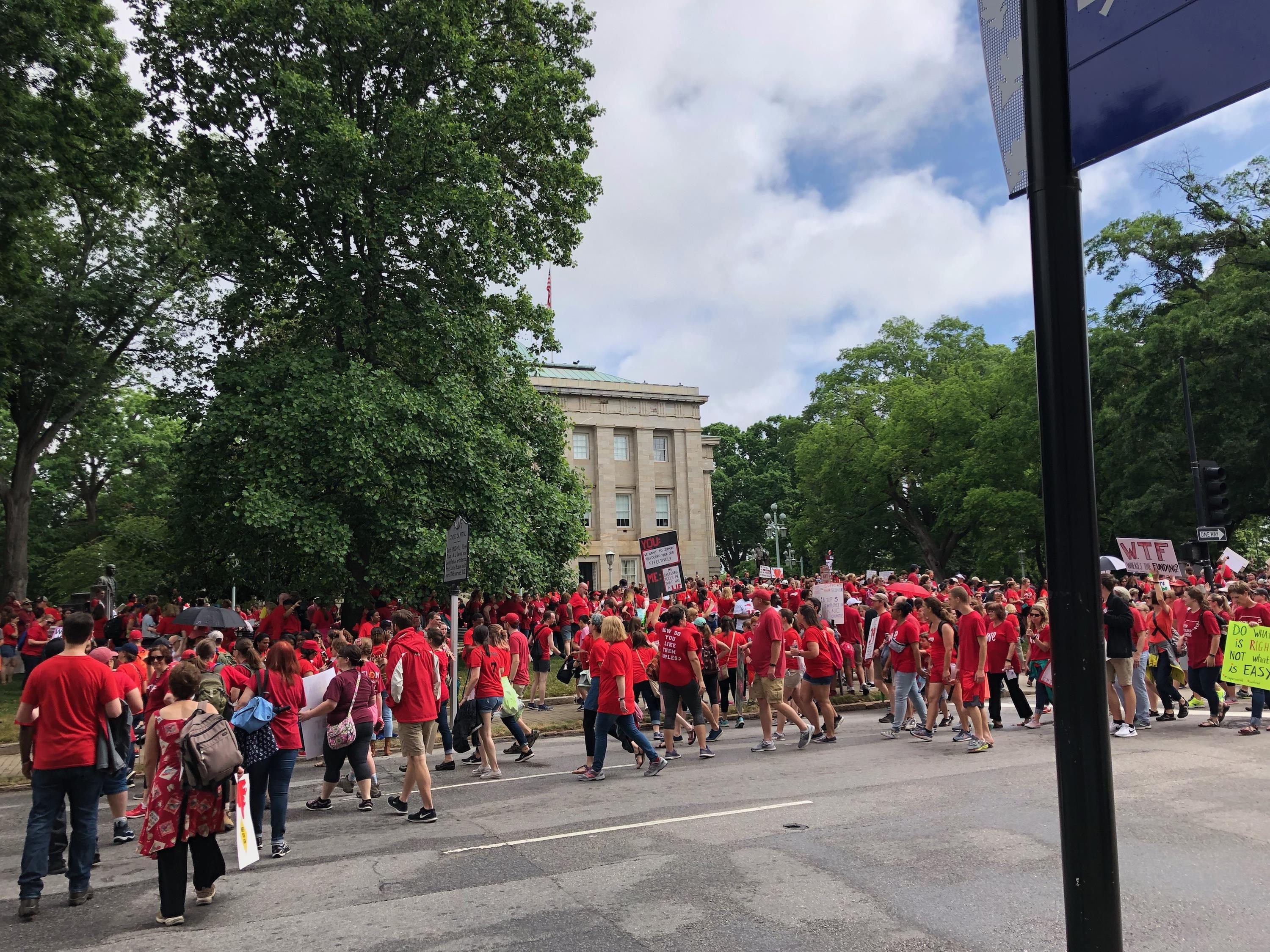
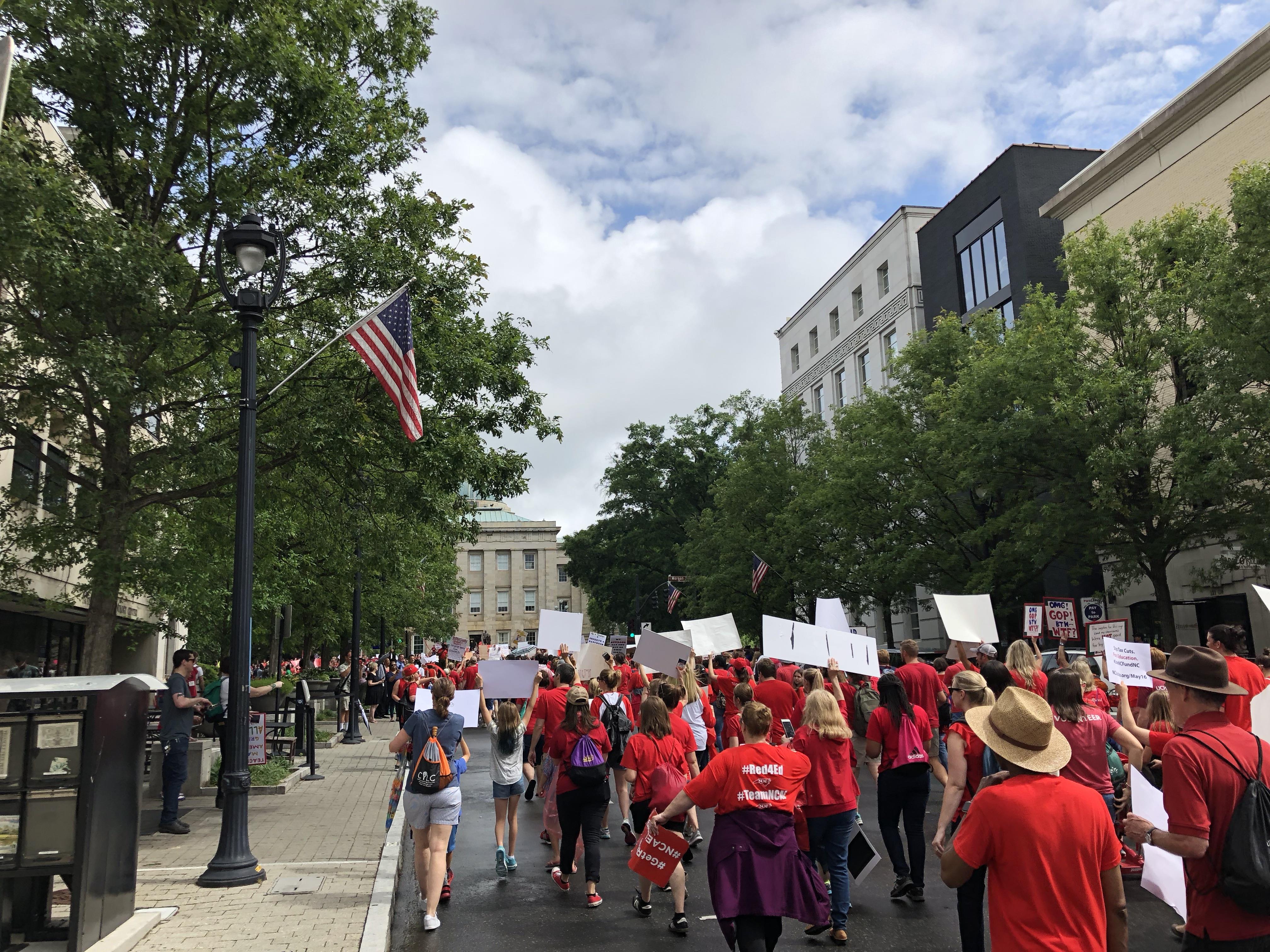
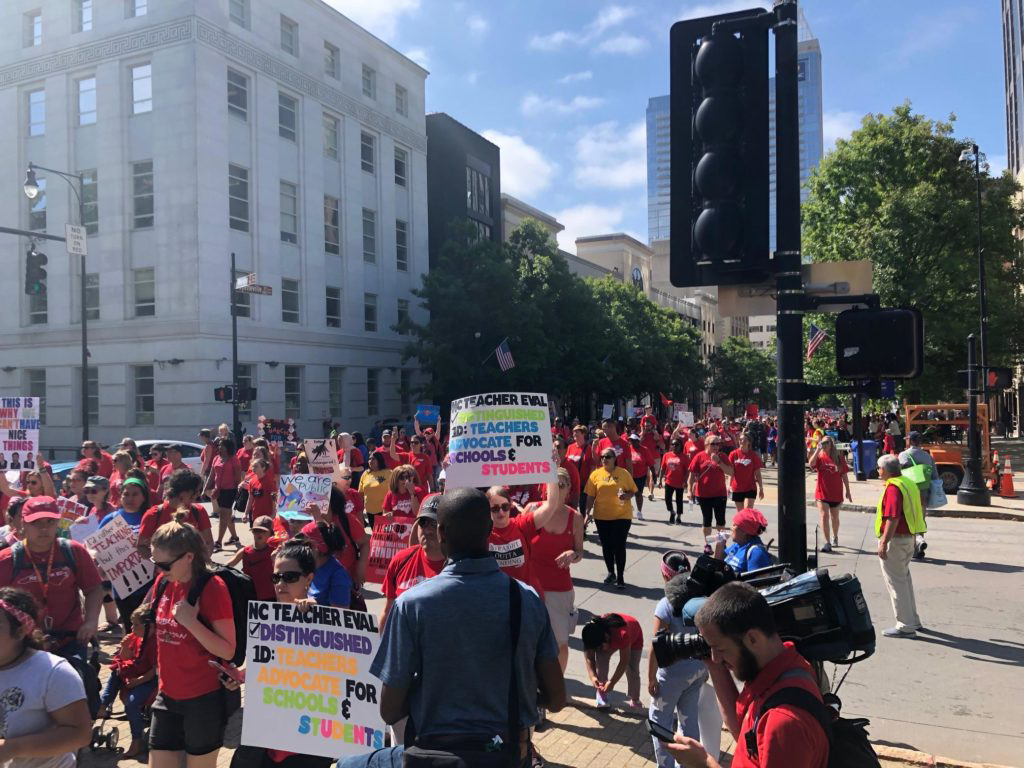
North Carolina teachers didn’t win the pay hikes and other changes they sought last year, despite a rally that brought 20,000 people to the capital, but they believe their activism helped elect a more sympathetic legislature and will take to the streets again Wednesday.
Schools across the state have announced they will have to close as teachers, support staff and advocates press their demands in Raleigh.
Mark Jewell, president of the North Carolina Association of Educators, said last year’s demonstration energized teachers to vote and help break the Republican supermajority in the state House and Senate.
“Last year, we changed some policymakers,” he said. “This year, we want to change some policy.”
Teachers in neighboring South Carolina also plan to rally Wednesday and Oregon teachers plan to gather next week as walkouts that began in West Virginia last spring continue across the country, including many that have proven successful.
In Los Angeles, teachers won promises for more counselors and nurses. In Denver, they got a revamped pay scale. And in West Virginia, educators who went out on strike again this year blocked a plan to create the state’s first charter schools.
In North Carolina, the list of demands this year includes Medicaid expansion, restoration of extra pay for teacher’s master’s degrees and a $15 minimum wage for support staff.
North Carolina’s superintendent of public education, Mark Johnson, criticized the organizers for scheduling the march on a school day, when classes must be canceled. In addition, students who depend on free or reduced breakfasts and lunches may not be able to get the food they need, he said, although some school parent-teacher associations packed meals for those students to take home Tuesday.
“We want to retain teachers and show them that they are appreciated,” he said. “But there are also organizations for whom this is political.”
Johnson and the organizers agree on some priorities, he said, such as higher wages, more investment in classroom supplies and school safety programs, fewer tests, and better professional development opportunities, Johnson said.
GOP lawmakers point to figures showing they’ve already made steady strides in per-pupil education spending and teacher salaries this decade.
The National Education Association, the NCAE’s parent group, estimates North Carolina’s average teacher pay this year will rank 29th in the nation, compared with 47th in 2013. But the NCAE and Cooper, a close ally, say pay for the most veteran teachers has barely increased.
South Carolina Gov. Henry McMaster also criticized teachers for leaving the classroom for their protest. Sabrina Jensen, who teaches students with severe disabilities in Blythewood, said teachers must get the attention of legislators. It seemed they were on board with significant improvements, but then backed off, she said.
“They need to see we actually mean it, and we’re not just talking to be talking,” she said. “They can’t pat us on the head and say things will be better, just be patient. … We’ve patiently waited all these years to be treated like professionals.”
North Carolina teachers wanted to schedule the rally as early in the budget process as possible, said Lauren Piner of Greenville, North Carolina, who teaches ninth grade world history. Even so, they missed the release of the House education budget, which came Friday and included language that would limit teacher leave days to certain events — protests not included.
One upside to last year’s rally was that more teachers began attending meetings of the local education board and county commissioners, Piner said.
Inspired by their colleagues in Washington and other states, Oregon teachers are planning a walkout on May 8, said Suzanne Cohen, president of the Portland Association of Teachers.
“Educators are at a breaking point,” Cohen said. “Schools are in crisis, and we are calling on everyone to support fully funding our schools.”
Erin Grace, a Spanish teacher at Rockcastle High School in Kentucky, credited the rank-and-file roots of the activism for successes in that state. The protests there last year continue to reverberate, with Gov. Matt Bevin sending subpoenas to several school districts seeking the names of teachers who might have used sick days to attend statehouse rallies.
“For whatever reason, the people on the ground finally see what is going on and took it upon themselves to get involved,” she said. “It’s not top-down. It’s bottom-up. At the end of the day, public education is not getting the support it needs to do the job that society needs us to do.”
Related Stories
‹

Teachers March on Raleigh Demanding Better Pay, Better SupportThousands of North Carolina public school teachers and staff gathered on the Halifax Mall next to the Legislative Building in the state capitol to push elected officials for better pay, retirement and more funding per student. Mark Jewell, President of the North Carolina Association of Educators, told the gathered crowd that last year’s teachers’ rally […]

Chatham County Schools Closed in Advance of Teacher RallyChatham County Schools will be closed Wednesday, May 1, coinciding with a large teacher rally in Raleigh. The Chatham County Board of Education unanimously voted in a special meeting on Thursday night to close the school district for students on May 1. “We would prefer to have a normal day of school, but we simply […]

CHCCS Cancels Classes on Scheduled North Carolina Teacher RallyChapel Hill – Carrboro City Schools will be closed for an optional teacher workday on May 1, as state education advocates have organized another Day of Action in Raleigh lobbying for education initiatives. Last year’s rally drew nearly 20,000 attendees, according to estimates at the time. CHCCS was one of the first districts to cancel […]
![]()
North Carolina Schools Chief: Change Date for Teacher RallyNorth Carolina’s elected public schools chief says organizers of a May 1 teacher march and rally should reschedule so students won’t miss class because instructors will take off. Republican Superintendent of Public Instruction Mark Johnson said Thursday that he can’t support protests that force schools to close and urged they be held on a non-school […]

North Carolina Teachers' Group Plan Another May RallyNorth Carolina’s largest teacher-lobbying group will organize another march and rally this spring to seek higher school salaries and funding from the General Assembly. North Carolina Association of Educators President Mark Jewell confirmed on Monday the group will hold a public education “Day of Action” for May 1 in Raleigh. An estimated 19,000 people marched […]

On the Porch: Bill Brown - Art and Science Merge at NCMAThis Week:
Bill Brown joined the North Carolina Museum of Art as a Conservation Intern in 1988. Thirty-two years later he retired from the Art Museum as Chief Conservator. He received his M.A. and Certificate of Advanced Studies in Conservation from State University College at Buffalo, NY in 1989. At the Museum, he established the Art + Science Initiative, a collaborative program with Duke University math and science departments. Bill has a passion for Italian Old Master Paintings of the 14th to 18th century. He works part-time as a conservator in private practice and provides conservation support for the Museum and Gallery collection of old master paintings at Bob Jones University in Greenville, SC . He enjoys retirement with his wife and young adult son.

On the Porch: Nora Gaskin - Conjuring Crime StoriesThis Week:
Author Nora Gaskin is a lifelong resident of the Durham-Chapel Hill area. Her latest is novel is "Lammie Loves Cubby". Nora has a bachelor’s degree in English with Honors in Creative Writing from UNC, and a Masters in English from the University of Washington in Seattle. She spent over 24 years as a stockbroker and financial advisor in the Durham office of a major investment firm. She retired in 2005 to focus on writing. She is the publisher at Lystra Books and Literary Services and the author of three novels and one nonfiction book. She lives and writes in Chatham County, inspired by her native landscape, her husband, and dogs. Her favorite word is "gratitude."
![]()
Therapy Smarts and Sen. Natalie Murdock on How HB696 Impacts Children and Families — On Air Today (June 15, 2026)Founder and CEO of Therapy Smarts Avani Shah and N.C. District 20 Sen. Natalie Murdock speak with 97.9 The Hill on Monday, June 15.

On the Porch: Steven Fenberg - What Funded America's Infrastructure?This Week:
Writer Steven Fenberg discovered Jesse Jones was reputedly the most powerful person in the nation next to President Franklin Roosevelt during the Great Depression and World War II. As chairman of the federal government’s Reconstruction Finance Corporation (RFC)—the nation’s indispensable infrastructure bank—Jones initiated and managed massive New Deal agencies that saved and expanded the nation’s economy and then shifted the RFC’s priority from domestic economics to global defense to fight and win WWII. Fenberg told this remarkable story as executive producer and co-writer of the Emmy Award winning documentary film “Brother, Can You Spare a Billion?” that was narrated by Walter Cronkite and broadcast nationally on PBS. Fenberg then wrote the biography “Unprecedented Power: Jesse Jones, Capitalism, and the Common Good.”

Viewpoints: Constitutional Changes Are Rarely NecessaryConstitutional amendments are supposed to be rare. They are supposed to matter. They are meant to alter foundational principles or governmental structure when absolutely necessary.
›