With the midterm election approaching, political science professor at Catawba College Dr. Michael Bitzer says North Carolina is seeing a growing trend of millennials removing themselves from party affiliations.
Bitzer calls this the “rise of the unaffiliated voter,” which is now the second-largest voter block in the state behind Democrats.
This could be a direct symptom of the extremely polarizing political climate of the moment, which Bitzer said has reached a “hyper-level”.
“I think it could be particularly a generational phenomenon,” said Bitzer. “Millennials could be eschewing the party labels, saying, ‘I don’t want to be associated with that particular political party.’”
Despite the growing trend of unaffiliated voters in the state, Bitzer said that unaffiliated voters still tend to show strong partisanship.
“If [voters] say they’re independent, but they lean to the Democratic Party or they lean to the Republican Party, they are often times just as partisan as those folks who strongly identify with a political party,” said Bitzer.
This trend has led to an increased importance of primary elections and begs the question of whether North Carolina will move toward closed primaries. North Carolina currently allows unaffiliated voters to participate in either the Republican or Democratic primary elections. Voters can participate in either party’s primary but not both.
This change would have to come at the state level, but Bitzer believes a desire for ideological purity could push the parties in this direction.
“Now the big question in my mind going forward for the political parties in North Carolina is will they continue to allow unaffiliated voters to potentially come in and sway a political party one way or the other, or will they close off and say ‘no you can only be a registered member of our party to vote in our primary,” said Bitzer.
There are currently 13 states with closed primaries.
Related Stories
‹
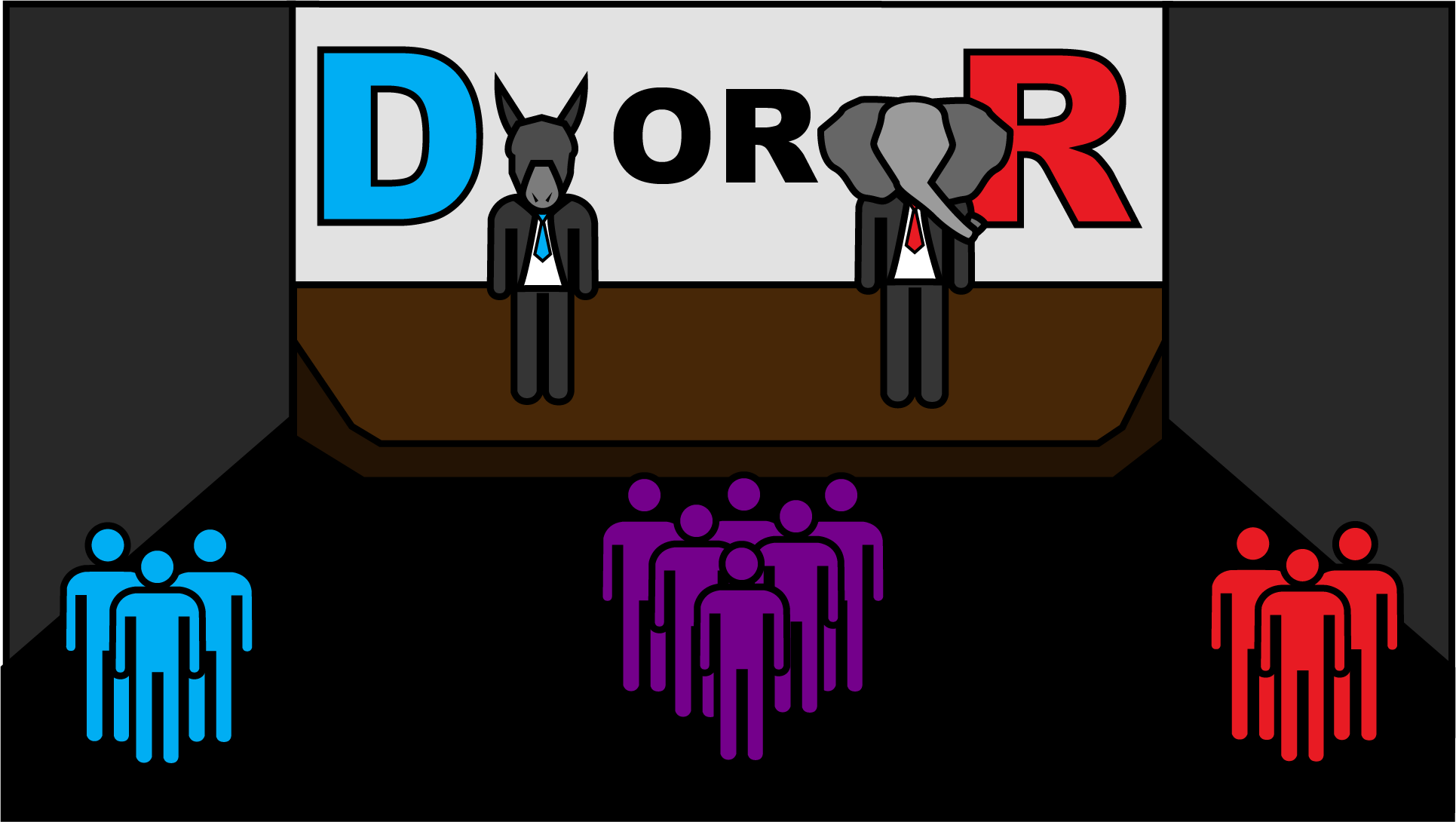
Imperfect Political Parties Drive Youth Voters to Register UnaffiliatedHalf of youth voters identify as independent in North Carolina, leading to questions about why they do and how to best reach them.
More Presidential Candidates Could Be on North Carolina Ballot With Signature DrivesThree political movements seeking to run presidential candidates in North Carolina filed voter signature lists before Monday's deadline.
Trump Refers to Black Man From Racially Offensive 1988 Campaign Ad While Stumping in North CarolinaDuring a stop in North Carolina, Trump referenced one of the most controversial campaign advertisements that relied on racist tropes.

Postal Service Work To Comply With Trump’s Executive Order Is Rushed and Sloppy, a Whistleblower ContendsThe U.S. Postal Service is poised to launch a hastily built, error-riddled computer system that could jeopardize the process of mail voting.

Longtime Chatham County Educator Wins $10 Million Lottery PrizeThe North Carolina Education Lottery office revealed that Jean Johnson, who teaches in Chatham County, is the winner of a $10 million prize.
![]()
Theodore Nollert on North Carolina's Budget Corrections Bill and Its Process – On Air Today (August 26, 2026)Theodore Nollert — the directory of policy for Carolina Forward and a Chapel Hill Town Council member — joins 97.9 The Hill's Brighton McConnell on Wednesday, August 26.
UNC Health Expands, Rebrands Venture Capital Efforts of Emerging TechThe statewide healthcare system announced Rex Health Ventures platform is now UNC Health Ventures and will use $125 million to invest in emerging health tech companies.
Corporate Tax Cuts, Prediction Market Leeway, and Underfunding Education: Why Orange County's Legislators Voted Against NC's BudgetAll three of Orange County’s state representatives voted against North Carolina's updated budget, citing issues with its contents and construction.

On the Porch: Dr. James Wood - Sports Around the WorldThis Week:
James Wood is currently Professor of Latin American and modern world history at North Carolina A&T State University. He is the author of The Society of Equality: Popular Republicanism and Democracy in Santiago de Chile, 1818-1851 and the co-editor of "Problems in Modern Latin American History: Sources and Interpretations", now in its fifth edition with Rowman and Littlefield. As a Fulbright scholar for Chile in 2016 he was a visiting professor at the Universidad Diego Portales in Santiago (where he observed Chilean student activism up close).
On the Porch: Bill Brown - Art and Science Merge at NCMAThis Week:
Bill Brown joined the North Carolina Museum of Art as a Conservation Intern in 1988. Thirty-two years later he retired from the Art Museum as Chief Conservator. He received his M.A. and Certificate of Advanced Studies in Conservation from State University College at Buffalo, NY in 1989. At the Museum, he established the Art + Science Initiative, a collaborative program with Duke University math and science departments. Bill has a passion for Italian Old Master Paintings of the 14th to 18th century. He works part-time as a conservator in private practice and provides conservation support for the Museum and Gallery collection of old master paintings at Bob Jones University in Greenville, SC . He enjoys retirement with his wife and young adult son.
›