

A Belichick Theme Since Brady: UNC Needs Better QB Production
By David Glenn
In Bill Belichick’s 24-year National Football League tenure with the New England Patriots, his win-loss records during his time with legendary quarterback Tom Brady and after the pair’s 2020 split represent an extraordinary dichotomy.
Football is a multi-faceted game, of course, so it would be inappropriate to pretend that any single factor — by itself — explains everything.
However, the QB contrast in New England was truly striking, and now Belichick has QB-related issues at North Carolina for the second year in a row, too.
Combining the regular season and postseason, Belichick’s record with Brady as his quarterback in New England was 249-75. That’s a success rate of about 77 percent, an astonishing number by NFL standards, and of course the legendary coach/QB pairing won a record six Super Bowls together, too.
After Brady left New England for Tampa Bay in free agency, Belichick’s record with the Patriots was 29-38, for a success rate of about 43 percent.
Again, that’s with Brady — 77 percent. After Brady — 43 percent.
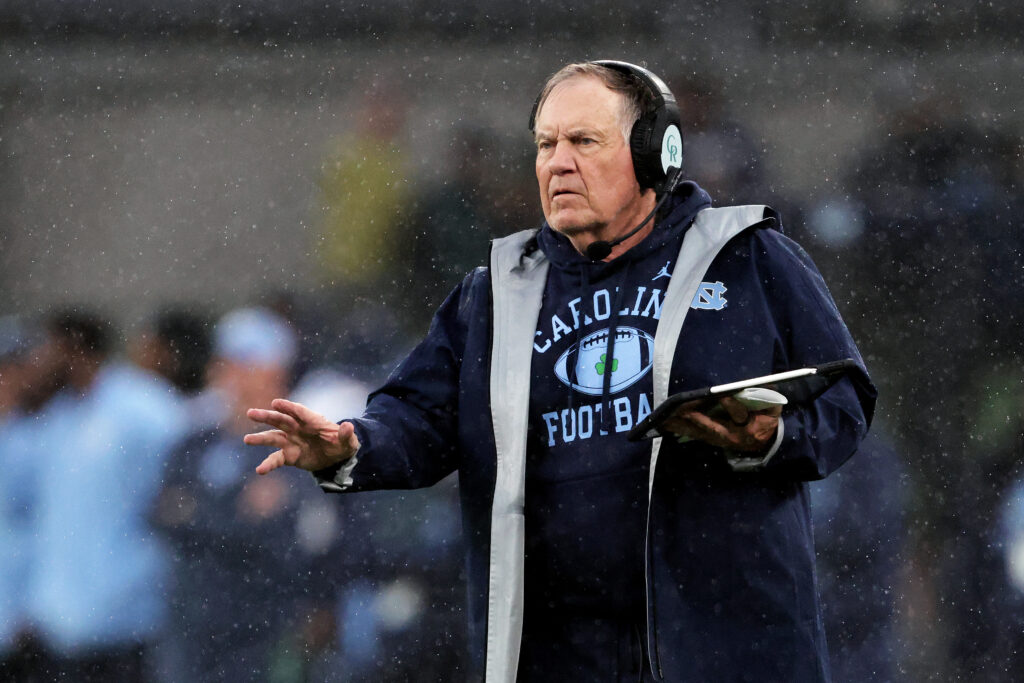
AP Photo/Peter Morrison)
During his final four seasons in New England, Belichick’s starting quarterbacks included the late-career version of Cam Newton, the new-to-the-NFL edition of Mac Jones and career journeymen such as Brian Hoyer and Bailey Zappe. Over those four years, Belichick had just one winning record, a single playoff trip and zero postseason victories. In Belichick’s final NFL season (2023), the Patriots finished 4-13.
It’s no secret that Belichick tries to build high-football-IQ teams that limit their penalties, turnovers and mental mistakes, prepare and execute situational football better than their opponents do, make life miserable for opposing offensive coordinators and quarterbacks, and score “enough” points with smart game-planning, high-level execution and plenty of efficiency.
To Belichick’s credit, that blueprint led directly to Carolina’s 15-10 win over TCU in Ireland to start this season. With the coach’s second-year defenders leading the way, the Tar Heels exploited the Horned Frogs’ offensive inefficiencies and posted just enough points to claim the victory.
The Heels also are the least-penalized team in the Atlantic Coast Conference so far this season, they’re fourth in the league in scoring defense (at less than 14 points per game), they have been making life difficult for opposing offenses, and their new quarterback, 23-year-old sixth-year senior transfer Billy Edwards, has been a strong leader and a good decision-maker by all accounts.
The problem in Chapel Hill, of course, is that — for the second year in a row under Belichick — UNC is just not getting much production from the QB position.
There was a seemingly endless number of problems last year, when summer transfer arrival Gio Lopez was the very late plug-in as the starting quarterback, the underqualified and overmatched Freddie Kitchens was the offensive coordinator, and the o-line ranked among the worst in the league. Unsurprisingly, in the 17-team ACC, Carolina finished 16th in scoring offense (19 ppg), dead-last in total offense (289 ypg), 14th in rushing offense (105 ypg) and 16th in passing offense (184 ypg).
There appears to be a lesser set of complications this year, with Edwards as the starter and the much more accomplished Bobby Petrino as the play-caller. Indeed, UNC’s numbers in scoring offense (23 ppg), total offense (366 ypg), rushing offense (155 ypg) and passing offense (211 ypg) all improved during the team’s 2-1 start, which included wins over TCU and East Tennessee State before last week’s 28-20 collapse at Clemson.
“Obviously, a disappointing end,” Belichick said of a game UNC led 17-6 at halftime. “They made a few more plays than we did in the last eight minutes of the game. We missed a couple of opportunities on offense and missed some tackles on defense. … We’ve just got to keep working and keep getting better, which we are, so there’s really not too much to say.”
Better pocket protection by UNC’s offensive tackles (who were dominated at Clemson) is one necessary area of improvement in the team’s passing game, but it’s also up to Edwards — who’s not a running threat — to throw more accurately and make more big plays downfield.
Edwards has a better supporting cast than Lopez had last season, with Petrino now calling the plays, star wide receiver Jordan Shipp and three solid running backs still in the fold, Ohio State transfer Jelani Thurman arriving as a weapon at tight end, and seventh-year center Christo Kelly returning from injury to anchor the offensive line.
Through three games, though, the Tar Heels completed a league-worst 56 percent of their passing attempts, and — as in their loss at Clemson — they’re simply not exceptional enough in other areas right now to overcome that sort of deficiency.
Whether measured by passing efficiency rating or advanced metrics such as QBR (see below), eight ACC teams are being held back by mediocre or subpar quarterback play this season: Boston College, Clemson, Duke, Florida State, Georgia Tech, Stanford, Syracuse and UNC. Among those eight, only Duke has looked exceptional in any way, with the Blue Devils riding the combination of elite running back Nate Sheppard (FBS-best 176 rushing ypg) and consistently strong defense (12 ppg) to their soon-to-be 4-0 start.
Moving forward, UNC’s passing game simply must improve if the Tar Heels are going to make a run at the six victories typically required for a bowl game. They will be massive underdogs against Notre Dame and Miami, meaning they would somehow have to find four more wins against the following lineup: at Pitt, at Duke, Syracuse, at UConn, Louisville, at Virginia, NC State.
Possible? Yes. Probable without better QB play from Edwards or someone else? Definitely not, and Tom Brady ain’t walking through that door.
ESPN’s Total QBR
(ACC Starters Through Week Three)
94.5 — Darian Mensah*, Miami
87.4 — Kevin Jennings, SMU
86.4 — Ethan Grunkemeyer*, Virginia Tech
83.6 — Lincoln Kienholz*, Louisville
77.4 — Beau Pribula*, Virginia
75.9 — Ashton Daniels*, Florida State
75.2 — Gio Lopez*, Wake Forest
62.7 — Mason Heintschel, Pittsburgh
62.2 — CJ Bailey, NC State
54.8 — Jaron-Keawe Sagapolutele, Cal
54.6 — Billy Edwards Jr.*, North Carolina
53.9 — Alberto Mendoza*, Georgia Tech
52.6 — Davis Warren*, Stanford
38.1 — Mason McKenzie*, Boston College
34.3 — Steve Angeli, Syracuse
29.6 — Walker Eget*, Duke
27.8 — Tait Reynolds* Clemson
Passing Efficiency Rating
(ACC Starters Through Week Three)
228.6 — Darian Mensah*, Miami
194.0 — Kevin Jennings, SMU
186.8 — Lincoln Kienholz*, Louisville
183.2 — Beau Pribula*, Virginia
173.0 — Ethan Grunkemeyer*, Virginia Tech
157.3 — Mason Heintschel, Pittsburgh
153.9 — Gio Lopez*, Wake Forest
151.7 — Jaron-Keawe Sagapolutele, Cal
150.7 — Alberto Mendoza*, Georgia Tech
146.7 — CJ Bailey, NC State
139.7 — Ashton Daniels*, Florida State
138.7 — Walker Eget*, Duke
132.3 — Billy Edwards Jr.*, North Carolina
122.8 — Tait Reynolds* Clemson
122.7 — Mason McKenzie*, Boston College
116.9 — Steve Angeli, Syracuse
116.2 — Davis Warren*, Stanford
* — 2026 transfer or true freshman (new to current team)
David Glenn (DavidGlennShow.com, @DavidGlennShow) is an award-winning author, broadcaster, editor, entrepreneur, publisher, speaker, writer and university lecturer (now at UNC Wilmington) who has covered sports in North Carolina since 1987.
Chapelboro.com does not charge subscription fees, and you can directly support our efforts in local journalism here. Want more of what you see on Chapelboro? Let us bring free local news and community information to you by signing up for our newsletter.

